Summary
Editor's rating
Is it worth the price or just a fancy stand?
Simple design that focuses on topspin only
Materials and build: solid, a bit heavy, clearly not a toy
How it holds up after repeated use
Daily use: stability, feel, and the learning curve
What you actually get with the TopspinPro
Does it actually help your topspin?
Pros
- Gives clear, instant feedback on paddle angle and brushing motion
- Solid steel construction and mesh that hold up well to regular use
- Height-adjustable and usable indoors, so you can practice without a court
Cons
- Pricey for a single-purpose trainer focused only on topspin
- Takes up some space and is not ultra-compact to store or transport

Specifications
View full product page →| Brand | TopspinPro |
Finally practicing topspin without needing a court
I picked up the Pickleball TopspinPro Training Aid Blue because I was tired of hearing coaches say “you need more topspin” without really managing to change my stroke. Courts are often busy where I live, and I don’t always have a partner. So I wanted something I could use in my garage or living room to just repeat the motion until it felt natural. I’ve used it on and off for a few weeks now, roughly 15–20 minutes a day when I can.
My level: I’m not a pro, I’d say solid intermediate. I can rally fine, but my shots used to be pretty flat and I’d either hit long or baby the ball so it stayed in. So I was looking for a tool that would help me feel the “brush up the back of the ball” motion people talk about, without having to guess if I was doing it right. The promise of this thing is exactly that: you swing, the ball spins, and the mesh screen tells you if your paddle angle is off.
Right away, what stood out is that this is not a toy. It’s fairly heavy, mostly metal, and feels more like gym equipment than a plastic gadget. Setup was straightforward, and I had it at the right height for my stance in a few minutes. Then I just started swinging and trying to get the ball to really spin without touching the mesh. The feedback is instant, which is the whole point.
It’s not perfect, and it’s not cheap. But after a couple of weeks, I do feel my swing path has changed a bit on court. I’m not suddenly a topspin monster, but my drives are dipping more and I’m not sailing as many balls long. In short: it does what it says, but you have to actually put in the reps, and it’s better suited for someone who already has basic stroke mechanics than a total beginner.
Is it worth the price or just a fancy stand?
Let’s talk money. This thing is not cheap compared to basic training aids like cones or a simple rebounder. You feel you’re paying for a niche tool that does one job: teaching topspin mechanics. For some people, that will feel expensive for what is basically a steel frame, a mesh, and a ball on a rod. I get that reaction. When I first looked at the price, I hesitated quite a bit and compared it to just taking a few extra lessons instead.
After using it, I’d say the value depends on your situation. If you’re already spending money on court time, clinics, and paddles, and your main technical issue is hitting too flat or sailing balls long, then this trainer can be a useful complement. It lets you work on the stroke at home, every day, without booking a court. That repeatable practice is hard to get otherwise. Compared to the cost of a few private lessons, the price is not crazy, especially if you share it with a partner or family.
On the other hand, if you’re a casual player who only plays once a week and doesn’t really care about fine-tuning topspin, then it’s probably overkill. You’d get more out of just playing more games or doing cheaper drills at the courts. Also, if your fundamentals (grip, stance, contact point) are very shaky, I’d put the money into coaching first and only look at this once you have a basic stroke that you want to polish.
Considering the solid build, the focused function, and the fact that I do notice an improvement in how I hit, I’d say the value is good but not outstanding. It makes sense for motivated players and coaches who will actually use it regularly. For everyone else, it’s an interesting tool but not essential. So yeah, decent value if topspin is a real priority for you; just don’t expect miracles if you’re not putting in the time.
Simple design that focuses on topspin only
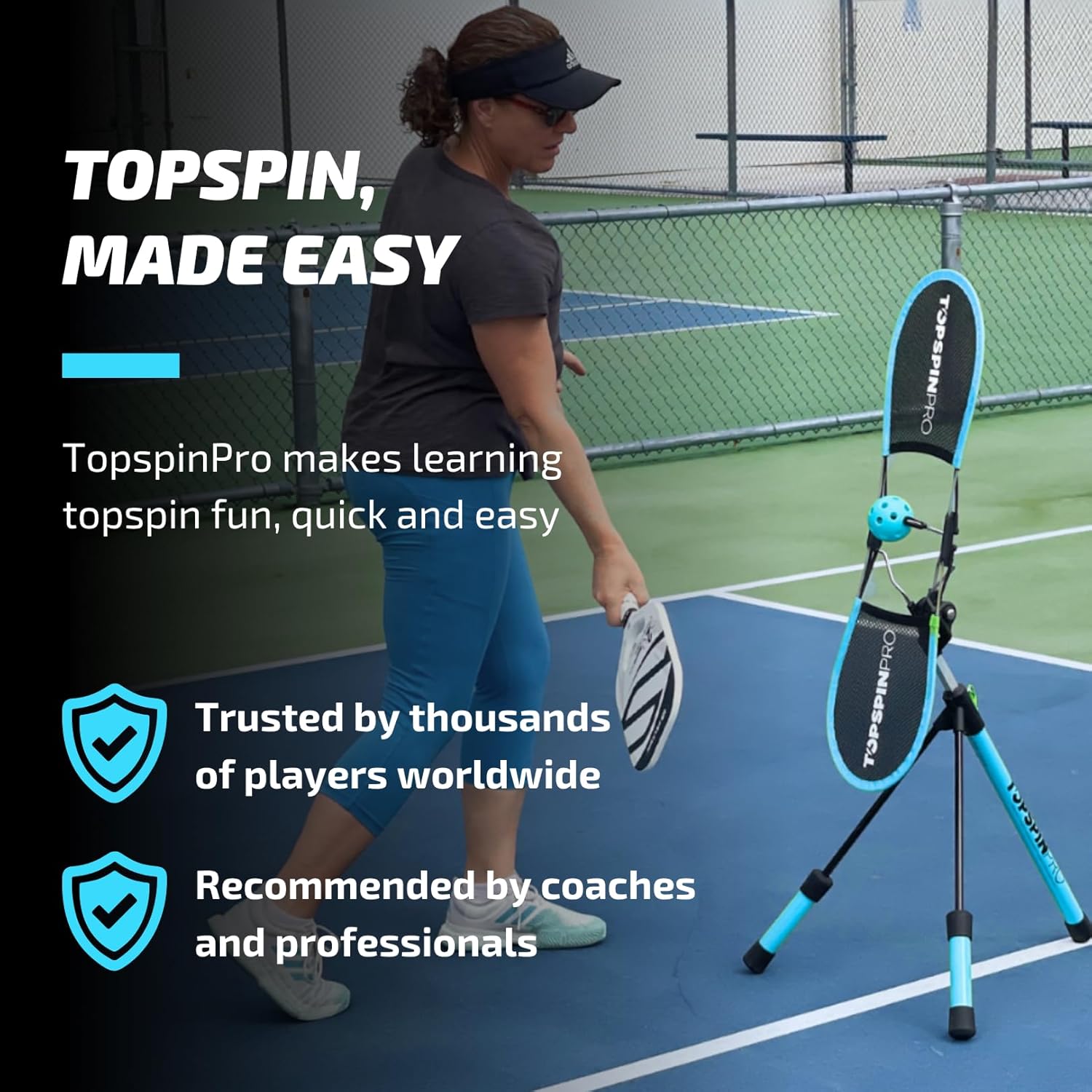
The design is pretty no-nonsense: metal frame, adjustable poles, a mesh screen, and a ball on a rod. No decorative stuff, just functional parts. The blue color is mostly on the branding and accents; the rest is mostly black and metal. Visually it looks like a piece of training gear, not a living-room decoration, which is fine by me. It folds down, but not into something tiny – think more like a folded tripod than a flat board.
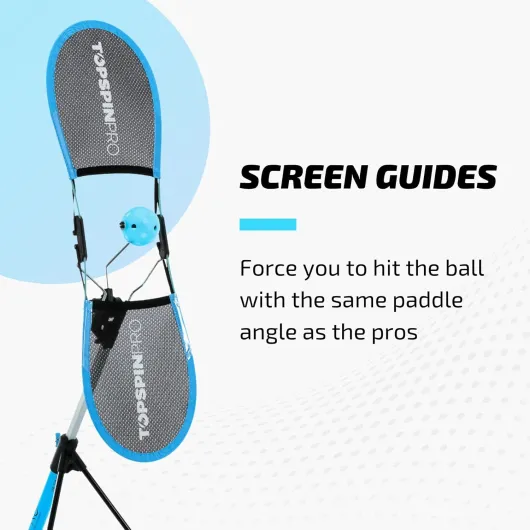
The key design element is the vertical mesh screen. It’s there to guide your paddle angle and punish you when you open the face too much or swing flat. When I first used it, I kept smacking the mesh because my regular swing was too open. That instant feedback was useful: the sound and the feel of hitting the mesh is a clear sign you messed up the stroke. After a few sessions, I was hitting the ball cleanly and only brushing close to the mesh instead of slapping into it.
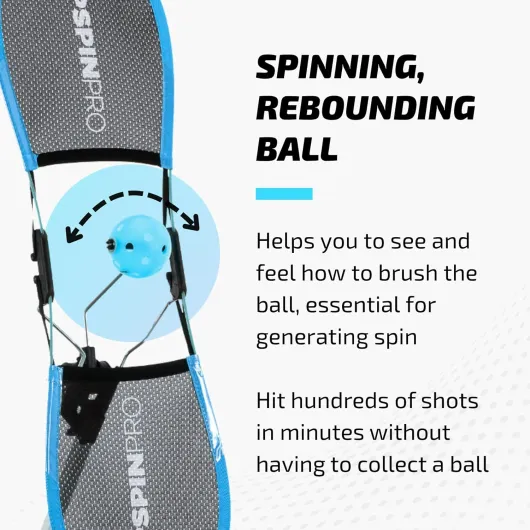
The ball is mounted so it can spin freely, and that’s another smart part of the design. When you get the motion right, you see and feel the ball spinning forward. If you hit too flat, it just kind of wobbles or doesn’t spin much. That visual spin feedback is surprisingly helpful. It becomes a little mini-game: how fast can I get it to rotate while still avoiding the mesh. It keeps you focused on the right motion instead of just smacking it out of habit.
The only downside in design for me is the footprint and storage. It’s called portable and, yes, you can move it around and toss it in a car, but it’s still a metal frame with some bulk. If you’re in a small apartment, you’ll notice it. Also, it only trains one thing: topspin. There’s no way to flip it around for slice or flat serves; it’s laser-focused on that one stroke style. That’s fine if that’s your current weakness, but just be aware you’re buying a single-purpose tool, not a complete practice station.
Materials and build: solid, a bit heavy, clearly not a toy
The frame is made of steel, and you feel that right away. It’s not flimsy at all. The 4 kg weight gives it a solid base, and when I hit a bit harder, it didn’t tip over or slide much unless I really went wild. For indoor use on smooth floors, I’d still put it on a mat or rug, just to be safe and to protect the floor. The poles feel like standard metal tubing with plastic joints. They lock in place reasonably well; I didn’t have any scary wobble, but you do need to tighten everything properly during setup.
The mesh screen is a synthetic fabric that feels similar to netting used in sports goals. It’s tight enough to give you a clear boundary but flexible enough that hitting it doesn’t hurt your paddle or your arm. After a few weeks of use, with me definitely whacking it several times per session at the beginning, there are no tears or major marks. You can see a few scuffs where I hit most often, but nothing worrying. So in terms of wear, it seems ready to handle regular practice.
The ball itself is obviously not a standard pickleball; it’s a training ball fixed on an axis. The surface has enough grip so the paddle can grab it and create spin. I was a bit worried it would feel too different from a real ball, but in practice, the contact feeling is close enough for training. It’s not perfect, but you still get that sense of brushing the ball. The rod holding the ball hasn’t loosened on me so far, and the rotation is still smooth.
Overall, the materials feel like they match the price reasonably well. You’re paying for a heavy, stable piece of gear, not a plastic gadget. On the downside, that means it’s not ultra-compact, and you probably won’t want to drag it around every day. But for home use, garage, or club training, the build quality feels solid. I’d expect it to last at least a couple of seasons of regular use, maybe more, as long as you don’t leave it outdoors in the rain all the time.
How it holds up after repeated use
Durability was a concern for me because some training aids feel good for a month and then start loosening or breaking at the joints. So far, after a few weeks of use, the TopspinPro is holding up well. The steel frame hasn’t bent or warped, and the joints are still snug. I’ve folded and unfolded it multiple times to move it between a spare room and the garage, and nothing feels like it’s about to snap. The weight definitely helps it feel sturdy rather than fragile.
The parts that take the most abuse are the mesh screen and the ball assembly. The mesh has taken plenty of hits from my paddle, especially in the first days when I was still figuring out the right angle. You can see where I hit most often, but there are no rips or loose threads yet. It looks like the kind of material that will fray slowly over a long time rather than suddenly fail. Even if it does eventually wear, it doesn’t look like something that will break in a month or two of normal use.
The ball and its rotating mechanism are also doing fine. It still spins smoothly, without grinding or sticking. I was half-expecting some wobble or loosening after repeated side hits, but it’s stayed aligned so far. Obviously I haven’t used it for years, so I can’t speak to long-term life, but based on the construction, I’d be surprised if it just fell apart with normal home use. Just don’t leave it outside in rain or direct sun for days; it’s metal and fabric, not outdoor furniture.
Overall, I’d call the durability pretty solid for the price range. It feels like equipment you can keep for several seasons. The one thing I’d do to keep it in good shape is store it folded in a dry place and maybe check the screws or joints every couple of months to tighten anything that loosens with use. If you treat it decently, it looks ready to last much longer than the 1-year warranty they mention.
Daily use: stability, feel, and the learning curve
Using it day to day, the first thing I noticed is there’s a genuine learning curve. On day one, I was hitting the mesh constantly, especially when I tried to swing with power. My default stroke clearly had more of a flat hit than I thought. After maybe two or three short sessions, I started to get a feel for closing the paddle face and brushing up the back of the ball. The drill becomes almost meditative: same motion, again and again, trying to keep the contact clean and make the ball spin faster.
Stability-wise, the steel frame does its job. If you’re doing gentle dinks and controlled swings, it barely moves. Once you start ripping harder drives, you can make it shift slightly, especially on smooth floors. It didn’t tip over on me, but I could feel it rock a bit if I really went after it. Putting it on a mat or carpet helps. For an indoor trainer, it’s stable enough that you’re not constantly adjusting it between swings, which is what matters.
The feel of contact is decent. Obviously, a fixed ball isn’t the same as a ball flying at you, but the friction and feedback are close enough that your muscles learn the motion. I liked that you get instant feedback in three ways: the sound of hitting the mesh if you mess up, the visual of the ball spinning when you do it right, and the sensation in your wrist/forearm. That combination keeps you honest. You can’t really “fake” a good stroke here; it either spins or it doesn’t.
In terms of how often I actually used it, I’d say it’s realistic for someone motivated to do 10–20 minutes before or after work a few times a week. It sets up and adjusts fast enough that you’re not wasting time. After a while, I found it especially useful right before going to play: a quick warm-up of 5–10 minutes at home made my first few drives on court feel more solid. If you’re the type who buys training gear and then never uses it, this won’t magically change that. But if you’re already putting in practice time, this fits in pretty well.
What you actually get with the TopspinPro
Out of the box, you get the main frame, the adjustable poles, the spinning ball assembly, and the mesh screen. No electronics, no app, just a physical trainer. The whole thing weighs around 4 kg, so it’s not featherlight, but that weight helps keep it stable when you’re swinging harder. The listed size is 27 x 11 x 0.1 cm, which is clearly just one dimension; in reality, when set up, it’s roughly the size of a small standing fan. So it doesn’t take over the whole room, but you do need a bit of space around it to swing freely.
The concept is simple: there’s a ball held in the middle that can spin freely on an axis, and in front of it you have a vertical mesh screen. Your goal is to swing your paddle with a slightly closed face, brush up the back of the ball, and get the ball to spin without your paddle hitting the mesh. If you’re too flat or open, you’ll slap the screen. If you swing correctly, the ball will spin forward and you feel that brushing motion in your wrist and forearm.
I liked that the height is adjustable, so you can set it for different shot types. I set it lower to mimic dinks and kitchen-line shots, and higher for drives and serves. The adjustment is done with simple clips and telescoping poles, nothing fancy, but it works. It’s rated for players from about age 5 up to very tall adults, which seems realistic based on how far it extends. I’m average height and had plenty of room both up and down.
In everyday use, the presentation is straightforward: it’s a dedicated topspin station you can use almost anywhere flat. No court, no net, no partner needed. You won’t work on footwork or targeting, but for pure stroke path and paddle angle, the setup makes sense. Just don’t expect some magic smart device with tracking; it’s a mechanical trainer, and you bring the effort and discipline.
Does it actually help your topspin?
For me, the big question was simple: after a few weeks with this thing, does my topspin on court actually get better, or is it just a nice feeling at home? I’d say it does help, but you need to already have basic stroke mechanics and be willing to pay attention. It’s not some magic fix where you swing randomly and suddenly your shots are great. The trainer forces you to repeat the same motion over and over, and that repetition is what makes the difference.
In practice, after about three sessions of 15–20 minutes, I noticed two things on court: 1) my paddle face was naturally a bit more closed on drives, and 2) I was finishing my swing more upward instead of just straight through the ball. The result was that my shots started dipping in more often and I wasn’t sailing as many long. It’s not night-and-day, but the trend is clearly positive. I could also feel that same brushing sensation on the real ball that I had been feeling on the trainer.
Where it helped me most was consistency. Because the screen punishes you every time you open the paddle too much or swing flat, you eventually groove a more reliable swing path. That carries over to serves and third-shot drives. It’s also pretty useful for topspin dinks if you lower the height and focus on softer, more controlled brushing. I wouldn’t say it turned my soft game into a weapon, but it gave me a clearer idea of how to add a bit of spin without popping the ball up.
There are limits though. The trainer doesn’t handle footwork, spacing, or timing with a moving ball. You’re always hitting a stationary target, so you still need on-court practice to adapt this motion to real rallies. Also, if your grip, stance, or shoulder rotation are way off, this won’t fix all that by itself. It’s more of a fine-tuning tool for your paddle path and contact, not a complete technique overhaul. So yes, it’s effective for what it focuses on, but it’s not a full solution to every swing problem.
Pros
- Gives clear, instant feedback on paddle angle and brushing motion
- Solid steel construction and mesh that hold up well to regular use
- Height-adjustable and usable indoors, so you can practice without a court
Cons
- Pricey for a single-purpose trainer focused only on topspin
- Takes up some space and is not ultra-compact to store or transport
Conclusion
Editor's rating
After a few weeks with the Pickleball TopspinPro Training Aid Blue, my takeaway is pretty straightforward: it does what it says, as long as you’re ready to put in the reps. The steel frame and mesh design give you clear feedback on your paddle angle, and the spinning ball makes it obvious when you’re actually brushing the ball instead of just slapping it. My drives now dip a bit more, and I’m not sending as many balls long, which is exactly what I was hoping for.
It’s not perfect. It only trains topspin, it takes up some space, and the price will feel high if you’re more of a casual player. It won’t fix bad footwork or a totally broken swing by itself, and you still need real court time to adapt the motion to a moving ball. But as a focused tool for building muscle memory for topspin, it’s pretty solid. I’d recommend it to intermediate players and motivated beginners who already know the basics and want to add reliable spin, or to coaches who want a simple, durable station for lessons. If you’re just starting out or only play occasionally, you can probably skip it and spend that money on more court time or lessons instead.