Summary
Editor's rating
Is it worth the money?
Simple design that focuses on function, not looks
Metal frame and mesh netting: solid enough, not tank-level
Holding up so far, with a few things to watch
How it actually plays: rebound, stability, and real-world use
What you actually get in the box
Pros
- Consistent rebound that’s good for dinks, volleys, and basic drives
- Sturdy metal frame that stays in place on driveway or garage floors
- Includes both a 6x6 ft rebounder and a 6 ft mini net for extra practice options
Cons
- No angle adjustment on the rebounder, limits variety of practice bounces
- Not designed to be left outside long-term in bad weather

Specifications
View full product page →| Brand | SwingIt |
Finally, a way to drill without begging for a partner
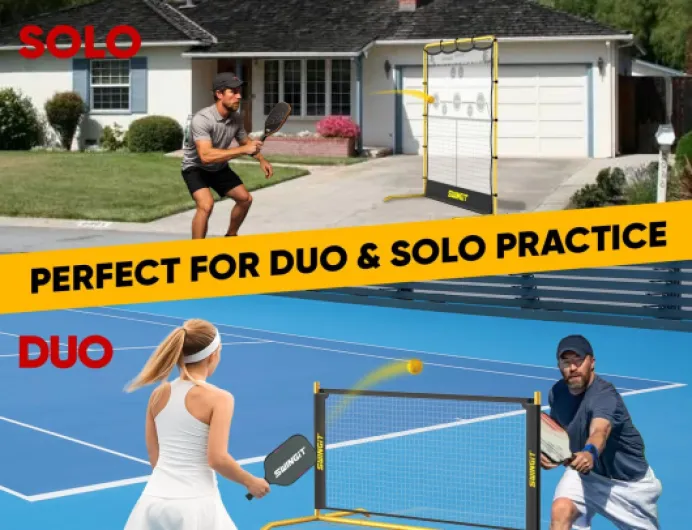
I picked up this SwingIt portable pickleball rebounder because I was getting tired of hunting for a drilling partner every time I wanted to work on dinks and volleys. Courts near me are often packed, and when I do get a court, people want to play games, not stand there feeding balls. So I wanted something I could throw in the car or leave in the garage and just hit against whenever I had 20–30 minutes.
First impression: it looks like one of those portable soccer goals, but with a printed target and kitchen lines. Assembly was less painful than I expected. I’m not a DIY person at all, and I still got it up in around 15–20 minutes the first time, taking it slow and checking the parts. Now that I know which pole goes where, it’s more like 8–10 minutes to set up or take down.
I’ve used it mainly in my driveway and occasionally in the garage when it’s windy. The rebound is decent: not exactly like a real opponent, but close enough that you can work on timing, contact point, and consistency. I’ve done a bunch of short sessions: 10–15 minutes before heading to the courts, and sometimes 30–40 minutes when I skip open play. It’s not perfect, but it definitely gets used, which is more than I can say for half the “training gadgets” I’ve bought.
Overall, my early takeaway is that it’s a pretty solid tool if you’re serious about getting reps in at home. It’s not some magical fix for your game, but if you’re willing to put in the work, this net gives you a simple, reliable target to hit at without chasing balls all over the place.
Is it worth the money?
Price-wise, this sits in that mid-range zone: not bargain-bin cheap, but definitely less than the high-end, adjustable rebounders you see targeted at serious clubs. For what you pay, you’re getting two usable pieces of gear (rebounder + mini net), a metal frame that feels decent, and a setup that actually helps you practice real pickleball shots instead of some gimmicky thing you use twice and forget.
Compared to just booking more court time, this pays off if you’re the kind of person who will actually drill at home. I’ve already used it more than some other training aids that cost about the same. The big value for me is being able to practice when courts are full or when I only have 20 minutes. No driving, no waiting, just set it up in the driveway and go. If that sounds like something you’d do, the cost makes sense.
Could you DIY something cheaper? Maybe. You could hit against a wall or rig a cheap net, but you wouldn’t get the clear kitchen lines or the controlled, consistent rebound that this gives. Also, a real wall will eat balls and scuff them up faster. Here, the mesh is gentler on the balls and you can place the net exactly where you want it, indoors or outdoors.
For me, the value is “good, not insane.” It’s not some steal of the century, but for the quality and how often I use it, I’m comfortable with the price. If you’re on a tight budget and barely play, it might feel like overkill. But if you’re playing weekly and want to clean up your soft game and volleys, this is a pretty solid investment in actually getting more reps without relying on other people.
Simple design that focuses on function, not looks
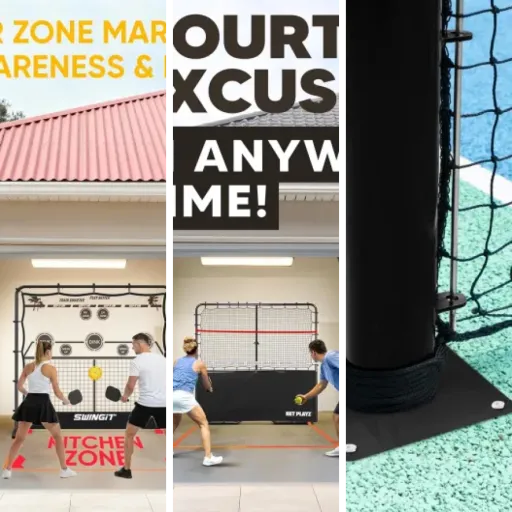
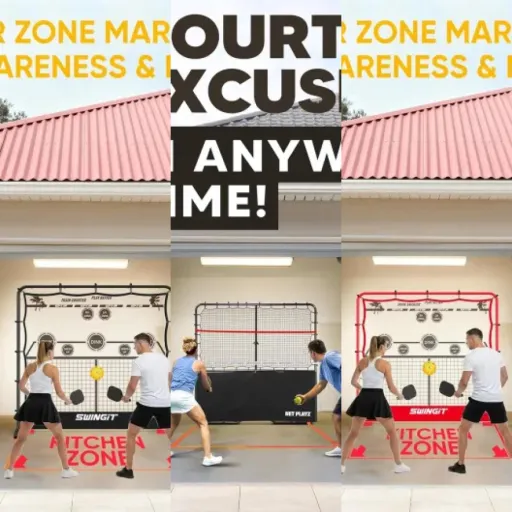
The design is very straightforward: a 6x6 ft square frame with a tensioned mesh and printed targets on it. No weird angles, no folding arms, nothing complicated. That’s good and bad. Good because there’s not much to break, bad because you can’t easily adjust angles or tilt like on some higher-end rebounders. It basically stands straight up, and you control the rebound with your shot height and pace.
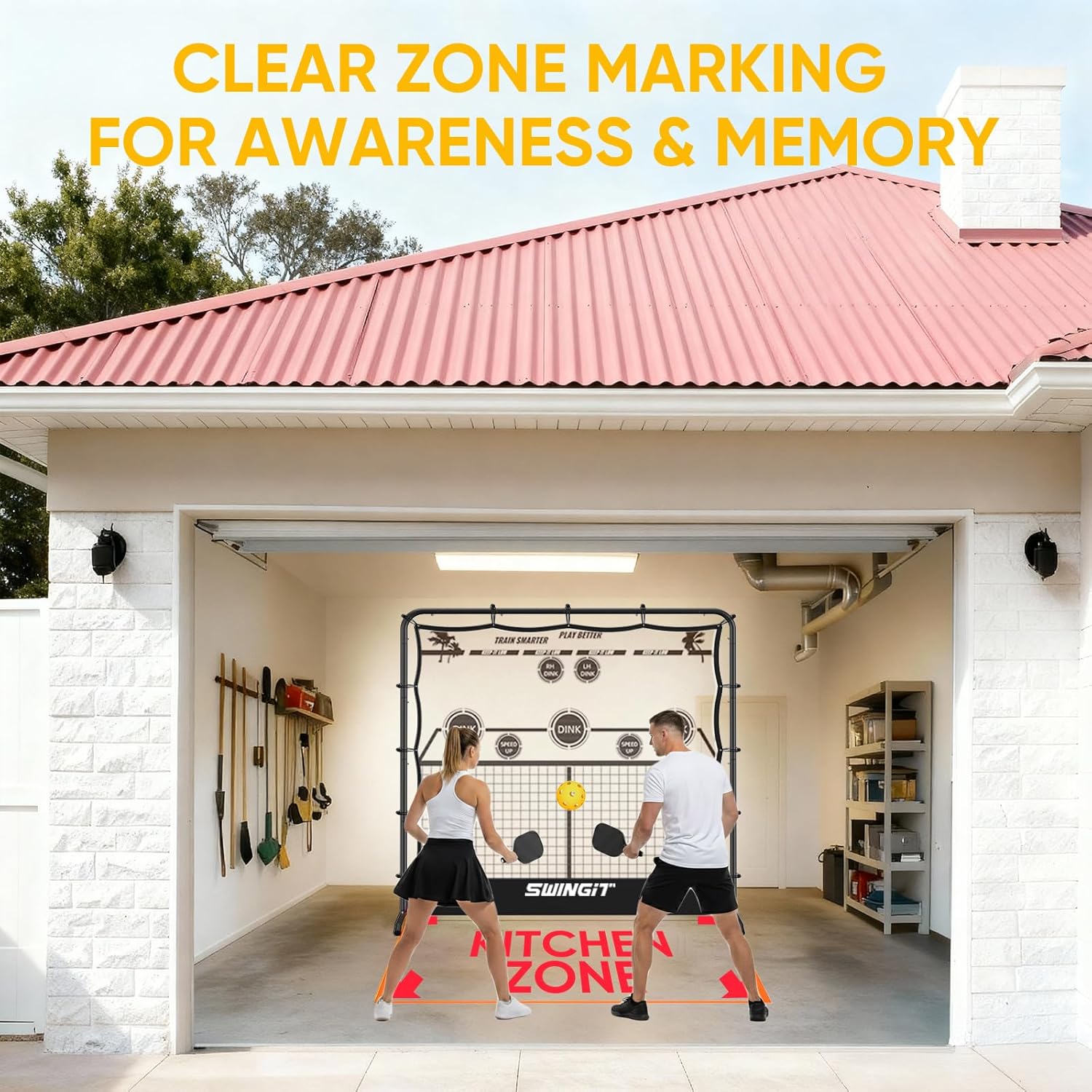
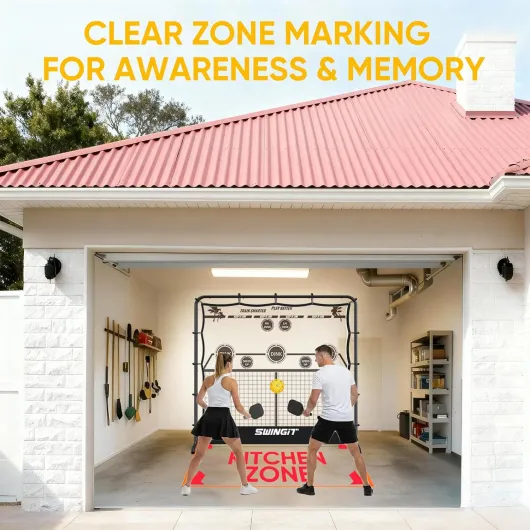
The printed kitchen lines and zones are actually one of the better parts of the design. You have a clear non-volley zone marked, and you can visually see if your dinks are dropping short or floating too deep. I’ve used it to work on hitting specific squares: cross-court dinks into one area, then drives into another. It makes solo drilling a bit less boring because you can set simple little challenges for yourself, like “hit 20 in a row into that box without missing.”
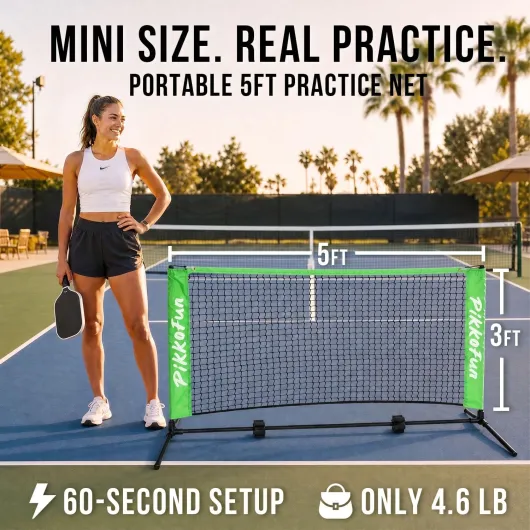
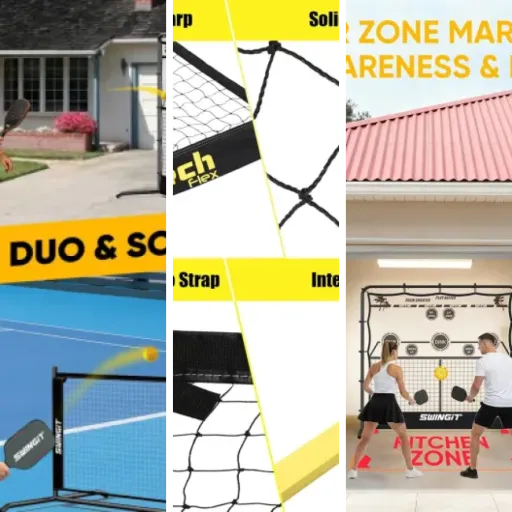
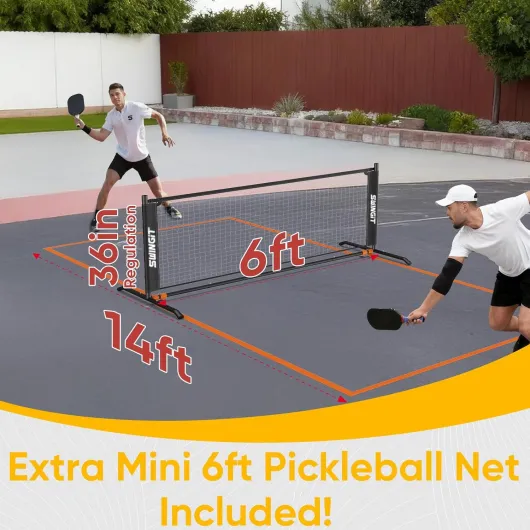
The mini net design is minimal, but it does the job. It’s 6 ft wide, which is obviously narrower than a full court (20 ft wide), but for driveway practice it’s enough to work on clearing the net and basic shot height. I’ve used it for quick warmups and to practice softer third shots with a buddy in a small space. It’s not going to replace real court time, but as a portable net, it’s fine.
If you’re expecting some fancy-looking piece of equipment, this isn’t it. It looks like training gear: metal tubes, black mesh, graphics. But in terms of practicality, the design is solid. It’s easy to understand, and once it’s set up, it stays where it should. I’d only really complain about the lack of angle adjustment; being able to tilt the rebounder slightly forward or backward would give a more realistic variety of bounces.
Metal frame and mesh netting: solid enough, not tank-level
The frame is iron metal, and you can feel that as soon as you start assembling it. The poles aren’t super thick, but they’re not bendy either. I’ve hit plenty of drives and mishits into the frame, and nothing has warped or loosened so far. It’s not the kind of thing you’d leave outside in all weather for months, but for regular use in a driveway or garage, it feels sturdy enough.
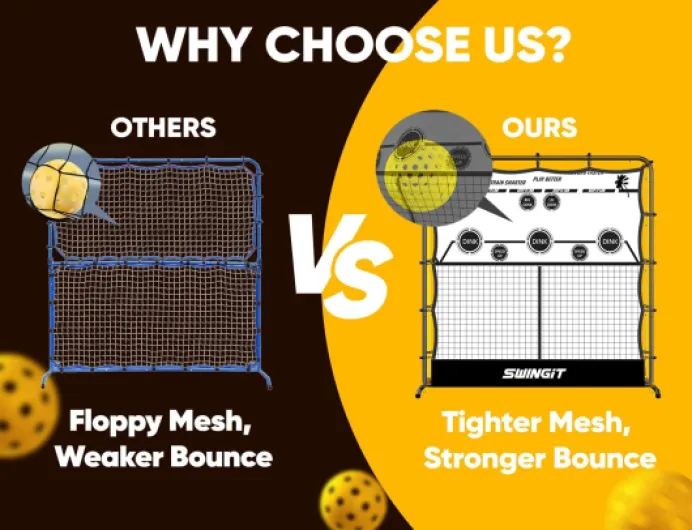
The rebound surface is a polyester mesh, tightened with bungees around the frame. The bungees are what control the tension and the rebound. They’re adjustable, so if you want a bit more pop, you can tighten them. Out of the box, the tension was already decent. I’ve mostly left it as is, except for re-tightening a couple of spots after the first few sessions when things settled in.
The carry bag is basic nylon. It’s not padded or fancy, but it holds everything. Zipper feels okay, not cheap to the point where you’re scared to pull it. I wouldn’t drag it across rough pavement, but carried by the straps, it’s fine. If you’re planning to throw this in the trunk regularly, the bag will probably get scuffed over time, but that’s normal. At least it’s big enough that you’re not wrestling with it every time you pack up.
Overall, the materials feel like mid-range training gear. You’re not getting thick, powder-coated steel like some premium rebounders, but you’re also not dealing with flimsy plastic joints or saggy netting. For the price point, the balance between weight and sturdiness is pretty good. Just don’t treat it like permanent outdoor equipment. If you take 5 minutes to bring it inside after use and don’t leave it baking in the sun or sitting in the rain, it should hold up fine for regular practice.
Holding up so far, with a few things to watch
I haven’t had this thing for years, but after a bunch of sessions over several weeks, it’s holding up well. No bent poles, no ripped mesh, and the printed graphics are still clear. The bungees are usually the weak point on these kinds of nets, and so far they’re fine. They did stretch a tiny bit after the first few uses, but once I re-tightened them, the tension has stayed pretty consistent.
I’ve set it up and taken it down multiple times, and the joints still fit snugly. Sometimes with cheaper frames, the connections start to loosen and you get wobble or gaps, but I haven’t seen that yet. It’s metal-on-metal connections, so as long as you don’t force the wrong pieces together or step on a pole, you should be okay. I’d avoid tossing the frame around or dropping heavy stuff on it in the garage, but under normal use it feels solid.
Weather-wise, I haven’t left it outside overnight on purpose. I used it in light wind and a bit of damp ground, then brought it in. The mesh dries quickly and doesn’t seem to hold water. Still, this is not the kind of gear I’d leave out in full sun and rain all season. If you want something permanent for the backyard, you probably need a heavier, more weather-resistant setup. This one is better treated as portable equipment you store indoors.
Based on how it’s doing so far, I’d say durability is good for a home trainer in this price range. It’s clearly better than the super cheap rebounders you see for kids’ soccer, but it’s not built like commercial gym equipment either. If you’re reasonably careful and don’t abuse it, I don’t see any obvious reason it wouldn’t last multiple seasons of regular home practice.
How it actually plays: rebound, stability, and real-world use
This is the part that actually matters: does it feel like real practice, or just a toy? For me, the rebound is pretty solid. It’s not identical to rallying with a person, but it’s consistent. When I hit a firm dink or a controlled drive, the ball comes back at a predictable speed and height, so I can get into a rhythm. It’s especially good for working on volleys and reaction time, since you can stand closer and fire a bunch of balls in a row.
Stability-wise, the frame does a good job. On concrete in my driveway, it doesn’t walk around much, even when I hit harder shots. It might nudge a bit if you really crank a drive into the upper area, but it’s not sliding all over the place. I haven’t needed sandbags or stakes, which is nice. Indoors in the garage, it stays put completely. The bounce feels a bit livelier on indoor balls versus outdoor balls, but that’s normal and actually similar to hitting on a gym floor versus asphalt.
Where it shines is short, focused drills. I’ll do sets like: 50 dinks into the kitchen zone, then 30 volleys, then 20 drives aimed at a specific square. Because you’re not chasing balls across a full court, you rack up reps fast. I also like using it as a quick warmup before going to real courts; 10 minutes of hitting into the rebounder and I’m already loose when I show up to play.
It’s not perfect. You don’t get realistic topspin behavior like you do off a real opponent’s paddle, and you can’t simulate lobs or tricky angles. If you’re expecting it to fully replace live play, you’ll be disappointed. But as a tool to groove mechanics and build consistency in your dinks, volleys, and basic drives, it gets the job done. For the price, the performance is honestly better than I expected from a simple frame and mesh combo.
What you actually get in the box
Out of the box, you’re basically getting two products: the 6x6 ft rebounder with the printed kitchen lines, and a separate 6 ft wide mini net that’s 34 inches high. Plus the metal frame pieces, bungees, and a carry bag. So it’s a small home practice kit, not just a single net. The frame is all metal, and the netting is polyester. It’s not super heavy, but it doesn’t feel flimsy either. The whole thing weighs a bit over 10 pounds, which is light enough to move around but still stable once it’s set up.
The rebounder has a printed design with zones and a clear kitchen area, which is actually helpful. It’s not just decoration; you can aim for specific spots. The mini net is pretty basic: just a straight 6 ft net at pickleball height. I’ve used that more than I expected for quick warmups or to show beginners the right net height in the driveway.
Setup is mostly about matching numbered poles and clipping the net on with the bungees. The instructions are clear enough. If you dump everything on the ground and sort the parts first, it’s pretty straightforward. The first time, I double-checked each step and still got it done in under 20 minutes. After that, it’s a lot faster. The carry bag is big enough that you don’t have to fold everything with military precision to make it fit, which I appreciate.
In practice, it feels like a decent home training kit for the price. You’re not getting fancy hinges, wheels, or anything high-end, but you are getting a proper rebound surface, a separate mini net, and a frame that doesn’t feel like it’s going to fold in half the first time you hit a drive into it. For the cost, the overall package is pretty good value if you’ll actually use both parts.
Pros
- Consistent rebound that’s good for dinks, volleys, and basic drives
- Sturdy metal frame that stays in place on driveway or garage floors
- Includes both a 6x6 ft rebounder and a 6 ft mini net for extra practice options
Cons
- No angle adjustment on the rebounder, limits variety of practice bounces
- Not designed to be left outside long-term in bad weather
Conclusion
Editor's rating
Overall, the SwingIt portable pickleball rebounder does what it’s supposed to do: it gives you a stable, decent-quality target to hit at when you don’t have a partner or court. The rebound is consistent enough to work on dinks, volleys, and basic drives, and the printed kitchen lines make it easier to see if your soft game is landing where it should. The frame feels solid for home use, the mesh holds tension well, and the whole thing doesn’t scoot around the driveway every time you hit a drive.
It’s not flawless. You don’t get angle adjustments, it’s not meant to live outside in all weather, and it obviously doesn’t replace real matches or drilling with a live partner. But as a practical home trainer, especially if you’re trying to get more repetitions on your touch shots and volleys, it’s pretty effective. The extra mini net is a nice bonus and makes the kit more useful than a single-purpose rebounder.
I’d say this is a good fit for beginner to intermediate players who want to improve faster but don’t always have access to courts or partners. If you’re the type who actually drills and not just plays rec games, you’ll get value out of it. If you’re a casual player who only plays once a month and hates setting things up, you might not use it enough to justify the cost. For most regular players looking for a simple, no-nonsense solo trainer, it’s a solid pick.