From box scores to ball tracking: what DUPR’s AI shift really changes
DUPR is moving from simple box scores to full rally tracking, and that shift will redefine how every competitive pickleball player understands their rating. When the DUPR AI video rating pickleball system goes live, a single match filmed on a basic smartphone at your local park in Newport Beach or Austin can feed directly into the dupr rating and change how your skill level is calculated. For a community of more than two million players and over fifteen thousand clubs, leagues and tournaments, that means the rating measure finally starts to reflect what actually happens on court rather than just the final score.
Until now, DUPR has relied on a probabilistic model that ingests match results, opponent strength and margin of victory to assign a rating on a continuous scale, but it never really saw the game itself. With the new DUPR AI video rating pickleball update, the system will use computer vision from partners such as PlaySight, PB Vision, Swing Vision, Volley, Track Tennis and Save My Play to measure ball trajectories, shot selection and error patterns across full games. That vision driven layer turns each rally into structured data that reflects not only whether you won the match but how you played every point, which DUPR says will make each rating reflects the underlying skill more accurately.
Practically, this means that a game dupr records between two 4.0 players at a public park in Phoenix can be rated differently if one player consistently wins through high percentage patterns while the other survives on opponent errors. The DUPR AI video rating pickleball engine will tag serves, returns, third shot drops, dinks, speed ups and put aways, then feed those events into the same rating dupr scale that already underpins sanctioned tournaments. Over time, as more games are rated through video, the system should measure micro improvements in skill that never showed up in traditional ratings, such as better reset touch or improved decision making in transition zones.
Importantly, DUPR says the new system will not ignore traditional match entries, so players who do not film their games will still see their dupr rating updated through the existing pipeline. However, the company is clear that video enriched ratings will carry more detailed information about a player, because the data reflects both outcomes and process rather than only wins and losses. For serious competitors who already track their skill level across multiple events, that extra layer of information could be the difference between entering a 4.0 or 4.5 bracket at a regional tournament where the best games often hinge on a single high pressure rally.
The technical core of this shift is computer vision, the same class of technology that powers line calling and shot charts in tennis and basketball. In the DUPR AI video rating pickleball context, dupr vision style models will detect the ball, paddles and court lines frame by frame, then reconstruct each point as a sequence of labeled shots. That allows the system to measure things like rally length, depth control and unforced error rates, which in turn helps ensure that each rating reflects not just who you played but how your game is evolving over time.
What the AI actually measures, and how it affects everyday players
For the average rec player who grinds four times a week at local courts, the obvious question is simple, should you start filming every match you play. DUPR’s answer is that any recorded game, whether from a smart court installation or a phone clipped to the fence at your neighborhood facility or at the Bonita Canyon pickleball courts in Newport Beach, can feed into the DUPR AI video rating pickleball pipeline as long as it meets basic quality standards. That means your casual games can now be rated with the same system that governs sanctioned events, provided the footage is clear enough for the vision models to track the ball and players.
Once uploaded through a partner app such as Swing Vision or Save My Play, the video is processed to extract shot by shot data that the system can use to update your dupr rating. The algorithms measure serve consistency, return depth, third shot success, dink stability, speed up timing and finishing efficiency, then compare those metrics against players at your current level on the same scale. Over multiple games, the DUPR AI video rating pickleball engine can identify whether your skill is plateauing, whether your best games come in longer rallies or quick exchanges, and whether your match performance under pressure aligns with your practice form.
For a 3.5 player trying to reach a 4.0 skill level, this matters because the rating measure will start to pick up incremental gains that box score ratings miss. If your resets from the transition zone improve and your unforced errors drop, the data reflects that even before your win loss record fully catches up, and the rating reflects those changes gradually instead of in sudden jumps. That nuance should help players choose more appropriate brackets, avoid sandbagging accusations and build a clearer picture of where their game dupr profile sits relative to peers in their local community.
There is a flip side, a potential two speed rating ecosystem where players who film their games benefit from richer data while those who do not remain on a thinner statistical diet. A player who never records a match may see slower rating updates, because the system has fewer events to measure and must rely on sparse tournament results rather than continuous play. Over time, that could push serious competitors toward regular filming, especially in regions where court access is already stratified, a dynamic explored in depth in analyses of who actually gets onto the new pickleball courts being built across the country.
For now, DUPR maintains that traditional inputs and AI enhanced inputs will coexist on the same rating dupr scale, and that no player will be penalized for skipping video. Still, if you are chasing a nationals bid or trying to anchor a strong league équipe, it is hard to ignore a system that can show you exactly which patterns generate your best games and which patterns leak points. The DUPR AI video rating pickleball rollout effectively turns every filmed match into both a rating event and a coaching session, compressing feedback loops that used to take months of tournament play into a single weekend of recorded matches.
Equity, privacy and the new analytics arms race in competitive pickleball
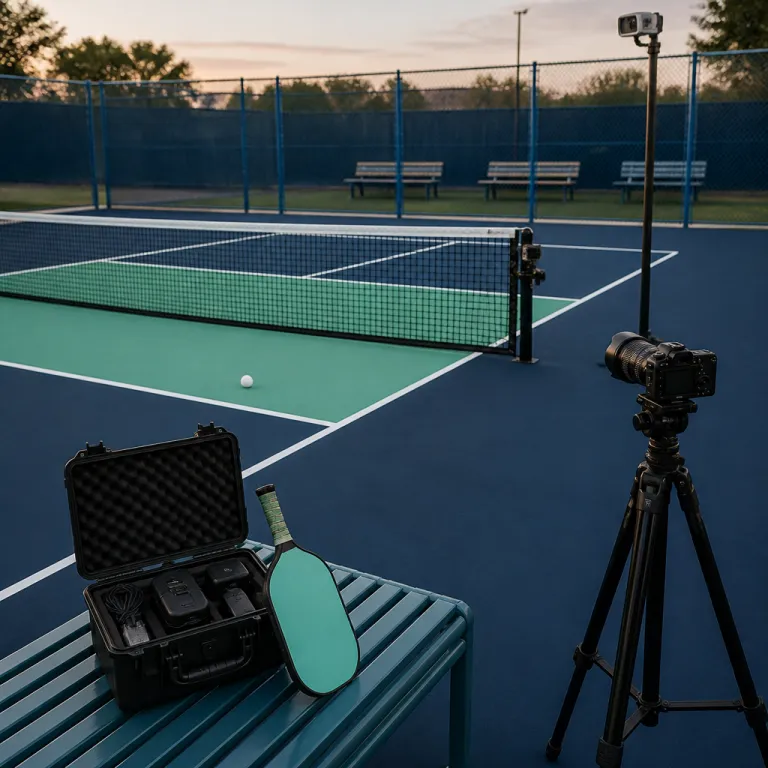
As with any analytics leap, the DUPR AI video rating pickleball shift raises questions about fairness, access and data governance that go beyond pure performance. Players with easy access to smart courts or stable tripod setups will be able to feed far more games into the system, while those relying on crowded public facilities may struggle to record clean footage during peak play time. That disparity could create an analytics gap where some players fine tune their skill level with granular feedback while others still guess which parts of their game need work.
Gear and tech savvy players are already pairing high end carbon fiber paddles with video tools, using slow motion replays to study spin RPM, paddle face angle and contact point on drives and rolls. For that cohort, the DUPR AI video rating pickleball integration is simply the next logical step, because the same footage that helps them optimize equipment choices from detailed paddle reviews can now update their dupr rating and validate whether those changes actually move the needle. In that sense, the system turns every match into a controlled experiment where the rating reflects not just subjective feel but objective outcomes measured across many games.
On the governance side, DUPR will need to communicate clearly how its privacy policy handles uploaded video, derived data and any sharing with third party partners. Players are right to ask who can access raw footage, how long it is stored, whether the system can be used to audit officiating decisions and whether directly dupr staff can review individual matches outside of anonymized datasets. Transparent answers will be essential if the broader community is to trust that the rating measure is driven by performance rather than opaque decisions behind the scenes.
There is also the question of how dupr vision style models handle edge cases, such as partial occlusions, low light conditions or unconventional camera angles that might mislabel shots. If the system misclassifies a defensive lob as an unforced error, or fails to detect a let serve, the resulting data reflects a distorted picture of the match, and the rating reflects that distortion unless corrected. DUPR and its partners will need robust quality control, including human review for flagged games, to ensure that the game dupr analytics remain reliable across the full range of real world playing environments.
For competitive amateurs in the 3.5 to 4.5 band, the takeaway is straightforward, the era of casual anonymity is ending, and your on court habits are about to be quantified in unprecedented detail. You do not need to film every match, but if you care about where your dupr rating lands on the scale that governs brackets, partner choices and even travel plans, you will probably want a steady stream of rated video in the system. In pickleball, as in every data driven sport, the number that matters most is no longer the logo on your paddle, it is the rating that survives your tenth tournament game under pressure rather than the one you earned on a perfect practice day.