Summary
Editor's rating
Is it worth the money for the average player?
Chunky, practical, and not trying to be pretty
Battery life and real-world autonomy
Build quality and how sturdy it feels
On-court performance: how it actually hits
What you actually get out of the box
Pros
- Consistent, adjustable feeds from about 12 to 75 mph with useful lob angles up to 45°
- Good battery life (realistically around 4+ hours) with an external, replaceable battery
- App control with stored custom programs and full oscillation for varied, realistic drills
Cons
- Fairly heavy to lift; rolling is fine but stairs and long carries are a pain
- App and feature set have a bit of a learning curve; not totally plug-and-play for all modes

Specifications
View full product page →| Brand | PUSUN |
A portable practice buddy that actually keeps up
I’ve been using the PUSUN PP-Smart Pro pickleball machine for a few weeks now, roughly three sessions per week, about 1.5–2 hours each. I bought it because I was tired of depending on whoever showed up at open play and wanted something that could feed me consistent balls for drilling dinks, drives, and serves. I’m not a coach or a pro, just a regular player who’s somewhere around 3.5 level and trying to get more serious.
Right away, the thing that stood out is that it’s a proper machine, not a toy. It’s not tiny, it’s not ultralight, but it’s still manageable to move around. It throws balls hard enough that I had to dial it down at first, and it can lob high enough to practice overheads without feeling like soft toss. So it’s clearly made for someone who wants to train, not just casually mess around.
At the same time, it’s not perfect. There are a few quirks with the app, and you do need a bit of patience to understand all the modes and how the oscillation works in real life. Also, you really feel the weight if you’re lugging it in and out of a car by yourself. It’s doable, but not effortless.
Overall, my first impression is that it gets the job done very well for solo or small-group practice. It’s not cheap, and there are a couple of corners where you can tell they prioritized function over polish, but so far I feel like I’m actually getting better from using it, which is the main point. In the rest of this review I’ll go through how it’s built, how it performs on court, and whether I think it’s worth the money for the average pickleball player.
Is it worth the money for the average player?
Let’s be honest: this is not a small purchase. For most people, it’s in the same price range as a decent TV or a budget laptop. So the question is whether you’re actually going to use it enough to justify the cost. In my case, I was paying for clinics and ball machine time at a club, and when I did the math over a year, owning a machine started to make sense, especially since a few friends chip in and we share it.
In terms of value for money, the PP-Smart Pro sits in a pretty good spot. You get a lot of features: wide speed range, lob capability up to 45°, spin options, full oscillation, an app with custom drills, plus a decent battery life. There are more expensive machines that might be a bit more polished or have fancier interfaces, but for actual play, this one covers the bases. It feels like you’re paying mainly for function, not for branding or flashy design.
Where it’s less attractive is if you’re a very casual player. If you only play once a week and mostly just want to have fun with friends, this is probably overkill. You’d be better off spending that money on lessons, more paddles, or just court time. This machine makes more sense if you’re: a) trying to move from beginner to intermediate or intermediate to advanced, b) a small group or family that drills a lot, or c) a coach or club that wants a capable machine without going to the top-end brands.
Overall, I’d rate the value as pretty solid for people who actually plan to drill regularly. It’s not cheap, but you do get a serious training tool with strong performance and a decent warranty. If you’re on the fence, I’d say only go for it if you’re genuinely going to put in the hours on court; otherwise it’ll just become an expensive black box sitting in the garage.
Chunky, practical, and not trying to be pretty
Design-wise, the PP-Smart Pro is all about function. It’s a black ABS and metal box with a hopper on top – nothing stylish, nothing fancy. If you’re looking for something that looks sleek on Instagram, this isn’t it. But on the court, the design choices make sense. The footprint is compact enough that it doesn’t hog space, and the height is good: you can reach the control panel and hopper without bending over too much.
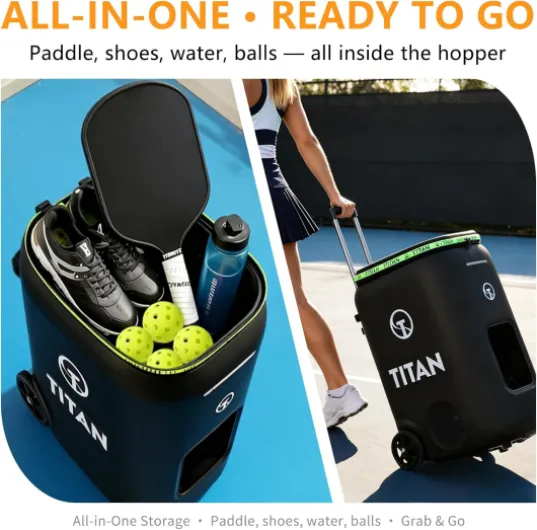
The hopper flipping upside down for storage and transport is a small detail that I ended up liking a lot. After a session, I just empty the balls, flip the hopper, and it takes up noticeably less space in the trunk and at home. It also protects the inside from dust. It’s one of those things you don’t think about when you buy it, but you appreciate every time you pack up.
The wheels and handle are pretty basic but do the job. The wheels are more like cart wheels than big off-road ones, so they’re fine on smooth surfaces and slightly rough concrete. If your courts are across gravel or grass, it’s going to be a bit bumpy, but still workable. The handle telescopes enough for me (I’m about 5'10"), and the balance when you tilt it is okay – it doesn’t feel like it’s going to tip over easily.
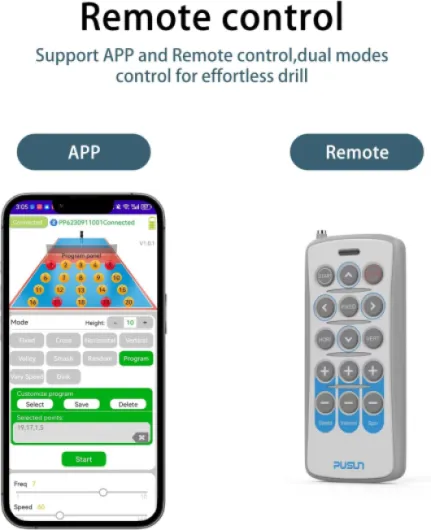
Control-wise, the buttons and ports are laid out simply: power switch, battery connection, and a basic interface if you don’t want to use the app. The remote is small and light, nothing fancy, but at least you can start/stop feeds without walking all the way back. Overall, the design is practical and a bit utilitarian. It doesn’t look premium, but it feels like it was planned by people who actually thought about how you move and use a machine around real courts.
Battery life and real-world autonomy
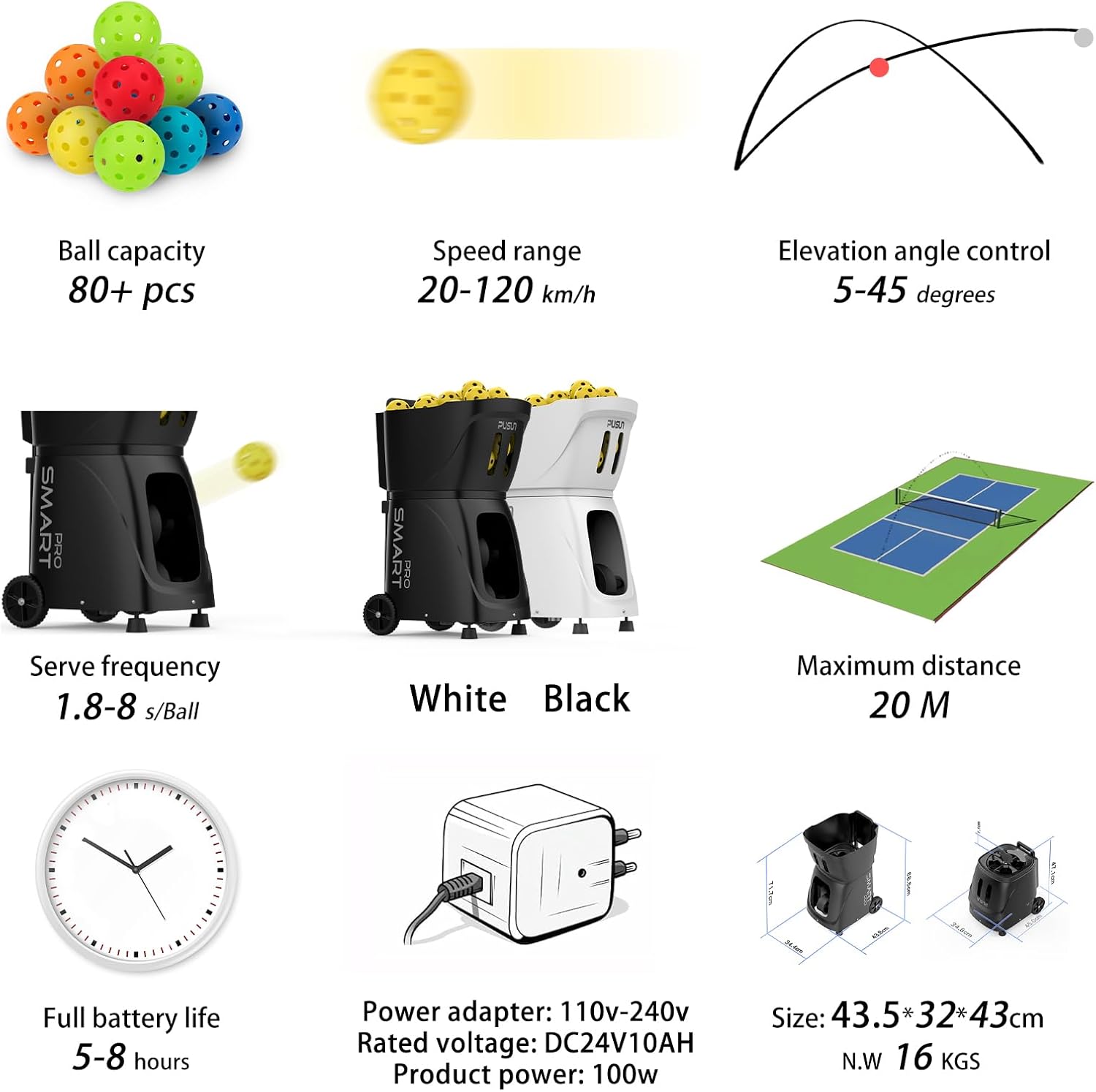
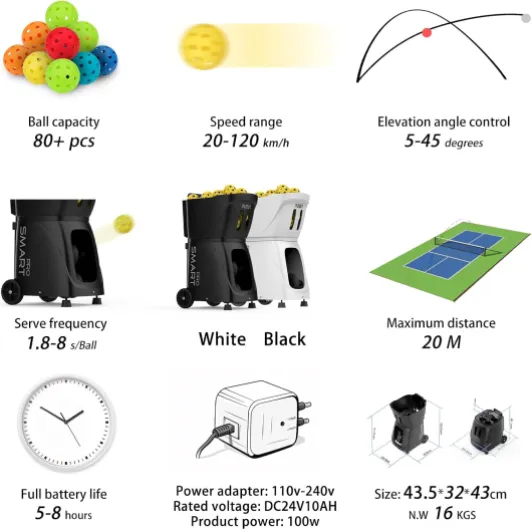
The specs say 4–6 hours of battery life, and in real use I’d say that’s fairly accurate, depending on how aggressive your settings are. On my usual sessions – speed in the mid-range, interval around 3–4 seconds, some oscillation but not crazy – I was getting about 4.5 hours before I felt it was safer to stop and recharge. I never fully drained it to zero because I’d rather not kill the battery long-term, but the indicator definitely drops faster if you push high speed and constant oscillation.
The battery is external and removable, which is a big plus. You can pop it out to charge it separately or swap to a second one if you decide to buy another later. That’s a lot better than some machines where, if the internal battery dies, you’re stuck sending the whole unit in. Here, if the battery gives up after the one-year warranty, at least replacing it is straightforward.
Charging time from low to full takes a few hours – think of it like charging a laptop, not a phone. It’s not instant, so don’t expect to run a full morning session, go for lunch, and be back at 100% in an hour. For home users, charging overnight is the easiest routine. The charger itself is basic but feels safe enough; it doesn’t get crazy hot, just warm.
For my use (3–4 sessions a week, 1.5–2 hours each), one battery is enough. If you’re a coach running drills all day, you’ll probably want a spare. I’d say the claimed 6 hours is optimistic and probably only at gentler settings, but 4 hours of solid training per charge is realistic, and that’s already plenty for most players.
Build quality and how sturdy it feels
The machine is made from ABS plastic and metal, and in hand it feels sturdy but not bulletproof. The outer shell is thick enough that I don’t worry about it cracking from normal knocks. I’ve bumped it into a court post and into my car bumper once while rolling it, and it only left small scuffs, no structural damage. The metal frame inside (you can see parts of it) gives it a solid core.
Moving parts like the wheels and handle feel okay but not premium. The wheels roll fine and don’t wobble, but they’re not heavy-duty industrial wheels. As long as you’re not dragging it over rough gravel every day, they should last. The telescoping handle locks in place properly; I haven’t felt any play or looseness yet. If something were to fail first over years, I’d bet on these parts, not the main firing system.
The ball feeding mechanism and internal wheels haven’t shown any weird noises or grinding so far. After several long sessions, the throws are still consistent and there’s no burning smell or overheating. I do try to keep dust and dirt off it and store it inside, which definitely helps. If you leave it exposed to sun and rain, I don’t see it aging well – it’s still plastic and electronics at the end of the day.
With the three-year warranty for personal use, I’m reasonably confident about durability. It doesn’t feel like a flimsy cheap import, but also not like a tank designed for abuse at a busy club 12 hours a day. For a regular player or small group sharing it, I’d say the durability is good enough if you treat it decently: don’t drop it, don’t leave it outside, and don’t kick it when you miss a shot.
On-court performance: how it actually hits
This is where the PP-Smart Pro justifies its price: ball delivery is consistent and strong. I tested it with both indoor and outdoor balls, mostly Franklin X-40s and some cheaper practice balls. From about mid-speed upwards, the feeds are very steady – same depth, similar bounce height, and no weird flyers. I ran about 80-ball cycles multiple times and didn’t get any jams, which lines up with other buyers saying it runs clean when fully loaded.
The speed range is wide enough for pretty much anything you’d want to train. At the lower end (around 12–20 mph), you can practice gentle dinks and softer third-shot drops. Mid-range speeds feel like realistic drives at rec level, and when you crank it closer to the top end, it’s honestly more than I’d ever see in my usual games. I used those higher speeds to practice reaction volleys at the kitchen line, and it’s a good way to get your footwork and paddle position sharper.
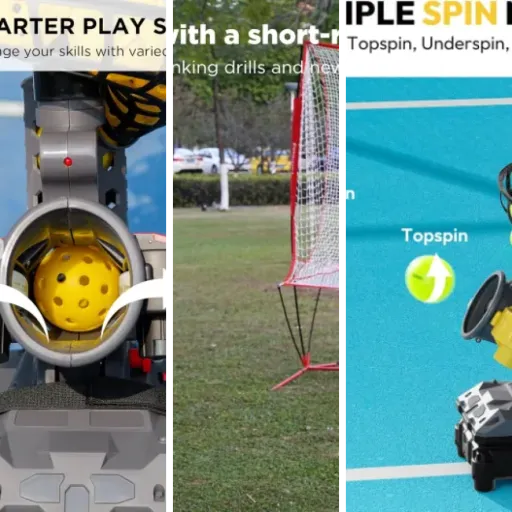
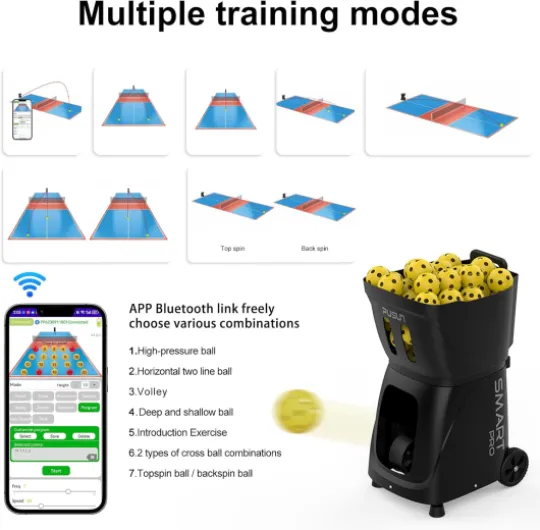
The trajectory and oscillation are also quite useful. With angles up to 45°, you can practice high lobs and overhead smashes. Full oscillation means it doesn’t just move side-to-side a bit; it can vary height and direction so you get more game-like feeds. I used one custom program where it mixed deeper baseline shots with shorter mid-court balls, and that alone gave me a decent cardio workout plus realistic movement.
The spin options (topspin, backspin, sidespin) are there and noticeable, but not as extreme as you might see in high-level play. Still, for practicing reading spin and adjusting your paddle angle, it’s useful. Overall, in pure performance, it’s pretty solid. It’s not a magic coach – you still have to know what to drill – but if you feed it a plan, it can repeat the same shot a hundred times without getting tired or complaining, which is exactly what I wanted.
What you actually get out of the box
Out of the box, you get the machine itself, a lithium battery, a remote, and a user manual. No balls included, so be ready with a bucket of at least 60–80 pickleballs if you want to take advantage of the capacity. The product page says 80+ balls, and that’s roughly accurate. I loaded 72 balls and still had some room, but past that you’re kind of stacking them and they start to bounce around more.
The machine is listed around 18–22 kg depending on which spec you read, and that feels right when you pick it up. It’s not something you’re going to carry one-handed for long, but it has built-in wheels and a handle, so you mostly tilt and roll it like a suitcase. For me, from trunk to court is fine; carrying it up a long flight of stairs would be annoying but not impossible.
In terms of features, on paper it’s pretty loaded: ball speed from about 12 to 75 mph, trajectory angle from 4° to 45°, serve interval from 1.8 to 8 seconds, plus topspin, backspin, and sidespin, and full oscillation. You control this either with the remote or the phone app, and you can store up to 12 custom training programs. That sounds like a gadget overload, but in practice you’ll probably use 3–4 favorite setups most of the time.
The warranty is also worth noting: three years on the machine for personal use, 1.5 years if it’s for a club or school, and one year on the battery. That’s decent reassurance for something this price. Overall, the package feels more like a serious training tool than a casual gadget, and you can tell they expect people to use it regularly, not just once a month.
Pros
- Consistent, adjustable feeds from about 12 to 75 mph with useful lob angles up to 45°
- Good battery life (realistically around 4+ hours) with an external, replaceable battery
- App control with stored custom programs and full oscillation for varied, realistic drills
Cons
- Fairly heavy to lift; rolling is fine but stairs and long carries are a pain
- App and feature set have a bit of a learning curve; not totally plug-and-play for all modes
Conclusion
Editor's rating
After several weeks of use, I see the PUSUN PP-Smart Pro as a solid, no-nonsense training machine that focuses on doing the basics well: consistent feeds, useful speed range, good lob height, and enough spin and oscillation to keep drills interesting. It’s not flashy and it’s not perfect, but on court it behaves like a reliable partner that doesn’t get tired and doesn’t argue. For me, that’s exactly what I wanted from a ball machine.
It’s best suited for players who are serious about improving – people who are okay spending a chunk of money to have reliable solo practice, or small groups who can share the cost. Coaches and clubs can also get good use out of it, especially with the custom drill programs and the app controls, though they might eventually want something even heavier-duty if they’re running it all day. If you’re a casual player who only hits occasionally, this is probably too much machine and too much money for what you’ll actually use.
In short: strong performance, decent build, and fair value if you’re going to put in the hours. If you just like the idea of owning a machine but don’t really enjoy drilling, save your cash. If you’re the type who’ll go out and run 500 forehand drives on a Tuesday night, this will fit you pretty well.