Summary
Editor's rating
Is it worth the money compared to bigger brands?
Looks, shape, and that loud gradient edge
Grip, balance, and fatigue after long sessions
Carbon face, honeycomb core, and what that means in real games
Build quality and how it’s holding up so far
Control, spin, and power: how it actually plays
What you actually get out of the box
Pros
- Good control and spin thanks to T800 raw carbon face and 16 mm core
- Lightweight and well balanced, comfortable for long sessions
- Strong value for money with cover and extras included
Cons
- Stock grip gets slippery with sweat and wears fairly quickly
- Power is only moderate, not ideal for players who rely on big hits

Specifications
View full product page →| Brand | Amoswiz |
A carbon paddle for people who are past the cheap starter kits
I’ve been playing pickleball 2–3 times a week for a while now, mostly rec games plus the odd local ladder night. I picked up this Amoswiz T800 carbon fiber paddle because I wanted something better than the basic fiberglass paddles you get in two‑packs, but I didn’t feel like dropping big money on one of the top brands. I’ve used it for about three weeks now, roughly 10–12 sessions, indoors and outdoors.
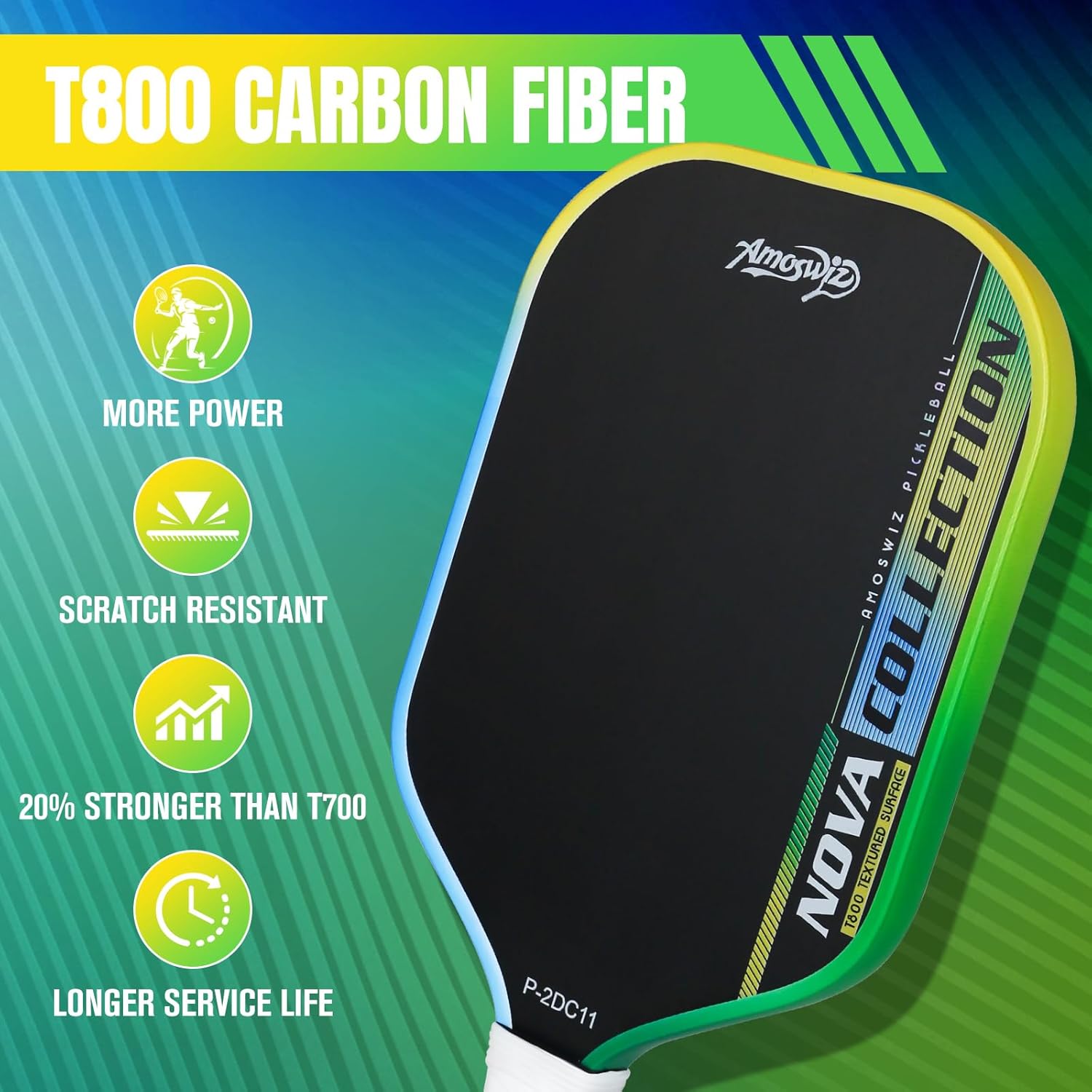
Right away, it feels like a paddle aimed at that in‑between crowd: not a toy beginner paddle, but not a pro tournament stick either. The specs are very on‑trend: 16 mm core, raw carbon face, thermoformed, foam in the edges. On paper it looks like a copy of the popular high‑end models, just from a lesser‑known brand and at a lower price.
I went in with fairly low expectations because of the unknown brand and the fact it’s made in China like most budget paddles. But I have to say, in actual games it holds up better than I expected. It doesn’t magically fix your technique, but if you’re moving up from cheap composite paddles, you really do feel the difference in control and spin after a couple of sessions.
It’s not perfect though. There are a few small annoyances that show you why it’s cheaper: mainly the grip getting slippery when sweaty, and a slightly hollow sound that some people might not like. Still, for regular rec play and intermediate players who want more control and spin without burning their wallet, it’s a pretty solid option.
Is it worth the money compared to bigger brands?
Price-wise, this sits in the mid‑range bracket: more than the bargain two‑pack sets, less than the big‑name raw carbon paddles. For that money, you’re getting modern specs (T800 carbon, 16 mm core, thermoformed, foam edges) plus some small extras like the cover and eraser. On paper and in hand, it feels like you’re getting good tech for what you pay.
If you compare it to the absolute budget paddles, the difference in control and spin is clear. Your soft game gets easier, and the paddle feels more solid overall. So if you’re currently on a cheap Amazon starter kit and you’re playing regularly, this is a logical upgrade without jumping into premium prices. You’ll notice the benefit pretty quickly in your consistency and touch.
Compared to the big‑name brands that cost almost twice as much, you do give up a bit in finish quality and maybe a bit of long‑term confidence. The grip isn’t as nice, the sound is a bit more hollow, and you don’t get the same brand support or resale value. If you already know you’re deep into the sport and you’re picky, you might be happier saving up for one of those.
For most intermediate rec players though, the value is solid: you get a paddle that plays like a modern carbon control paddle, without the premium logo tax. It’s not the best thing on the market, but for the current price level, it’s a good balance between performance and cost, as long as you’re okay re‑gripping it and accepting that it’s from a lesser‑known brand.
Looks, shape, and that loud gradient edge
Design-wise, the first thing that stands out is the green‑yellow‑blue gradient edge guard. In real life it looks a bit like a retro sports shoe from the 80s. Personally, I don’t mind it. It’s bright enough that you can spot your paddle quickly on a bench, and other players did comment on it. If you like loud colors, you’ll be happy. If you prefer totally plain gear, this might feel a bit flashy, but at least the face itself is mostly clean and dark.
The shape is a pretty standard, slightly elongated widebody. Not one of those super skinny elongated paddles, but also not a short, oversized one. That gives you a decent reach without feeling awkward at the net. The sweet spot felt centered and reasonably big; I didn’t get that dead feeling on mishits near the top edge that I’ve had on cheaper paddles. That’s probably helped by the foam in the corners and the thicker 16 mm core.
The grip size is listed at 4 1/4 inches, and that feels accurate. With the stock grip only, it’s a comfortable medium. I have average‑sized hands, and I didn’t feel the need to add an overgrip for size, only for sweat control. The shape of the handle is a normal octagonal profile, not too boxy, so switching between forehand and backhand is easy without thinking about it.
In terms of sound, it has a deeper “whump” than cheap paddles but still a bit hollow compared to some higher‑end carbon paddles I’ve tried. That’s not a problem, just something you notice. Visually and in hand, it looks like a modern, serious paddle, not a toy. You can tell it’s aimed at people who actually play regularly, not just once a year on holiday.
Grip, balance, and fatigue after long sessions
Comfort-wise, the main points for me are weight, balance, and how the grip feels when things get sweaty. This paddle is on the lighter side. On my scale it came in around 8 ounces, and on court it feels quick in the hand. At the net, hand battles and quick resets are easier because the head doesn’t feel heavy. If you’re coming from a cheap heavy paddle, your arm and shoulder will probably thank you after a couple of two‑hour sessions.
The balance feels pretty neutral. It doesn’t feel super head‑heavy or super handle‑heavy. That’s good for all‑round play: drives, dinks, and blocks all feel manageable. I didn’t get that “dragging” feeling on overheads or when reacting to fast shots at the kitchen line. After back‑to‑back days of playing, my elbow and wrist were fine, which is not always the case with stiffer, heavier paddles.
The weak point in comfort is the stock grip when you start sweating. The texture is okay at first, with a light tack. But after 30–40 minutes of harder play, it does get a bit slippery. I found myself wiping my hand on my shirt between points more often than with my usual overgrip. Adding the included spare grip or your own overgrip fixes most of that, but out of the box it’s just “okay” rather than great. If you have very sweaty hands, plan on re‑gripping it.
Vibration is pretty well controlled. Mishits don’t send a sting up your arm like some cheap composite paddles. You still feel contact, but it’s more of a dull thud than a sharp ping. For anyone with mild elbow issues, I’d say this is reasonable. Not as soft as some foam‑heavy control paddles, but much friendlier than the bargain‑bin paddles I started with.
Carbon face, honeycomb core, and what that means in real games
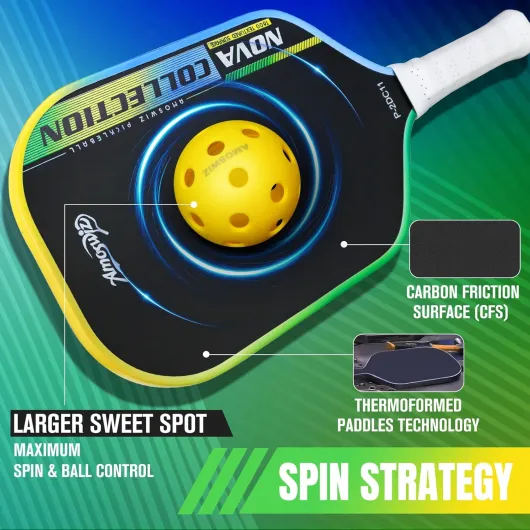
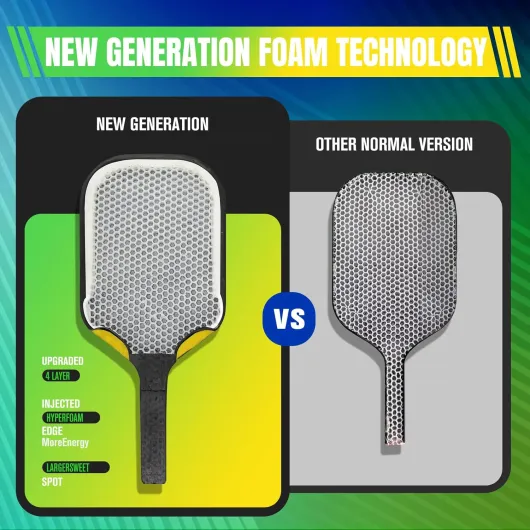
On paper, this thing ticks all the trendy boxes: T800 raw carbon fiber face, 16 mm polymer honeycomb core, thermoformed construction, and foam injected in the four corners. That’s basically the spec sheet you see on a lot of more expensive paddles right now. The question is how it actually feels compared to those.
The carbon face has a clear texture to it. Running your fingers over it, you can feel a light grit, not crazy rough like sandpaper, but definitely not smooth. On court, that translates to easier spin on serves and topspin drives compared to my old fiberglass paddle. I noticed my slices and cut dinks grabbed the ball better too. It’s not magic, you still need decent technique, but the material definitely helps.
The 16 mm core and foam edges give it a more muted, controlled feel. When you block at the net, the ball doesn’t rocket off the face the way it does on some thinner, power‑oriented paddles. If you’re used to super poppy beginner paddles, you might initially feel like this is a bit “dead”. After a few sessions, I actually preferred that because I could keep more balls in play, especially on fast hands battles at the kitchen line.
Compared to a couple of big‑brand raw carbon paddles I’ve tried from friends, the main difference is consistency. This Amoswiz one feels slightly less solid right at the edges; if you hit very close to the frame, you feel a bit more vibration and a small drop in power. But for the price point, the materials feel pretty solid, and nothing about it screamed “cheap plastic” or “toy”. It behaves like a real carbon paddle, just not at the absolute top tier.
Build quality and how it’s holding up so far
Durability is always tricky to judge long‑term, but after several weeks and a decent number of sessions, I can at least say how it’s holding up in the short term. So far, no structural issues: no rattles, no weird buzzing sounds, no delamination or soft spots on the face. The thermoformed shell still feels tight, and tapping around the face gives a consistent sound.
The edge guard has taken a few scrapes from low digs and one ugly scrape on an indoor court, and it’s only got cosmetic marks. No peeling or cracking yet. The gradient color on the edge will obviously scratch over time, but that’s just looks. The important part is that the guard is still firmly attached and not separating from the face.
The face itself shows the usual light scuffing from balls and paddle clashes, but the texture is still there. I used the included “eraser” a couple of times to clean ball marks, and it does help clean things up, though it won’t make it look brand new. The carbon weave isn’t fraying or flaking, which is what I’d worry about with a cheap finish.
Where you see more wear is the grip. After a few sweaty sessions, the stock wrap started to look a bit tired, with small signs of lifting at the edges. Nothing dramatic, but enough that I’d expect to re‑grip it within a couple of months of heavy use. Overall, for a mid‑priced paddle from a lesser‑known brand, the durability so far feels decent. I wouldn’t expect it to last forever like a top‑end one, but I also don’t feel like it’s going to fall apart after one season.
Control, spin, and power: how it actually plays
In terms of performance, I’d classify this as a control‑leaning all‑round paddle. If you’re an intermediate rec player who wants to keep more balls in and add some spin, it fits that role nicely. If you’re hunting for raw power to blast winners from the baseline, there are better options.
Control at the net is where it felt best. Dinks, drops, and blocks were easier to keep low compared to my older, bouncier paddle. The 16 mm core and the slightly muted feel help you take pace off the ball without babying every shot. On third shot drops, I noticed I was landing more balls in the kitchen without sending them long. It took me one or two sessions to adjust to the softer feel, but after that I felt more confident playing a patient soft game.
Spin is clearly better than on entry‑level paddles. My topspin serves kick a bit more, and slices stay lower. It’s not like the ball suddenly curves like crazy, but you do get more bite on the ball. That’s mostly down to the textured carbon face. If you’re already using a decent raw carbon paddle, you won’t be shocked; if you’re coming from a smooth fiberglass face, you will notice the difference.
Power is fine but not huge. You can still hit solid drives and overheads, especially if you swing through properly, but it doesn’t have that trampoline feel some power paddles have. On hard put‑aways at the net, I had enough pop to end points, but from the baseline, I had to work a bit more with my body and legs. For me that’s an acceptable trade‑off, because I value control more. Aggressive bangers who rely on the paddle to do the work might find it a bit tame.
What you actually get out of the box
Out of the box, the Amoswiz paddle gives you more than the bare minimum. In the package I had: the paddle, a neoprene cover, a spare grip tape, and a small cleaning “eraser” for the face. For the price range this sits in, that’s decent. The cover is nothing fancy but it’s thick enough to protect the face in a backpack, and the zipper hasn’t jammed on me yet. The spare grip is basic overgrip material, not super cushioned, but handy if you like to build up the handle size.
The paddle itself is standard shape, around 40 x 20 cm. Mine weighed in just under what they claim (about 8 oz / 226 g on my kitchen scale), which is on the lighter side compared to a lot of thermoformed paddles. The branding is minimal, mostly the gradient color on the edge and a clean face. No huge shiny logos screaming at you, which I appreciated.
Everything arrived well protected, no dings or weird glue marks on the edge. The edge guard line is pretty clean. The carbon face had a uniform texture, no glossy patches or bumps. The one thing that did feel a bit “budget” is the handle finishing at the butt cap: the tape overlap isn’t perfectly even, and you can feel a slight ridge if you’re picky. Not a big deal in play, but you can tell it’s not a $200 paddle.
Overall, in terms of what you get for the money, it’s good value for a mid‑range purchase. If you’re used to super polished big‑brand packaging, you’ll notice the difference. If you just want something that looks decent and is ready to hit the court right away, this gets the job done without feeling cheap or toy‑like.
Pros
- Good control and spin thanks to T800 raw carbon face and 16 mm core
- Lightweight and well balanced, comfortable for long sessions
- Strong value for money with cover and extras included
Cons
- Stock grip gets slippery with sweat and wears fairly quickly
- Power is only moderate, not ideal for players who rely on big hits
Conclusion
Editor's rating
After a few weeks of regular play, I’d sum this Amoswiz T800 paddle up as a solid mid‑range control paddle for serious rec and intermediate players. It gives you the modern features people are chasing right now—raw carbon face, 16 mm core, thermoformed build—without the premium price tag. On court, the main strengths are control at the net, decent spin, and a comfortable, light feel that doesn’t wear your arm out.
It’s not flawless. The stock grip gets slippery when you sweat, the sound is a bit hollow, and the overall finish isn’t as polished as the big brands. Power is decent but not huge, so heavy hitters may feel underwhelmed. But if you’re upgrading from a cheap starter paddle and you want more touch and spin without spending a fortune, it does the job well. I’d recommend it to intermediate players and improving beginners who know they’ll stick with the sport. If you’re already playing tournaments and obsessing over tiny differences in feel, you’ll probably want to look higher up the price ladder.