Summary
Editor's rating
Is it worth the money?
Shape, balance, and how it actually feels in the hand
Grip, feel, and fatigue after a few hours
Carbon fiber, core, and what feels cheap vs solid
How it holds up after regular play
Control, power, and spin on the court
What you actually get out of the box
Pros
- Good control and soft feel thanks to the 16 mm polymer honeycomb core
- Textured carbon surface offers respectable spin for serves and roll shots
- Comfortable, middle-of-the-road weight and grip that work for most adult players
Cons
- Power is only average, better suited for control players than heavy hitters
- Unknown brand with basic packaging and less polished finishing than premium paddles

Specifications
View full product page →| Brand | Amoswiz |
A cheap way to try a “raw carbon” paddle
I picked up this Amoswiz carbon fiber pickleball paddle because I wanted to try a T700 "raw carbon" style paddle without dropping a ton of cash on a big brand. It’s an unknown brand, the price was low, and the Amazon reviews were decent, so I treated it as a test paddle. I’ve used it for a bunch of rec games and a couple of small local round-robins, mostly as a 3.0–3.5 level player.
Right away, the paddle didn’t feel like junk, which was honestly my main concern. The weight at around 8 oz feels pretty standard, and the 16 mm thickness is what a lot of control paddles use right now. I usually play with a mid-range branded paddle, and swapping to this Amoswiz didn’t feel like a huge downgrade in terms of basic playability. That already surprised me for the price.
I won’t pretend I can verify if the face is truly Toray T700 carbon or just some generic carbon fiber with a textured coating. Like one of the Amazon reviewers said, you kind of just have to take their word for it. But in practice, it does give you that "grab" on the ball for spin and decent control at the net. So from a player’s point of view, it behaves close enough to other raw carbon paddles I’ve tried briefly.
Overall, my first impression after a few sessions was: this is a pretty solid budget option for someone who’s moved past the absolute beginner stage and wants more control and spin without paying big-brand prices. It’s not perfect, and there are some rough edges if you’re picky, but it gets the job done on court and feels like fair value for what you pay.
Is it worth the money?
The main selling point of this Amoswiz paddle is the price for what it claims to offer: a T700 carbon fiber face, 16 mm control core, and foam edge. When you compare that to big brands asking significantly more for similar specs, this one sits clearly in the budget or lower mid-range category. For someone who wants to try a raw carbon style paddle without spending a lot, it’s a pretty solid deal.
In practice, you’re trading brand reputation and high-end finishing for lower cost. You don’t get a case, no extras, and you can’t be 100% sure about the exact carbon source, like one of the Amazon reviewers mentioned. But on the court, the paddle behaves close enough to other raw carbon paddles I’ve tried briefly that I didn’t feel like I was being ripped off. Control and spin are there, power is adequate, and the build hasn’t given me problems so far.
If you’re a total beginner, honestly, you could start with something even cheaper or a paddle from a starter set. But if you’re in that phase where you play regularly and want to see what a modern 16 mm carbon control paddle feels like, this is a low-risk way to do it. You get a taste of that style of paddle without committing to a big purchase. If you end up loving the feel and want to upgrade later, you’ll at least know what type of paddle you like.
Overall, I’d call the value "good for the money" rather than mind-blowing. There are definitely better paddles out there if you’re willing to pay more, especially for power, finishing, and brand support. But for an unknown brand on Amazon, this one lands in that sweet spot of being affordable, playable, and not feeling like cheap junk. If your budget is tight and you want a control-focused paddle with real spin potential, it’s a sensible option.

Shape, balance, and how it actually feels in the hand
Design-wise, the Amoswiz goes for a pretty standard control paddle layout. The 16.5" x 7.6" size is that slightly elongated shape you see everywhere now, giving you a bit more reach without feeling like a total board. On court, that extra length does help at the kitchen for quick volleys and for stretching out to grab lobs or dinks. Compared to a more rounded, wider beginner paddle I used before, this one feels a bit more precise and less clunky in fast exchanges.
The balance is slightly head-light to neutral in my hand. It doesn’t feel super head-heavy, which is nice if you’re coming from a cheap Amazon paddle that often feels like a shovel. I could flick my wrist for quick counters and resets without feeling like the paddle was dragging behind. If you like adding lead tape, there’s room to tune it, but I played it stock and felt it was fine for rec and league play.
One design detail I noticed is the foam-injected edge. The brand claims it improves power and removes dead spots. I can’t scientifically prove that, but I did try hitting toward the edges on purpose a few times. Miss-hits still felt like miss-hits (no miracle), but they didn’t feel totally dead either. The paddle face feels pretty consistent across most of the sweet spot area, especially vertically. Horizontally, toward the far side edges, you still lose some pop, which is normal. I wouldn’t say the edge foam is a huge "wow" factor, but it doesn’t hurt.
Visually, the design is plain but clean. If you want something that stands out with bright colors, this isn’t it. But if you like a low-profile paddle that doesn’t scream “Amazon special,” it does that job. Overall, the design is practical: standard modern shape, decent balance, and a face layout that supports control and spin more than raw power.
Grip, feel, and fatigue after a few hours
The handle on this paddle is 5.12" long with a 4 1/4" grip, which is a pretty safe middle ground. I have average-sized hands, and it felt natural without needing an overgrip right away. The grip itself is cushioned with a slightly raised rib design, and it’s perforated, so it doesn’t feel like a slick, plastic wrap. After a couple of two-hour sessions, I didn’t get any blisters, which I sometimes do with harder grips on cheaper paddles.
In terms of weight and overall comfort, the 8 oz listed weight feels accurate. It’s not feather-light, but it’s not a brick either. I’ve played with heavier paddles that made my wrist and elbow sore after a long night of rec play. With this one, I didn’t feel any extra pain compared to my usual mid-range paddle. The 16 mm thickness also seems to soak up some vibration, so mishits don’t sting as much as they do on thinner or cheaper composite paddles. If you’ve got mild elbow or shoulder sensitivity, this feels relatively forgiving.
Grip tackiness is decent out of the box. My hands tend to get sweaty, and after about an hour, it did get a bit slippery, but not to the point where I was losing the paddle. I’d still probably throw an overgrip on it if I were using it as my main paddle, just for consistency and hygiene. But for a stock grip on a budget paddle, it’s okay. The ribbed pattern does help you keep a feel for the handle orientation without having to look down.
Overall comfort is pretty solid. No weird vibrations, no awkward balance, and the grip dimensions are in that "works for most people" range. It’s not as plush or fancy-feeling as some higher-end grips, but in practice, I could play full sessions without thinking about my hand or arm, which is what matters. For the price bracket, I’d say comfort is one of its stronger points.
Carbon fiber, core, and what feels cheap vs solid
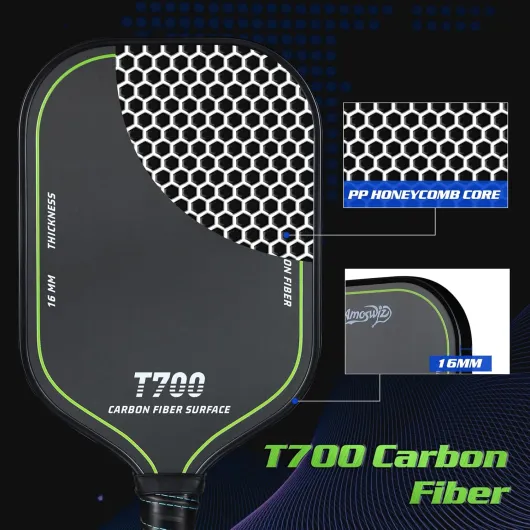
The marketing focuses heavily on the T700 raw carbon fiber face and the 16 mm polymer honeycomb core. On paper, that’s the same type of setup you see in a lot of paddles that cost quite a bit more. The surface definitely has a rough, textured feel to it, not just a smooth paint job. When you rub your fingers across it, you can feel that grip, which helps with putting spin on the ball. Whether it’s genuine Toray-branded T700 or just generic T700-style carbon, I honestly can’t say, but functionally it behaves like a raw carbon surface.
The core is a high-density polymer honeycomb. In actual play, it gives a soft, controlled feel on dinks and resets. The 16 mm thickness helps with that; the paddle doesn’t feel overly bouncy, which is good if you’re trying to dial in a softer game. When I switched back to a thinner, cheaper paddle I own, I could immediately feel how much harsher and more poppy the old one was. So the core on the Amoswiz does feel more modern and forgiving.
The frame is also carbon fiber, and the edge guard seems reasonably well attached. I checked around the seams after a few sessions: no peeling, no obvious gaps, and no rattling inside the core. That’s usually where you start to see corners cut on really low-end paddles. Here, it feels decent and put together. It’s not at the level of premium brands in terms of finishing, but it doesn’t scream "toy" either.
If I had to point out the cheaper feeling part, it would probably be the overall finish and branding rather than the core materials themselves. The graphics and logo are basic, and the grip tape feels more generic than what you’d get on a high-end paddle. But the main playing materials — face, core, frame — seem aligned with the product description and gave me a solid on-court feel. For the price point, the materials are honestly better than I expected.
How it holds up after regular play
I’ve used this paddle for several weeks of rec play, a couple of times per week, and so far, it’s holding up reasonably well. No major chips, no cracks, and the edge guard is still firmly attached. I looked closely around the edges and face after some harder sessions and a few accidental court scrapes, and while there are minor scuff marks, nothing looks like it’s falling apart. For a budget paddle, that’s a good sign.
The textured surface does show some light wear where I hit most of my balls, but the grip and spin are still there. On some cheaper paddles, the surface texture is just a coating that wears smooth pretty quickly. Here, after a few weeks, I haven’t noticed a big drop in spin performance. If you’re playing several times a week at a competitive level, you might wear it faster, but for casual league and rec players, it seems fine so far.
The handle and grip have also stayed in place. No twisting, no looseness, and no rattling in the core, which can happen when internal pieces break free on low-quality paddles. I did notice the grip tape starting to show a bit of fraying at the very end after some heavy use, but that’s normal and easy to fix with an overgrip. I’d probably re-wrap it eventually anyway.
Long-term, I obviously can’t speak for a full year of heavy play yet, but based on the build and the first few weeks, it doesn’t feel like a disposable toy. It feels like something that could reasonably last a season or more for a casual or intermediate player. Compared to big-name paddles, the finish is a bit rougher, but nothing jumped out as a major durability red flag at this stage.
Control, power, and spin on the court
On court, this Amoswiz paddle leans clearly toward control rather than raw power. The 16 mm core and textured carbon face give you a pretty soft touch on dinks and blocks. At the kitchen, I felt comfortable hitting soft shots and resets, and the paddle didn’t feel jumpy. Coming from a more basic fiberglass paddle, I noticed it was easier to keep the ball low and in the kitchen instead of popping it up accidentally. For players working on their soft game at the 3.0–3.5 level, that’s a nice upgrade.
Power-wise, it’s decent but nothing crazy. If you like to crush drives and smashes with minimal swing, this is not a cannon. You can still hit put-aways and decent drives, but you need a full swing and proper mechanics. The foam-injected edge might add a little extra solidity, but it doesn’t magically turn it into a power paddle. Compared to a thinner, poppier paddle I have, this one trades some easy power for much better control and consistency.
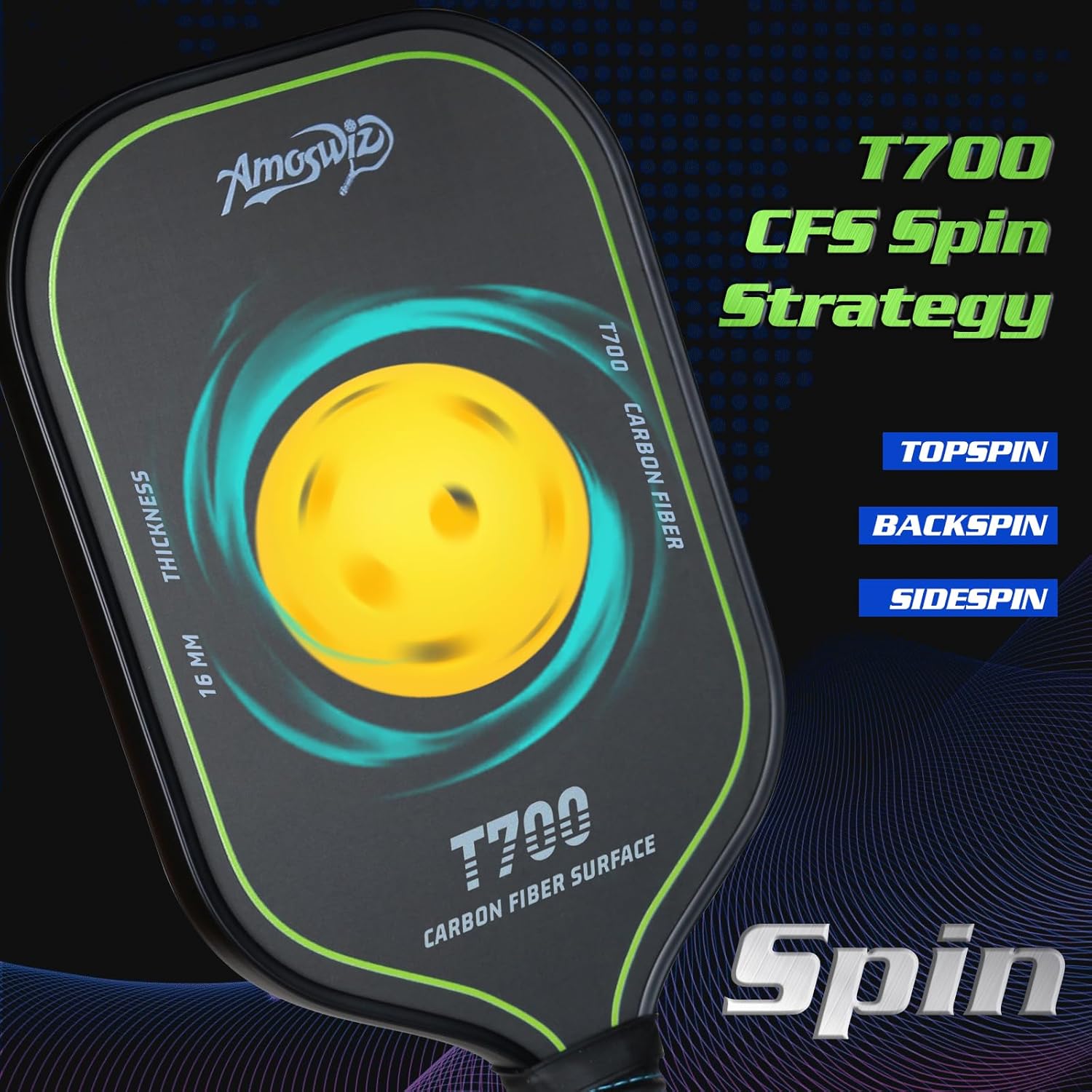
Spin is where the textured face helps. When I brushed up on the ball for topspin serves or roll volleys, I could feel the paddle grabbing the ball more than on a smooth composite face. My serves had a bit more kick, and I could hit spinnier thirds without changing my stroke too much. Is it on the same level as the most aggressive high-end spin paddles? Probably not, but for the price, it’s surprisingly capable. If you’re just starting to learn spin, this will give you enough grip to notice the difference.
Overall, performance feels well-balanced for intermediate and serious rec players: strong on control, respectable on spin, and average on power. If you’re a beginner upgrading from a cheap starter set, you’ll feel more control immediately. If you’re an advanced player who loves driving hard from the baseline, you might find it a bit underpowered and prefer something thinner or more power-focused. But as a budget control paddle, it plays better than the brand name suggests.
What you actually get out of the box
When the Amoswiz paddle showed up, the packaging was basic. No fancy case, no balls, no extras — just the paddle in simple protective wrapping. If you’re used to some brands throwing in a neoprene cover or a small bag, you don’t get that here. Personally, I didn’t care too much, but it’s worth noting if you like the whole bundle experience. The listing clearly says it’s just one paddle, so at least there’s no surprise there.
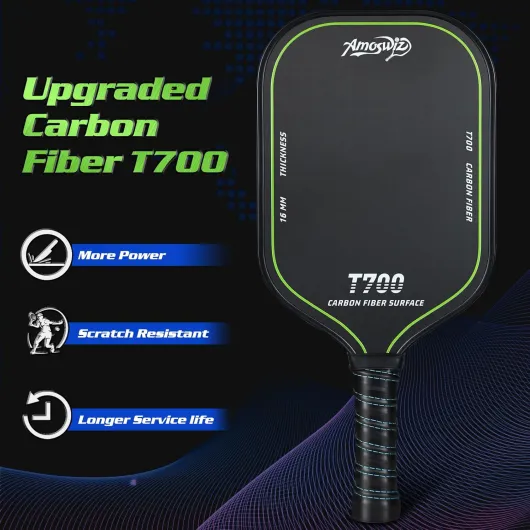
The paddle itself is full black with a "Black Control Paddle" label, so it looks pretty low-key. No bright graphics, no loud colors. Some people will like that, some will find it a bit boring. For me, it just looks like a generic carbon paddle you’d see at a local court. The surface has a visible weave and a tactile texture to it, which matches what the product page claims about T700 carbon fiber and a raw-style face. At least visually, it lines up with the description.
Specs-wise, the dimensions are standard: 16.5" long and 7.6" wide, with a 5.12" handle and a 4 1/4" grip. That combo is pretty common in the current paddle market, especially for control-oriented paddles. If you’ve used any elongated control paddle before, this won’t feel strange in your hand. The 16 mm core thickness is also right in the sweet spot for soft touch and forgiveness, which matches how they market it toward intermediate and "professional" players, though I’d say it’s more realistically aimed at intermediate and serious rec players.
Overall, in terms of presentation, it’s simple and no-frills. You get a paddle that looks the part of a modern carbon control paddle, without all the branding and accessories. If you’re expecting a whole fancy unboxing experience, this isn’t that. But if you just want a usable paddle that appears to match its specs on paper, the presentation is fine and in line with the low price.
Pros
- Good control and soft feel thanks to the 16 mm polymer honeycomb core
- Textured carbon surface offers respectable spin for serves and roll shots
- Comfortable, middle-of-the-road weight and grip that work for most adult players
Cons
- Power is only average, better suited for control players than heavy hitters
- Unknown brand with basic packaging and less polished finishing than premium paddles
Conclusion
Editor's rating
After using the Amoswiz T700 carbon pickleball paddle for multiple sessions, I’d sum it up as a solid budget control paddle that does what it says without any fancy extras. The 16 mm core and textured carbon face give you good control and decent spin, which is exactly what most intermediate and serious rec players are looking for. It’s not a power monster, but it’s predictable, comfortable, and easy to play with at the kitchen and in softer rallies.
Where it cuts corners is mostly in branding, packaging, and overall polish, not in basic playability. The paddle feels structurally sound, the grip is okay out of the box, and the edge guard and surface have held up fine so far. For the price, I think it offers good value, especially if you’re moving up from a starter paddle and want to see what a modern raw carbon-style control paddle feels like before investing in a premium brand.
I’d recommend this paddle to adult beginners who are starting to take the game more seriously, and to intermediate players who want a control-focused, budget-friendly option. If you’re a power-hungry advanced player or really picky about brand reputation and high-end finishing, you’ll probably be happier spending more. But if you just want a straightforward, carbon control paddle that gets the job done without draining your wallet, this Amoswiz is a reasonable choice.