Summary
Editor's rating
Value: what you get for the money
Design: practical, not pretty, but it works
Materials and build quality: solid enough for regular use
Durability and stability after repeated sessions
Performance: how it actually plays for dinks, volleys and drives
What you actually get out of the box
Pros
- Consistent, realistic rebound for dinks, volleys, and moderate drives
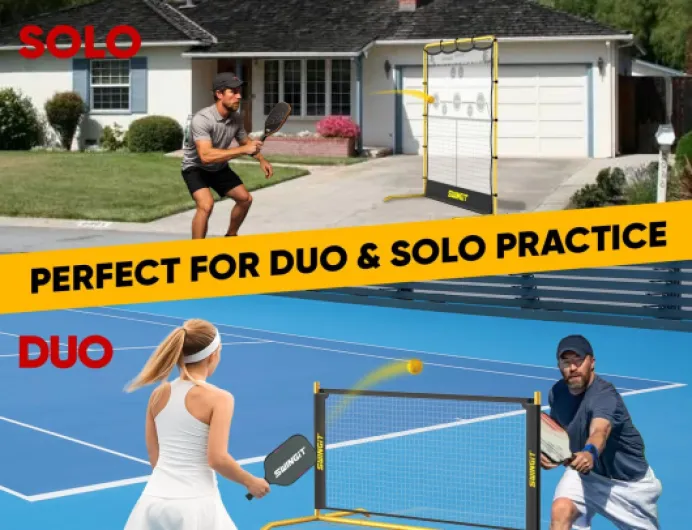
- 2-in-1 design works as both a solo rebounder and a mini practice net
- Sturdy metal frame with decent bungees and weather-resistant netting
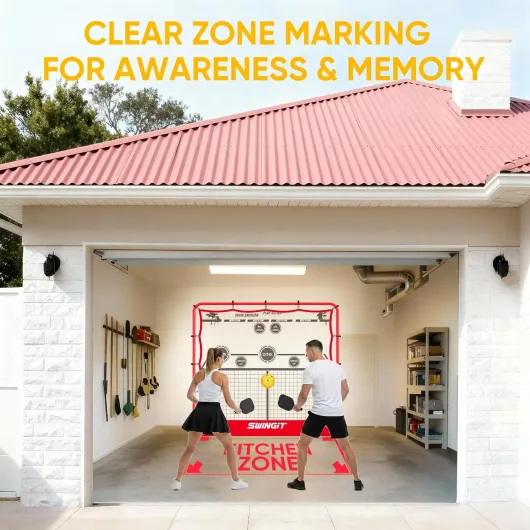
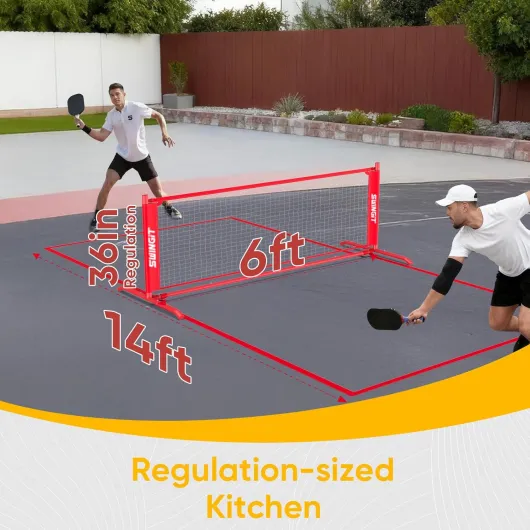
- Kitchen line system helps with accuracy and depth control in the non-volley zone
Cons
- Setup and mode switching take several minutes, not the advertised 60 seconds
- Can shift slightly on very smooth surfaces with harder hits
- Not ideal if you hate assembling gear or only practice very occasionally

Specifications
View full product page →| Brand | SwingIt |
A backyard solution when you can't find a partner
I picked up this SwingIt Portable Pickleball Rebounder Net for one simple reason: I was tired of hunting for a practice partner every time I wanted to work on dinks and volleys. Courts near me are often packed, and I don’t always have a full hour to spare, so I wanted something I could throw up in the driveway or garage and just hit balls for 20–30 minutes. I’ve used a couple of cheaper rebounders before (more like basic tennis trainers), and they were either too flimsy or the bounce was weird and unrealistic. So I went into this one a bit skeptical but curious.
Over a couple of weeks, I used it mostly in my driveway and once in the garage when it rained. I focused on three things: dinks at the kitchen line, quick volleys from a step or two back, and some basic forehand/backhand drives. I’m not a pro, just a regular player who plays a few times a week, so I’m looking for gear that is simple, holds up, and actually helps my consistency. No technical coaching features here, just a net and a rebound.
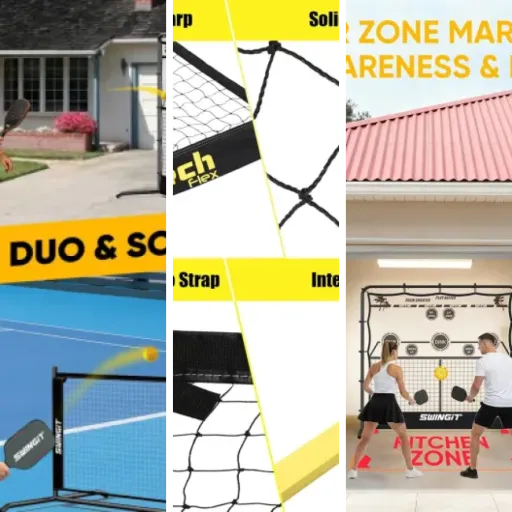
What stood out right away is that it’s a 6 ft by 6 ft setup, which is big enough that you’re not constantly missing the net, but not so huge that it takes over your whole space. The fact it doubles as a mini-net is what sold me on the listing. In theory, that means I can use it solo most of the time, then flip it to mini-net mode when a friend comes over for dink drills. I was curious if that “2-in-1” thing was just marketing or if it’s actually practical to switch between modes without a headache.
Overall, after using it several sessions, I’d say it’s a pretty solid training tool if your expectations are realistic. It’s not perfect, there are a couple of minor annoyances, and it’s not going to magically fix your technique. But if you want a simple way to get more touches on the ball at home without chasing it all over the place, this gets the job done reasonably well. I’ll get into the details on build, performance, and value below, but that’s the basic context of how I used it.
Value: what you get for the money
On value, I’d say this sits in the “good for the price” category, especially considering the 2-in-1 design. You’re getting a rebounder for solo work plus a mini practice net for partner drills, along with the kitchen lines and a bag. If you tried to buy a separate rebounder and a separate mini pickleball net of similar size and quality, you’d likely spend more overall and have more gear to store. So from a purely practical standpoint, the combo makes sense.
It’s rated around 4.6/5 stars on Amazon with over 100 reviews, and that lines up with my experience. It’s not perfect, but it’s very usable. The main value is simply being able to train whenever you want, without relying on partner schedules or court availability. For me, being able to walk outside, hit against this for 20 minutes before heading to real courts, and show up already warmed up and dialed in is worth quite a bit. If you’re serious about improving, those extra touches on the ball add up.
On the downside, the "60-second setup" claim is a bit generous, and switching between rebounder and mini-net mode is not instant. If you’re the type who hates assembling anything, you might find that part slightly annoying. Also, it’s not the cheapest thing on the market, and there are basic nets or DIY wall options that cost less. But those usually lack the consistent rebound and the dedicated kitchen line system, and often feel flimsier.
Overall, I’d rate the value as above average. It’s good value for money if you’ll actually use it a few times a week. If it’s just going to sit in the garage collecting dust, obviously nothing is worth it. But for regular players who want a reliable home trainer without spending a fortune, this hits a nice middle ground between price and usefulness.
Design: practical, not pretty, but it works
Design-wise, this thing is built for function, not looks. The 6 ft by 6 ft square footprint is a sweet spot: big enough to catch most shots but small enough to fit in a standard driveway or garage without hogging the entire space. The red color is easy to see, which I actually liked when hitting in lower light. It’s not subtle, but for a training tool, that’s fine. The main idea is simple: a tight rebound surface that sends the ball back with a realistic bounce, and a frame that doesn’t wobble every time you hit it.
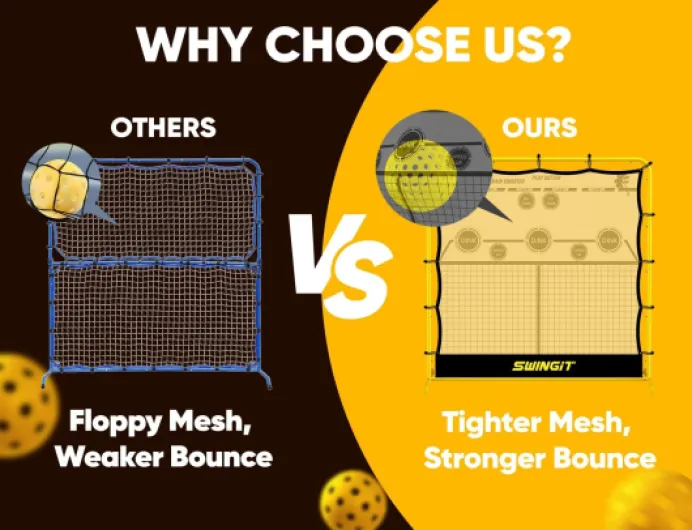
The frame connects with a quick-lock system and bungee cords that keep the net under tension. The bungee setup is important because that’s what gives you a consistent rebound. Compared to a random wall or a cheap, saggy net, this feels more predictable. It’s not as rigid as a solid wall, obviously, but for pickleball, that’s not a bad thing. You get a bit of give, which makes the rebounds feel closer to what you see off a real opponent’s paddle rather than a brick wall.
Switching between rebounder mode and mini-net mode is where the design is both smart and a little annoying. It’s nice that one frame can do both jobs, but it’s not like flipping a switch. You do have to reconfigure some parts and swap the net. The more you do it, the faster it gets, but if you think you’ll be changing modes every single session, keep in mind it’s a small project each time, not a 30-second swap. I ended up leaving it as a rebounder most of the time and only changing to mini-net when I knew I had a full session with a partner.
Overall, I’d call the design practical and user-friendly enough, with a slight learning curve the first couple of assemblies. It’s not the sleekest thing, but it’s stable, visible, and the layout makes sense. The dual-purpose concept is genuinely useful, as long as you’re okay with a bit of setup time when switching modes.
Materials and build quality: solid enough for regular use
The materials are pretty much what you’d expect at this price point: iron metal frame, polyester netting, and Oxford cloth for the bag and some of the net edging. The frame is powder-coated steel, which helps with rust resistance. It’s not super heavy industrial steel, but at around 4.8 kg (about 10–11 lbs) for the whole setup, it strikes a balance between being light enough to move and heavy enough to stay put while you’re hitting. In my driveway, it didn’t slide around unless I really smacked the ball hard from close range.
The net itself feels decently tough. The high-tension surface is created by those reinforced bungee cord connections all around the frame. The bungees are actually one of the better parts of the build. They’re thick enough that they don’t feel like they’ll snap after a few sessions, and they keep the net fairly tight and consistent. I’ve used cheaper rebounders where the bungees loosened quickly or started fraying after a week; I didn’t see that here in the first couple of weeks of use.
The weather-resistant netting claim seems reasonable. I left it outside for a few hours in light wind and sun, and nothing sagged or warped. I wouldn’t personally leave it out full-time in heavy rain or blazing sun for weeks; it’s still fabric and bungees. But for normal backyard use and occasional drizzle, it looks like it will hold up fine. The included carry bag is Oxford cloth, nothing fancy, but it’s thick enough that it doesn’t feel like it’ll rip the second you toss the frame in.
In short, the materials feel good enough for regular backyard or driveway practice, maybe not bulletproof for hardcore commercial use. If you’re planning to assemble it, leave it set up in a garage or on a patio, and use it a few times a week, I think it’s well matched to that use case. If you abuse it, throw it around, or leave it in bad weather constantly, you’ll probably shorten its life, but that’s true for most gear in this category.
Durability and stability after repeated sessions
In terms of durability, after several sessions the frame stayed stable, and nothing felt like it was loosening up or bending. The joints didn’t wobble more over time, and the quick-lock connections still clicked in firmly. With some cheaper nets, you start to see little gaps or misalignments after a few assembles and disassembles; I didn’t notice that here yet. The powder coating on the metal also helps prevent scratches from turning into rust spots right away.
The bungee cords and netting are usually the weak points on these types of products. So far, the bungees haven’t stretched out badly or lost tension. They still hold the net tight enough to give a consistent bounce. I didn’t see fraying or tearing at the corners, which is where stress usually shows first. The stitching around the edges of the net looks decent—not high-end, but not sloppy either. If you’re not abusing it, I’d expect it to last at least a few seasons of casual use.
Stability-wise, the 10 lb total weight helps. It’s light enough to move, but it doesn’t skate across smooth concrete unless you really hammer it. I used it on a slightly rough driveway and it stayed put. On a slick garage floor, it shifted a tiny bit with harder hits, but nothing dramatic. If you’re super picky, you could always weigh the base down with small sandbags, but I didn’t feel like it was necessary for normal practice.
For outdoor durability, I’d still recommend storing it in the carry bag or at least in a garage when you’re done. The materials can handle occasional weather, but constant sun and rain will eventually eat any net and bungees. Used like a normal person—set up for a session, then put away or park it in the garage—I think the durability is pretty solid for the price. Not indestructible, but reliable enough that you’re not babying it every time you use it.
Performance: how it actually plays for dinks, volleys and drives
On performance, the rebound is the main thing I cared about, and it’s honestly pretty decent. When you hit a normal dink or controlled volley, the ball comes back in a predictable way. It’s not identical to a live opponent, obviously, but you get a realistic enough bounce to work on timing, paddle angle, and footwork. I could stand at the kitchen line marker, dink to the net, and get a return that forced me to stay low and controlled. That’s exactly what I wanted for solo drilling at home.
For volleys and drives, if you hit with a firm stroke from a few feet back, the net responds well. The tighter tension means the ball doesn’t just die; it comes back with some speed, so you can practice quick reaction volleys. If you stand too far back and try to smash, it’s not going to send rockets back at you like a wall would, but for realistic pickleball pace, it’s good. I liked using it for quick backhand volleys and transition zone work, just shuffling side to side and reacting to the rebound.
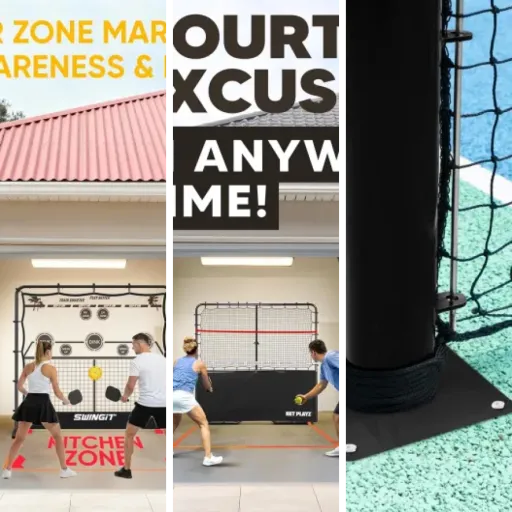
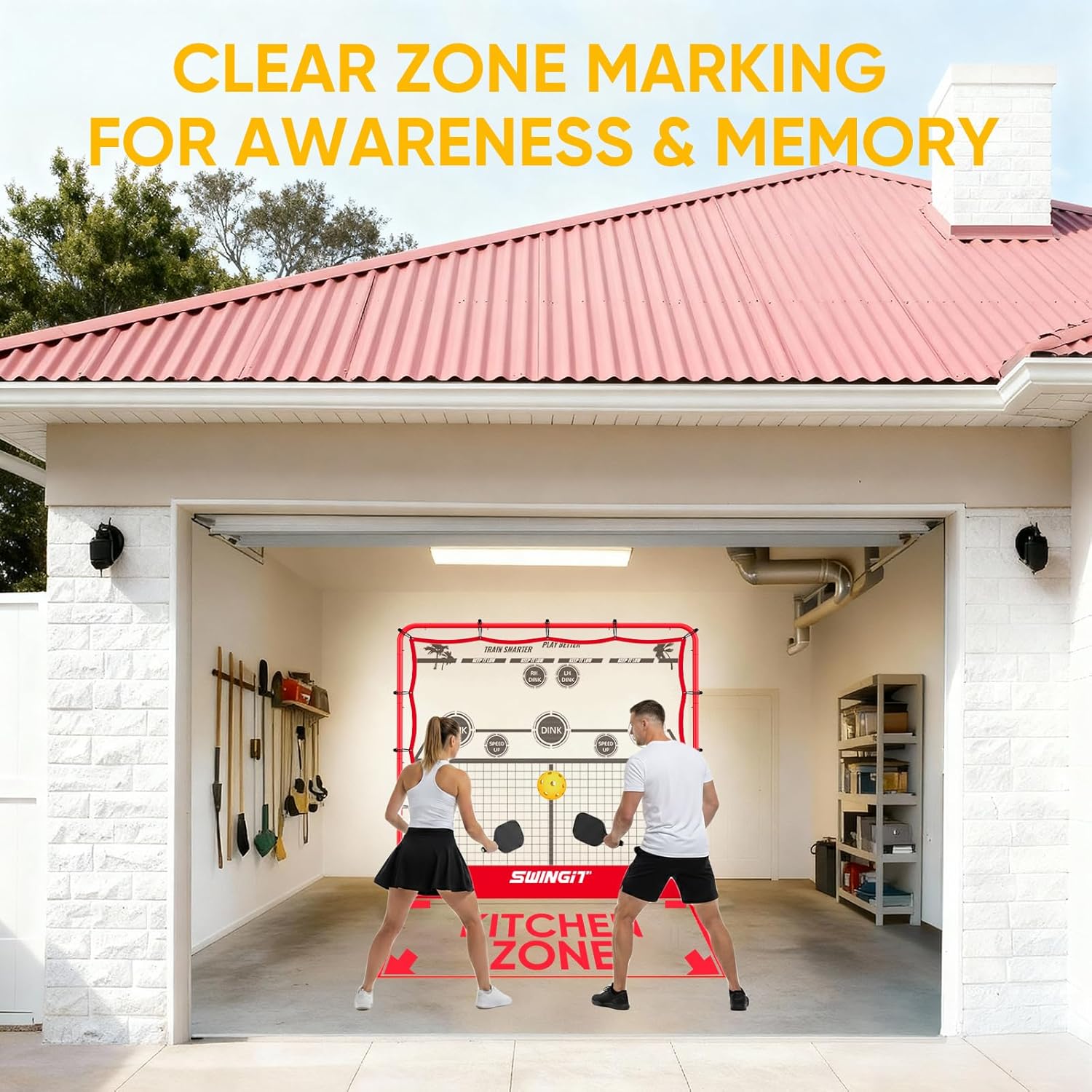
The kitchen line system on the ground is more useful than I expected. You can clearly see if your dinks are landing short where they should or drifting too deep. It’s not electronic or anything, just lines, but visually it makes you more honest about your placement. I caught myself sending a lot of balls deeper than I wanted on the first couple of sessions, and after a while I started dialing it in. That’s the kind of feedback I want from a simple trainer like this.
The only performance downside is that if you hit very soft, especially from too far back, the ball may not come back far enough, so you end up taking a step forward to reach it. That’s not necessarily bad—forces you to move—but if you’re expecting a super bouncy trampoline effect, that’s not what this is. It’s more controlled and closer to game pace. Overall, for solo practice of dinks, volleys, and moderate drives, it does its job well enough to justify the space it takes.
What you actually get out of the box
Out of the box, the SwingIt rebounder is pretty straightforward. You get: the all-metal frame pieces, the 6x6 ft rebounder net, the mini practice net (also 6 ft wide but set up at pickleball net height), a basic kitchen lines system, and a carry bag. No tools are needed, and all the frame parts are labeled, which sounds trivial, but it really helps when you’re trying to figure it out the first time. I laid all the pieces out, matched the numbers, and it went together without much head-scratching.
The brand claims "60-second setup" which, let’s be honest, is optimistic unless you’re doing it every day and know the pieces by heart. My first assembly to full rebounder mode took around 15–20 minutes, taking my time and double-checking the instructions. After that, taking it down and putting it back up is faster, but it’s still more in the 5–10 minute range, not one minute. So if you’re expecting something you pop up in literally a minute, that’s not it, but it’s still fairly quick for this kind of frame.
The kitchen line system is basically a visual aid you lay on the ground in front of the net so you can judge where your dinks are landing. It’s not high-tech at all, just a simple way to mark a non-volley zone. It’s handy if you’re working on keeping the ball short and controlled, but don’t expect some fancy training mat or anything. For me, it was enough: I could see immediately if I was leaving balls too deep, which is honestly what I needed.
So in terms of what you actually get: two usable training setups in one package, plus the line markers and a bag. No extras like balls or paddles, obviously, but that’s fine. Everything you need for the structure itself is there and clearly labeled. It feels thought-through, not like a random pile of parts. Not super premium, but decent and functional for home practice.
Pros
- Consistent, realistic rebound for dinks, volleys, and moderate drives
- 2-in-1 design works as both a solo rebounder and a mini practice net
- Sturdy metal frame with decent bungees and weather-resistant netting
- Kitchen line system helps with accuracy and depth control in the non-volley zone
Cons
- Setup and mode switching take several minutes, not the advertised 60 seconds
- Can shift slightly on very smooth surfaces with harder hits
- Not ideal if you hate assembling gear or only practice very occasionally
Conclusion
Editor's rating
If you’re looking for a straightforward way to practice pickleball at home without relying on a partner, the SwingIt Portable Pickleball Rebounder Net does a pretty good job. The rebound is consistent, the 6x6 ft size is forgiving, and the kitchen line markers actually help you see if your dinks are landing where they should. It’s not some fancy training system, but it gives you what you need: a stable target that sends the ball back in a realistic way so you can work on timing, control, and accuracy.
The 2-in-1 setup (rebounder plus mini-net) adds real value, especially if you occasionally drill with a friend. Just be aware that switching modes takes a few minutes and a bit of effort, so it’s not something you’ll want to do five times a day. Build quality is pretty solid for home use—metal frame, decent bungees, weather-resistant netting—and the whole thing is light enough to move but heavy enough not to dance around with every shot. For the price, and given the 4.6/5 average rating, I think it’s fairly priced for what it offers.
Who is it for? Players who actually want to put in solo practice in a driveway, backyard, or garage and don’t mind a short setup routine. Who should skip it? If you hate assembling gear, have zero storage space, or only play casually once a month, you’re probably better off just using the public courts or hitting against a wall. But if you’re trying to clean up your dinks and volleys and want a home setup that gets the job done without being overly complicated, this is a solid option.