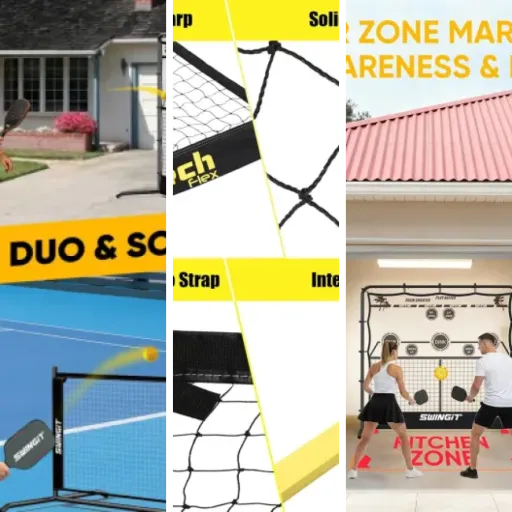
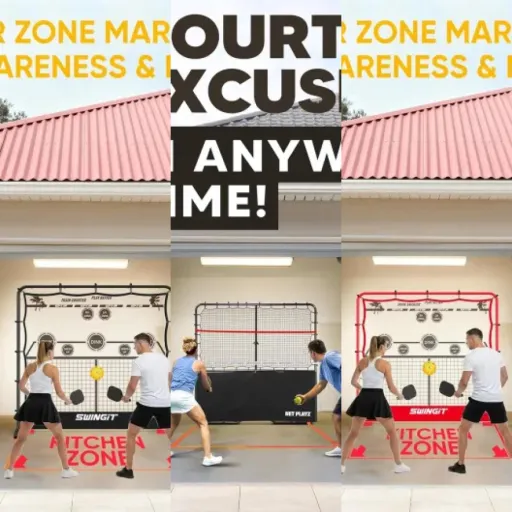
Summary
Editor's rating
Value for money: worth it if you’ll actually drill
Simple design that prioritizes function over looks
Materials feel decent for the price, not pro-grade but not flimsy
Sturdy enough for regular use, but protect it from the elements
How it actually performs for dinks, volleys, and drives
What you actually get in the box
Pros
- Large 6x6 ft rebounder with clear kitchen lines for realistic solo drills
- Includes a separate 6 ft mini net for partner play and warm-ups
- Sturdy metal frame with consistent bounce and easy, numbered assembly
Cons
- Bounce and tension aren’t perfectly uniform near the edges or on very hard drives
- Not ideal for permanent outdoor setup; better kept in a garage or indoors to avoid weather damage

Specifications
View full product page →| Brand | SwingIt |
A realistic way to practice when you can’t find a partner
I bought this SwingIt portable pickleball rebounder and mini net because I was tired of hunting for a practice partner every time I wanted to work on dinks and volleys. Courts near me are often packed, and I wanted something I could leave in the garage and roll out to the driveway. I’ve used it for a few weeks now, roughly 3–4 sessions per week, 30–45 minutes at a time.
The short version: it’s pretty solid for solo practice. It’s not perfect and it’s not some magic fix for your game, but it does what it says: you can stand in front of it and get a lot of controlled reps without needing another person. The rebound isn’t identical to a real opponent, but it’s close enough to work on timing, contact, and accuracy, especially for dinks, blocks, and simple drives.
What surprised me most is how stable it is for something that’s meant to be portable. I was expecting a flimsy frame that wobbles all over the place, but once it’s assembled and the bungees are tightened, it holds up fine in the driveway. I’ve hit it with some pretty firm drives and it hasn’t walked across the concrete or tipped over on me yet. For a 6 ft by 6 ft frame, the footprint is manageable, and it fits in my single-car garage against the wall without being in the way.
If you’re expecting a pro-grade coaching system with tons of adjustments and ultra-precise bounce, this isn’t that. It’s more of a practical, home-use trainer: decent build, clear kitchen lines, a fun target board, and a bonus mini net. For the price, and considering you also get the 6 ft mini net, I’d say it lands in the “good value if you’ll actually use it” category, especially if you’re newer to pickleball or just trying to get more reps between games.
Value for money: worth it if you’ll actually drill
From a value standpoint, this kit makes sense if you’re serious about getting more reps in. You’re not just paying for a single rebounder; you’re getting the 6x6 rebounder with printed kitchen lines plus a 6 ft mini net and a carry bag. When you compare that to buying a standalone rebounder and then a separate mini net, this bundle usually comes out cheaper or at least competitive, especially given the decent ratings it has (around 4.6/5 from other buyers).
Where the value really shows is in how often you use it. If this ends up collecting dust in your garage, then obviously it’s not a good buy. But if you’re like me and you actually set it up a few times a week for 20–30 minutes of focused practice, the cost per use drops quickly. For beginners and intermediate players, the ability to work on dinks, volleys, and drops without paying for court time or chasing partners is a big plus. It’s a straightforward way to actually practice the boring stuff that improves your game.
Could you just hit against a random wall for free? Sure, if you have a good wall nearby with the right surface and space. In my case, that wasn’t practical, and the wall doesn’t give you kitchen lines or a height reference. Compared to some other training gadgets that are basically just targets or plastic contraptions, this feels more useful because it simulates a basic court scenario and works for multiple sports (pickleball, tennis, even softball to some extent).
I wouldn’t say it’s cheap, but considering the all-metal frame, the size, and the extra mini net, I’d call it good value for money for a home trainer. There are more premium options out there, but they also cost more and usually don’t include a second net. If your goal is to have a reliable, practical tool to drill at home without going overboard on budget, this SwingIt kit sits in a pretty reasonable sweet spot.
Simple design that prioritizes function over looks
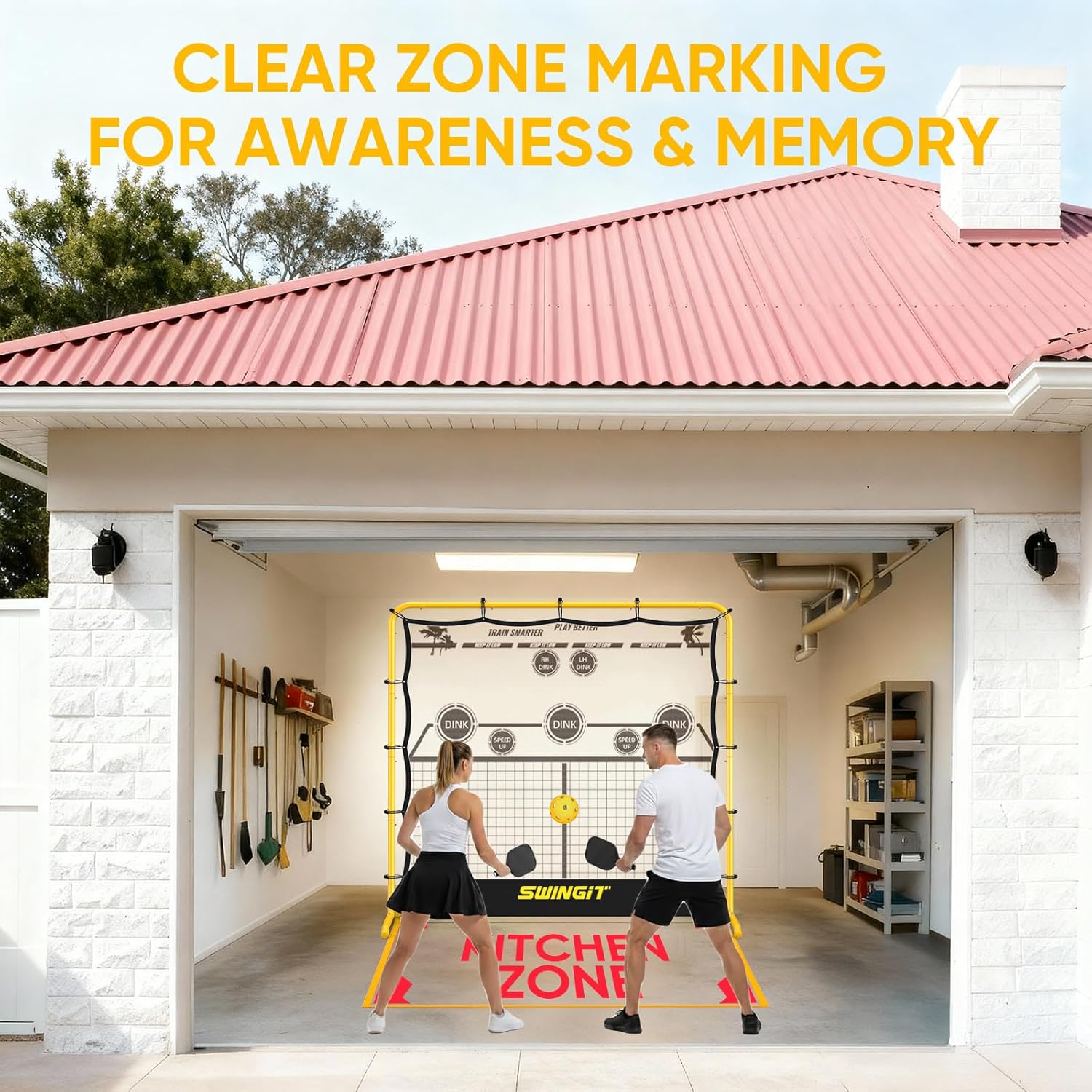
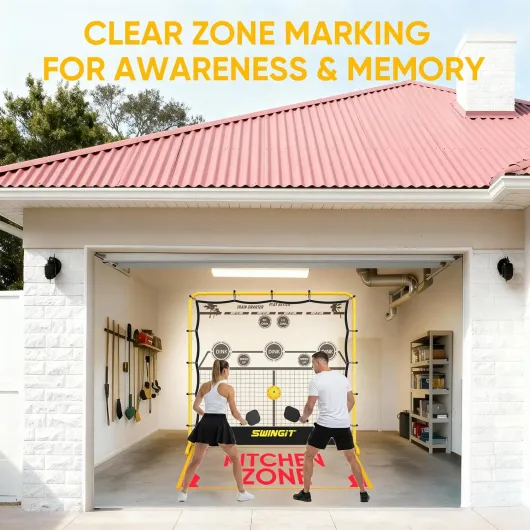
Design-wise, SwingIt kept things pretty straightforward. The rebounder is a 6 ft high by 6 ft wide square, so the hitting area feels generous. You don’t feel cramped like with some smaller rebounders where you’re constantly missing the edges. The kitchen line system is printed directly on the mesh, so you get a clear visual of where the no-volley zone would be on a real court. That actually helps more than I expected for controlling depth on dinks and drops.
The frame is a basic rectangular structure: iron metal tubes that slot together with push-buttons. No fancy joints or hinges, just simple connections. The yellow accents are there so you don’t trip over it as easily and you can see it at a glance in the driveway or yard. It’s not pretty, but it’s obvious where the hitting surface is, where the frame is, and where the kitchen starts. The scenic print on the net is mostly cosmetic, but it’s not distracting; once you start hitting, your eyes just focus on the ball and the kitchen lines.
One thing I like is the angle you naturally get from the rebounder. Because it’s a vertical surface, the ball comes back at a predictable angle if you hit the middle area. For dinks and controlled volleys, it behaves in a fairly consistent way. If you hit too low or too high, you’ll get some weird rebounds, which is honestly good feedback that your contact point or trajectory is off. So the design unintentionally punishes sloppy shots, which is useful for training.
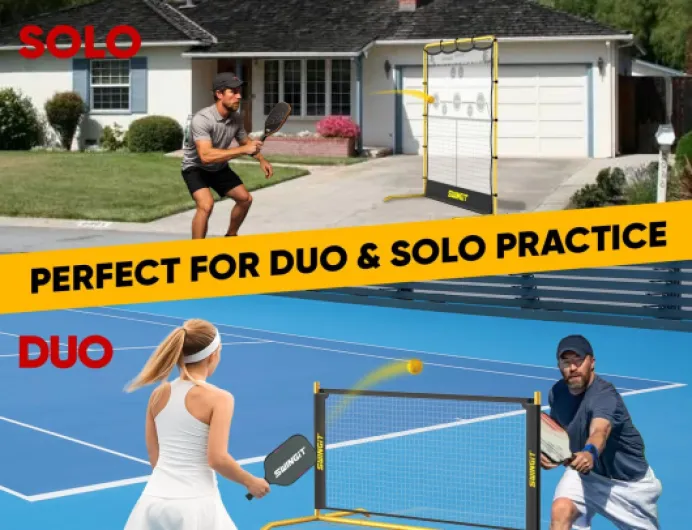
The 2-in-1 idea also makes sense: the rebounder for solo sessions, the mini net for when you have someone to hit with. The mini net being 6 ft wide means you’re not simulating a full court, but it’s enough for cross-court dink drills or mini games. If you’re limited on space, that smaller width is actually helpful. Overall, the design is practical: nothing fancy, but it focuses on giving you a big target, visible lines, and a compact width for tight spaces.
Materials feel decent for the price, not pro-grade but not flimsy
The frame is made of iron metal tubes, and you can feel the weight difference compared to super cheap aluminum or plastic setups. At around 10.5 pounds for the whole kit, it’s light enough to move but heavy enough that it doesn’t blow over from a light breeze. When I pick up the frame, it doesn’t flex or creak much, which gives a bit of confidence that it can handle regular use. Still, it’s not gym-grade steel or anything; if you abuse it or leave it in the rain constantly, it’ll probably show rust over time.
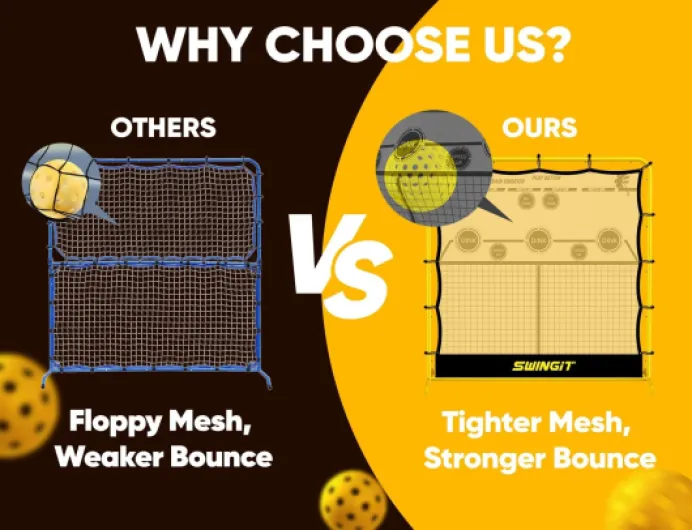
The netting is polyester, which is standard for this kind of product. The mesh on the rebounder is tighter and more reinforced than the mini net, which makes sense since it takes direct hits. The printed design and kitchen lines are sharp and easy to see, and after a few weeks of use, I haven’t seen any peeling or fading. The bungee cords feel decent: not super thick, but they hold tension well enough to give a good bounce. I’d expect the bungees to be the first thing to tire out over a long period, just because that’s typical, but so far they’re holding fine.
The mini net materials are a step down in terms of overall sturdiness compared to a full-size tournament net, but that’s expected. It’s more of a practice accessory than something you’d leave up permanently at a club. The poles are thinner, but as long as you’re not hanging on it or yanking it around, it does the job. The carry bag is basic but functional: simple fabric, zipper seems okay, straps are fine for short carries from car to driveway or yard.
Overall, I’d put the material quality at “good enough for regular home use.” It doesn’t feel like it’s going to fall apart in a month, but it also doesn’t feel like something you’d see in a pro training facility. For the price point and the fact you’re getting both a rebounder and a mini net, the materials are in line with expectations. Just don’t expect it to be indestructible, and try not to leave it fully exposed to weather all the time.
Sturdy enough for regular use, but protect it from the elements
After a few weeks of use, I’d say the durability is better than I expected for an Amazon training kit in this price range. The frame has stayed straight, no bending or warping, even after being moved around and bumped a few times. The joints still click together firmly; I haven’t had any pieces loosen up or start to wobble. The net hasn’t torn or stretched out noticeably, and the tension with the bungees is still pretty much the same as day one.
That said, I don’t leave it outside full-time. I keep the frame and rebounder net set up in the garage and just slide it out into the driveway when I want to use it. If you left it in the yard under sun and rain 24/7, I’m pretty sure the metal would start to show rust and the net would fade or weaken faster. The materials are decent but not built for harsh, constant exposure. So if you care about longevity, treat it like a piece of sports gear, not permanent outdoor furniture.
I’ve hit a lot of balls into it, including some mishits up near the top bar and near the sides, and nothing has snapped or come loose. The bungee cords are usually the weak point on these types of rebounders. So far, no fraying or loss of elasticity on mine, but if something is going to go first after a year or two, I’d bet it’s those. The good news is bungees are cheap to replace if needed, and you could probably find generic ones if SwingIt doesn’t sell spares.
For the mini net, the durability is “fine for casual use.” I wouldn’t sit on it or throw it around, but for normal play and storage in a garage, it should last a while. Overall, I’d rate durability as pretty solid for home use. There are definitely heavier, more rugged options out there for more money, but for a 2-in-1 kit at this price, it holds up well as long as you use common sense and don’t abuse it.
How it actually performs for dinks, volleys, and drives
In practice, the rebounder does what I needed: it lets me hit a lot of balls in a short time without chasing them all over the place. The bounce is fairly natural. If you hit a soft dink into the kitchen area, it comes back with a soft, short rebound that you can step into. If you drive the ball a bit harder from behind the kitchen line, it comes back with enough pace that you have to react, which is good for practicing blocks and quick volleys. It’s not identical to a real opponent, but it’s close enough that the timing and footwork carry over to the court.
The big plus is the consistency. Once you figure out where on the net to hit, you can get a pretty repeatable ball. That’s perfect for drilling things like forehand dinks, backhand dinks, and simple third shot drops. I’ve spent entire sessions just working on hitting specific printed zones, and it’s honestly more focused than some casual games on a real court. You can also work on both forehand and backhand volleys by standing closer and punching the ball into the net repeatedly, which is something I struggled to do efficiently without a wall or partner.
There are some limitations. If you try to rip really hard drives, the rebounder will return them, but you start to see more variation in the angle and depth. It’s still usable, but this setup shines more for controlled shots and medium-pace practice than for full-power drives. Also, if you hit too close to the edges, the bounce can get weird as the tension isn’t identical all the way around. It’s not a deal-breaker, but it reminds you this is a home trainer, not a perfectly tuned wall.
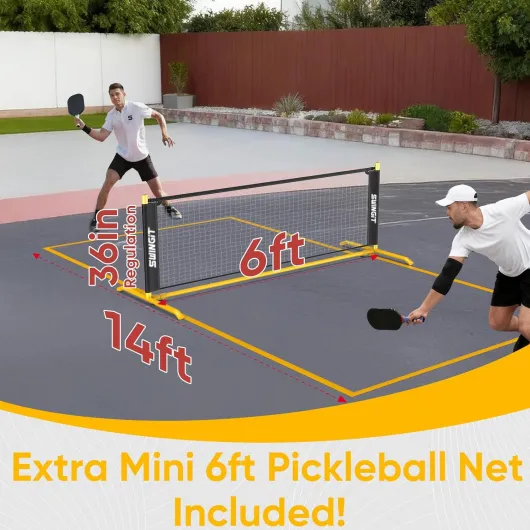
The mini net performs fine for what it is: a 6 ft wide, 34-inch-high little net that you can toss in the driveway. I’ve used it to warm up with a friend before heading to the courts and to do some skinny singles-style drills. It doesn’t sag badly, and the height feels correct. So between the rebounder and the mini net, you get a decent mix of solo and partner options. Overall, performance is solid: not mind-blowing, but it gets the job done and gives you a real way to practice specific shots at home.
What you actually get in the box
When you open the box, you’re basically getting a 2-in-1 setup: the big 6x6 ft rebounder system with the kitchen lines printed on the mesh, and a separate 6 ft wide mini pickleball net that sits at 34 inches high. There’s also a carry/handbag, all the metal frame pieces, the bungee cords for tension, and the netting. Everything is labeled under the SwingIt brand, even if it feels a bit like one of those Amazon-special training kits.
Assembly is pretty straightforward but you do need to pay attention the first time. The metal tubes are numbered, and if you take five minutes to lay them out and match the numbers, it goes together without much drama. For me, first assembly took around 20–25 minutes because I double-checked everything. Now that I know where each piece goes, I can break it down and rebuild it in closer to 10–15 minutes, though honestly I mostly leave the frame together and just move it in and out of the garage.
The rebounder side is a large mesh panel with a scenic print and clear kitchen zone lines. The targets aren’t fancy high-tech zones, just printed areas you can aim at. The bungees run around the perimeter to tension the net. The mini net is simpler: a basic frame and net, like a shrunken-down portable pickleball net. It’s fine for warm-ups, casual play in the driveway, or quick dink drills with a partner if you don’t want to set up a full-size court.
Overall, the kit feels like a home-training bundle: one big piece for solo practice, one mini net for two-player drills or light games. It’s not super compact once built, but everything technically fits into the included bag if you’re willing to disassemble. For someone who wants a flexible setup for driveway, backyard, or a park, this covers the basics without a bunch of extra gimmicks.
Pros
- Large 6x6 ft rebounder with clear kitchen lines for realistic solo drills
- Includes a separate 6 ft mini net for partner play and warm-ups
- Sturdy metal frame with consistent bounce and easy, numbered assembly
Cons
- Bounce and tension aren’t perfectly uniform near the edges or on very hard drives
- Not ideal for permanent outdoor setup; better kept in a garage or indoors to avoid weather damage
Conclusion
Editor's rating
Overall, the SwingIt Portable Pickleball Rebounder with Kitchen Lines plus the 6 ft mini net is a solid home training setup. It’s not fancy and it doesn’t try to be. You get a big, stable rebounder with a natural enough bounce to work on dinks, volleys, and medium-paced drives, and the printed kitchen lines actually help with depth control. The frame feels sturdy for the weight, and the polyester net holds up fine with regular use. The mini net is a nice bonus for partner drills or quick warm-ups in the driveway.
It’s best suited for beginners to solid intermediates who want to practice more but don’t always have a partner or easy court access. If you’re trying to clean up your soft game, third shot drops, and blocks, this is a practical tool. If you’re a high-level player looking for super realistic, high-pace rallies or a fully adjustable pro setup, you’ll probably find it a bit basic. Also, if you’re not the type to actually drill on your own, this will just take up space.
If you treat it as what it is—a home-use training aid with decent build quality and a fair price—it delivers. Use it indoors or in a garage when possible, don’t leave it baking in the sun 24/7, and it should last a good while. For the money, and especially with the 2-in-1 setup, I’d say it’s good value for players who are serious enough to put in the solo practice time but don’t want to spend a fortune on training gear.