Summary
Editor's rating
Good value if you already own a main paddle and actually drill
Skinny face, long handle: built to punish mishits
Light, easy to swing, but not the cushiest grip
Carbon fiber, 16 mm core: feels like a real paddle, just harsher on mistakes
Feels sturdy enough for regular drills, with no early red flags
Unforgiving but effective for consistency and sweet spot training
What this training paddle actually is (and isn’t)
Pros
- Narrow face and long handle clearly expose mishits and improve sweet spot discipline
- 16 mm core and carbon fiber face give a realistic feel close to regular paddles
- Lightweight and quick through the air, good for long drill sessions and hand-speed work
Cons
- Very niche design; not ideal as a primary game paddle for most players
- Stock grip is basic and may need an overgrip for better comfort and sweat management

Specifications
View full product page →| Brand | Qyntelix |
A training paddle that exposes your weak shots fast
I picked up this Qyntelix Pickleball Training Paddle because I wanted something that would force me to hit the sweet spot instead of getting away with sloppy contact. I’m an intermediate player, play a few times a week, and I’m trying to clean up my consistency at the kitchen line and on resets. I’ve used it for a couple of weeks in drills and warmups before rec games.
The first thing I noticed is how unforgiving it is when you miss the center. The hitting area is narrow on purpose, so if your timing or paddle angle is off, the ball dies or sprays. That sounds annoying, but it actually shows you very clearly where your technique is weak. After about three sessions, I could already tell I was focusing more on footwork and clean contact instead of just slapping at the ball.
I didn’t buy it for power or spin or any of that; it’s really just a training tool. If you treat it like a regular paddle, you’ll probably hate it, because you’re not getting the same sweet spot size or forgiveness. But for drills, wall practice, and warmups, it does what it says: it makes you more precise. I also like that it’s close in weight to a normal paddle, so switching back doesn’t feel weird.
It’s not perfect, and it’s basically a one-purpose item. If you’re on a tight budget and only want one paddle, this is not the one. But if you already have a main paddle and want something to sharpen your control and timing, it’s a pretty solid little tool that exposes your mistakes quickly and pushes you to clean them up.
Good value if you already own a main paddle and actually drill
On value, this paddle sits in a pretty reasonable spot. It’s not dirt cheap like the absolute entry-level paddles, but it’s also well below the high-end $200+ performance paddles. For a specialized training tool that uses a 16 mm core and carbon fiber face, the price feels fair. You’re basically paying for a focused practice aid rather than another full-featured match paddle.
The big question is whether it’s worth buying something this specific. If you only own one paddle and mostly just show up and play games, I’d say your money is better spent upgrading your main paddle first. This thing really pays off only if you’re willing to spend time drilling: dinks, resets, wall work, and accuracy drills. If that’s you, then it’s a good value because it gives you very clear feedback and should last long enough to justify the cost.
Compared to DIY solutions (like just putting tape on your paddle to mark a smaller target), this is obviously more expensive, but it feels more realistic because the whole face is actually narrower. You’re forced to be precise, not just aim at a zone on a big face. Also, since the weight and materials are similar to a regular paddle, the reps carry over better to real play. That, for me, is where the value really is.
I’d call it a good purchase for intermediate players who are serious about improving consistency and already have a primary paddle they like. It’s not some miracle gadget, and there are probably slightly cheaper training paddles out there, but this one does its job well enough that I don’t feel like I overpaid. If you buy it and let it sit in your bag, it’s a waste. If you actually use it weekly, the cost per session ends up pretty low, and it becomes a solid value overall.
Skinny face, long handle: built to punish mishits
The design is very straightforward: a long, narrow paddle face and an extra-long handle. The whole point is that the hitting area lines up with where the sweet spot would be on a normal paddle, but everything around it is basically gone. So visually, it looks like someone took a standard paddle and trimmed off the sides. When you first see it, it almost looks like a junior tennis racquet head, just rectangular.
The elongated handle is actually one of the things I liked. It feels closer to a tennis grip, and if you come from tennis or like to use two hands on your backhand, this shape makes sense. You can slide your hand up or down easily and try different grips. For drills, I found it comfortable to choke up for quick kitchen exchanges and slide down for deeper drives or serves. The handle length also keeps the sweet spot in the same relative place as on a normal paddle, which is key for realistic training.
Balance-wise, the paddle doesn’t feel head-heavy or awkward. The 7.7-ounce weight is manageable, and because the face is narrow, it actually feels quick through the air. That’s good for hand-speed drills and kitchen firefights. The downside is that if your timing is off by even a little, you just flat-out miss the ball, especially early on. The design is intentionally unforgiving, which is the whole point, but it can be frustrating at first.
From a usability standpoint, the design makes sense if you’re serious about drilling. For casual open play, I wouldn’t use it; the narrow face just makes life harder for no reason. But for targeted practice, the long handle + skinny face combo is effective. It forces disciplined swing paths and better eye contact with the ball. Just know that the design is niche on purpose: this is a training stick, not a do-everything paddle.
Light, easy to swing, but not the cushiest grip
In terms of comfort, the first thing that stands out is the weight. At around 7.7 ounces, it sits in that comfortable zone where your arm doesn’t feel beat up after a long drill session. I did a couple of 45-minute dink and reset drills with just this paddle and didn’t get any real forearm fatigue. The narrow face also cuts through the air easily, so you don’t feel like you’re muscling it around on fast exchanges.
The 16 mm core helps with vibration. When you hit the sweet spot, there’s a solid but not harsh feel in the hand. Mishits, of course, feel worse, but that’s partly the point of this thing. Compared to some cheaper paddles I’ve tried, the shock on mishits is noticeable but not painful. I didn’t have any wrist or elbow soreness afterward, and I’m usually pretty sensitive to that kind of thing with stiffer paddles.
The grip is where I’d say it’s “good enough” but not great. The 4 1/4" circumference is pretty standard, and most players will be fine with it. The stock grip has decent tack, but it’s on the thinner, basic side. After a few sweaty sessions, I found myself thinking I’d probably just throw an overgrip on it to improve cushioning and sweat absorption. Nothing wrong with it, just nothing special. The handle length, though, is nice if you like to adjust your hand position or use two hands.
Overall, comfort is solid for a training paddle. You can use it for longer drills without your arm hating you, and the feel is close enough to a regular paddle that the transition is smooth. If you’re super picky about grips, plan on adding an overgrip, but that’s a cheap and easy fix. For most intermediate players, it’s comfortable enough to use regularly without thinking about it too much.
Carbon fiber, 16 mm core: feels like a real paddle, just harsher on mistakes
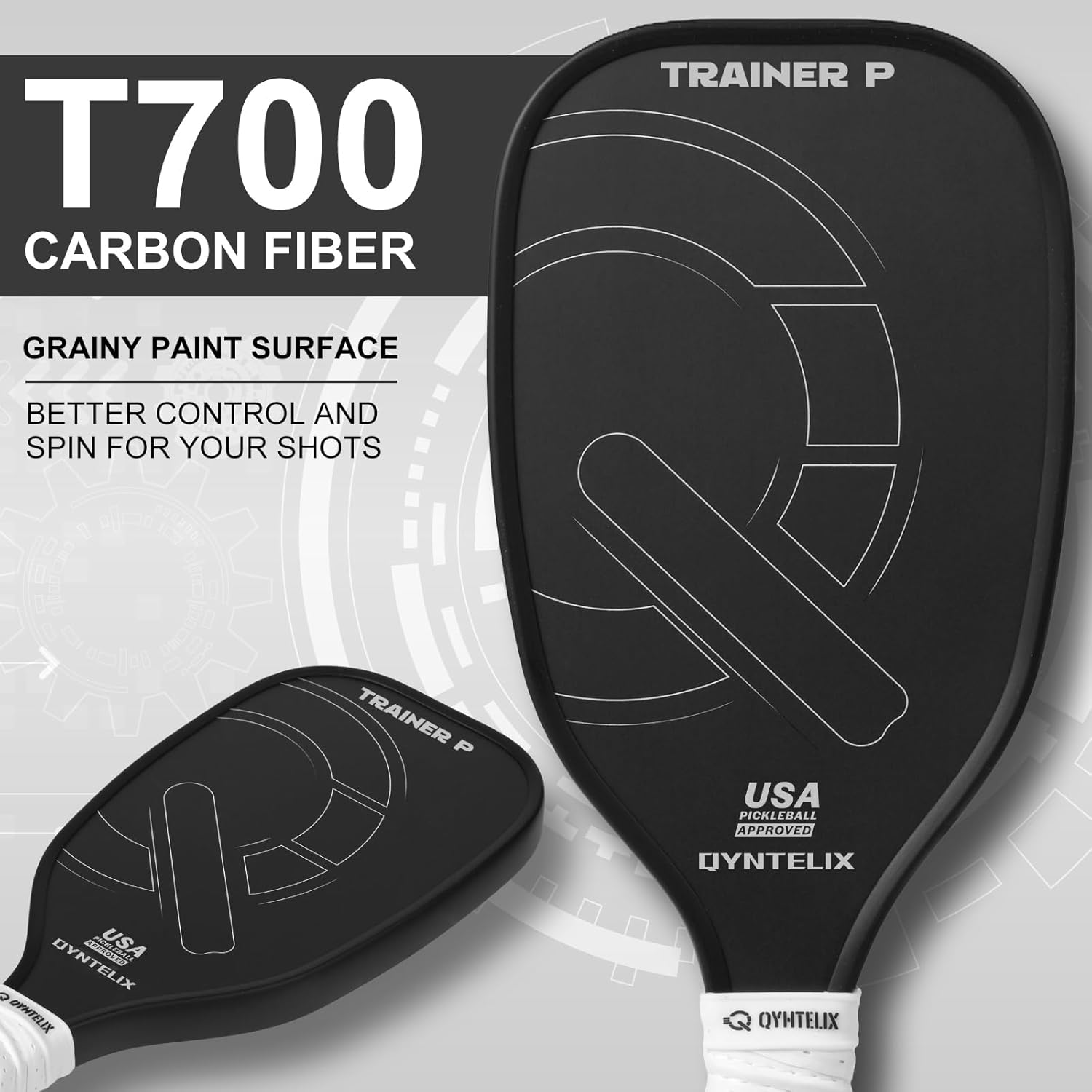
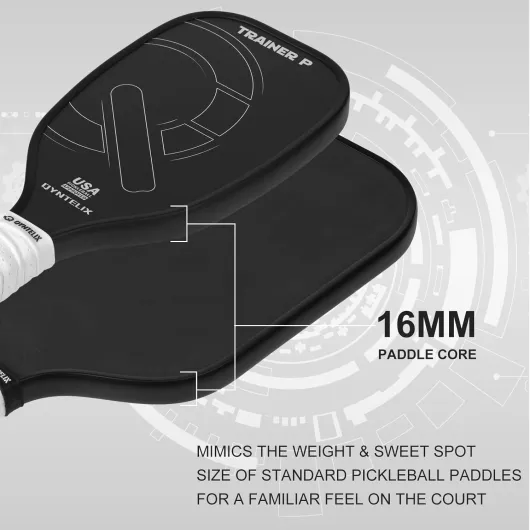
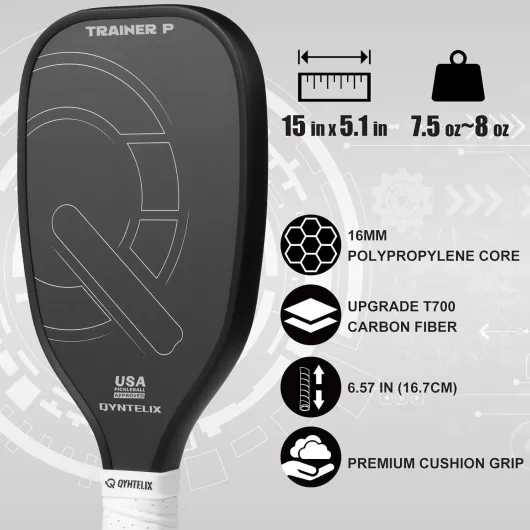
Material-wise, Qyntelix didn’t cheap out too much. You get a 16 mm polypropylene honeycomb core and a T700 raw carbon fiber face with a textured particle paint coating. That combo is pretty standard for mid-range carbon paddles now, so the feel is relatively close to what many people are already using on court. It’s not some flimsy plastic training toy; it feels like an actual paddle in your hand.
The 16 mm core is a good call. It gives it a slightly softer, more controlled feel compared to thin 13 mm cores, and it helps keep the weight in a normal range. When you make clean contact in the center, you get a familiar pop and feedback, very similar to a full-size carbon paddle. When you miss the middle, though, the material plus the narrow face combine to give you instant feedback: the ball either dies or comes off with a weird sound and less control.
The carbon fiber + particle paint surface has decent grit. It’s not the roughest thing I’ve ever felt, but it’s enough to grab the ball for spin during drills. I wouldn’t buy this specifically for spin, but if you’re practicing topspin rolls, slices, or heavy dink spin, it behaves close enough to a normal paddle that the reps still translate. The surface also hasn’t worn down noticeably in the short time I’ve used it, which is a good sign for durability.
Overall, the materials make it feel like a legit piece of gear instead of some gimmick. The build doesn’t scream premium, but it’s solid enough for regular practice. If you’ve used cheap entry-level paddles before, you’ll notice this one feels more stable and less tinny. There are fancier brands out there with better finishing, but for a training tool at this price, the material choice is sensible and gets the job done.
Feels sturdy enough for regular drills, with no early red flags
Durability is always a bit hard to judge in a short testing window, but I can at least talk about how it’s holding up so far and what I see in the build. After a couple of weeks of use—mostly drills, some wall work, and a few warmup sessions—the paddle shows minimal wear. The edge, which is usually where cheaper paddles start to chip or fray, still looks clean. I’ve had a few accidental taps on the court and net post, and nothing has cracked or loosened.
The carbon fiber face and particle paint surface haven’t peeled or smoothed out noticeably yet. The grit is still there and still grabs the ball fine. I’ve used some budget paddles where the texture basically disappears after a handful of sessions; that’s not happening here, at least not this early. The core also feels consistent—no dead spots or weird buzzing sounds, which can happen if the internal honeycomb starts to separate.
The handle and grip attachment are usually weak spots on cheaper gear, but on this one, the handle feels solid. No twisting, no creaking, and the grip wrap hasn’t started to unravel. The stock grip will probably wear smooth over time, like most grips, but that’s an easy and cheap replacement. Given the price and the fact it’s a training paddle, I’m not expecting tank-level construction, but so far it feels reliable for regular use.
Based on the build quality and early signs, I’d say it’s durable enough for an intermediate player who drills a few times a week. If you’re a heavy hitter who abuses paddles or tosses them around, you might eventually see more wear, but for normal practice use, it seems to hold up. I haven’t seen anything that makes me think it’ll fall apart quickly, which is about all I realistically expect at this price point.
Unforgiving but effective for consistency and sweet spot training
Performance-wise, you have to judge this paddle by what it’s designed to do: train precision, not win you rec games. On that front, it works. The skinny face instantly exposes lazy footwork, late contact, and sloppy paddle paths. When I first used it for dinking at the kitchen, I was spraying balls off the edge whenever I got lazy with my feet or tried to reach instead of moving. After a few sessions, I noticed I was naturally setting up earlier and watching the ball into the center of the paddle more carefully.
On resets and soft blocks from the transition zone, the 16 mm core and carbon face give a realistic feel. If you soften your hands properly and meet the ball in front, the resets land in the kitchen like they should. If you’re stiff or off-center, the ball either pops up or dies. It’s a pretty clear feedback loop: good technique = playable ball, bad technique = obvious miss. That’s exactly what you want in a training tool. I also used it for wall drills, and the narrow face made those sessions more demanding, which translated pretty well when I switched back to my normal paddle.
Power is fine but not really the focus. You can still drive and serve with it, and the weight plus carbon face give enough pop that it doesn’t feel dead. But because the face is so narrow, you’re not going to feel as confident ripping big drives in games unless you’re very dialed in. Spin is decent thanks to the textured surface, so if you’re working on roll volleys or spin serves, the reps feel realistic enough.
Where it really shines is as a warmup and drill paddle. I started using it for 5–10 minutes before games, especially for dinks and quick volley exchanges. When I then switched to my normal paddle, everything felt bigger and more forgiving, and I noticed fewer off-the-edge mishits. It’s not magic, but if you stick with it, it can clean up your consistency. Just don’t expect it to suddenly fix your technique without focused practice; it just makes your bad habits more obvious.
What this training paddle actually is (and isn’t)
The Qyntelix training paddle is basically a skinny, sweet-spot-focused version of a regular pickleball paddle. It’s USAPA approved, but realistically you’re buying it as a trainer, not as your main match paddle. The main idea is simple: shrink the usable face so that when you switch back to a normal paddle, everything feels easier and more forgiving. Think of it like a weighted donut on a baseball bat, but for precision instead of strength.
On paper, it has a 16 mm polypropylene honeycomb core, T700 carbon fiber face with a gritty, particle paint coating, and an elongated handle. The dimensions listed are about 38.1 cm long by 13 cm wide, so it’s much narrower than a standard paddle face. The weight is around 7.7 ounces, so it falls in that light-to-mid range where most rec players are comfortable. Grip size is 4 1/4 inches, which should work for most adults unless you have really small or really large hands.
Out of the box, it’s pretty straightforward: you get one paddle, no fancy case, no extras (despite some reviews mentioning practice balls; mine didn’t come with any). The branding is low-key; this isn’t one of those loud, flashy paddles. It looks like a serious tool, not a toy, which I actually prefer. It’s clearly built around function: long handle, skinny face, textured surface.
In practice, you quickly realize this is not a multi-role paddle. It’s not something you’ll enjoy in full-on matches unless you’re very advanced or just messing around. It shines in drills: dinking, resets, wall work, and serve/return accuracy. If you go in expecting a training aid instead of a magic fix, the product makes sense. It’s a simple idea that, if you actually use it regularly, can expose bad habits and help you tighten up your game.
Pros
- Narrow face and long handle clearly expose mishits and improve sweet spot discipline
- 16 mm core and carbon fiber face give a realistic feel close to regular paddles
- Lightweight and quick through the air, good for long drill sessions and hand-speed work
Cons
- Very niche design; not ideal as a primary game paddle for most players
- Stock grip is basic and may need an overgrip for better comfort and sweat management
Conclusion
Editor's rating
Overall, the Qyntelix Pickleball Training Paddle is a simple, focused tool that does what it’s supposed to do: punish bad contact and force you to clean up your technique. The skinny face, 16 mm core, and carbon fiber surface combine to give you a feel that’s close to a real paddle, just far less forgiving. If you’re an intermediate player who drills regularly and wants to sharpen dinks, resets, and hand speed, it’s a pretty solid addition to your bag.
It’s not perfect. The grip is basic, the design is very niche, and it’s not a paddle you’ll want to use for every game. If you only want one paddle or you rarely practice outside of rec play, this will probably feel like an unnecessary extra. But if you already have a main paddle and you’re actively working on your consistency, this trainer gives you clear feedback without feeling like a toy. For the price, materials, and performance as a training aid, I think it’s a good buy for serious improvers and probably overkill for casual players.