Summary
Editor's rating
Is it worth the money for an intermediate player?
Elongated shape, bigger reach, a bit of an adjustment
Grip, balance, and fatigue over long sessions
Carbon fiber face and foam perimeter: how it actually feels
Build quality and early wear after a few weeks
Control first, power second – how it actually plays
What you actually get out of the box
Pros
- Very good control and touch on dinks, drops, and resets
- Grippy carbon face gives noticeable spin on serves and groundstrokes
- Comfortable grip and reduced vibration, easier on the arm
- Elongated shape adds useful reach and a large feeling sweet spot
Cons
- High price compared to decent mid-range paddles
- Less free power than some power-focused paddles; you have to swing for pace
- Small adjustment period if you’re coming from a standard, non-elongated shape

Specifications
View full product page →| Brand | Selkirk Sport |
A control paddle that actually feels different
I’ve been playing pickleball regularly for a bit more than a year, mostly 3.0–3.5 level rec games, and I picked up the 2024 Selkirk LUXX Control Invikta because I wanted more control and spin than my cheap composite paddle was giving me. I’m not sponsored, I paid for it myself, and I’ve used it for about three weeks, roughly 15–20 sessions. So this is not a “hit five balls and review” situation. I’ve used it in open play, a local ladder league, and a small weekend round robin.
My first impression: this paddle is clearly tuned for touch. The face feels a bit softer than a lot of power paddles I’ve tried from friends, and the longer shape takes a couple of games to get used to. Once I adjusted, my dinks and resets got more consistent, but my lazy drives lost a bit of free power compared to my previous, slightly heavier paddle. You can still hit hard, you just have to swing with intention instead of relying on trampoline effect.
What surprised me most is how big the usable sweet spot feels. On my old mid-range paddle, anything off-center felt dead and the ball dropped short. With the LUXX Control, mishits are still not great, but they stay in play more often. That alone probably saved me several points per night. My soft hands are not amazing, but this paddle definitely forgives me more than cheaper options.
It’s not perfect, though. The price is high, and if you’re more of a banger who just loves to crush from the baseline, you might feel like you’re paying extra for control you don’t really use. Also, coming from a standard shape to the elongated Invikta, I did clip the edge on a few quick hand battles at the kitchen for the first couple of sessions. Once the muscle memory settled, that went away, but there is a small adjustment period. Overall, it feels like a serious paddle for people who actually care about placement, not just swinging as hard as possible.
Is it worth the money for an intermediate player?
Let’s talk price, because that’s the part that stings a bit. The LUXX Control line sits in the higher bracket. It’s definitely not a budget paddle, and you can find plenty of decent options for less. I bought mine on Amazon where it was a bit cheaper than local shops, but it was still a noticeable jump from my previous mid-range stick. So the real question is: does it play enough better to justify the extra cash?
For me, as a mid-level player who’s starting to care about consistency and spin, the answer is mostly yes. My control on dinks, drops, and resets improved, and I’m making fewer stupid errors from balls flying long. The spin boost is real, and the comfort on my arm is better. Those are things I actually notice in games, not just on paper. If you’re playing regularly and trying to clean up your soft game, it feels like money that actually buys you something.
On the downside, if you’re more of a beginner or a casual once-a-week player, this is probably overkill. You won’t fully use what you’re paying for, and a cheaper composite or entry-level carbon paddle will get the job done for less. Also, if your style is pure power and you don’t care much about feel at the kitchen, you might be happier with a more power-focused paddle in the same price range, or even a cheaper but poppier paddle.
So in terms of value, I’d call it good but not insane. You’re paying a premium for better materials, a more tuned control feel, and a bigger usable sweet spot. If those things matter to you and you’re on court several times a week, it’s money reasonably well spent. If you just want something to smack the ball around a bit, save your cash and go with a more basic option.

Elongated shape, bigger reach, a bit of an adjustment
The big design thing with this model is the elongated Invikta shape. It’s noticeably longer than a standard paddle like the Selkirk Epic or most entry-level paddles from big box stores. In real play, that extra length shows up in two situations: reaching for lobs and stretching for wide cross-court dinks. I can get to balls that I used to just barely miss. That’s the main design advantage here for me. The trade-off is a slightly smaller feeling face in tight hand battles at the kitchen.
During the first few sessions, I definitely mishit a few quick volleys closer to the handle or off the tip because my brain was still calibrated to a shorter paddle. After about three or four outings, that mostly went away, but if you’re coming from a very wide, short beginner paddle, expect a small learning curve. I’d say after a week of regular play, I wasn’t thinking about the shape anymore; it just felt normal, and the reach started feeling like a nice bonus rather than something I had to manage.
Design-wise, Selkirk throws a lot of terms at this thing: FlexFoam Perimeter, Air Dynamic Throat, ThroatFlex, 360° Proto Molding. In practice, what I noticed is this: the paddle feels solid around the edges, and mishits near the frame don’t buzz my hand like some stiffer paddles do. The open throat area does seem to help with swing speed a bit; the paddle doesn’t feel like it’s fighting the air on fast swings. I wouldn’t say it magically makes me faster, but it does feel less clunky than some thick, square paddles I’ve tried.
Visually, the throat cutout and the slightly more technical look make it stand out a bit compared to basic rectangles, but not in a silly way. If you’re self-conscious about showing up with a paddle that screams “I bought the cheapest set on Amazon,” this looks more like what you’d see in the hands of people who take rec games seriously. It’s not perfect—some people might prefer a more traditional, full-throat look—but overall the design choices make sense on court more than in the marketing sheet, which is what matters.
Grip, balance, and fatigue over long sessions
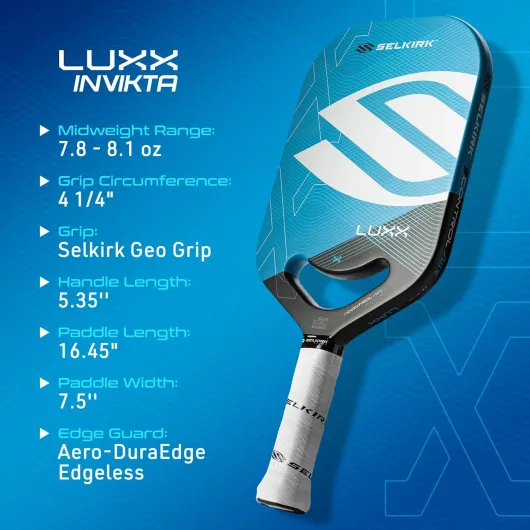
Comfort-wise, this paddle is one of the better ones I’ve used so far. The 4 1/4 inch grip feels right in the middle: not too chunky, not too skinny. The stock grip has a bit of cushion and a tacky surface that holds up fine even when my hands get sweaty. I played a three-hour open play session in warm weather, and I never felt like the paddle was slipping or twisting in my hand. I did eventually add an overgrip just because that’s what I’m used to from tennis, but it’s not mandatory out of the box.
The 8.1 oz weight is a nice compromise. My old paddle was slightly heavier and more head-heavy, and my wrist would feel it after a long night. With the LUXX Control, I’m less tired at the end of a session. It’s not ultra light, but the balance is better. The elongated head does add a bit of swing weight, but the throat design seems to keep it from feeling like a shovel. On fast exchanges at the net, I can still flick and react without feeling late all the time.
One thing I noticed is that mishits don’t send a jolt into my arm. That’s probably the foam perimeter doing its job. On some stiff paddles, if you catch the ball near the edge, you feel it in your elbow right away. Here, the impact is more muted. I’ve had minor elbow issues in the past, and with this paddle, those haven’t flared up, even after several longer sessions in a row. So for players with sensitive joints, this might be a decent option.
Downsides: if you really like a thinner, hard grip with a lot of feedback, the stock grip might feel too cushy. Also, if you’re used to ultra-light paddles, 8.1 oz could still feel a bit heavy. For me, it hits a sweet spot between stability and comfort. I can play longer without feeling like I’m fighting the paddle, which is pretty much what I want from a control-focused stick.
Carbon fiber face and foam perimeter: how it actually feels
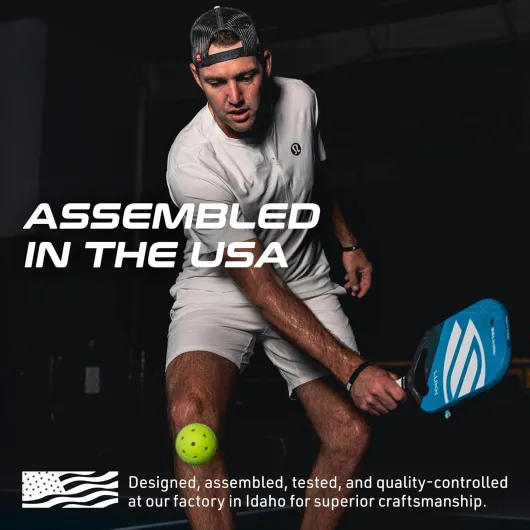
On paper, this paddle is loaded with material buzzwords: carbon fiber face and frame, polypropylene X7 core, foam perimeter, textured surface. In real use, the main thing I notice is a softer, controlled impact feel and fewer harsh vibrations on off-center hits. Coming from a cheaper composite paddle, the difference in feel is pretty clear. The ball seems to sit on the face a tiny bit longer, especially on dinks and resets, which makes it easier for me to keep the ball low over the net.
The carbon fiber surface has a grippy, almost sandpaper-like texture when new. It’s not crazy abrasive, but you can definitely feel it under your fingers. That helps with spin. My topspin serves and slice returns started biting more right away, without me changing my motion much. After a few weeks, the texture still looks and feels fine; no obvious smooth spots yet. I can’t say how it’ll look after six months, but so far it holds up better than some cheap paddles where the grit fades quickly.
The foam around the perimeter is something you don’t see, but you do feel. Shots near the edge don’t feel as dead as on my older paddle. Instead of a dull thud and the ball dropping into the net, I get more usable rebounds. It’s still a mishit, but it stays in play more often, which is pretty valuable at my level. Also, the paddle doesn’t buzz in my hand. I’ve used stiffer graphite paddles that made my wrist ache after long sessions; this one is easier on the arm.
If you like a super crisp, pingy feel, you might find this one a bit muted. It’s not mushy, but it leans more towards “soft control” than “hard pop.” For me, that’s a plus, especially around the kitchen. For pure power hitters, maybe less so. Overall, the materials feel pretty solid and in line with the price. You’re paying for that carbon face and foam tech, and on court, it doesn’t feel like pure marketing. It actually changes how the paddle plays, mostly in a good way.
Build quality and early wear after a few weeks
Durability is always hard to judge in just a few weeks, but I can at least share how it’s holding up so far. I’ve used the LUXX Control Invikta for around 15–20 sessions, mostly on outdoor courts with the usual plastic balls. The edge guard is still fully attached, no peeling or gaps. I’ve had a couple of light clashes with other paddles at the net (nothing crazy), and only small cosmetic marks showed up, no cracks or structural issues.
The carbon fiber face still looks good. The gritty texture is mostly intact, with only very slight smoothing in the main contact area. You can still feel the texture easily with your fingers. On cheaper paddles I’ve used, the spin surface starts to feel smoother after a similar amount of play, so this one seems to be holding up better than the budget stuff. Of course, I can’t say what it’ll look like in six months or a year, but early signs are positive.
The grip is also holding up fine. No unraveling, no weird flattening, and the tackiness is still there. I sweat a fair amount, and I don’t baby my gear—paddle goes in the bag, sometimes in a hot car, not always in a case. Given that, I’d say the materials are handling normal recreational abuse pretty well. The foam perimeter isn’t visible, but since the feel of the paddle hasn’t changed, I’m assuming it’s doing its job without degrading quickly.
That said, this is not a cheap paddle. At this price, I’d expect it to last at least a solid season of regular play, if not more. So far, it feels like it will, but I can’t prove that yet. If you’re someone who plays five days a week and hits very hard, you might wear through the texture faster than I will. For a typical 2–4 times per week player, based on my experience so far, the durability seems pretty solid and in line with what you’d want from a premium option.
Control first, power second – how it actually plays
On court, the LUXX Control Invikta lives up to its name: it’s clearly built around control and touch. The biggest difference I felt compared to my older mid-range paddle was on dinks, resets, and third shot drops. The ball doesn’t rocket off the face as easily, which forces you to swing a bit more, but it also makes it easier to keep the ball low and in. My unforced errors on simple dinks dropped noticeably after a couple of sessions once I got the feel down.
From the baseline, you can still hit hard, but it’s not a free-power paddle. If you’re lazy with your swing, the ball will land shorter than you expect. When I commit to my stroke, I can hit solid drives and passing shots, but I have to generate it with my body, not rely on the paddle to do it all. For players who already hit big, this is fine. For someone who wants a paddle that does the heavy lifting on power, this might feel a bit tame. On the flip side, I had fewer balls sailing long, which is nice.
Spin is where this paddle shines for me. The textured carbon face grabs the ball well. My topspin serves kick higher, and my slice returns stay lower and skid more. I also noticed I could shape passing shots better, bending them away from opponents. I’m not some spin wizard, but even with my average technique, the difference from a smoother-faced paddle is pretty obvious. The spin also helps on roll volleys at the kitchen; I can dip the ball at opponents’ feet more reliably.
In hand battles and blocks, the paddle is stable. The sweet spot feels big, and even when I catch the ball a bit off-center, blocks still go back deep instead of dying at my feet. The open throat and weight balance help with quick reactions. I did need a few sessions to fully adjust to the elongated shape in these fast exchanges, but once dialed in, I felt confident. Overall, performance is very solid for intermediate players who care more about control, spin, and consistency than pure raw power.
What you actually get out of the box
Out of the box, the LUXX Control Invikta looks and feels like a higher-end paddle, but without any crazy gimmicks. Mine is the blue version in the elongated shape. The finish is clean, no glue marks or rough edges on the bumper. The branding is obvious but not loud. If you care about looks, it’s decent: modern but not flashy. Personally, I care more about how it plays than how it looks, but it doesn’t scream “cheap Amazon set,” which is nice when you show up at a new court.
Weight-wise, mine came in right around the listed 8.1 ounces on a kitchen scale. That puts it in the middle range: not a featherweight, but not a brick either. When you first pick it up, the balance feels slightly towards the head compared to a shorter, standard-shaped paddle, which makes sense for an elongated design. That extra reach is noticeable right away when you’re stretching for lobs or wide dinks. If you’re used to a shorter paddle, it might feel a bit awkward for the first few games, but I got used to it quickly.
In terms of specs, the grip size (4 1/4 inches) feels pretty standard. I have average-sized hands, and I didn’t feel like I needed an overgrip immediately. There’s enough cushion that it doesn’t feel like holding a wooden stick, but it’s not super squishy either. If you’re used to tennis, it’ll feel familiar. The paddle thickness and the carbon fiber face give it a more “solid” sound than cheap paddles. The pop sound is muted, not that loud, hollow ping you get on low-end gear.
Overall, the presentation lines up with the price point: it looks and feels like a serious piece of equipment. No case is included, at least in my box, which at this price I would have appreciated. Not a deal breaker, but if you’re expecting a bundle with cover, balls, and all that, this is not it. You’re basically paying for the paddle and the tech inside it, nothing else.
Pros
- Very good control and touch on dinks, drops, and resets
- Grippy carbon face gives noticeable spin on serves and groundstrokes
- Comfortable grip and reduced vibration, easier on the arm
- Elongated shape adds useful reach and a large feeling sweet spot
Cons
- High price compared to decent mid-range paddles
- Less free power than some power-focused paddles; you have to swing for pace
- Small adjustment period if you’re coming from a standard, non-elongated shape
Conclusion
Editor's rating
After a few weeks with the 2024 Selkirk LUXX Control Invikta, my overall take is that it’s a very solid control-focused paddle aimed at players who actually care about placement, spin, and consistency more than raw power. The elongated shape gives you extra reach and a generous sweet spot, the carbon face adds real spin, and the foam perimeter and core keep the feel comfortable and forgiving. My soft game definitely got cleaner once I adjusted, and I’m making fewer dumb errors on simple dinks and drops.
It’s not a magic fix, though. You still have to swing properly to get power, and if you’re a pure banger who just wants maximum pop, there are better fits. The price is also on the high side, so it makes the most sense for intermediate and up players who are on court often and want a paddle that supports a more controlled style. Beginners or very casual players are probably better off with something cheaper until they figure out their preferences.
If you’re an adult rec player around 3.0–4.0 level, playing a few times a week, and you’ve started to notice that your cheap paddle is holding back your touch and spin, this is a strong option. If you’re budget-conscious, or you just want to hit as hard as possible without worrying about finesse, you can skip it and look at more power-oriented or mid-priced options. Overall, I’d say it’s a good, well-built paddle that does what it claims for the right type of player, but it’s not some miracle stick that will suddenly fix bad technique.