Summary
Editor's rating
Value for money: good deal on sale, borderline at full price
Design and shape: built for spin and reach, not flash
Comfort and grip: good feel, slight vibration, average handle
Materials and build: decent core, but some trust issues
Durability: mixed signals and some worrying reviews
On-court performance: control and spin first, power second
Specs and first impressions out of the bag
Pros
- Good control and spin thanks to the MaxGrit surface and polypropylene core
- Comfortable weight and grip size for most players, easy to handle at the net
- USAPA approved and clearly a step up from basic starter paddles, especially when found on sale
Cons
- Multiple reports of handles breaking early, especially at the handle–paddle junction
- 90-day limited warranty and basic packaging don’t inspire long-term confidence
- Power is only moderate; players who like to hit very hard may want something beefier

Specifications
View full product page →| Brand | Franklin Sports |
A 'pro' paddle at a mid-range price… worth it?
I’ve been playing pickleball a few times a week for a while now, and I picked up this Franklin Sports Pro Signature Series (13mm, blue) because I wanted something a bit more serious than the basic starter paddles. It’s USAPA approved, the specs looked decent, and the MaxGrit surface sounded like it could help with spin. On paper, it ticks a lot of boxes for a mid-range paddle that you can take to proper matches without feeling under-equipped.
In practice, I’ve used it for around a dozen sessions, mostly doubles, with a mix of casual and slightly more competitive games. I’m not a pro, but I’m not a total beginner either – I’d say solid intermediate. I’ve also had the chance to compare it side by side with a couple of other paddles in our group, including a cheaper beginner composite paddle and a more expensive carbon-fiber one. So I had a decent reference point to judge it against.
The short version: it plays nicely, has good control, and the gritty surface really does grab the ball. But there are some concerns about build quality and durability, especially around the handle, that you can’t ignore once you’ve read a few reviews and used it a bit. It’s not junk, but it’s also not some miracle pro weapon. It sits in that middle ground of "pretty solid, but with trade-offs".
If you’re thinking about this paddle because you’ve seen it on sale or you’ve heard Franklin mentioned at your local courts, it can be a good step up from basic wooden or generic paddles. You just need to go in knowing what you’re getting: nice feel and spin for the price, with a small risk that the handle or build might not hold up as long as some competitors. I’ll break down how it actually feels on court and where it falls short.
Value for money: good deal on sale, borderline at full price
In terms of value, a lot depends on the price you find it at. The Amazon review mentioning it being "on offer" is exactly how I see it: at a discount, it’s a pretty good deal; at full price, it’s more of a maybe. You’re getting a USAPA-approved paddle with a gritty surface, a decent polypropylene core, and a known brand name. Performance-wise, it does what most intermediate players need: decent control, usable spin, and enough power to keep rallies interesting.
Compared to true entry-level paddles (the cheap sets you get in pairs), this Franklin is a clear step up. The feel is better, the sweet spot is larger, and the MaxGrit face gives you more shot options. If you’re moving from that level, you’ll notice the difference and probably feel that the money was well spent. The issue is that in this price range, there are now quite a few paddles from other brands that offer similar or better build quality, sometimes with longer warranties or more confidence-inspiring handles.
For me, the value hit a good spot because I bought it on a discount. At that price, I was okay with the risk that it might not last forever. If it broke after a season, I’d be annoyed but not furious. At full price, I’d start comparing it more seriously with alternatives that have fewer durability complaints. The 90-day warranty is also something to factor in: it covers early failures but doesn’t really protect you long term.
So I’d sum up the value like this: if you find it on sale and you’re an intermediate or improving beginner who wants better control and spin without spending a fortune, it’s a good value for money choice. If it’s at the top end of its usual price and you’re hard on your paddles, I’d either negotiate with my wallet and look for a deal, or consider other options that feel more solid. It’s not a rip-off, but it’s not a no-brainer either.
Design and shape: built for spin and reach, not flash
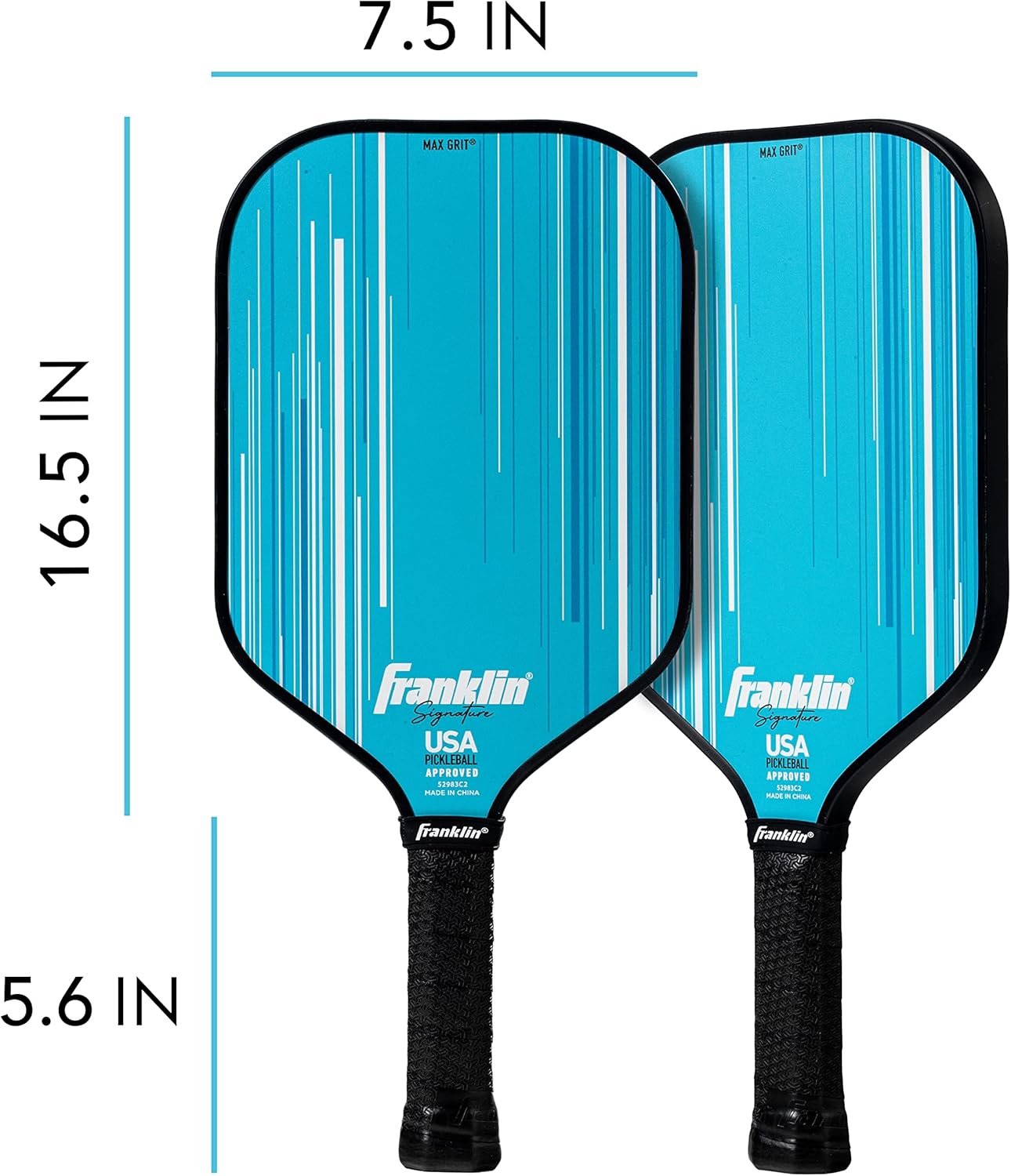
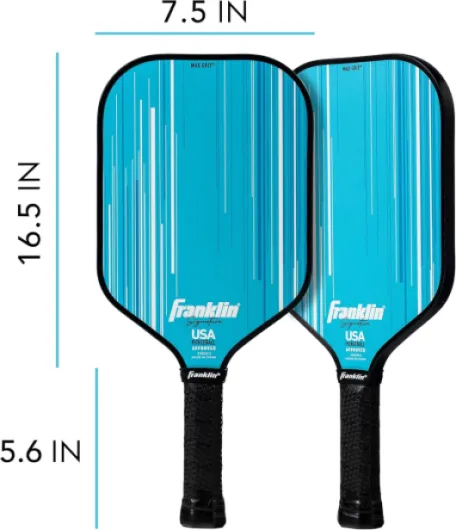
Design-wise, this Franklin paddle goes for a slightly elongated shape: 16.5" long with a 7.5" width. On court, that extra length is noticeable in a good way. I found it easier to reach for volleys at the kitchen and to stretch for lobs behind me. At the same time, it’s not so skinny that you feel like you’re swinging a stick. The sweet spot still feels reasonably wide, especially in the upper-middle part of the face, which is where most of my contact tends to be.
The blue color version looks fine – nothing flashy, but not ugly either. It’s more "generic sports paddle" than something you’d stop and admire, which honestly is fine by me. The graphics are simple: Franklin logo, some text about MaxGrit and the Signature Series. After a few sessions, the gritty surface will show ball marks and minor scuffs, but that’s pretty normal. I didn’t see any chipping or peeling of the grit after about ten outings, just cosmetic wear.
One design detail I paid attention to is the edge guard and how the handle meets the paddle face. The edge guard feels okay, not super thick, but it does its job against light taps on the ground. Where I’m less confident is the transition between the handle and the face. You can feel that it’s a separate piece joined to the core, and that’s exactly where some Amazon reviewers reported breaks. Mine hasn’t cracked, but you can tell it’s a potential weak spot if you’re hard on your gear or if you tend to grip high on the handle.
From a usability standpoint, the design is clearly leaning toward a control/spin style of play. The elongated shape plus the MaxGrit face push you toward dinks, slices, and controlled drives rather than just swinging for raw power. If you’re used to a more traditional, wider paddle, you might need a session or two to get used to the slightly different balance and contact point, but I adapted fairly quickly. Overall, the design is practical and focused on playability, not on looking fancy.
Comfort and grip: good feel, slight vibration, average handle
Comfort-wise, I actually liked this paddle more than I expected. At around 7.7 oz, it sits in that sweet spot where your arm doesn’t feel beaten up after a long session, but you still have enough weight to punch volleys and put away overheads. I played a couple of back-to-back 2-hour sessions and didn’t feel any serious arm fatigue or wrist pain, which I sometimes get with heavier paddles. So from a pure weight perspective, it’s quite friendly.
The grip circumference is 4.25", which for my average-sized hands felt just right. The stock grip has a slightly tacky feel and a bit of cushioning. It’s not the nicest grip I’ve ever used, but it’s good enough that I didn’t rush to rewrap it. After a few sweaty games, it does get a bit slippery, so if you sweat a lot, you may want to throw an overgrip on top. The handle length (5.6") is long enough for a comfortable one-handed grip and just barely okay for a loose two-handed backhand. If you’re big on two-handed shots, you might find it a bit short.
Despite the marketing about MaxGrit damping vibration, I still felt a bit of buzz in the hand on mishits, especially near the top edge. It’s not painful, but it’s there. If you have elbow issues or are very sensitive to vibration, this may not be the softest option. Compared to a thicker 16 mm core paddle I’ve used, this 13 mm version definitely sends a bit more feedback into your hand. Some people like that; others don’t. Personally, I didn’t mind it, but it’s something to be aware of.
Overall, I’d rate comfort as pretty solid but not perfect. The weight and grip size are on point for most players, and the paddle feels nimble at the net. The main downside is that slight vibration on off-center hits and the average-quality handle that doesn’t inspire total confidence. If you’re coming from a cheap wooden paddle, this will feel like a big step up in comfort. If you’re used to higher-end, thicker-core paddles, this will feel a bit harsher and less cushioned.
Materials and build: decent core, but some trust issues
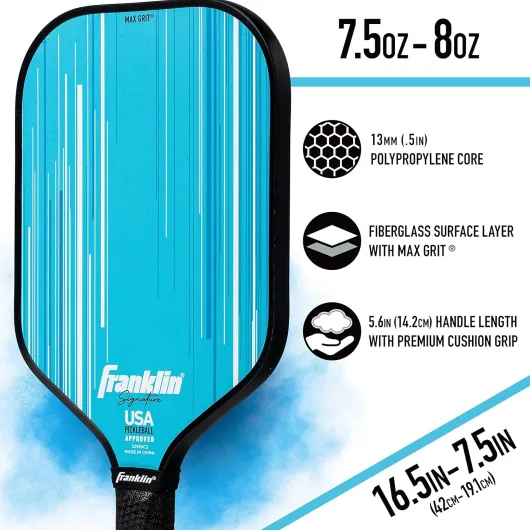
The paddle is basically a polypropylene sandwich: polypropylene core, fiberglass face, and a MaxGrit surface layer on top. Polypropylene cores are standard in modern paddles because they give a good mix of control and power and tend to absorb some vibration. Here, the 13 mm thickness means you get a slightly firmer feel compared to a 16 mm core. On court, that translated into a bit more pop off the face, especially on drives and smashes, but still enough softness for dinks and drops.
The fiberglass face is what helps with the larger sweet spot. Compared to a cheap wooden paddle or a very basic composite, mishits near the edges still had enough control that the ball didn’t just die. You can feel the paddle helping you out a bit when your contact isn’t perfect. The MaxGrit layer is the other big material piece. It’s rough enough that you can grip the ball on slices and topspin serves. I noticed a clear difference in how much spin I could get compared to a smooth-faced paddle I used before. It’s not night and day, but it’s noticeable.
Where I’m less happy is the overall sense of sturdiness, especially in the handle. The core and face feel fine, but the handle feels a bit hollow and not super reinforced. I didn’t have mine snap, but I can see why some users reported the handle breaking early. If you’re swinging hard or if you occasionally bang the paddle on the court going for low balls, this could be a problem. The 90-day limited warranty doesn’t give you a ton of peace of mind either – it’s better than nothing, but it doesn’t scream long-term confidence.
So in terms of materials, I’d say: core and face are pretty solid for the price, grip and handle are just okay. If you’re gentle with your gear, you’ll probably be fine. If you’re tough on paddles or you play almost every day, I’d be a bit cautious. There are other paddles in a similar price bracket that feel a bit more robust, especially around the handle area.
Durability: mixed signals and some worrying reviews
This is where things get a bit shaky. My own paddle has held up fine over roughly ten sessions – no cracks, no delamination, no handle wobble yet. The MaxGrit surface is still rough enough to grab the ball, even though it’s picked up the usual scuffs and ball marks. The edge guard has a few dings from scraping the court, but nothing serious. So based only on my experience, I’d say durability is okay so far.
But when you look at user reviews, a different picture shows up. There are several 1-star reviews mentioning the handle breaking very early, sometimes even on the first outing or within ten uses. That lines up with what I felt when I inspected the handle area: it doesn’t feel heavily reinforced. If there’s a weak spot in this paddle, it’s right where the handle meets the core. For casual play a couple of times a week, you might never hit that limit. If you play hard, hit big serves, or occasionally slam the paddle, the risk seems higher.
Another thing is the packaging. Some buyers mentioned the paddle arriving in thin bubble wrap and a flimsy paper bag. Mine also came with very minimal protection. That’s not ideal for something that can crack if it’s crushed or bent in transit. It’s probably why some people open the package and already have small defects or structural issues. Franklin gives a 90-day limited warranty, which is okay but not generous. If something goes wrong after that window, you’re on your own.
So overall, I’d call durability questionable. Not terrible, not unusable, but clearly not bulletproof. If you treat your gear gently, store it in a bag, and don’t slam it, you’ll probably be fine and get decent life out of it. If you’re a heavy user or you want a paddle that can survive serious abuse, there are more robust options out there, even if they cost a bit more. This is one of those products where the performance feels good, but you always have a small doubt in the back of your mind about how long it will last.
On-court performance: control and spin first, power second
Performance is where this Franklin paddle actually holds its own. The main thing I noticed is good control, especially on dinks and drops. At the kitchen line, I could place the ball pretty accurately, and the paddle didn’t feel too springy. Soft shots stayed soft as long as my technique was decent. The sweet spot is centered slightly higher up the face, which worked well for me since most of my contact in volleys is in that zone. Miss near the edges and you’ll feel it, but the ball doesn’t completely die.
The MaxGrit surface genuinely helps with spin. On serves, I could get a decent kick on topspin serves and a nice bite on slices. Same for third-shot drops with a bit of spin – the ball seemed to dip a little more than with a smooth-faced composite paddle I used before. Don’t expect pro-level spin just from the paddle, but if you already use spin in your game, this face makes it easier to grab the ball. A couple of players I play with even commented that my slice returns were skidding more than usual when I switched to this paddle.
Power is decent but not huge. The 13 mm core gives more pop than a 16 mm control paddle, but the overall feel is still more control-oriented than raw power. My drives and smashes had enough punch to finish points, but they didn’t feel as heavy as when I borrowed a friend’s thicker, higher-end paddle with more mass in the head. If your game relies on blasting winners from the baseline, you might want something beefier. If you’re more about placement, spin, and consistency, this will suit you better.
In quick exchanges at the net, the paddle feels quick and easy to maneuver. That slightly elongated shape plus the moderate weight make it easy to react to fast volleys and block shots back into play. I did notice that on very off-center blocks, the paddle twisted in my hand a bit more than a heavier, more stable paddle, but that’s the trade-off you get with a lighter, thinner-core design. Overall, performance-wise, I’d say this paddle gets the job done well for intermediate players who want control and spin with just enough power to be dangerous.
Specs and first impressions out of the bag
On paper, the specs are pretty straightforward: the 13 mm version I tried is listed at 16.5" x 7.5", with a 5.6" handle and a 4.25" grip circumference. Weight is in the 7.5–8 oz range; mine felt right in the middle, around 7.7 oz, which matches the product info. That’s a nice all-round weight – not a featherweight control paddle, but not a heavy power slab either. The core is polypropylene, which is standard these days, and the face is fiberglass with the MaxGrit texture.
When I pulled it out of the packaging, the first thing I noticed was the gritty face. You can actually feel the texture under your fingers; it’s not just a light coating. It feels closer to sandpaper than to a smooth composite face. The grip is pre-wrapped with a fairly basic but comfortable overgrip-style wrap. No fancy molded shape here, just a standard round-ish grip that should work for most people unless you have very big or very small hands.
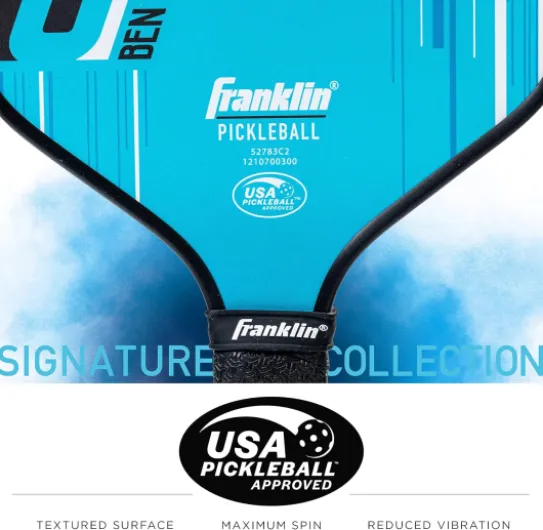
Another practical detail: it’s USA Pickleball (USAPA) certified. That means if you want to show up at tournaments or sanctioned events, this paddle is allowed. For someone like me who plays mostly rec games but occasionally jumps into local tournaments, that’s useful. You don’t have to buy a separate paddle just for competitions. The paddle also comes alone in the bag – no cover, no extras. So if you want a case or sleeve, that’s on you.
Overall, the first impression is "solid mid-range paddle." It doesn’t scream premium, but it also doesn’t feel like a toy. The spec sheet is balanced: decent length, standard grip, reasonable weight. Nothing wild or experimental, which is good if you’re moving up from entry-level gear and just want something that behaves predictably on court.
Pros
- Good control and spin thanks to the MaxGrit surface and polypropylene core
- Comfortable weight and grip size for most players, easy to handle at the net
- USAPA approved and clearly a step up from basic starter paddles, especially when found on sale
Cons
- Multiple reports of handles breaking early, especially at the handle–paddle junction
- 90-day limited warranty and basic packaging don’t inspire long-term confidence
- Power is only moderate; players who like to hit very hard may want something beefier
Conclusion
Editor's rating
Overall, the Franklin Sports Pro Pickleball Paddle (13 mm, MaxGrit, blue) is a solid mid-range paddle with good control and spin, but it comes with some durability question marks. On court, it feels nice in the hand, the weight is comfortable, and the gritty face really does help you put spin on serves, slices, and soft shots. For intermediate players or serious beginners who want to move up from basic paddles, it offers a clear performance upgrade without jumping into high-end prices.
The downside is mainly around build quality, especially at the handle. My unit has held up so far, but the number of reviews mentioning broken handles after just a few games is hard to ignore. The 90-day warranty gives you some cover early on, but it doesn’t scream long-term reliability. If you play gently and don’t abuse your gear, you’ll likely be fine and enjoy the way it plays. If you’re tough on paddles or you play a lot, you might want something more robust.
I’d recommend this paddle to players who: play a few times a week, want better control and spin than a cheap starter paddle, and can grab it at a decent discount. It’s less ideal for heavy hitters, daily players, or anyone who values rock-solid durability above all. In short: nice to play with, good when on sale, but not the most trustworthy tank on the market.