Summary

Editor's rating

★★★★★ ★★★★★

Value for money: good performance, small-brand compromises

★★★★★ ★★★★★

Short, wide, and loud: how it’s built and how it feels in hand

★★★★★ ★★★★★

Grip, balance, and fatigue: how it feels over a full session

★★★★★ ★★★★★

Triple-layer T700 carbon and thick core: good on paper, mostly good in practice

★★★★★ ★★★★★

Build quality and early wear: mostly solid with one red flag

★★★★★ ★★★★★

On-court performance: spin, control, and power for real

★★★★★ ★★★★★

Unboxing: nice box, missing one obvious thing

★★★★★ ★★★★★

Pros

  • Strong spin potential thanks to raw T700 carbon face and real surface texture
  • Good balance of control and power with a forgiving 16mm core and wide body
  • Comfortable, longer handle that works well for two-handed backhands and grip variations

Cons

  • No paddle cover included despite the price and otherwise good packaging
  • Octagonal, slightly bulky grip may not suit players with smaller hands and feels different at first
  • At least one reported early core failure raises some questions about quality control
Brand Warping Point

Bright carbon paddle that actually plays pretty well

I’ve been playing with the Warping Point Neon Gen 3 for a bit now, mostly in rec games with 3.0–4.0 level players, and I’ll be straight: it’s a pretty solid paddle, especially if you’re coming from a cheap beginner set. It’s not perfect and it’s not from a big-name brand like Joola or Selkirk, but on court it holds its own better than I expected. Think of it as a mid/high-tier paddle from a smaller brand that’s trying to tick all the current trend boxes: raw carbon, thermoformed, thick core, spin-focused.

The first thing that hits you is the look. It’s loud: gradient neon colors on a carbon face. If you like flashy gear, you’ll be happy. If you’re more low-key, this might feel a bit much. But once you start playing, the more important stuff is the feel: the paddle has good spin, a noticeable sweet spot, and a slightly top-heavy balance that gives some extra pop on drives.

Where I think this paddle stands out is for players who are past the pure beginner stage and starting to care about third-shot drops, resets, and spin serves. If you’re still using a big-box wooden or fiberglass paddle, you’ll instantly feel the difference in control and consistency. I could shape the ball a lot better, especially on topspin drives and slice returns. It feels like the face really grabs the ball without being too wild.

It’s not all positive. There are some trade-offs: no cover in the box, the handle shape won’t suit everyone, and there’s at least one report of the core failing early (my unit has been fine so far, but it’s worth noting). Still, for the price and what you get in terms of playability, I’d say it’s a decent option for rec and league players who care more about feel and spin than brand prestige.

Value for money: good performance, small-brand compromises

★★★★★ ★★★★★

In terms of value, this Warping Point Neon Gen 3 sits in that mid to upper price range where you start expecting real performance but not necessarily pro-tour pricing. You’re paying for modern construction (raw carbon, thermoforming, thick core) and you do actually get those benefits on court: more spin, better control, and a more solid feel than entry-level paddles. If you’re upgrading from a cheap Amazon two-pack, you will feel where the money went.

Where the value gets a bit questionable is the missing extras and the fact that it’s from a relatively unknown brand. No cover is the obvious one. At this price, most competitors toss in at least a simple neoprene sleeve. It’s not expensive to add, and the lack of one makes the package feel slightly incomplete. You do get an extra grip wrap, which is useful, but from a buyer perspective a cover would probably be more appreciated.

On the flip side, performance-wise, it compares pretty well with other raw carbon paddles in the same bracket. You’re getting good spin, decent power, and solid control without paying the premium for a big logo. The Amazon rating around 4.4/5 lines up with how I feel: generally positive, with a few people running into issues or preferences (handle shape, durability on that one unit). If you’re brand-conscious or want strong resale value, you might stick to more established names. But if you care mainly about how it plays for the money you spend, this holds up fine.

I’d call the value good but not mind-blowing. It’s not a steal, but it’s also not overpriced for what it delivers. If you’re an improving player in the 3.0–4.0 range looking for a real upgrade that gives you spin and control without jumping to the most expensive options, this is a reasonable buy. Just budget for a separate cover and keep an eye on the paddle in the first few weeks to make sure your unit doesn’t have any weird rattles or defects.

71lQlMeqUPL._AC_SL1500_

Short, wide, and loud: how it’s built and how it feels in hand

★★★★★ ★★★★★

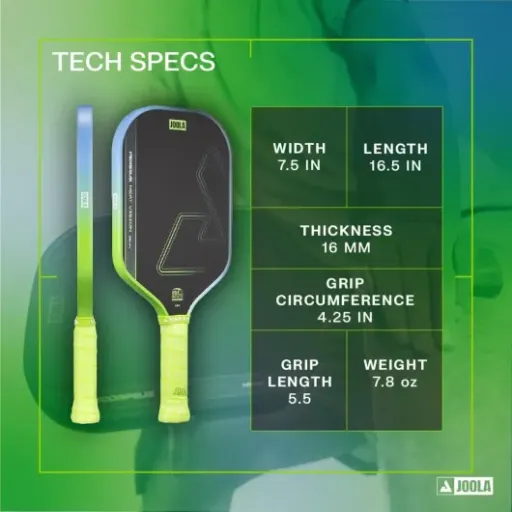
Design-wise, this is a short and wide style paddle, not a long elongated one. The dimensions are around 16.4" long by 7.5" wide, so you get a broad face and a decent sweet spot. In play, that wider shape is forgiving on off-center hits. You can actually hear and feel when you hit the sweet spot; it has a slightly softer, drum-like sound on good contact that I liked. Mishits near the edge are still playable thanks to the thick 16mm core and reinforced edges.

The graphics are loud: green–purple–orange gradient around the edges and on the face. On court, it definitely stands out. I got a couple of comments about the colors the first session I used it. Personally, I don’t care much about looks as long as it plays well, but if you’re shy about bright gear, this design is not subtle. One reviewer nailed it calling it “business on the paddle, party along the sides” – that’s exactly the vibe.

The handle is elongated at 5.5" with an octagonal (hexagon-ish) shape. For me, the longer handle is great for two-handed backhands and gives a bit more leverage. But the grip shape and size (about 4 2/8" circumference) can feel bulky if you have smaller hands. One user with smaller hands mentioned it felt a bit chunky, and I get that. It’s not a super slim grip. I had to adjust my grip pressure a bit during the first session so it didn’t twist.

Balance-wise, it’s slightly top-heavy. You notice a bit more weight in the head compared to some balanced or head-light paddles. In practice, that means more pop on drives and overheads, but a bit more effort on super fast hands battles at the kitchen. It’s not a sledgehammer, but if you’re used to very neutral paddles, you’ll feel the difference. I got used to it after a couple of games, but players with elbow issues might want to pay attention to that head bias.

Grip, balance, and fatigue: how it feels over a full session

★★★★★ ★★★★★

Comfort-wise, I’d put this paddle in the “good but not perfect” category. The grip itself is cushioned and fairly tacky, with decent sweat absorption. I played a couple of longer sessions (around 2 hours each) and didn’t have issues with the paddle slipping, even when my hand got sweaty. The included extra grip tape is handy once the original wrap wears down. The cushioning also helps with shock, so mishits don’t feel harsh in the hand.

Where comfort gets a bit more subjective is the shape and size of the handle. The octagonal profile is noticeable. If you’re used to more rounded or thinner grips, this feels more blocky at first. People with smaller hands might find it a bit bulky, as one reviewer mentioned. I have medium-sized hands and got used to it after about a set, but I did notice I had to adjust my grip slightly compared to my usual paddle. The longer handle, though, is a plus for two-handed backhands and gives you more room to experiment with grip positions.

In terms of arm and wrist fatigue, the paddle’s slight head-heaviness is a double-edged sword. The extra mass in the head helps with power so you don’t have to swing as hard, which can reduce effort in some shots. On the other hand, during very fast kitchen exchanges and long sessions of hard drives, you do feel that weight out front a bit more. For me, it was manageable, and actually less tiring than my older, heavier composite paddle, but if you’re very sensitive to balance, it’s something to consider.

One thing I did notice positively: the paddle seems to absorb impact pretty well. On blocks and hard drives coming at me, the handle didn’t buzz or sting. Another user also mentioned reduced fatigue over extended play, which lines up with my experience. So, while the grip shape won’t be everyone’s favorite, the overall comfort during a full session is quite decent, especially if you’re coming from a cheaper, harsher-feeling paddle.

71yDIDmiLpL._AC_SL1500_

Triple-layer T700 carbon and thick core: good on paper, mostly good in practice

★★★★★ ★★★★★

On the material side, this paddle checks all the current trendy boxes: triple-layer T700 raw carbon fiber face, 16mm polypropylene honeycomb core, thermoformed unibody frame, and EVA-reinforced edges. If you’ve looked at other modern paddles, this spec sheet will look familiar. In hand, the face has a clear textured feel – you can run your finger over it and feel the grit. It’s not just printed texture; there’s actual grip on the surface.

The 16mm core is on the thicker side, which usually means more control and a softer feel. That’s mostly what I felt: the paddle doesn’t feel ultra-stiff or pingy. It has a controlled, slightly muted response on soft shots, which helps with dinks and resets. On harder hits, you still get enough rebound that drives don’t feel dead. One buyer did mention a rattle and crushed core after a few days of heavy use, so clearly there can be quality variance. Mine hasn’t had that issue so far, but it’s worth keeping in mind if you’re a heavy hitter or play daily.

The EVA-reinforced edge and thermoformed frame are supposed to improve durability and enlarge the sweet spot. Compared to cheaper paddles, off-center hits definitely feel less punishing. I had a few shots near the edge that still made it over with decent pace instead of just dying. The paddle does have a visible edge guard though, unlike some borderless designs. One reviewer pointed this out because they were used to Warping Point’s edgeless models. Personally, I prefer having an edge for protection, even if it adds a bit of weight.

Overall, the materials feel legit for this price bracket. It doesn’t feel like a discount plastic board. The weight is around 0.76 kg listed (which is clearly wrong as a playing weight, but in reality it feels in the typical 7.8–8.3 oz range in hand), and the build feels solid. I wouldn’t say it’s bulletproof given at least one report of core issues, but for regular rec play a few times a week, it feels up to the task.

Build quality and early wear: mostly solid with one red flag

★★★★★ ★★★★★

Durability is always tricky to judge early, but I can at least talk about my experience and what other buyers reported. Out of the box, the paddle feels sturdy. The thermoformed unibody frame and EVA-reinforced edge give the impression of a solid shell. I’ve had a few paddle clashes at the net and some accidental taps on the court surface, and so far there’s no chipping or separation along the edges. The edge guard looks and feels secure, not flimsy.

The face texture is another area people worry about. Some carbon paddles lose grit quickly. After several sessions, the surface on mine still feels grippy to the touch and I haven’t noticed a big drop in spin. Obviously, over months of play it’ll smooth out like any paddle, but it doesn’t feel like a cheap spray-on texture that disappears after a week. Users who mentioned spin in their reviews also seemed happy with it, which suggests the face holds up decently over normal rec use.

The main red flag is that one review where the core apparently crushed and started rattling within days. That’s not normal and points to either a bad unit or a quality control miss. The player said the paddle went from great to dead and muffled very quickly. On the positive side, they updated their review and said Warping Point contacted them and handled it, so at least the brand seems to stand behind the product. Still, it’s something to keep in the back of your mind if you’re a heavy hitter or play every day.

So far, my own paddle shows no rattles, no delamination, and no soft spots, but I haven’t beaten it up for months yet. For a typical adult rec player using it a few times a week, I’d expect it to last a reasonable amount of time. If you’re super picky about long-term durability and want a paddle that can survive constant tournament-level abuse, you might lean toward a bigger brand with a longer track record. For most people, though, the durability seems acceptable, with that one reported core failure being the main outlier.

61KKr3H7WDL._AC_SL1500_

On-court performance: spin, control, and power for real

★★★★★ ★★★★★

Performance is where this paddle actually justifies its specs. The spin is the standout. The raw T700 carbon face with that fine grit grabs the ball really well. I noticed it right away on topspin drives and cross-court dinks with a bit of roll. My serves kicked more, my slice returns stayed lower, and it was easier to bend balls into the court instead of floating them long. If you like playing with spin or you’re trying to add more shape to your shots, this paddle helps.

On control, the 16mm core and wide body give a stable, forgiving platform. Third-shot drops were more consistent for me than with my older fiberglass paddle. The paddle doesn’t feel too jumpy on soft shots, so you can actually baby the ball over the net without it randomly flying deep. In the kitchen, resets and dinks feel predictable once you get used to the head weight. The sweet spot feels pretty big; when you catch it, you get that softer sound and a clean, solid feel. Off the edges, you still lose some power and control, but less than on cheaper paddles.

For power, I’d call it moderate to good, not insane. The slightly top-heavy balance and solid face give enough pop for punch volleys and overheads. Drives have good pace, especially when you swing through. It’s not as explosive as some pure power paddles, but it sits in a nice middle ground. You can attack when you want, but you don’t feel like you’re constantly trying to tame the ball on soft shots. That balance is probably why a lot of people around the 3.0–4.0 level seem to like it.

I did notice one thing: if your timing or technique is sloppy, the paddle won’t magically fix that. Shots still sail long if you’re too wristy with all that spin potential. Also, one reviewer reported the paddle going flat and rattly after a few days due to a crushed core. That obviously kills performance, but to Warping Point’s credit, they apparently reached out and made it right. My unit has held up fine so far with regular play. Overall, in terms of raw on-court performance for spin, control, and decent pop, it does the job well for rec and competitive league play.

Unboxing: nice box, missing one obvious thing

★★★★★ ★★★★★

Out of the box, the Warping Point Neon Gen 3 feels like a serious product. The packaging is actually pretty premium for a paddle from a lesser-known brand. It comes in a sturdy, giftable box with proper branding, foam protection, and a small manual. If you’re buying this as a gift, the first impression is solid. It doesn’t look cheap or thrown together like some random Amazon paddles.

Inside you get the paddle and a replacement grip tape, which I actually appreciate. I rewrap my grips quite often, and having an extra roll in the box is more useful to me than some random stickers. The grip that comes pre-installed is already wrapped, so the extra roll is basically for when that one wears out. That’s a nice, practical touch from the brand.

The weird part is what’s not there: there’s no paddle cover. Several buyers mentioned this too, and I agree. At this price point, most paddles at least throw in a basic neoprene sleeve. It’s not a deal-breaker, but it’s something you notice right away, especially when the box and presentation look this polished. It feels like they spent money on the box and forgot the one accessory that actually protects the paddle.

Overall, presentation is clean and modern, but slightly mismatched with the content: fancy box, good-looking paddle, extra grip tape… and then you’re left tossing it raw into your bag. If you’re picky about keeping your gear in good shape, plan on buying a separate cover. For a new or casual player, though, the unboxing experience will feel pretty premium and “real paddle brand,” not like a random no-name product.

Pros

  • Strong spin potential thanks to raw T700 carbon face and real surface texture
  • Good balance of control and power with a forgiving 16mm core and wide body
  • Comfortable, longer handle that works well for two-handed backhands and grip variations

Cons

  • No paddle cover included despite the price and otherwise good packaging
  • Octagonal, slightly bulky grip may not suit players with smaller hands and feels different at first
  • At least one reported early core failure raises some questions about quality control

Conclusion

Editor's rating

★★★★★ ★★★★★

Overall, the Warping Point Neon Gen 3 is a pretty solid raw carbon paddle aimed at intermediate players that actually plays the way the specs suggest. You get strong spin, a forgiving sweet spot, and a nice mix of control and pop thanks to the 16mm core and slightly head-heavy balance. The bright design is going to stand out on court, and the longer handle is genuinely useful if you like two-handed backhands. For anyone moving up from a cheap starter paddle, this will feel like a clear upgrade in terms of feel, consistency, and shot options.

It’s not perfect. The missing paddle cover feels cheap at this price, the octagonal grip won’t suit everyone (especially smaller hands), and there’s at least one report of an early core failure, even if the brand seems to have handled it. Also, since Warping Point isn’t a big name, you’re taking a small bet on long-term support compared with the big brands. But if you’re mainly focused on how it plays right now, and you want a spin-friendly, control-focused carbon paddle without paying the very top-tier prices, it’s a decent choice.

I’d recommend this to rec and league players around the 3.0–4.0 level who want more spin and control and are okay with a slightly head-heavy feel. If you have very small hands, prefer super light or head-light paddles, or are extremely picky about long-term durability and brand reputation, you might want to look at alternatives. For most improving players, though, it gets the job done and makes the game more enjoyable without feeling like overkill.

See offer Amazon

Sub-ratings

Value for money: good performance, small-brand compromises

★★★★★ ★★★★★

Short, wide, and loud: how it’s built and how it feels in hand

★★★★★ ★★★★★

Grip, balance, and fatigue: how it feels over a full session

★★★★★ ★★★★★

Triple-layer T700 carbon and thick core: good on paper, mostly good in practice

★★★★★ ★★★★★

Build quality and early wear: mostly solid with one red flag

★★★★★ ★★★★★

On-court performance: spin, control, and power for real

★★★★★ ★★★★★

Unboxing: nice box, missing one obvious thing

★★★★★ ★★★★★
Published on
Warping Point Neon Gen 3 Pickleball Paddle, UPA-A Approved, Triple-Layer T700 Raw Carbon Fiber, 16MM EdgeFusion Core™, Thermoformed Frame, Tour-Level Spin, Control & Power for 3.5–4.0 Players Gradient Green Purple Orange Warping Point Neon Gen 3 Pickleball Paddle, UPA-A Approved, Triple-Layer T700 Raw Carbon Fiber, 16MM EdgeFusion Core™, Thermoformed Frame, Tour-Level Spin, Control & Power for 3.5–4.0 Players Gradient Green Purple Orange
🔥
See offer Amazon