Summary
Editor's rating
Value: good for serious setups, overkill for casual players
Design: built like proper court hardware, not a toy
Materials: heavy steel, decent hardware, and built for weather
Durability: feels like it’s built for clubs more than casual backyards
Performance on court: stable, proper height, and easy to tension
What you actually get in the box (and what you don’t)
Pros
- Very stable and heavy, with regulation-height posts that keep the net at proper tension
- Galvanised steel, powder coating, and brass/stainless hardware hold up well outdoors
- Base plates avoid the need for ground sleeves or concrete work, good for hard courts
Cons
- Heavy and not very portable; awkward to move frequently by one person
- Posts-only version means you still need to buy a net and center strap separately

Specifications
View full product page →| Brand | Vermont |
Heavy posts for people who are done with flimsy portable nets
I’ve been slowly turning my driveway and a corner of our local sports hall into a more serious pickleball setup, and I was getting tired of those light foldable nets that sag after an hour. So I picked up the Vermont Pickleball Posts with Base Plates (black, posts only) to see if a heavier, almost club-style system would make a real difference. I’ve been using them for a few weeks now, indoors on a gym floor and outdoors on a rough asphalt court.
Right away, this is not a casual “throw it in the trunk and set up in 2 minutes” product. The whole thing is around 33 kg, and each post with its base plate has a decent heft. You feel it when you carry them from the car to the court. But that weight is also the main point: you get way less wobble and basically no drifting when people hit the net or lean on it by mistake. Compared to my cheap Amazon portable net, the difference in stability is pretty obvious.
The other thing to note: I bought the posts-only version. No net, no center strap by default, unless you pick the options. I already had a 22 ft pickleball net that I like, so I just wanted a more solid way to hold it. If you expect a full kit right out of the box, double-check the listing, because this particular variant really is just the posts and base plates.
Overall, my first impression was: solid gear aimed more at clubs, schools, or people who are serious enough to leave a setup in place for a while. If you want something ultra portable and light, this is probably the wrong product. If you’re mainly annoyed by saggy nets and posts that move every time someone touches them, then this kind of system starts to make sense, even if it’s a bit of a pain to move around.
Value: good for serious setups, overkill for casual players
On price, these Vermont posts sit above the usual foldable portable nets, and that makes sense given the materials and design. You’re paying for heavy steel, proper hardware, and long-term outdoor use, not a quick backyard toy. For a single household that just wants to knock the ball around twice a month, I’d say this is probably too much—both in money and in physical bulk. A lighter, all-in-one portable net will do the job well enough and be easier to store.
Where the value starts to make sense is if you’re outfitting a club, school, or a shared court where the posts will be used a lot. In that context, the cost spread over dozens of players and years of use is reasonable. Also, the fact that you don’t need to install ground sleeves or dig up concrete is a cost saver. The base plates let you get close to a permanent setup without paying for construction work. If you’ve ever priced out in-ground tennis or pickleball posts with installation, you know that can get expensive fast.
The catch, especially with this posts-only variant, is that you still need a decent net and probably a center strap and weight. If you already have those, great. If you don’t, you need to factor that into the total budget. Once you add everything, you’re in a price range where you could also look at other semi-permanent or club-grade systems. Compared to those, I’d say the Vermont kit is good value but not a crazy bargain. You’re paying a fair price for what you get.
So from a value perspective: if you’re serious about having a solid, stable court that feels closer to what you’d see in proper facilities, this makes sense. If you’re just discovering pickleball and not sure how often you’ll play, I’d start with something cheaper and lighter. This feels more like a second-step purchase once you know the sport is sticking around in your life.
Design: built like proper court hardware, not a toy
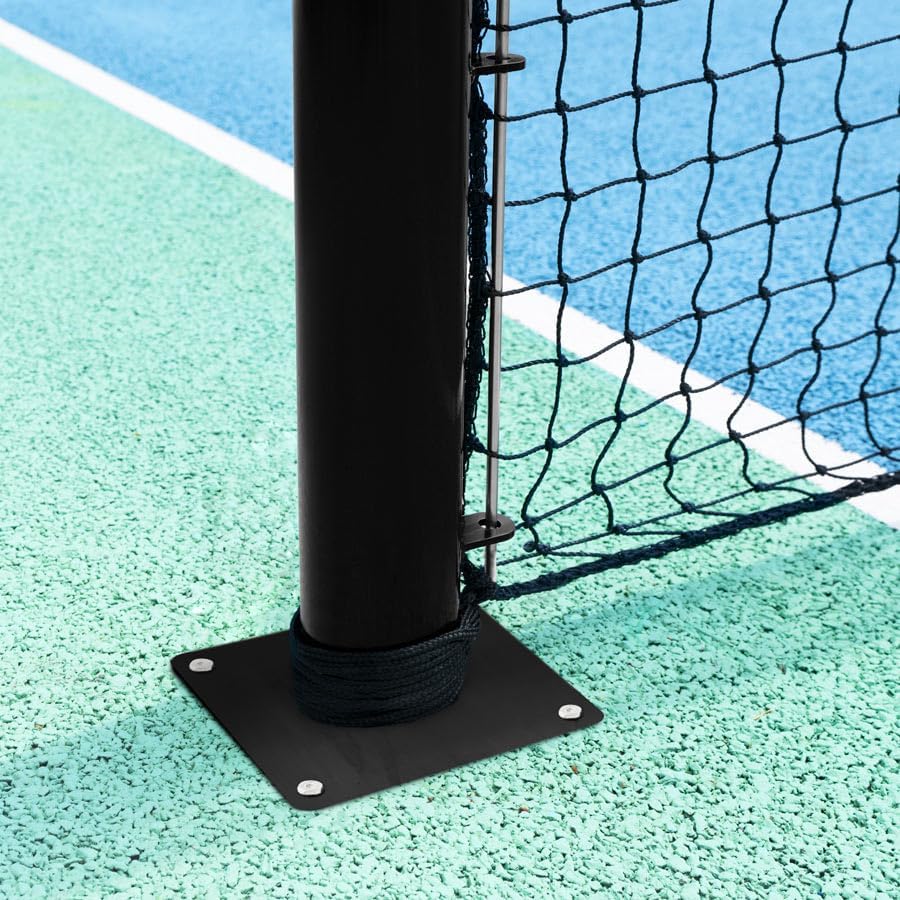
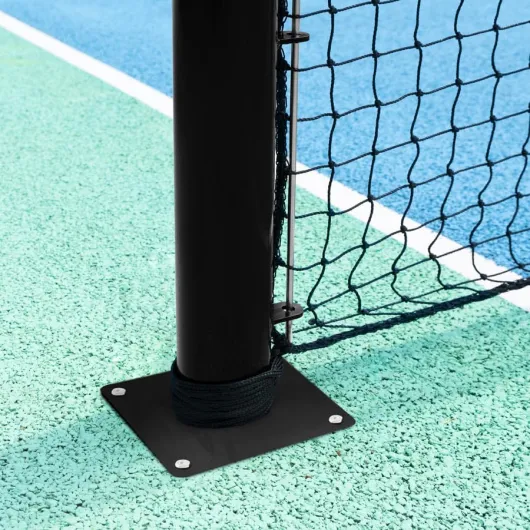
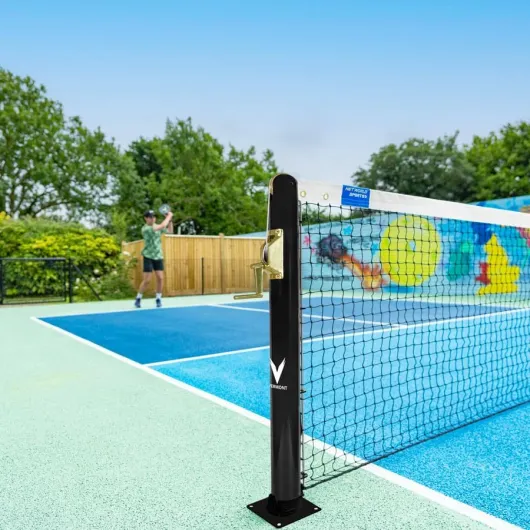
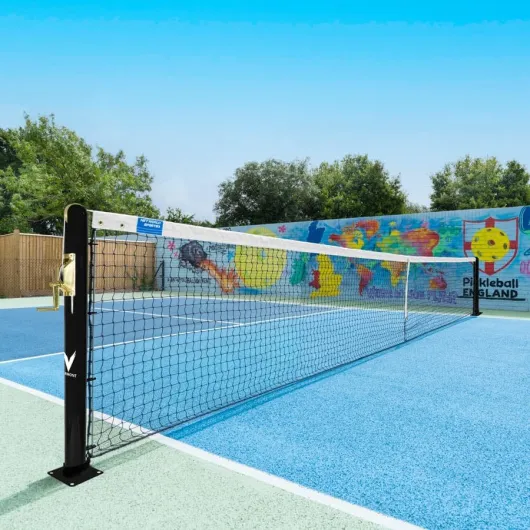
The design is pretty straightforward: two 91 cm (36") galvanised steel posts with a flat base plate that sits on the surface. The posts are regulation height for pickleball and comply with IFPA/USAPA standards, which is nice if you care about playing at the correct net height. One post has the built-in winder mechanism, and the other side is more basic with hardware to attach the cable or rope from your net. There’s also a small eyelet for a center strap so you can pull the net down to the proper 34" in the middle.
The base plates are the main difference compared to classic in-ground posts. Instead of needing concrete sleeves or drilling deep holes, you just place the plates directly on the court and, if you want, bolt them into the hard surface. There are pre-drilled holes in the plates for that. On my indoor gym test, I didn’t bolt them down (I’m not drilling the school’s floor), and they still stayed put thanks to the weight. Outdoors on asphalt, same thing: they didn’t slide around during normal play. If someone full-on crashes into the net, sure, the posts can shift a bit, but in normal use they’re stable.
Aesthetically, I picked the black version, which looks clean and blends in well with a lot of courts. They also offer blue and green, which might match proper court lines better. The finish is a powder-coated steel, which should hold up better than plain paint. After a few weeks, including some rain and being left outside for several days, I didn’t see any rust or flaking. They look like standard tennis posts, just scaled and set up for pickleball.
The only thing I found a bit annoying design-wise is the footprint of the base plates. They’re wide enough to be stable, but if your court space is tight or you’re improvising lines in a small driveway, you need to plan around them so nobody steps on the edges. They’re not sharp, but they are metal, and if someone lands on one awkwardly, it’s not going to feel great. So the design is clearly aimed at proper courts or at least a decent hard surface, not a cramped backyard where kids are running everywhere.
Materials: heavy steel, decent hardware, and built for weather
Material-wise, this thing is pretty straightforward: galvanised steel posts, a powder-coated finish, and brass hardware with some stainless steel elements like the lacing bars. The idea is to be rust-resistant enough for long-term outdoor use. I left the posts outside on an open asphalt court for about ten days straight, including a couple of rainy days and cold nights. So far, no visible rust, no bubbling under the paint, and all the moving parts on the winder still turned smoothly.
The posts themselves feel thick-walled and solid. If you tap them, there’s a dull sound—you can tell they’re not thin tubing. The base plates are also chunky, not some flimsy sheet metal. You can see why the whole kit weighs over 30 kg. The powder coating on the black version looks even and consistent. I didn’t see any obvious thin spots or scratches right out of the box. After some dragging on the asphalt (my bad, I was lazy and slid one instead of lifting it), I did mark the underside of the plate a bit, but the damage was cosmetic and only on the bottom.
The brass winder is a nice touch. On cheaper nets, that part is usually plastic or low-grade metal that corrodes fast. Here, after being exposed to some rain and then sun, the winder still looks the same and turns fine. Same with the stainless lacing bars: they feel overbuilt for pickleball, more like tennis-court hardware. If you’re used to those foldable aluminium frames with plastic clips, this feels like a different category altogether.
My only small concern is that, over a few years, the powder coating on the edges of the base plates might chip if you move them a lot and bang them against concrete. Once that happens, you’ll probably want to touch up with some anti-rust paint just to be safe. But that’s more a long-term maintenance thing. Right now, after a few weeks of fairly rough handling, I’d say the materials are pretty solid and clearly aimed at heavy use, not casual once-a-month games.
Durability: feels like it’s built for clubs more than casual backyards
In terms of durability, everything about these posts screams “installed at a club and left there for years.” Obviously, I haven’t had them for years, but I tried to be a bit rough with them to see how they handled it. I stored them in a damp garage, dragged one of the base plates over rough asphalt, left them out in the rain, and had kids hanging on the net during a family game (not recommended, but it happens). So far, there’s no bending, no obvious loosening of the welds, and the finish still looks fine aside from a few scuffs on the underside.
The galvanised steel and powder-coat combo is a good sign for long-term outdoor use. On cheap steel posts with just paint, you usually start seeing rust at the base or around bolts pretty quickly, especially if water pools around them. After a couple of wet days, I checked all the usual weak spots: bolt holes, welds at the base, and the bottom edges of the plates. Nothing yet. Obviously, long-term sun, snow, and constant use will eventually take a toll, but early signs are positive.
The moving parts are often where cheaper systems fail, and here the brass winder and stainless lacing bars feel like they’ll outlast the rest of the unit. I purposely didn’t baby the winder: I tightened the net quite hard and then released it several times. No grinding noises, no sticking. If something does fail years down the line, my guess is it’ll be the coating rather than the metal underneath. The metal itself feels overbuilt for pickleball.
My only durability-related gripe is user-induced: because these are so heavy, people are tempted to drag them instead of lifting. That’s when you scratch the base and edges and eventually expose bare metal. If you’re using them at a club or school, I’d probably tell staff and players not to drag them, or even add small furniture sliders or mats under the plates if you move them a lot indoors. But overall, they feel like they’re made to handle repeated use by groups, not just delicate weekend play.
Performance on court: stable, proper height, and easy to tension
On the court, the difference between this setup and a typical portable net is mainly about stability and tension. With my old lightweight frame, if someone brushed the net or pushed off it, the whole thing would move a few inches and the net would sag more and more over time. With these Vermont posts and base plates, the posts basically stay put. The net height stays consistent, and I don’t have to keep adjusting it between games. Over a 3-hour session with four players rotating, I only tweaked the tension once, and that was more out of habit than necessity.
The winder mechanism is actually useful. Instead of pulling on a rope and guessing, you crank the net cable to get it taut, similar to a tennis net. That gives the net a firmer feel when the ball clips the tape—it reacts more like a proper court. For people who care about a more realistic bounce and consistent play, this matters. For beginners, they might not notice much, but once you’ve played on both, you can feel the difference when the ball hits the top of the net.
Height-wise, because the posts are regulation 36" and there’s the center strap eyelet, it’s easy to get the net to the proper 34" in the middle. I used a simple tape measure the first couple of times to dial it in, then left the strap at that length. After that, it was just “set the posts down, attach the net, crank the winder a bit, and done.” I didn’t see any drift in height unless someone seriously leaned on the net, and even then, it was minor.
The only performance downside is the portability factor. Moving these around between an indoor gym and an outdoor court is annoying. You really want two people to carry them comfortably, especially if you have to walk a bit. If you’re setting them up in one place and leaving them for weeks or months, great. If you think you’ll be hauling them out of the garage every single time you play, they start to feel like overkill. So performance on court is strong, but day-to-day practicality depends a lot on how often you move them.
What you actually get in the box (and what you don’t)
When the package arrived, the first thing I noticed was the sheer weight. The box is not huge, but at 32.84 kg it’s not something you casually carry with one hand. Inside, you get two main posts, each with a heavy base plate designed to be bolted down if you want. There’s brass hardware, a winder on one post, and the eyelet for a center strap. In my case, since I went for the posts-only version, there was no net or center strap in the box, so I had to use my existing gear.
The brand pushes that you can also get an optional net and center strap/weight. Based on the spec sheet, their net is a 22 ft x 3 ft HDPP net with UV treatment and a proper headband, which sounds closer to what you see on tennis courts than the thin mesh you get with cheap portable sets. I can’t comment on their net directly because I didn’t buy that bundle, but the posts clearly look ready to handle a proper, tight net with a steel cable or headline wire.
Assembly is pretty straightforward but not “instant.” You need a basic wrench or socket set to tighten the base plate bolts and the hardware. I’d say it took me around 25–30 minutes the first time, going slowly and checking everything. After that, it’s mostly just a question of carrying the posts to the court and dropping them where you want them. If you plan to bolt the base plates into concrete or a wooden deck, that’s extra work and tools that are not included.
So in terms of presentation, it’s very much a no-nonsense, functional kit. No fancy branding, no big instruction booklet with color photos. You get what you need to put up two regulation-height posts, and that’s about it. Personally, I’m fine with that, but if you like products that come with tons of accessories and detailed guides, this feels a bit bare-bones. On the upside, there’s not much you can mess up: two posts, base plates, hardware, and you’re ready to go.
Pros
- Very stable and heavy, with regulation-height posts that keep the net at proper tension
- Galvanised steel, powder coating, and brass/stainless hardware hold up well outdoors
- Base plates avoid the need for ground sleeves or concrete work, good for hard courts
Cons
- Heavy and not very portable; awkward to move frequently by one person
- Posts-only version means you still need to buy a net and center strap separately
Conclusion
Editor's rating
Overall, the Vermont Pickleball Posts with Base Plates are solid, heavy-duty posts that make sense if you want something close to a permanent court without actually setting posts in concrete. The build quality is good, the materials feel ready for outdoor use, and on-court performance is much better than the usual flimsy portable nets. The net stays tight, the height is correct, and the whole setup feels more like a real court than a temporary backyard rig.
They’re not perfect. The weight that gives them stability also makes them annoying to move often, and this posts-only version means you still need to bring your own net and center strap. For a casual player who just wants to set up quickly and pack away after every game, I’d say this is too much. But for clubs, schools, or anyone with a dedicated hard surface who plans to leave the posts in place most of the time, they’re a pretty solid choice. You pay a bit more upfront, but you’re likely getting several years of reliable use out of them.