Summary
Editor's rating
Is it worth the money compared to a wall or cheaper nets?
Big surface, smart markings, a few quirks
Metal frame and tight net: solid, but not bulletproof
Built to last a few seasons if you treat it like sports gear, not furniture
How it actually plays for dinks, drops, and drives
What you actually get out of the box
Pros
- Large 6ft x 6ft surface makes solo practice more forgiving and realistic
- Multiple angle settings that actually change the type of rebound (good for dinks, drops, and low balls)
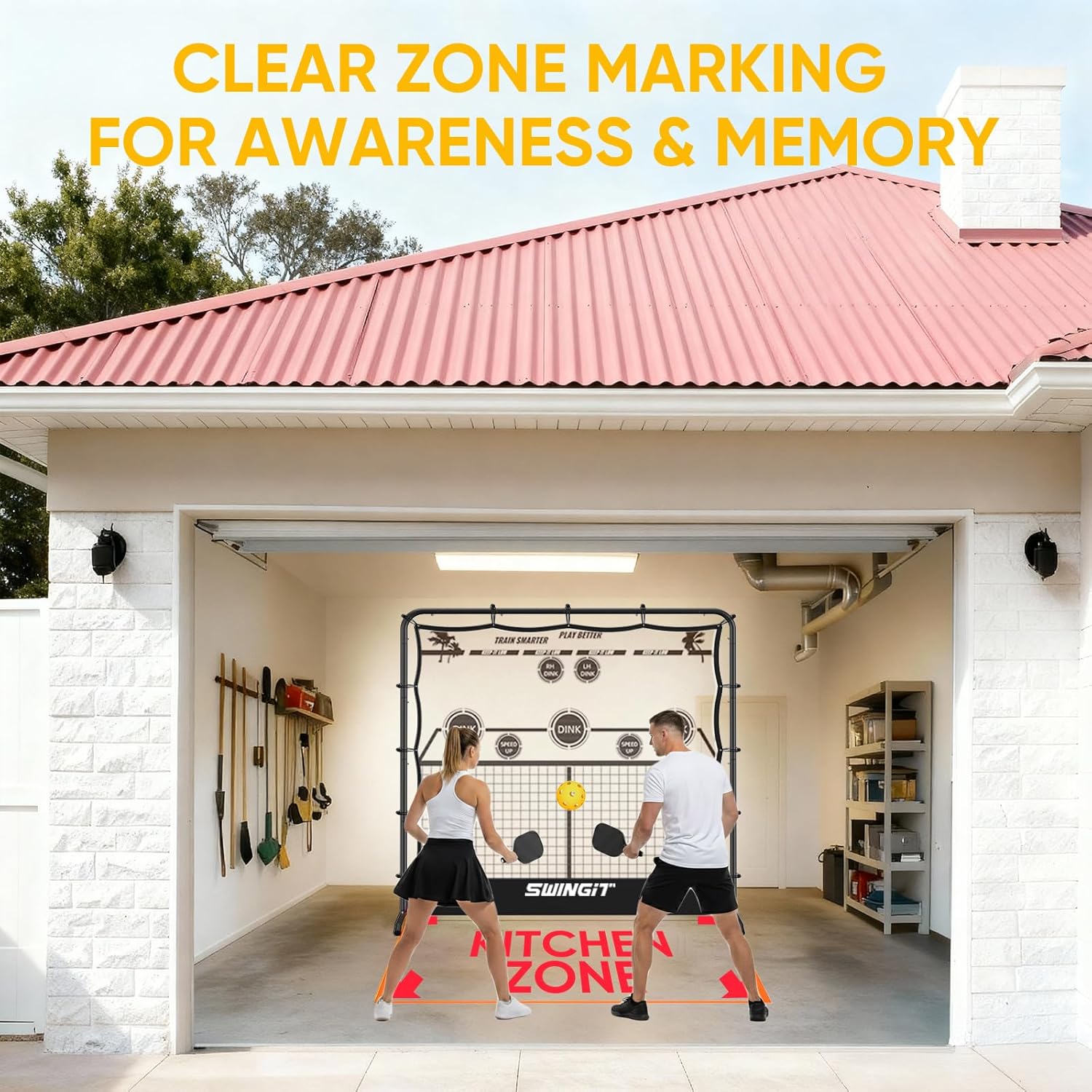
- Quiet, court-like practice in driveway/garage with net height and kitchen markings for real-game references
Cons
- Net tension is fairly soft out of the box and may require extra bungee cords for a stronger rebound
- Initial assembly and net fitting can be tricky since the net must be pulled very tight
Specifications
View full product page →| Brand | Net Playz |
A practice partner that doesn’t cancel last minute
I’ve been using this Net Playz 6-foot pickleball rebounder for a few weeks because I was tired of driving to the courts and then standing around waiting for games. I wanted something I could throw in the driveway or garage and just grind dinks and volleys without needing a partner. On paper, this thing ticks all the boxes: big surface, angle adjustments, and it’s actually designed for pickleball, not just a random soccer or tennis rebounder.
In practice, it’s pretty close to what I expected: useful, not perfect. It helps a lot with consistency, control, and getting more touches on the ball, especially on dinks, drops, and basic volleys. It’s not magic, it won’t turn you into a 4.5 by itself, but if you put in the reps, it does help you clean up your soft game and timing. I’m around a 3.5 player and I mainly used it to work on third-shot drops and firefights.
The first thing that stood out is the size. Six feet by six feet is actually a big bonus. I’ve hit on smaller 4x4 rebounders before, and you end up chasing balls constantly when you miss by a little. Here you’ve got more margin, especially on high balls above the net area. It feels closer to hitting into an actual court space rather than a tiny target. That alone made the sessions less annoying and more realistic.
It’s not flawless though. Tension of the net is the main thing that decides whether you like it or not. Out of the box, the rebound is on the softer side. Good for soft game, slightly underwhelming if you want to blast drives and get a quick return. I had to tweak the bungees and add a couple more to get a snappier bounce. So if you’re expecting a super lively wall-like rebound right away, you’ll probably be a bit underwhelmed until you play with the setup. Overall, it’s a pretty solid training tool if you understand what it’s good at and where it falls short.
Is it worth the money compared to a wall or cheaper nets?
In terms of value, this sits in that zone where it’s not dirt cheap, but not outrageously priced either. It’s more expensive than a basic rebound net or some DIY setup against a wall, but you’re paying for a few specific things: the bigger 6x6 size, the angle adjustments, and the pickleball-specific markings. If you’re a casual player who only hits once in a while, it might feel like overkill. But if you’re someone who actually drills, wants to move up levels, and doesn’t always have a partner, it starts to make sense.
Compared to just hitting against a wall, here’s the trade-off: a wall is cheaper and gives you a harder rebound, but it’s loud, not adjustable, and usually doesn’t have any net height or kitchen references. This rebounder is quieter, more flexible with angles, and gives you better visual cues for real match situations. For me, being able to set it up in the garage and not annoy the entire neighborhood is a big plus. I also like that I can quickly fold it and lean it against the wall when I’m done, which you obviously can’t do with a cement wall.
There are cheaper, smaller rebounders out there, but most of them are 4ft wide and not really built with pickleball in mind. You can still use them, but you’ll be chasing more balls and you won’t get the same feel for net height and kitchen shots. The extra size on this one genuinely improves the training experience. The Amazon rating around 4.4/5 feels fair to me: it’s good value if you’ll actually use it regularly, not a miracle deal but not overpriced for what it offers.
On the downside, having to potentially buy extra bungee cords to get the rebound you really want is a bit annoying given the price. It’s not a huge expense, but it’s still an extra step. Also, if you expect this to fully replace court time or real opponents, you’ll be disappointed. Think of it as a tool to add more quality reps, not a full training solution. If you keep that in mind, the value is solid. If you’re on a tight budget and have access to a decent wall, you might be better off saving the money and just taping a fake net line on the wall.
Big surface, smart markings, a few quirks
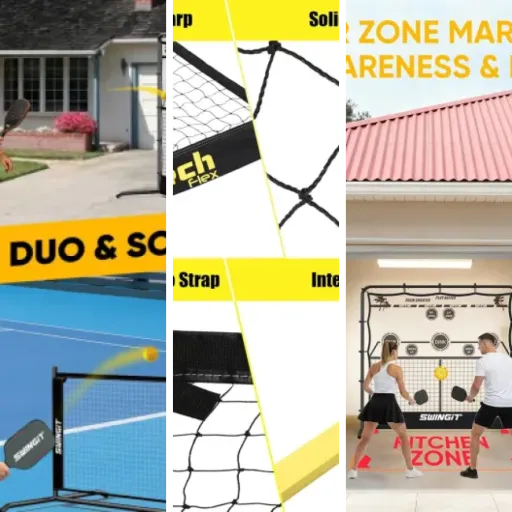
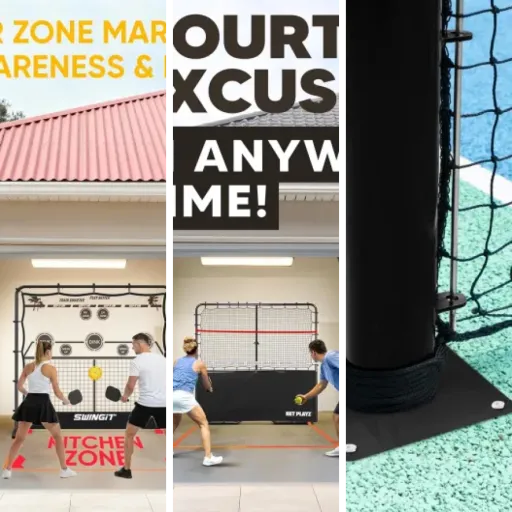
The design is fairly straightforward: a big rectangular frame with a rebound net stretched across it, plus a couple of webbing straps and markings. What I liked is the 6ft x 6ft size. Compared to the usual 4ft-wide rebounders, this one feels way more forgiving. You can work cross-court dinks, higher lobs, and even a bit of off-center stuff without constantly missing the net. For solo training, that matters a lot because nothing kills a session faster than chasing balls every 30 seconds.
The front has a standard net height indicator and an adjustable target line. The height strap gives you a clear idea of where the net would be in a real game, which is helpful when you’re working on clearing the net by just a small margin on drops. The target webbing can be moved to different spots so you can focus on hitting a specific zone. It’s basic but effective. I used it mostly to aim deep third-shot drops and to practice hitting at someone’s feet for firefights.
The angle adjustment system is simple: you move the rear support to preset positions for 70°, 80°, 90°, or 120°. It’s not some micro-precise mechanism, but it holds fine and you can change it in under a minute. I found myself using 80° the most for general dinks and volleys, 90° for flatter drives and block volleys, and 120° when I wanted to work on digging out low balls. 70° felt a bit too slow for me, but for beginners or warming up, it’s probably useful.
On the downside, the way the net attaches can be a little picky. A couple of Amazon reviewers mentioned feeling like the net didn’t fit properly or only covered part of the frame until they really cranked it tight. I had the same initial feeling: you think you’ve done something wrong because you have to pull it quite hard to get it on. Once you accept that it’s supposed to be tight, it makes more sense, but the first build feels a bit awkward. Also, if you want a livelier bounce, you’ll probably end up adding extra bungee cords like I did, which isn’t included in the box. So the design is practical and thought-through, but you might need to tweak it to match your preferences.
Metal frame and tight net: solid, but not bulletproof
The frame is metal (they say metal, feels like a light steel or aluminum mix), and for home training it’s decent. It’s light enough that you can move it around by yourself, but not so light that it tips over every time you smack a drive at it. I hit it with some pretty firm shots and it didn’t wobble much. As long as the feet are fully opened and you’re on a flat surface, stability is fine. I wouldn’t hang off it or let kids climb on it, but for pickleball use, it’s good.
The rebound net itself feels like a tough synthetic mesh. Out of the box, the tension is on the lower side, so the rebound is softer and more controlled. That’s actually good for dinks and beginners, but if you’re a stronger player and want a quick pop back, you’ll probably feel it’s too dead. Just like one of the Amazon reviews said, I also ended up adding extra bungee cords around the frame to tighten it more. Once I did that, the rebound was noticeably firmer and more fun for firefights and drives.
The included straps (target line, net height webbing, and non-volley line) are basic nylon-style webbing. They do the job, nothing fancy. The printing/markings are clear enough to see from a normal hitting distance. Over time, I could see the white lines getting dirty if you leave the rebounder outside all the time, but that’s just normal outdoor gear aging. I kept mine either under a covered patio or in the garage, and after a few weeks of use there was no visible wear beyond a bit of dust.
One review mentioned the net only covering about 80% of the top area. I didn’t have that exact problem, but I get why they said it: if you don’t pull the net extremely tight and hook it correctly in the corners, it can look like it doesn’t fully reach. The tolerances are tight, which is good for rebound, but can be a bit annoying during assembly. Overall, the materials feel good enough for regular adult and teen use. This is not a cheap toy, but it’s also not built like commercial gym equipment. For home players drilling a few times a week, it’s fine.
Built to last a few seasons if you treat it like sports gear, not furniture
Durability-wise, after a few weeks of use I don’t see any red flags. The frame hasn’t bent, the joints still feel solid, and the net hasn’t stretched out in any obvious way. I’ve hit hundreds of balls at it, from soft dinks to full drives, and it’s holding up fine. The bungees are always the weak point on this kind of product, and they still look okay so far. If something is going to wear out first, it’ll probably be those or the net edges where they attach to the frame.
The metal frame feels like it can survive normal backyard abuse: occasional bumps, moving it around, folding it, and storing it in a garage. I wouldn’t leave it permanently exposed to rain and sun if you want it to last several years. It’s metal plus synthetic netting; UV and moisture will eventually take their toll. If you treat it like any other outdoor sports gear (cover it or bring it in when you’re not using it for a while), you’ll probably get multiple seasons out of it without issues.
Some users mentioned net fit problems, like the net not covering the entire top area or feeling too short. That sounds more like a quality control or installation quirk than true durability. In my case, the net was tight but fine once fully stretched. The sewing and stitching look decent, not sloppy. The webbing straps haven’t frayed, and the printed lines are still clear. Again, this isn’t pro-club equipment, but for home practice it’s solid.
If you’re the type who wants something you never have to touch or adjust again, this might annoy you a bit because you’ll probably end up re-tensioning the net or replacing some bungees over time. If you’re okay with occasionally tweaking it, it’s perfectly acceptable. I’d rate durability as pretty solid for the price and intended use, with the caveat that you shouldn’t leave it out in a storm and expect it to look brand new forever.
How it actually plays for dinks, drops, and drives
Performance-wise, this rebounder is clearly tuned more for control and consistency than raw power. If you’re working on dinks, third-shot drops, or just getting cleaner contact, it’s very helpful. At about 10–15 feet away on the 80° setting, you get a nice, predictable rebound that forces you to soften your hands and aim. It’s great for drilling patterns like cross-court dinks or straight-ahead volleys. You can hit 100+ balls in a row without thinking about it, and that kind of repetition is exactly what most of us don’t get enough of in games.
For firefights and drives, it’s decent but requires some tweaking. Out of the box, the net doesn’t send the ball back super fast. You can absolutely work on block volleys, punch volleys, and some defensive reactions, but it doesn’t fully mimic a hard hitter on the other side. Once I tightened the net with extra bungees, it got closer to what I wanted. I could stand fairly close and rip balls at it, and the rebound forced me to react quickly. Still, it’s a bit softer than a concrete wall, which is both a plus and a minus: quieter and easier on joints, but not as lively.
The angle options do what they promise. At 70°, the rebound is slower and higher, which is nice for overhead practice or absolute beginners. At 80°, you get a more realistic rally feel for dinks and basic groundstrokes. At 90°, the ball comes back flatter and quicker, good for blocks and drives. 120° is the interesting one: with the net leaning back, low shots come off the bottom section and force you to bend and scoop, which is good training for digging out tough kitchen balls. It’s not perfect, but it’s a clever way to mix in more demanding shots.
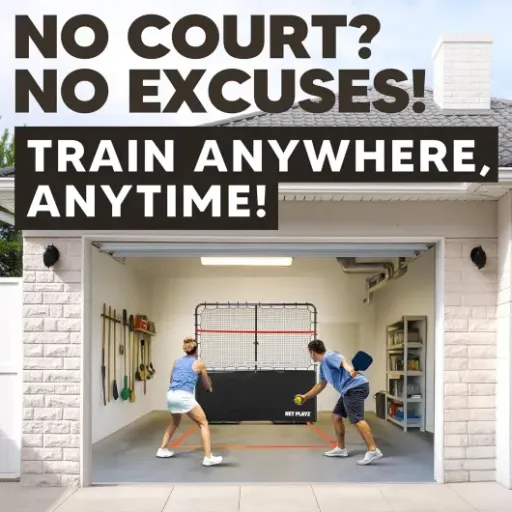
One thing I liked is you can use it pretty much anywhere: driveway, garage, backyard. I used it indoors in a garage during bad weather and the noise level was fine. Much quieter than slamming balls into a wall. So if you have neighbors who complain, this is a nice compromise. Overall, in terms of pure performance, I’d say it’s strong for solo drilling and touch work, decent for power training. It won’t fully replace real opponents, but it definitely increases your reps and helps smooth out your mechanics.
What you actually get out of the box
When you unpack the box, you’re basically looking at a metal frame and a bunch of nets and straps. Inside you get: the main frame, the rebound net, a target webbing, a net height webbing, a non-volley (kitchen) line, a baffle cloth, and a simple instruction sheet. No tools needed beyond what’s included, which is nice. It’s clearly built specifically with pickleball in mind, not some generic multi-sport thing they just relabeled.
The frame is metal and feels reasonably sturdy for home use. It’s not gym-grade equipment, but it doesn’t feel flimsy either. Once it’s all assembled, the footprint is about 6ft x 6ft, so it’s not tiny. You need some space in your driveway, garage, or backyard to use it without constantly worrying about hitting cars, walls, or neighbors. I used it in a two-car garage and in a backyard patio area; both worked fine as long as I stood about 10–20 feet away depending on the drill.
The angle adjustability is a big part of how they present this thing: 70°, 80°, 90°, and 120° options. The idea is simple: shallower angle = slower, softer rebound; steeper = faster, flatter return; and 120° tilted back to simulate low skidding shots from the kitchen. That breakdown is actually accurate in real use. You can feel a clear difference between the settings, and it does change how you have to prepare your paddle and footwork. It’s not some gimmick; the angles do affect the drill.
Marketing-wise, they talk a lot about mastering dinks, kitchen control, and realistic rebounds. I’d say they’re a bit optimistic in the wording, but the core is true: this is mainly a control and consistency tool. If you expect a perfect match simulation, you’ll be disappointed. If you just want something reliable to hit 300 dinks in a row without a partner, it does that job pretty well. The included target line and net height indicator are simple but useful to give you visual references so you’re not just randomly bashing balls into a big square.
Pros
- Large 6ft x 6ft surface makes solo practice more forgiving and realistic
- Multiple angle settings that actually change the type of rebound (good for dinks, drops, and low balls)
- Quiet, court-like practice in driveway/garage with net height and kitchen markings for real-game references
Cons
- Net tension is fairly soft out of the box and may require extra bungee cords for a stronger rebound
- Initial assembly and net fitting can be tricky since the net must be pulled very tight
Conclusion
Editor's rating
Overall, the Net Playz 6ft Pickleball Rebounder is a pretty solid training partner if you want to practice alone and actually care about improving your control and consistency. The big 6x6 surface, angle options, and net height/kitchen markings make it much more useful than a random small rebound net. It shines for dinks, drops, and basic volleys, and with a bit of tweaking (extra bungees), it’s decent for firefights and drives too. Noise is low enough for garage or driveway use, which is a big plus if you live in a neighborhood.
It’s not perfect. Out of the box, the rebound is on the softer side, and you might need to play with the net tension to get the feel you want. Assembly can feel a bit awkward the first time because the net has to be pulled very tight, and a couple of users clearly struggled with that. Also, it’s not cheap, so if you’re a very casual player or you already have a good wall available, you might not get full value out of it.
I’d recommend this to players from beginner up to around 4.0 who want more touches on the ball without relying on a partner: people working on soft game, third-shot drops, and basic reaction speed. If you’re more into pure power training, or you hate fiddling with gear and adjusting bungees, you might want to look at a harder, more basic wall solution. But if you’re willing to spend a bit for a dedicated pickleball trainer, this one does the job well and should last a few seasons with normal care.