Why 3.0 players lose the point before the serve crosses the net
Most 3.0 pickleball players think doubles is about better shots. In reality, many points are lost because the serving team starts in the wrong place on the pickleball court and never fixes its court positioning before the opponents attack. If you stand too deep, drift sideways, or freeze in the transition zone, you donate free points to any halfway organized team.
This pickleball doubles positioning guide focuses on where to stand when your partner serves, because that first formation quietly shapes every rally you play. In doubles pickleball, the serving team begins at a structural disadvantage since both players must respect the bounce rule before they can volley, so smart positioning pickleball decisions are the only way to keep opponents from camping at the kitchen and hammering down at your feet. When you understand the geometry of the court and how to move forward together, your points won start to climb even if your third shot is only average.
Think of the serve as a trigger for a choreographed team movement, not a solo act. Your partner hits the ball, you both execute a planned step court pattern, and you land in the right volley zone instead of getting stuck halfway. That mindset will help you play pickleball with more intention, especially for women and men at the 3.0 level who already know the rules but have never been handed a clear doubles strategy map.
The serving team shape: up and back, not both deep
When your partner serves in pickleball doubles, the correct default is simple. The server stands behind the baseline on the correct side of the pickleball court, and the non serving partner starts at the kitchen line on the same half of the court as the server. This up and back shape gives your team immediate pressure at the net while still respecting the bounce rule on the return.
Too many 3.0 players in doubles pickleball stand deep with the server, leaving the entire kitchen open and inviting opponents to float a soft return and then move forward uncontested. If you are the non server, your job is to step court up to the non volley zone line before the serve, set your pickleball paddle in a ready position, and prepare to defend quick drives or lobs that might sneak over your partner. This court positioning may feel aggressive at first, but it will help your team control the middle and shorten the distance you must move forward after the third shot.
Players with cranky knees or slower first steps sometimes fear this forward role, yet smart footwork can protect your joints while you still play up. A simple knee smart footwork reset, like the patterns explained in a knee friendly pickleball footwork guide, shows how short split steps and compact shuffles let women and men hold the kitchen line without overstriding. Once you trust that movement, you stop hiding deep and start playing as a real serving team instead of two singles players sharing a game.
Exactly where to stand when your partner serves
Positioning starts with centimeters, not slogans. When your partner serves from the right side in pickleball doubles, you as the non server should stand about 0.3 to 0.5 metres (roughly 1 to 1.5 feet) behind the kitchen line and roughly one large step inside the sideline, with your body angled slightly toward the middle. Taller players can shade a touch deeper, while shorter players may stand a little closer, as long as you stay out of the kitchen for legal volleys. This stance keeps you clear of non volley zone faults while letting you pounce on any ball drifting toward the middle or floating too high.
If the serve comes from the left side, mirror that same court positioning on the left half of the pickleball court, again shading a little toward the middle to close the central gap between partners. Your paddle should sit at chest height, ready for a quick reaction, because many opponents at the 3.0 level love to drive the return straight at the non server to test their reflexes and doubles strategy awareness. By starting close to the non volley zone line, you shrink the angles they can use and keep opponents from blasting easy winners through the middle.
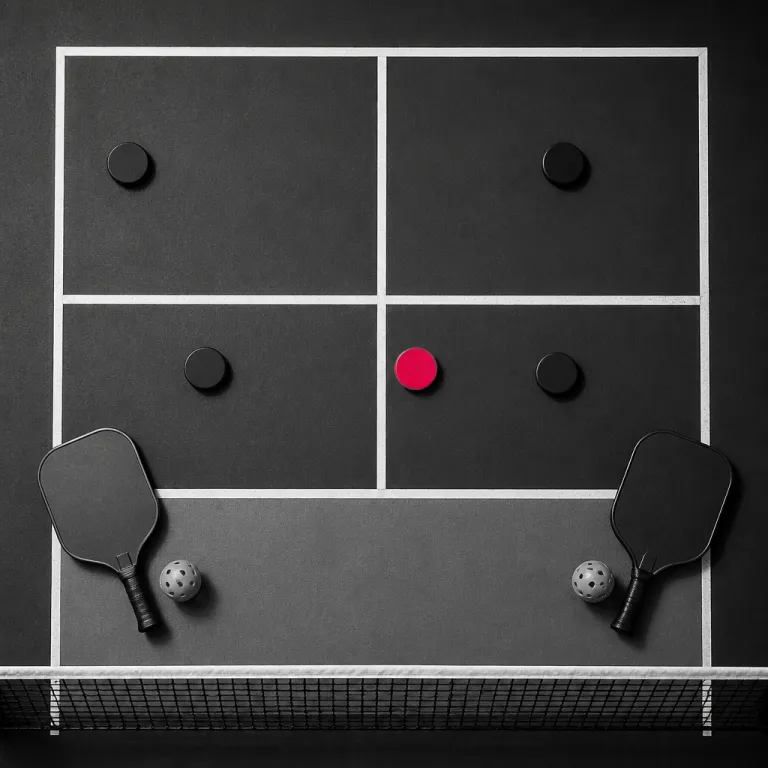
For players who like visual maps, a dynamic guide to footwork and positioning mastery can help you picture these exact spots and the angles they create. The annotated court diagram below shows a simple printable pickleball positioning map you can sketch or download and keep in your bag as a quick reminder before you start playing.
[Printable Positioning Map – Serving Team]
Legend: S = Server, P = Partner (non server)
Baseline
---------------------------------
| | |
| S | | <– Server behind baseline
| | |
| | |
| | |
| P | | <– Partner 0.3–0.5 m behind NVZ,
| (1 step | | 1 step inside sideline,
| inside line) | | shaded toward middle
---------------------------------
NVZ / Kitchen Line
Reading the return and timing your move forward
Once the serve leaves your partner’s pickleball paddle, the real work begins. The serving team must survive the return, hit a playable third shot, and then move forward together through the transition zone without getting pinned by a deep drive at the feet. That is where most 3.0 points are quietly decided, long before the highlight reel volley at the kitchen.
As the non server, you should watch the return of serve like a hawk and call out what you see to your partner. If the return lands deep and heavy, your partner may need to hit a safer third shot drive or a higher third shot drop, which means you delay your move forward for a split second and respect the chance of a counterattack. When the return sits shorter or slower, you can move forward more aggressively as a team, using small split steps to stay balanced and ready for a quick ball at your body.
Drills that force you to walk through this pattern are worth more than any sale shop impulse paddle upgrade. A backwards walking drop pattern, for example, teaches you how to control the ball while retreating and then move forward again under pressure, which directly translates to better third shot decisions in live play. A simple checklist for practice might include 10 minutes of serve and return patterns, 10 minutes of third shot drops while moving, and 5 minutes of transition footwork without the ball. For clarity, treat each block as a repeatable protocol: 3 sets of 10 serves and returns with full movement, 3 sets of 8 to 10 moving drops per side, and 5 one minute rounds of shadow steps through the transition zone at a steady, controlled tempo.
The middle, the transition zone, and who owns which ball
The ugliest errors in recreational doubles come from confusion, not lack of talent. Two pickleball players drift toward the same sideline, nobody claims the middle, and a slow ball rolls between them while both stare in disbelief. That is a court positioning failure, and it usually starts with poor spacing when the partner serves.
From the moment the serve is struck, imagine a vertical line splitting your half of the pickleball court into two lanes. You own the lane closest to you and share responsibility for the middle with your partner, using a simple rule that the player with the stronger forehand in the middle usually takes that ball when both are at the kitchen. During the rally, if one partner is closer to the non volley zone line while the other is still in the transition zone, the player closer to the kitchen should usually claim the middle ball because they see the angles earlier and can volley down into open space.
The transition zone itself, that strip between the baseline and the kitchen, is the worst place to stop moving. Any deep, quick drive at your feet there is almost unreturnable, especially for women and men still building soft hands and balance under pressure. Your goal in every point is to move forward through that zone together after a controlled third shot, then hold the line so you can play pickleball on your terms instead of reacting to whatever the opponents choose.
Printable positioning map: four formations every 3.0 team needs
Thinking in pictures helps many recreational players lock in better habits. A simple doubles positioning map breaks the game into four repeatable formations that you and your partner can rehearse until they feel automatic. Once these shapes are clear, every serve, return, and rally becomes a variation on a familiar pattern instead of a new puzzle.
The first formation is the serving team shape, with the server deep and the partner at the kitchen, shaded slightly toward the middle to close gaps. The second is the return team shape, where both players aim to reach the non volley zone line quickly after the return, forming a straight wall across the kitchen that forces the serving team to hit a quality third shot. The third is the transition formation, where both partners in pickleball doubles move forward in sync after the third shot, staying about one metre apart so no middle ball falls between them while they cross the danger zone.
The final formation is the kitchen line battle, where both teams are up and every ball is a test of patience, soft hands, and smart doubles strategy. In this phase, tiny shifts in positioning pickleball decisions, like taking half a step toward the middle or backing off 0.2 metres to handle a fast ball, can decide close points won or lost. To make this easier, sketch a basic court diagram on paper, mark the four formations with simple Xs for each player, and keep that printable map in your bag as a quick visual reminder before you start playing.
Key figures on doubles positioning and recreational play
- Recent USA Pickleball membership reports, such as the 2023 USA Pickleball Annual Growth Report, describe doubles as the primary format for a large share of new players, which means learning where to stand with a partner has a direct impact on the majority of recreational games played.
- Participation surveys from the Sports & Fitness Industry Association (SFIA), including the 2023 SFIA Pickleball Report, note that women make up a substantial portion of core players, so any pickleball doubles positioning guide must address movement patterns and court coverage that work for mixed and women’s teams, not just men’s pairings.
- Coaching clinics that track common mistakes consistently find that many unforced errors at the 3.0 level occur within a couple of metres of the non volley zone line, highlighting how critical kitchen positioning and transition footwork are for improving points won. Local teaching pros who chart rec play often estimate that well over half of rally ending errors at this level happen near the kitchen.
- Local coaches who review match play at club tournaments often report that serving teams who reach the kitchen together within the first few shots of the rally win a clear majority of those points, compared with far fewer when one partner remains stuck deep near the baseline. While exact percentages vary by club, informal charting frequently shows a swing of 15 to 25 percentage points in favour of teams that close the net early.
- Equipment usage surveys from major paddle brands and retailer sell through data suggest that most recreational pickleball players own one or two paddles with average weights between roughly 215 and 235 grams, so better court positioning and movement usually offer more immediate gains than another marginal paddle upgrade.
FAQ: doubles positioning when your partner serves
Where should I stand when my partner serves in doubles
In standard doubles, the server stands behind the baseline while the non server starts near the kitchen line on the same side of the court. You should position yourself about 0.3 to 0.5 metres (around 1 to 1.5 feet) behind the non volley zone line and one step inside the sideline, angled slightly toward the middle. Taller players can stand a fraction deeper, while shorter players may prefer a touch closer, as long as you avoid stepping into the kitchen on a volley. This stance lets you protect the middle, react to quick drives, and support your partner’s third shot without risking a kitchen fault.
Why is it bad for both partners to stand deep on the serve
When both partners stand deep behind the baseline, the serving team leaves the entire kitchen open and hands the initiative to the returners. Opponents can hit a controlled deep return, move forward together, and establish a strong wall at the non volley zone line before you even hit your third shot. That pattern forces you to attack from the transition zone under pressure, which usually leads to rushed swings and easy points for the other team.
How do we decide who takes the middle ball in doubles
A simple rule for most recreational teams is that the player with the forehand in the middle should usually take that ball when both partners are at the kitchen line. If one partner is closer to the non volley zone while the other is still in the transition zone, the player closer to the kitchen should often claim the middle because they see the ball earlier. Clear communication, like calling “mine” or “yours” early, prevents hesitation and closes the gap that many opponents love to target.
What is the transition zone and why is it dangerous
The transition zone is the area between the baseline and the kitchen line, where players often move forward after serving or returning. It is dangerous because any deep, quick drive at your feet there is hard to handle, especially if you are off balance or still walking. Good doubles positioning means using small split steps, soft third shots, and coordinated movement so you pass through this zone quickly instead of camping there.
How can I practice better doubles positioning without a coach
You can mark target spots on the court with tape or cones to show where the server, non server, and return team should stand in each phase of the rally. Then run simple patterns with a partner, such as serve, return, third shot, and move forward together, pausing after each shot to check your spacing and angles. For a short solo or partner session, aim for 3 sets of 10 serves with full movement, 3 sets of 10 third shot drops while advancing, and 5 minutes of shadow footwork through the transition zone. Repeating these patterns for 15 to 20 minutes per session builds automatic habits that carry into real games, even without formal lessons.