Summary
Analysis score
Average of the criteria rated below
Value for money: niche tool with trade-offs in space and polish
A big, court-style layout with hidden footprint
Metal frame and training straps: built for realism more than portability
Sturdy on paper, but early feedback flags assembly issues
Angle options and kitchen focus: how it should behave in practice
What this 6-foot Net-Playz rebounder actually offers
Pros
- Large 6 ft x 6 ft rebounding surface with pickleball-specific layout (kitchen line, net height, target strap)
- Multiple angle settings (around 70°, 80°, 90°, 120°) for different shot types and difficulty levels
- Metal construction and 13.56 kg weight should provide solid stability during practice
Cons
- Reported missing bolts in the assembly kit raise quality control concerns
- Real footprint is quite large (around 3.14 m depth), making it hard to use in small spaces
- Very limited user feedback so far, with only one review and a modest 3.0/5 rating

Specifications
View full product page →| Brand | Net-Playz |
A solo pickleball partner when courts and partners are scarce
The Net-Playz 6-foot Pickleball Rebounder is clearly aimed at players who want to work on their soft game without needing a partner or even a court. It’s a 6 x 6 ft metal-framed rebound net, sold as a way to drill dinks, volleys and groundstrokes in a garage, driveway or backyard. On paper, it focuses heavily on control and kitchen work rather than just blasting balls as hard as possible. The marketing angle is simple: more repetitions, more consistency, without waiting for court time or friends’ schedules.
The product has a modest public rating of 3.0/5 stars from a single Amazon review, so the feedback volume is very low. That means there’s not much data from buyers yet, but the one detailed comment already points out some practical issues around missing hardware and the real footprint once assembled. In other words, this is not a widely proven classic yet; it looks more like a niche training tool still waiting for more long-term user feedback.
From the spec sheet, the concept is interesting: adjustable angles from 70° to 120°, a marked kitchen zone, a net-height indicator and a target strap to work on precision. Those features suggest a product designed more by players than by pure marketers. The frame is metal and the listed weight is about 13.56 kg, which should make it stable but also quite heavy to move around frequently.
In my opinion, this rebounder sits somewhere between a clever training aid and a slightly awkward piece of gear that needs space and tolerance for setup quirks. If you have room and patience, it could help you groove your strokes. If you’re short on space or easily annoyed by assembly issues, the early feedback and the overall bulk should make you think twice before pulling the trigger.
Value for money: niche tool with trade-offs in space and polish
There’s no clear public price listed here, so value has to be judged against what you’re getting and the kind of alternatives typically available. A 6 ft x 6 ft metal rebounder with angle adjustability, kitchen markings, a target strap and net-height indicator is more specialized than a basic flat practice wall or a cheap, small rebound net. You’re paying—at least conceptually—for a more realistic simulation of the front of a pickleball court and the ability to do many types of drills solo.
However, the current Amazon rating sits at 3.0/5 stars from just one buyer, and that buyer already raises two key issues: missing bolts in the assembly kit and a real depth of about 3.14 meters once the full frame, including the rear structure, is accounted for. That hidden footprint can be a deal-breaker if you planned to use it in a compact garage or tight backyard. Missing hardware on a brand-new product is also the kind of problem that makes people question whether they’re getting good value, regardless of how clever the design is.
Compared to generic rebounders (often aimed at tennis, soccer or multi-sport use), this Net-Playz model is more focused on pickleball specifics: the kitchen zone, net height, and the angle tuning for dinks and low shots. If you are an active pickleball player who values targeted practice, that focus can justify a higher price than a generic net. On the other hand, if you just want something to bounce balls against now and then, a simpler and smaller rebounder could be cheaper, easier to move, and less intrusive in your space.
In my opinion, the value is decent but not mind-blowing, and it heavily depends on your situation. If you have enough room, are serious about drilling dinks and control, and don’t mind dealing with some assembly quirks, this could be a worthwhile investment in your training. If space is tight, you’re sensitive to quality-control headaches, or you only play casually, there are likely more straightforward and cheaper solutions that will fit your needs better.
A big, court-style layout with hidden footprint
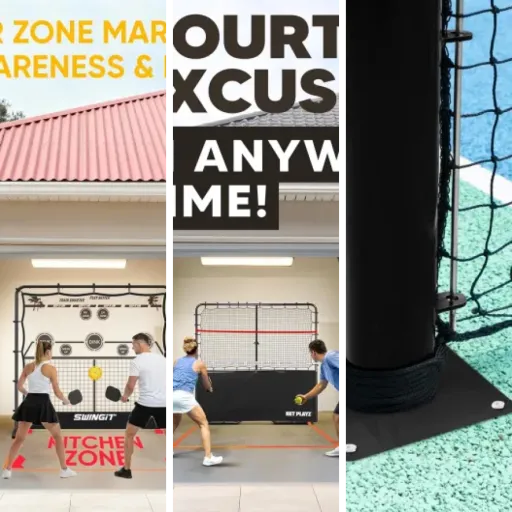
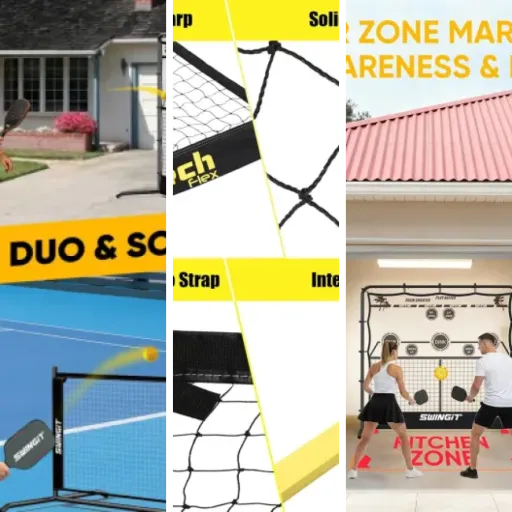
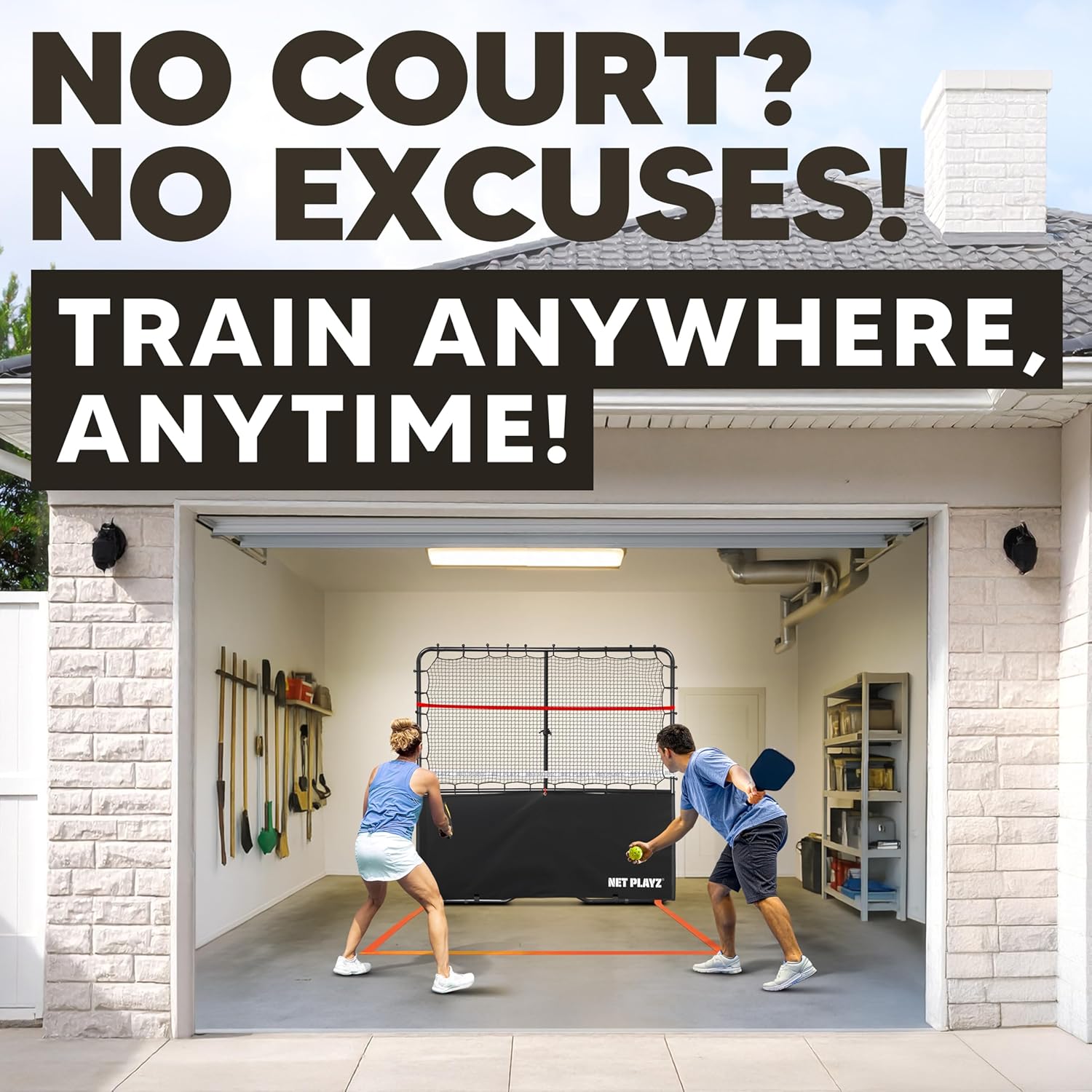
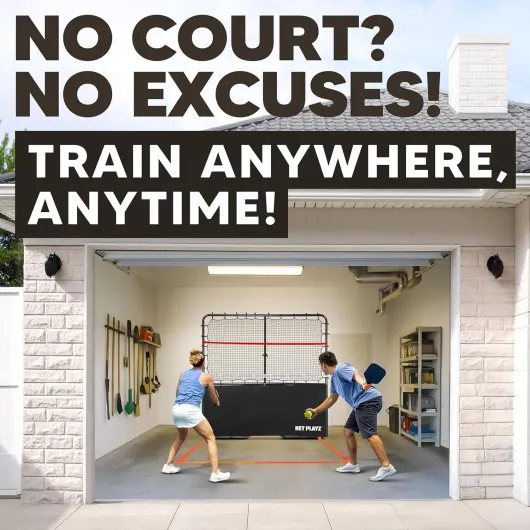
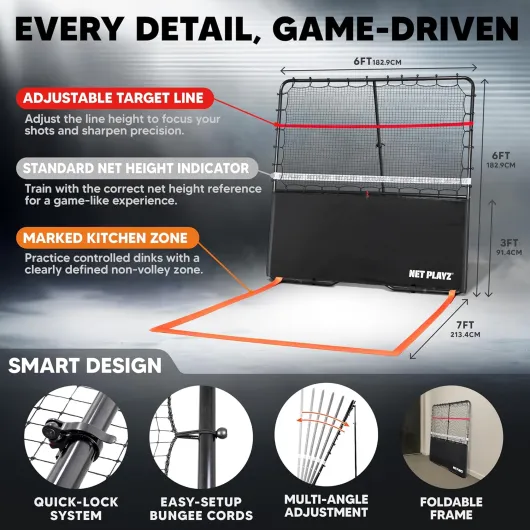
Design-wise, the Net-Playz rebounder goes for a full 6 ft x 6 ft face and a black metal frame, which on paper should give you a generous hitting area. That’s useful if your accuracy isn’t perfect yet or you’re working on footwork and want to move side to side without constantly missing the net. The added orange non-volley line marks out the kitchen zone on the ground, while the white strap indicates net height, and the red strap gives you a clear aiming line. So visually, you’re not just hitting at a blank wall; you’re working with a mock-up of the front of a pickleball court.
The frame is advertised as adjustable through multiple angles. Having presets like 70°, 80°, 90°, and 120° is a big design plus: it means you can simulate lobs, regular rallies, close net battles, and those annoying low dinks that force you to get under the ball. On paper, that’s more versatile than a simple flat rebound screen that only sends balls straight back. The manufacturer also claims a quick-lock system and a foldable structure, which suggests the legs and braces are designed for repeated angle changes rather than a one-time setup.
However, the only Amazon reviewer highlights an important design detail that the product photos don’t make obvious: there is an extra meter of frame behind the net. The visible kitchen layout in the pictures already extends roughly 7 ft, but then the reviewer mentions an additional meter at the back, bringing the total depth to around 3.14 meters. That’s a big deal if you were hoping to tuck this into a tight garage or on a short driveway. What looks like a relatively flat structure in the photos is actually more like a long, angled tunnel of metal tubing.
In my opinion, the design is smart for training but not subtle in terms of space. The face size, angle options and visual markers are strong ideas for technique work. On the downside, the hidden depth and large footprint make it something you’ll need to plan around. This is not a compact little trainer you slide behind a door; it’s closer to a semi-permanent setup that really belongs in a roomy garage, a long driveway, or a decent-sized backyard.
Metal frame and training straps: built for realism more than portability
The materials are pretty straightforward: the Net-Playz rebounder uses a metal frame with a tensioned net and several webbing straps for markings. The weight is listed at about 13.56 kg, which is not light for a home training aid. On paper, that weight combined with metal construction should give the structure decent stability when taking repeated hits from pickleballs. For a rebounder, a bit of heft is usually better than something ultra-light that shifts with every shot.
The included components are clearly identified: one main net, an orange non-volley (kitchen) line, a red target webbing, and a white net-height webbing. These are simple pieces, but they matter for how you experience the product. The target strap lets you focus on specific trajectories (for example, consistent dinks to a certain height), and the net-height strap helps keep your shots realistically low over the “net” rather than just anywhere on a big surface. On paper, that combination of metal frame plus functional accessories makes more sense than a bare frame with none of the game references.
There’s no detailed information about coating, rust resistance, or UV protection for the net. So durability outdoors is a bit of an unknown. If you plan to leave it outside permanently, that’s something to keep in mind. The manufacturer, TRI GREAT USA CORP, doesn’t give a long list of technical material specs either, so you’re mostly trusting that the general metal build and standard sports netting will cope with regular use. Given the product weight, it’s unlikely to be flimsy, but that doesn’t automatically guarantee long-term rust resistance or perfect welds.
In my opinion, the materials are aligned with a mid-range training aid: metal for strength, a proper 6 ft net for coverage, and a few training straps to make practice more realistic. It’s not a high-tech product packed with exotic materials, but it doesn’t read like cheap plastic either. The trade-off is that you end up with something heavy and a bit cumbersome, which is fine if you plan to leave it in one spot, less ideal if you want to move it in and out of storage every session.

Sturdy on paper, but early feedback flags assembly issues
On paper, the Net-Playz rebounder looks reasonably robust: a metal frame, 13.56 kg weight, and a large 6 x 6 ft net all point toward a structure that isn’t going to blow away or fold at the first hard shot. Metal is usually a decent choice for repeated impacts and outdoor use, provided the joints, welds and coatings are up to par. There’s no mention of flimsy plastic hinges or ultra-light tubing, which is reassuring if you want to hit a lot of balls at it.
That said, the only published Amazon review gives a less rosy picture of the initial build experience. The reviewer reports that the sealed bag of bolts was short by two pieces, which made it impossible to fully assemble the rebounder until they find matching replacements. They describe the parts they could assemble as looking reasonably solid, but the missing hardware is a clear quality control concern. When you buy a heavy metal structure with multiple joints and angle adjustments, incomplete hardware is more than a minor annoyance—it directly affects whether you can even use the product.
Beyond that specific case, there’s no long-term feedback about rust, net stretching, or frame bending. No one has publicly reported the frame collapsing or the net tearing quickly, but with only one review, the absence of complaints doesn’t prove much. The brand, Net-Playz (under TRI GREAT USA CORP), is not a total unknown in sports accessories, but it’s also not one of the giants with a long track record in every household.
In my opinion, the durability picture is mixed: the materials and weight suggest a structure that should hold up under normal pickleball use, but the reported hardware shortfall hints at spotty quality control. If you’re comfortable tightening bolts, possibly sourcing a few spares from a hardware store, and occasionally checking joints, this rebounder could be fine for the long haul. If you expect flawless assembly and zero hassle from day one, the early feedback doesn’t fully inspire confidence.
Angle options and kitchen focus: how it should behave in practice
The performance pitch of this rebounder is centered on realistic, game-like returns and a strong focus on dinks and kitchen control. The angle presets are the key here. At around 70°, rebounds should be slower and higher, letting beginners or warm-ups happen at a comfortable pace. At 80° and 90°, you’re getting closer to standard rallies and volleys, where the ball comes back quicker and lower. At 120°, the idea is to simulate those tough, low shots you receive in real games, forcing you to get under the ball and work on soft hands.
The presence of a marked kitchen zone and net-height indicator supports structured drills. For example, you can force yourself to keep all returns landing in the kitchen area, or clear the height strap by just a small margin to mimic a tight net clearance. The red target webbing also gives you a visual line to aim for, which is useful when you’re working on repetition and accuracy rather than just hitting randomly. On paper, it should be possible to build sessions around very specific skills: cross-court dinks, punch volleys, or low reset shots from mid-court.
The manufacturer claims a “patented design” for realistic rebounds, though there are no technical details about the net tension system or frame geometry. With a full 6 x 6 ft rebounding surface, mishits should still come back into play most of the time, which is good for rhythm. Also, since the sport type is explicitly pickleball, the tension and angle settings are presumably tuned for pickleballs rather than tennis or other balls, which often bounce differently. In theory, that should avoid the too-bouncy or too-dead feeling some generic rebounders have.
However, because there is only one published review and it mainly focuses on assembly and footprint issues, there’s very little direct buyer feedback on the actual ball behavior over time. In my opinion, the spec sheet suggests a solid platform for serious practice, especially for players who want to groove their touch in the kitchen. But until more users report on how the rebounds feel after weeks or months, there’s still a bit of uncertainty about how well the marketed “game-like” rebound really holds up in day-to-day training.
What this 6-foot Net-Playz rebounder actually offers
The Net-Playz Pickleball Rebounder is a 6 ft x 6 ft rectangular training net built specifically for pickleball. It isn’t just a generic rebound wall: the layout is designed to mimic a pickleball court’s non-volley zone (the kitchen) and net height. Included in the box are several dedicated training elements: the main net, an orange non-volley line, a red target webbing, and a white net-height webbing. Together, they turn the frame into a sort of portable mini-court front.
The manufacturer highlights several angles for training: around 70° for slower rebounds and overhead-style shots, 80° for groundstrokes, volleys and dinks, 90° for flat groundstrokes and tight net play, and 120° to simulate low balls coming from the kitchen area. This suggests you can fine-tune how aggressive or soft the rebounds are, and practice very specific shot types without needing to change location or equipment.
The branding around a “reflex training zone” and “game-like rebound” points to a design that is supposed to send the ball back with realistic speed and trajectory, not just a random bounce. The spec sheet also pushes the solo angle heavily: the idea is you can use it to warm up, do footwork and touch drills, or simply get in a lot of reps without another player. There’s mention of a quick-lock setup and a foldable frame, implying that the unit can be broken down or at least folded to be stored when not in use.
On the less shiny side, the product sits around rank 415,651 in Sports & Outdoors and about 49,886 in Tennis on Amazon, which is pretty low traffic. Combined with the very small number of reviews, that points to a training aid that hasn’t yet proven itself at scale. In my opinion, this is the kind of gear that will appeal mostly to motivated players who already know the value of repetition and are willing to live with some bulk and setup effort in exchange for structured solo practice.
Pros
- Large 6 ft x 6 ft rebounding surface with pickleball-specific layout (kitchen line, net height, target strap)
- Multiple angle settings (around 70°, 80°, 90°, 120°) for different shot types and difficulty levels
- Metal construction and 13.56 kg weight should provide solid stability during practice
Cons
- Reported missing bolts in the assembly kit raise quality control concerns
- Real footprint is quite large (around 3.14 m depth), making it hard to use in small spaces
- Very limited user feedback so far, with only one review and a modest 3.0/5 rating
Conclusion
Analysis score
The Net-Playz 6 ft Pickleball Rebounder is a specialized training aid aimed squarely at players who want structured solo practice, especially for dinks and kitchen control. On paper, it has several strong points: a full-size 6 x 6 ft rebounding face, multiple angle settings (70°, 80°, 90°, 120°), and clear visual markers for the kitchen line, net height and target line. Those features make it far more focused on real pickleball situations than a generic rebound net, and that’s its main appeal.
On the downside, the early buyer feedback already flags two important issues: incomplete hardware in the bolt pack and a much larger depth than the photos suggest, around 3.14 m including the rear frame. Combined with the 13.56 kg weight, this is not a compact, grab-and-go trainer. It’s a bulky structure that needs space and a bit of tolerance for assembly hiccups. With only one published review and a modest 3.0/5 rating, the long-term reliability and day-to-day convenience are still question marks rather than proven strengths.
In my opinion, this rebounder suits motivated pickleball players who have enough space and care more about realistic drills than about tidy storage. If you’re trying to sharpen your kitchen touch, work on consistent dinks, and build confidence hitting alone in your driveway or garage, the feature set could justify the purchase. Players who are short on space, easily frustrated by assembly problems, or just looking for casual rebound fun might be better off with a simpler, smaller, and likely cheaper net that demands fewer compromises.