Summary
Editor's rating
Value for money: strong for beginners, mixed for advancing players
Design choices: mostly good, one weird decision
Comfort and grip: easy to play, no drama
Materials and build: modern buzzwords, decent execution
Durability and wear: holding up well, but surface smooths out
On-court performance: control first, spin and power second
What you actually get with the Friday Challenger
Pros
- Good control and forgiving feel, especially for dinks and blocks
- Comfortable, familiar grip and manageable 8.0–8.1 oz weight
- Thermoformed carbon build feels solid and seems durable for the price
Cons
- Surface texture is mild and smooths out, limiting spin potential
- Power is only moderate compared to other thermoformed carbon paddles
- Smooth logo area on the face reduces grip on off-center hits
Specifications
View full product page →| Brand | Friday |
A carbon paddle that doesn’t wreck your wallet
I’ve been playing with the Friday Challenger paddle for a few weeks now, mostly in rec games and a couple of local round robins. I’m not sponsored, I paid for it myself, and I bought it because I wanted to see if one of these cheaper T700 carbon paddles could actually hang with the bigger brands. On paper it checks all the trendy boxes: raw carbon face, thermoformed, foam-injected walls, honeycomb core, tennis-style grip, USAP approved. Basically the usual buzzwords you see on paddles that cost way more.
In practice, it feels like a solid mid-range paddle that’s tuned more for control than for raw power or spin. If you’re coming from a $40 Amazon starter paddle, this will feel like a clear step up. If you’re already used to Joola, Selkirk, Six Zero, or similar, this will feel more like a budget option with some compromises, especially in the spin department.
I mostly play around 3.5 level, trying to creep toward 4.0, and I’d say this paddle fits that lower-to-mid range crowd pretty well. It’s forgiving, the sweet spot is decent, and it’s easy to pick up and use without a big learning curve. At the same time, once you start relying heavily on topspin rolls, heavy serves, and aggressive counters, you start noticing where it falls short compared to pricier paddles.
So overall, my first impression is: good value, not miracle gear. It gets the job done, but it’s not going to suddenly turn you into a pro, and there are a couple of design choices that feel a bit odd once you play harder and faster games. Let’s break it down a bit more.
Value for money: strong for beginners, mixed for advancing players
In terms of value, this is where the Friday Challenger makes the most sense. If you catch it on sale, it’s a pretty solid deal for a thermoformed T700 carbon paddle. You get modern construction, a decent sweet spot, good control, and a comfortable grip without paying premium brand prices. For someone moving up from a cheap starter paddle, this feels like a legit upgrade without blowing your budget.
Where the value becomes more debatable is if you’re already around 3.5+ and focusing on spin-heavy play. At that point, the main weakness of this paddle – the relatively mild and quickly smoothing texture – starts to matter a lot more. You can absolutely still play decent pickleball with it, but you’ll notice the difference if you switch to a Joola or other grippier carbon paddle. The problem is those options are often quite a bit more expensive, so you’re paying a premium for that extra spin and consistency across the whole face.
If I break it down simply:
- For beginners and casual weekend players: very good value. You get a modern-feeling paddle that’s forgiving and durable enough.
- For intermediate players on a strict budget: still a reasonable choice, especially if you care more about control than heavy spin.
- For ambitious 3.5–4.0+ players: value is lower, because you’ll probably outgrow its spin potential and end up buying something else later anyway.
So, does it justify its price? I’d say yes for most casual players, and "only somewhat" for people who are serious about climbing levels and building a spin-based game. It’s a good stepping stone, just not the endgame paddle for more advanced players.
Design choices: mostly good, one weird decision
Design-wise, the Challenger goes for the popular elongated, flat-top shape. That gives you a bit more reach at the top of the paddle, which I really noticed on lobs and high volleys. The width (7.5") is fairly standard for this style, so it doesn’t feel like a skinny control paddle or a super wide one either. The head shape feels familiar if you’ve tried any of the current carbon paddles from bigger brands.
The balance is slightly handle-heavy, which lines up with one of the Amazon reviews. I felt the same thing: the paddle swings fast and feels easy to maneuver at the kitchen. If you tend to overswing or spray balls long, this kind of balance actually helps you calm your strokes down a bit. It’s not a sledgehammer power paddle, more like a controlled and steady one. For blocking hard drives and hand battles, that’s actually pretty nice because it’s quick to get into position.
Now, the weird part: Friday put a smooth logo/color section on one side of the face, near the handle but extending a bit higher than I’d like. That area has basically no texture. Most of the time, you’re hitting closer to the middle anyway, so it’s not the end of the world, but in fast exchanges when you catch the ball a little low on the face, you really feel the difference. There’s noticeably less bite on the ball from that zone. It’s exactly the kind of small detail you don’t notice until you start pushing your game a bit.
Visually, it’s pretty low-key. No wild graphics, which I actually like. It looks like a modern carbon paddle, not a toy. But from a pure design standpoint, I’d say: shape and balance are well thought-out, the smooth logo patch is not. If they just made the whole face consistently textured, this would make a lot more sense for players who are improving and starting to rely on spin in all parts of their game.
Comfort and grip: easy to play, no drama
Comfort-wise, this paddle is very user-friendly. At around 8.0–8.1 oz, it sits in that sweet spot where it’s not featherlight but also not a brick. I played a couple of 2-hour sessions back to back, and my arm didn’t feel beat up. The handle-heavy balance helps here: the paddle doesn’t feel like it’s dragging your wrist down on overheads or drives.
The grip size (4 1/4") worked fine for me. I’ve got medium-sized hands, and out of the box it felt comfortable enough. The stock grip has a slightly tacky feel without being sticky, and it doesn’t get overly slick when you sweat. One reviewer mentioned adding an overgrip, and I did the same after a few sessions, not because it was bad, but because I prefer a slightly thicker, sweat-absorbing grip. With an overgrip, it felt just right and still didn’t get slippery.
The tennis-style grip shape is something I liked. If you’re coming from tennis or squash, the handle feels familiar, and grip changes between forehand and backhand are pretty natural. No weird edges or hot spots on the handle either. I didn’t get any blisters or pressure points, which I’ve had with some cheaper paddles with rougher handle finishes.
In terms of vibration and feel, there is some feedback on mishits, but nothing harsh. The thermoformed build and foam walls seem to help a bit with stability. You feel when you miss the sweet spot, but it doesn’t sting your hand or elbow. So from a comfort perspective, I’d rate it pretty solid: easy to swing, comfortable grip, and no obvious arm killers here. If you’re prone to elbow issues, this feels safer than a super stiff, head-heavy power paddle.
Materials and build: modern buzzwords, decent execution
The Challenger uses T700 raw carbon fiber on the face, a honeycomb polymer core, and thermoformed construction with foam-injected walls. That’s basically the current trend in pickleball paddles: stiffer build, more solid feel around the edges, and better durability against warping and core crush. On paper it sounds like the same spec sheet as paddles that cost way more.
In the hand, the build quality feels pretty solid for the price. The edge guard on mine was straight, no gaps. The face didn’t have obvious bubbles or weird spots. The handle felt secure with no creaks when squeezing or twisting it. After several sessions, including a few mishits into the ground and some fence clips, nothing rattled, and there were no signs of delamination or separation between face and core. One reviewer mentioned six months of use without delam, which lines up with my early impressions.
That said, the surface texture is where you can tell this isn’t top-tier. It’s technically a gritty/raw carbon style finish, but it’s not very aggressive. Out of the box, it felt less rough than some other raw carbon paddles I’ve tried. After a bit of use and a gentle cleaning, it already felt smoother than I’d like. Another reviewer pointed out the same thing and even said it got quite smooth after six months. So yes, the materials are legit carbon, but the way they finish the surface doesn’t give you that high-spin bite you might expect from all the T700 talk.
Overall, I’d say the materials are good for the money, and the structural build seems reliable. Just don’t buy it thinking you’re getting the same spin and face quality as a $220 paddle. You’re getting a trimmed-down version of that tech that focuses on durability and control more than on extreme performance.
Durability and wear: holding up well, but surface smooths out
Durability so far looks pretty decent. I’ve banged the edge into the court a few times chasing low balls and clipped the fence a couple of times, and structurally it’s fine. No cracks, no weird buzzing, no separation at the edges. The thermoformed frame and foam-injected walls seem to keep everything tight. Another reviewer mentioned six months of frequent play with no delamination, which is a good sign, especially with all the delam issues floating around with some other brands.
The edge guard on mine is a bit scuffed now, but that’s on me. I’m not gentle with paddles. It hasn’t chipped or peeled off, just cosmetic wear. One Amazon review said their edge got chewed up despite using tape, but the plastic itself held up. That matches what I’m seeing: it doesn’t look pretty after a while, but it’s still functional and not falling apart.
The part that doesn’t age as well is the face texture. Out of the box it was already not super rough, and after a few sessions and a couple of cleanings with a damp cloth, it felt smoother. You can still get spin, but less than at the start. Another user mentioned that after six months it felt quite smooth, and I believe it. So while the paddle’s structure seems durable, the "gritty" aspect of the surface fades faster than I’d like. If you rely on that for your game, you’ll probably notice the drop in spin over time.
So I’d split durability into two parts: build durability is good, performance durability (spin) is average at best. The paddle will physically last you a while, especially as a rec player, but the spin potential won’t stay at its day-one level for very long. For the price, that’s not shocking, but it’s something to keep in mind if you’re trying to stretch every bit of performance out of your gear.
On-court performance: control first, spin and power second
On the court, the Challenger plays like a control-oriented, slightly muted carbon paddle. The sweet spot is decent, roughly in the middle-upper area, and when you hit there, the ball comes off predictably. Dinks and soft shots are easy to manage. I felt pretty confident at the kitchen just dropping balls over and over. If you’re moving up from a cheap fiberglass beginner paddle, your consistency on soft shots will probably get better with this.
In terms of power, it’s okay but not huge. Drives and serves have enough pop to be effective, but it doesn’t have that rocket feel some high-end thermoformed paddles have. For me, that was actually a plus at first, because I tend to overhit. With this paddle, my serves stayed in more often, and my third shot drives didn’t fly as much. If you’re a power-hungry player who loves crushing the ball, you might find it a bit tame. But if you like to keep the ball in and rely on placement, it’s fine.
The big talking point is spin. The surface is marketed as gritty, but in practice it’s just okay. You can get some topspin and slice, but it’s not on the level of Joola or other high-end carbon paddles. I noticed this most on topspin rolls from the baseline and on aggressive topspin dinks. I had to work harder with my wrist and swing to get the same dip I usually get with a grippier face. One Amazon reviewer basically said the same thing and even switched away from it when they started pushing toward 4.0, and I get that. For casual play, it’s fine, but if your game is built around heavy topspin, this will hold you back a bit.
At the net in hands battles, the paddle shines more. The slightly handle-heavy balance makes it quick, and blocking drives is straightforward. The control focus helps you keep counters in the court instead of flying long. Overall, I’d sum up the performance as: good control, mid power, below-average spin for a carbon paddle. Great for learning and for consistent rec play, less ideal if you’re chasing a more aggressive, spin-heavy style.
What you actually get with the Friday Challenger
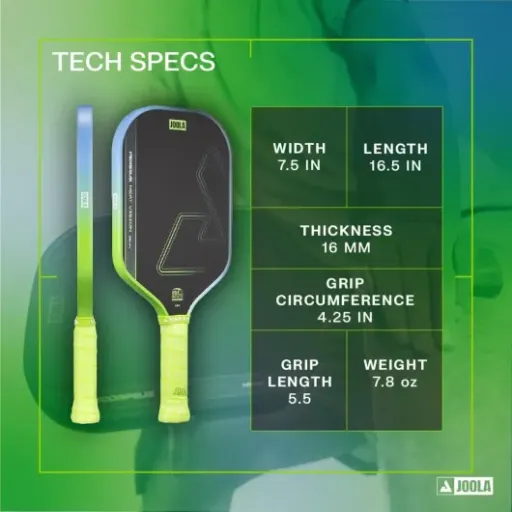
On paper, Friday is basically saying: “We took the same tech as the big brands and cut the price.” The Challenger is a 16.5" long, 7.5" wide, 16mm thick paddle with a listed weight around 8.0–8.1 oz. Grip size is 4 1/4 inches, which is pretty standard and should work for most people. It’s USAP approved, so you can use it in tournaments if you want. The core is a honeycomb polymer, and the frame and face are carbon fiber, with this T700 raw carbon buzzword they love to mention.
When you unbox it, there’s nothing fancy: you get the paddle and that’s it. No case, no overgrip, no extras. Honestly, at this price, that’s fine. I’d rather they put the cost into the paddle itself. The branding is “Friday,” and the specific model is the Challenger, with the flat-top shape and the so-called “1 Haze” gritty surface. The look is pretty simple: dark, with a logo area near the throat that, as other users mentioned, is smooth and not textured.
The paddle is marketed as suitable for all skill levels, from beginners to advanced players. After using it, I’d say that’s half true. It’s definitely good for beginners and casual players, and it works fine for 3.0–3.5 players who focus on consistency. But once you start playing more spin-heavy or faster hands battles, the limitations of the surface become more obvious. The brand also pushes the idea that it’s a cheaper version of top-tier tech. That’s not completely wrong, but it’s not a perfect clone of the high-end stuff either.
So in terms of presentation, it’s a straightforward, no-nonsense paddle: the specs are modern, the buzzwords are there, and it matches the current trend of thermoformed carbon paddles. Just don’t expect the same overall performance as a $200 paddle just because the product page uses similar language.
Pros
- Good control and forgiving feel, especially for dinks and blocks
- Comfortable, familiar grip and manageable 8.0–8.1 oz weight
- Thermoformed carbon build feels solid and seems durable for the price
Cons
- Surface texture is mild and smooths out, limiting spin potential
- Power is only moderate compared to other thermoformed carbon paddles
- Smooth logo area on the face reduces grip on off-center hits
Conclusion
Editor's rating
Overall, the Friday Challenger paddle is a good, budget-friendly carbon option that leans heavily toward control and comfort. It’s built with modern materials, feels solid in the hand, and holds up well to regular play. At the kitchen and in slower rallies, it does its job nicely: predictable touch, easy blocking, and no nasty vibrations. For beginners and casual players, it’s a clear upgrade over the random cheap paddles you find in big-box stores.
The trade-offs show up when you start playing faster and relying more on spin and aggressive shots. The surface just doesn’t grab the ball as much as higher-end paddles, and it seems to smooth out over time. Power is fine but not huge, and that’s either a plus or a minus depending on your style. If your main focus is consistency, placement, and not spending a fortune, this paddle makes sense. If you’re already around 3.5 and pushing toward 4.0, especially with a spin-heavy game, you’ll probably end up wanting something with a grippier and more consistent face.
So, who is this for? Recreational players, new club players, and budget-conscious intermediates who value control and durability over max spin. Who should skip it? More advanced or very competitive players who are ready to invest in a paddle that gives them every bit of spin and pop they can get. It’s a good tool for learning and casual competition, but it’s not the last paddle you’ll ever buy if you plan to keep climbing levels.