Summary
Editor's rating
Value for money: good if you know what you’re buying
Loud colors and a wide, sporty shape
Comfort: light and breathable, but quite roomy
Light materials, average quality feel
Durability: fine for casual use, not built like a tank
On-court performance: good grip, average support
What you actually get with the Blade Lite
Pros
- Very light and breathable, comfortable for long casual sessions
- Good grip on indoor courts with non-marking TPU sole
- Affordable price point with features tailored to badminton (low profile, court feel)
Cons
- Runs slightly big and wide, fit not very secure for intense play
- Materials and structure feel budget and may not last under heavy use
- Cushioning and support are only moderate, not ideal for players with joint issues or very aggressive footwork

Specifications
View full product page →| Brand | HUNDRED |
Light shoes, quick feet… at least on paper
I’ve been using the HUNDRED Unisex Blade Lite badminton shoes (size 12 UK, red/orange/white) for a few weeks on an indoor court. I play badminton twice a week, sometimes a bit of table tennis, so I’m not a pro but I’m not just hitting once a month either. I bought these mainly because of the low weight and the price, and also because they’re non-marking, which is mandatory at my local hall.
First impression out of the box: the shoes feel very light, almost like running shoes, and the shape looks a bit wide. The colors are loud but not ugly. My main concern from day one was fit and support. For badminton, if the shoe is too loose or too soft on the sides, you feel it immediately when you do lateral movements or lunges toward the net.
Over the first three sessions (about 6 hours of play), I focused on three things: grip on the wooden court, comfort during long rallies, and how my knees/ankles felt the next day. In parallel, I kept an eye on the build quality: glue marks, sole wear, and how the knit upper behaved after a few washes and heavy sweating. So this isn’t a lab test, just a normal player’s feedback after real use.
Overall, the shoe does the job for the price, but it’s not perfect. There are some good points like the weight and grip, and some weak spots like the wide fit and the feel of the materials. If you’re expecting a premium Yonex-level shoe, you’ll be disappointed. If you just need something light and usable for hobby play, it can make sense, as long as you understand the compromises.
Value for money: good if you know what you’re buying
For the price range these usually sit in, I’d say the value is pretty solid, as long as your expectations match the product. You’re getting a light, non-marking badminton shoe with decent cushioning, good grip, and a breathable upper. For a beginner or intermediate player who doesn’t want to spend a lot on big brands, that’s already a good starting point. Compared to some generic no-name indoor shoes, this at least feels designed with badminton in mind.
However, you do feel where they saved money: materials feel budget, the fit is a bit imprecise (especially wide and slightly long), and the support is only average. If you compare this to a mid-range Yonex or Asics indoor shoe that costs significantly more, you clearly get less structure, less refinement, and probably less long-term durability. So it really depends on your budget and how serious you are about the sport.
If you’re playing once or twice a week for fun, and you just want something light, grippy, and not too expensive, the Blade Lite makes sense and can be considered good value. You might want to size down or use thicker socks, but overall you’ll get a usable shoe that does the job. If you already know you’re going to train hard, jump often, and really push your shoes, I’d personally save up a bit more and go for a more robust model.
So, in simple terms: good value for casual players, average value for demanding players. It’s not a rip-off, but it’s not a miracle bargain either. It sits in that middle space where it’s decent for the money, with clear compromises you can feel after a few sessions.
Loud colors and a wide, sporty shape
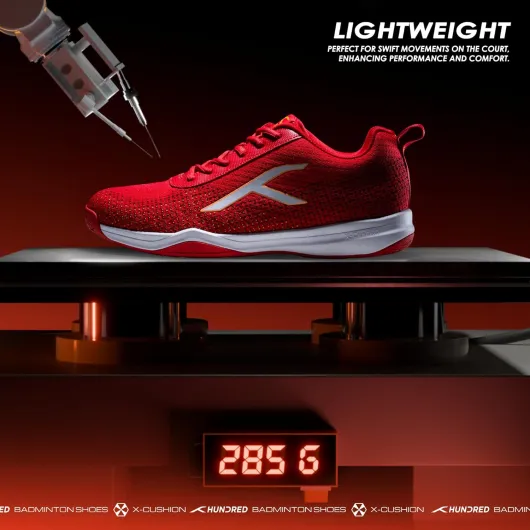
Design-wise, the Blade Lite goes for a flashy red/orange/white combo. On court, it stands out, no question. Personally, I don’t mind bright colors for sports shoes, and these look fine once they’re on foot. They don’t look premium, but they also don’t scream “super cheap”. The finish is okay: some minor glue marks here and there, but nothing shocking for this price level.
The shape is clearly on the wide side, especially in the forefoot. If you have wide feet, you’ll probably be happy. My feet are average width, and I felt a bit of extra room side-to-side. That’s not ideal for quick lateral moves because your foot can slide a bit inside the shoe. I had to lace them quite tight and even then, in very aggressive side steps I could feel a tiny bit of movement. For casual play, it’s fine. For high-intensity matches, I’d prefer a narrower, more locked-in design.
The low-top cut gives you plenty of ankle mobility, which is good for speed but obviously doesn’t provide any extra ankle support. The extended puller at the back is a small but handy feature: when you’re sweaty and rushing to the court, you just grab the loop and slide your foot in easily. It sounds like a gimmick, but I actually used it almost every time.
Visually, the knit upper and TPU overlays look modern and sporty. It’s not a shoe you’d really wear casually in the street (the design screams “court shoe”), but for the gym or indoor sports it fits right in. If you like subtle, this colorway is not it. If you’re okay with something a bit loud that says “I’m here to play”, then the design is perfectly acceptable.
Comfort: light and breathable, but quite roomy
On comfort, my experience is mixed but mostly positive for the right type of player. The feather-light design is real: you don’t feel like you’re dragging bricks on your feet, even after two hours. For long sessions, that matters. I didn’t get any hot spots or blisters during the break-in because frankly, there isn’t much to break in. The upper is soft from the start, and the foam insole is neutral and acceptable.
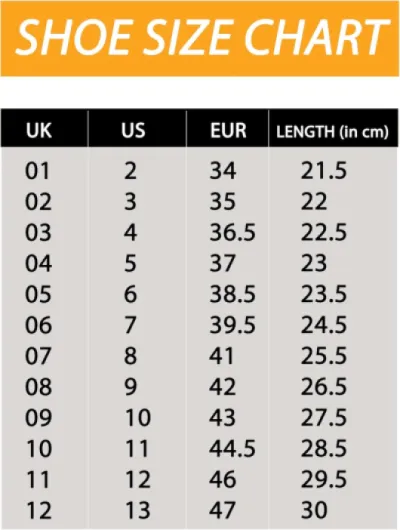
The downside is the fit and support. As other buyers mentioned, the shoes run a bit big and are wide. My usual size is 12 UK, and here I feel I could have gone half a size down if that existed. In fast lateral movements, my forefoot slides slightly, which isn’t catastrophic but not ideal. If you have narrow feet or like a super snug fit, you’ll either need thicker socks or to size down. If you have wide feet, you might actually find these very comfortable, with room for your toes to move.
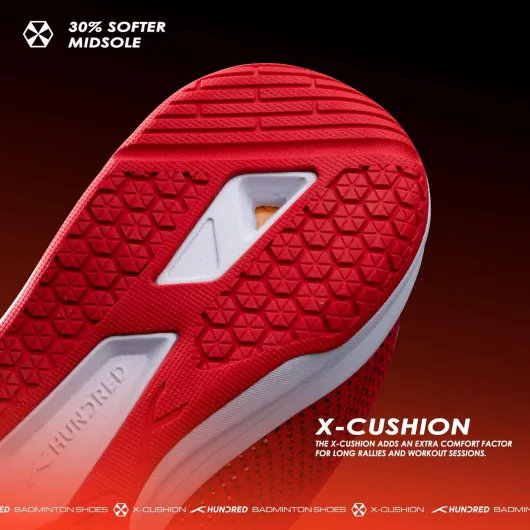
The cushioning (their “X-cushion”) is moderate. Don’t expect a soft, bouncy feel like a running shoe. It’s more on the firm side, which can be good for stability and court feel. After a 2-hour session, my feet felt okay, no sharp pain, but I did feel that the shock absorption is just average. If you have sensitive knees or play very intensely, you might want extra insoles or a more cushioned model. For casual or intermediate play, it’s fine.
Breathability is a clear strong point. The knit upper lets air through, and my socks were less soaked than with some older synthetic shoes I used before. In a hot hall, that makes a difference. Overall, comfortable enough for casual and regular play, but not the locked-in, super-supported feel of higher-end court shoes.
Light materials, average quality feel
The shoe uses a knitted polyester upper with TPU overlays, an EVA foam insole, and a thermoplastic polyurethane (TPU) sole. On foot, the first thing you notice is the low weight. The upper is quite thin and flexible, which is great for airflow and comfort straight out of the box, but it doesn’t give the same structured feel as thicker synthetic leather or more rigid mesh. You can literally pinch the sides and feel how soft they are.
In terms of perceived quality, I’d say it’s decent but clearly budget. The knit is uniform and I didn’t see loose threads, but the TPU overlays and the glue work don’t give that solid, high-end impression. After a few sessions, the upper started to show small creases at the flex points, which is normal, but it also reminded me that this isn’t a shoe built for years of hardcore use. The insole is basic EVA foam, removable, with moderate thickness. It does the job but doesn’t feel premium.
The TPU outsole is the more reassuring part. The rubber compound grips the court well, and after several hours of play, the wear is minimal. It’s clearly designed for indoor courts and feels better than random generic sports shoes in terms of traction. Also, the shoe is non-marking, and I didn’t leave any marks on the wooden floor, which keeps the facility manager happy.
If you’re used to brands like Yonex, Asics, or Mizuno, you’ll immediately feel the difference: the Blade Lite feels lighter but also less solid and less structured. If you’re coming from basic trainers or running shoes, you’ll probably see this as an upgrade in terms of grip and court feel, but don’t expect miracles on the durability or support side.
Durability: fine for casual use, not built like a tank
On durability, I obviously can’t give a multi-year report, but after a few weeks of use (roughly 12–14 hours of play plus some walking around the gym), I can already see where the shoe stands. The outsole is holding up well so far: no obvious flat spots or chunks missing, and the grip pattern is still intact. For indoor use only, I don’t see it dying quickly, as long as you don’t wear them outdoors on rough surfaces.
The upper is where I have more doubts long-term. The knitted polyester is light and flexible, but it also looks like the kind of material that could snag or wear if you drag your toe or scrape the floor a lot. I already see some light creasing around the toe flex area, which is normal, but it reminds me it’s not heavily reinforced. If you’re the type who often slides or drags your toes on lunges, expect visible wear earlier than with a more robust synthetic upper.
The stitching and glue are okay but not premium. I noticed a couple of small glue smudges near the midsole, purely cosmetic. No separation yet between sole and upper, which is good. The laces and eyelets also look fine; I don’t think they’ll be the first thing to fail. The insole, however, will probably flatten a bit with time, as it’s just basic EVA. If you play a lot, you might end up replacing it with a better aftermarket insole for comfort and support.
In short, durability seems acceptable for the price and casual use, but I wouldn’t expect these to last years under heavy, competitive play. If you’re a weekend player or you rotate between multiple pairs, they should hold up reasonably. If this is your only pair and you hammer them 4–5 times a week, don’t be surprised if the upper or cushioning shows its limits after a season.
On-court performance: good grip, average support
Performance-wise, the grip is the best part. On a standard indoor wooden badminton court, I had no slipping issues. Quick direction changes, lunges, and sudden stops felt controlled. Compared to a basic running shoe or generic gym shoe, it’s clearly better. The TPU sole grabs the floor well without squeaking like crazy, and I never felt like I was going to slide out in a rally.
Where the shoe is less convincing is lateral support. Because of the wide fit and soft upper, when you do very aggressive side steps or deep lunges, you feel your foot moving slightly inside the shoe. It’s not dangerous for casual play, but if you’re an advanced player who plays at full speed, you might find that annoying. I noticed it especially when defending smashes and jumping backwards; the heel holds okay, but the forefoot could be more locked-in.
For speed and agility, the low weight does help. You feel quick on your feet, and you don’t get that heavy feeling some cheaper, bulky shoes give after an hour. Transitions from front to backcourt feel easy, and the low-to-the-ground profile gives decent stability. Just remember: light and flexible usually also means less structure, and that’s exactly what you get here.
I also tested them for a bit of table tennis, and for that use they’re more than enough: good grip, plenty of mobility, and comfort is fine. Overall, the performance is solid for beginner to intermediate level and recreational players. If you’re playing tournaments or you train several times a week at high intensity, there are better, more supportive models, but they’ll also cost more.
What you actually get with the Blade Lite
On paper, the Blade Lite is a low-top, unisex, non-marking badminton shoe with a focus on low weight and breathability. Size here is 12 UK, but the comments on Amazon about sizing are pretty accurate: the shoe runs slightly big and a bit wide. If you have a narrow foot, expect some extra space, especially in the forefoot area. That’s something to keep in mind if you usually like a snug, locked-in feel.
The brand highlights a few features: an extended pull tab at the heel to slide the shoe on easily, an “X-cushion” midsole with EVA foam, a TPU outsole for grip, and a knitted upper for better airflow. In reality, the pull tab is just a small convenience, nothing life-changing, but it does help when you’re in a rush and your socks are slightly damp. The cushioning is moderate, not super soft, more on the firm side, which can be good for stability but less comfortable if you’re used to running-shoe-style softness.
The pair weighs around 0.4 kg, which matches the lightweight promise. When you hold them in your hand next to a typical cheap indoor shoe, you can clearly feel the difference. For beginners or casual players, that lighter feel is noticeable, especially when you do repeated jumps or fast footwork drills. However, lightweight also means the shoe doesn’t feel heavily reinforced on the sides or around the toe, so don’t expect tank-like protection.
So, in simple terms: this is a budget-friendly, light, breathable badminton shoe, aimed more at casual or intermediate players than hardcore competitive ones. If you come from a basic generic sports shoe, you’ll probably feel an upgrade in grip and agility. If you come from a higher-end court shoe, you’ll more likely see the limits in structure and materials.
Pros
- Very light and breathable, comfortable for long casual sessions
- Good grip on indoor courts with non-marking TPU sole
- Affordable price point with features tailored to badminton (low profile, court feel)
Cons
- Runs slightly big and wide, fit not very secure for intense play
- Materials and structure feel budget and may not last under heavy use
- Cushioning and support are only moderate, not ideal for players with joint issues or very aggressive footwork
Conclusion
Editor's rating
The HUNDRED Blade Lite badminton shoe is a light, breathable, budget-friendly option that works well for beginner to intermediate players and for general indoor sports like table tennis. The grip on indoor courts is genuinely good, and the low weight makes movement feel easy and less tiring during long sessions. Comfort is decent right out of the box, with no real break-in needed, and the non-marking sole is a practical plus if your hall is strict about that.
On the flip side, the shoe runs a bit big and quite wide, and the upper doesn’t offer a very locked-in, structured feel. For casual play, that’s acceptable, but for high-intensity, competitive badminton, you’ll probably want more support and a snugger fit. The materials and build feel clearly in the budget category: fine for a season or for occasional play, but I wouldn’t expect them to survive years of heavy use. If you know all that and just want a light, grippy shoe without spending too much, it’s a reasonable choice. If you’re serious about performance and durability, you should look higher up the range.