Summary
Editor's rating
Value: good for regular home practice, less good if you expect miracles
Design: clever idea, a bit fussy on the rebound side
Materials and build: decent frame, mixed feelings on rods and bungees
Durability: fine for casual use, but don’t abuse the rods
Performance: useful for dinks and volleys, but rebound is very setup‑dependent
What you actually get out of the box
Pros
- Compact 2‑in‑1 design works as both rebounder and mini dink net
- Genuinely useful for solo dink, volley, and reaction drills in small spaces
- Light enough to move and store easily, with straightforward assembly
Cons
- Rebound is very dependent on bungee tension and can feel dead if not set up tightly
- Fiberglass rods and bungees are potential weak points if over-stressed or heavily used
- Not suited for strong power shots or players who want a hard, wall-like rebound

Specifications
View full product page →| Brand | MerryMove |
A backyard pickleball partner that doesn’t complain
I picked up the MerryMove Pickleball Practice Rebounder Net because I wanted something to hit against on days when I can’t get to the courts. I don’t have a full driveway court or a gym, just a regular garage and a small patch of flat ground outside, so I needed something fairly compact that I could move around without needing two people. The idea of a 2‑in‑1 rebounder plus mini net sounded handy, especially for dink practice.
Over a few weeks, I used it mostly in the garage and occasionally in the driveway. My sessions were usually 15–30 minutes, a couple of times a week. So not hardcore daily training, but enough to see what it can actually do and what starts to get annoying. I focused on dinks, volleys, and quick reaction drills at the kitchen line distance, since that’s what this thing is mainly sold for.
Right away, I noticed something: when the tension is set up well, the rebound is decent and feels useful. When it’s not tight enough, it’s kind of useless. The net just eats the ball and you’re left picking it off the floor. So a big part of my opinion on this product comes down to setup and how picky you’re willing to be with bungees and tension. If you’re the type who hates fiddling with gear, that matters.
Overall, my impression is that it’s a pretty solid training aid for specific drills, especially if you don’t have full court access and you’re okay with a bit of tweaking. It’s not perfect, it’s not going to replace real court time, and there are some quality and rebound issues depending on your unit and how you set it up. But if you just want more touches on the ball at home, it does get the job done within its limits.
Value: good for regular home practice, less good if you expect miracles
In terms of value for money, I’d put this in the “good but not mind-blowing” category. You’re getting a 2‑in‑1 product: a rebounder with targets and a mini net. If you actually use both modes, the price feels fair. Even just as a rebounder, if you’re hitting it a few times a week, it basically pays for itself in saved court trips and extra reps. The Amazon rating around 4.3/5 lines up with how I feel: most people find it useful, a few are annoyed by the rebound issues.
Where the value drops is if you’re unlucky and get a kit with mismatched bungees or you’re not willing to tweak it. One reviewer called it junk because it barely rebounded and they couldn’t get support. I understand that frustration, especially if your unit is missing the right parts and the return window is closed. If you’re not handy or patient, this product can feel like a bad buy. For me, with a bit of adjustment and the mindset that it’s a home practice tool, not pro gear, the value is decent.
Compared to a solid wood or composite rebound board, this one is lighter and easier to move, but the bounce is softer and more sensitive to setup. On the flip side, those hard boards are usually more expensive and less portable. So you’re trading some performance for portability and price. If you’re mainly working on dinks, drops, and light volleys rather than drives, you’re getting what you need without spending a ton.
Overall, I’d say the MerryMove rebounder offers pretty solid value for casual to intermediate players who want more touches at home. If you’re super picky about rebound feel or you want something you can just throw together and never adjust, you might want to look at more premium, sturdier options and be ready to pay more. For what it is and what it costs, it’s a reasonable deal as long as your expectations are in check.
Design: clever idea, a bit fussy on the rebound side
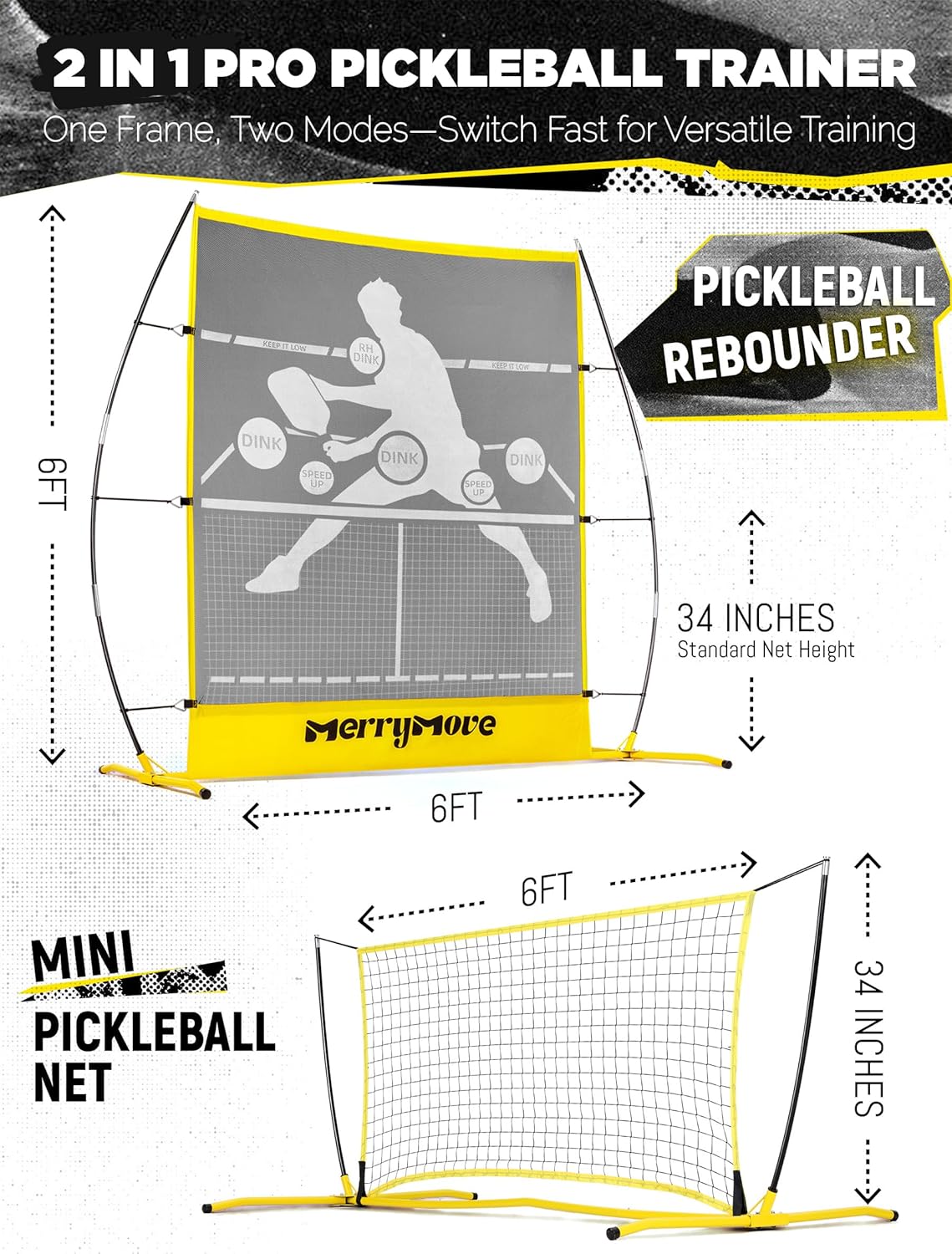
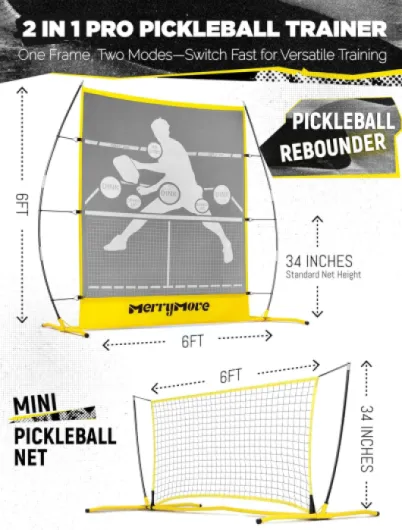
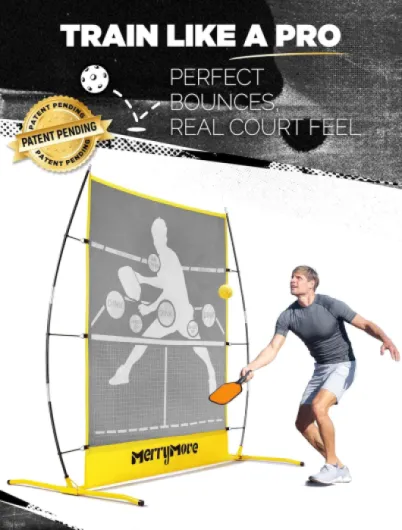
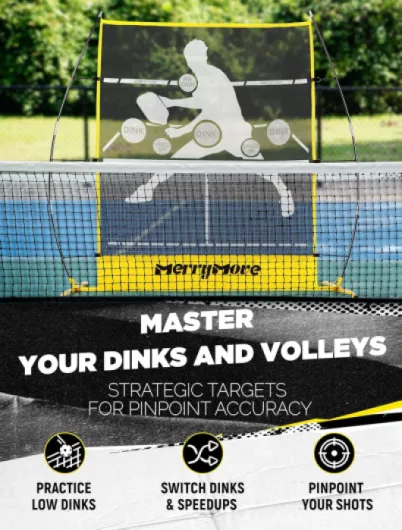
Design-wise, the MerryMove rebounder is pretty simple but functional. It’s a rectangular frame made from iron tubes, with fiberglass poles providing tension and shape for the rebound surface. The mesh panel has printed target zones that are meant to help you work on hitting specific spots, like aiming deep or controlling your height over the net. I actually found the targets useful; they give you something to focus on instead of just mindlessly hitting.
One of the better design choices is the size: 6 ft wide and 6 ft high in rebound mode is big enough that you’re not constantly missing the thing, but not so big that it takes over your garage. I could stand about kitchen-line distance away and work on dinks and volleys without feeling cramped. For the mini net configuration, the 6 ft width is obviously narrower than a regulation net (22 ft), but for dink practice in tight spaces, it’s fine. You’re not simulating a full game; you’re drilling.
The weak point in the design is the reliance on bungee tension for a good rebound. If the bungees are too long or not tightened enough, the net just absorbs the ball and the rebound is dead. Some buyers, and I get why, complained that the ball just hits and rolls down. I had a similar experience until I started shortening the bungees and adding extra tension like one of the reviewers suggested. Once you do that, the design actually works decently, but I’d argue it shouldn’t require that much tinkering. The product would be better if it shipped with more appropriately sized, higher-tension bungees out of the box.
Portability wise, the design is okay. It breaks down into a few frame sections, poles, and the net, so you can move it or store it against a wall. It’s not something you’ll throw in a backpack, but it’s manageable. Overall, the design concept is good: compact footprint, solo and partner practice options, visual targets. The execution is decent but a bit rough around the edges, mainly due to how sensitive the rebound is to setup and tension.
Materials and build: decent frame, mixed feelings on rods and bungees
The materials are a mix of iron for the frame and fiberglass for the poles, plus a mesh netting for the rebound surface. The iron frame feels reasonably sturdy for a home product. It’s not super heavy-duty gym equipment, but it doesn’t feel flimsy either. Once everything is locked in, the base doesn’t wobble much on a flat surface. On slightly uneven driveway concrete, I had to adjust the legs a bit and sometimes add a small weight on one side if I was hitting harder volleys.
The fiberglass poles are what give the rebounder its shape and tension. They’re flexible, which is good for absorbing some impact and creating that trampoline effect. The downside is they’re also a potential breaking point. One Amazon reviewer mentioned a fiberglass rod snapping, and I can see how that could happen if you over-tension the net or bend them wrong during setup. I didn’t break any during my time with it, but I was careful not to force anything. For a product at this price, I’d say the materials are acceptable, but not bulletproof.
The mesh net itself feels like standard sports netting. It’s not super thick, but it handled repeated pickleball impacts without fraying or tearing in my usage. Where I’m less impressed is the bungee cords. The kit comes with a mix of long and short ones, but at least one reviewer said they didn’t get the right ratio and that hurt their rebound. Mine were fine quantity-wise, but the tension isn’t very strong out of the box. To get a decent bounce, I had to double up or shorten them, which puts more strain on the fiberglass poles over time.
In terms of wear, after a few weeks of use, I didn’t see any major damage: no rust, no obvious bending, no tears. But you can tell this is mid-range home gear, not commercial-grade. If you treat it decently, store it indoors when not in use, and don’t crank everything to the max, I think the materials will hold up for casual training. If you plan to leave it outside all year or expect it to survive constant abuse, you’re probably asking too much for what it is.
Durability: fine for casual use, but don’t abuse the rods
Durability so far seems reasonable for home use, but I wouldn’t call it bombproof. The iron frame feels like it can handle a lot of setups and takedowns. I didn’t see any bending or looseness after repeated use. The joints still fit snugly, and there was no obvious wobbling that got worse over time. As long as you’re on a fairly level surface and not crashing into it, the frame should be okay.
The spots that worry me more are the fiberglass poles and the bungees. Fiberglass is strong but doesn’t like being over-flexed. One reviewer had a rod snap, and I can see how that would happen if you crank the net tension too high or twist the poles during assembly. When I really tightened the bungees to get better rebound, I could feel a bit of extra stress on the poles. It didn’t break for me, but it’s something I was aware of. I’d say if you’re heavy-handed or careless, that’s where you could run into problems.
The mesh net itself held up well to regular pickleball hits. No tearing, no major stretching. The printed target zones still looked clear after a bunch of sessions. The bungee cords are the most “consumable” feeling parts. They still worked, but I wouldn’t be shocked if, after a season of frequent use, some of them lost elasticity or snapped. The good news is bungees are cheap and easy to replace at any hardware store, so that’s not a deal-breaker for me.
I didn’t leave it outside long-term, but given the materials (iron and fiberglass), I’d keep it stored indoors or at least under cover. Iron can rust, bungees can degrade in sun, and the net will last longer if it’s not baking in UV all day. In short: for normal, semi-regular home practice, the durability seems decent. If you’re rough with your gear or plan to leave it outside year-round, I’d lower my expectations and be ready for some parts to fail sooner.
Performance: useful for dinks and volleys, but rebound is very setup‑dependent
On performance, I’d split it into two parts: solo rebound practice and mini net use. For solo work, once I dialed in the tension, the rebound was decent for dinks, soft volleys, and quick reaction drills. Standing at about kitchen-line distance, I could hit 20–30 ball sequences where the ball came back in a predictable way. It’s not exactly like a real opponent, but it’s close enough to make your hands and timing work. For short, focused sessions in the garage, I actually liked it quite a bit.
Where it falls short is when the tension is off or if you expect a strong rebound like a solid wall. Several buyers said the ball just hits and rolls down, and I get that complaint. Before I tightened the bungees more aggressively, my rebound was pretty weak too. If you’re hoping to practice fast drives or big power shots, this isn’t the tool. The mesh plus flexible poles just don’t give that kind of bounce, even when tuned. It’s really more of a touch and control trainer than a full-swing simulator.
In mini net mode, the performance is simpler: it’s a 6 ft practice net for dinks and short rallies. For that, it works fine. Height feels right, and as a target to clear and aim near the net, it’s totally usable. I used it with a partner a couple of times just for warm-ups and soft drills, and there’s nothing fancy to say: it does exactly what a small net should do. You’re not getting full court spacing or angles, but for kitchen work, it’s helpful.
Over a few weeks, I did feel some real benefit. My hand speed and consistency in quick net exchanges improved a bit, mostly because this thing makes it easy to grab 10–15 minutes of reps without driving to the courts. That’s where the performance matters: not that it’s perfect, but that you’ll actually use it. If you’re willing to tweak it and accept that it’s mainly for soft game practice, it’s pretty effective. If you want a powerful rebounder straight out of the box with zero fuss, you might be disappointed.
What you actually get out of the box
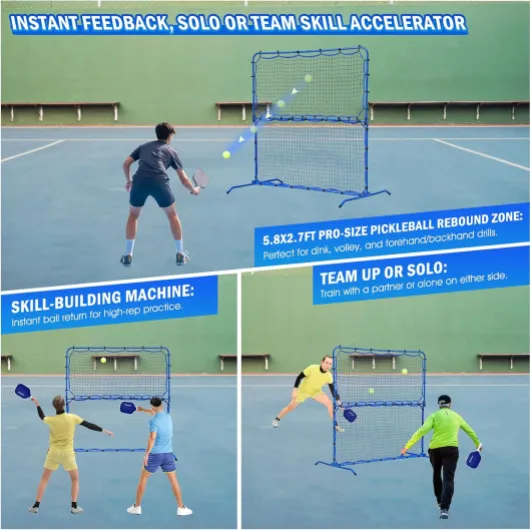
Out of the box, the MerryMove setup is basically a metal frame, fiberglass poles, a mesh/net panel with target zones printed on it, a regular mini net configuration, and a bunch of bungee cords. The brand isn’t some big name in pickleball, so I went in with moderate expectations. It’s about 6 feet high and 6 feet wide in rebounder mode, and the mini net is 6 feet wide by about 34 inches high, so it’s narrower than a real pickleball net but good enough for focused drills.
The 2‑in‑1 concept is straightforward: you can use it as a rebounder board with targets for solo training, or reconfigure it as a low mini net for dink practice with a partner. In practice, I mostly left it as a rebounder because that’s what I needed for solo work. Swapping between the two modes isn’t hard, but it’s also not something you’ll want to do every single day if you’re lazy like me. It’s a few minutes of moving pieces, not a 10‑second flip.
The manual is basic but clear enough that I didn’t struggle with assembly. I had it set up in under 20 minutes the first time, and quicker after that. The frame pieces are labeled, and the design is simple: rectangle frame, uprights, then you tension the net with bungees. Where people get tripped up, and I did too, is how tight you actually need to pull those bungees to get a decent bounce. The box doesn’t exactly scream that at you.
Function-wise, the product is clearly aimed at home practice: garage, driveway, backyard, even indoors if you’ve got space and forgiving walls. It’s not a tournament net, it’s not a pro-level rebound wall, it’s a practice tool for regular players. If you go in expecting a professional rebound wall, you’ll probably be disappointed. If you go in expecting a reasonably portable practice partner that helps you get reps, the overall package makes more sense.
Pros
- Compact 2‑in‑1 design works as both rebounder and mini dink net
- Genuinely useful for solo dink, volley, and reaction drills in small spaces
- Light enough to move and store easily, with straightforward assembly
Cons
- Rebound is very dependent on bungee tension and can feel dead if not set up tightly
- Fiberglass rods and bungees are potential weak points if over-stressed or heavily used
- Not suited for strong power shots or players who want a hard, wall-like rebound
Conclusion
Editor's rating
After using the MerryMove Pickleball Practice Rebounder Net for a bit, my take is pretty simple: it’s a useful home practice tool if you’re mainly working on your soft game and you’re willing to spend a little time getting the tension right. When it’s set up properly, the rebound is good enough for dinks, volleys, and quick-hand drills, and the mini net mode is handy for focused dink sessions with a partner. It’s not fancy, but it lets you get real reps in without driving to the courts.
It’s not perfect, though. The rebound can be weak if the bungees aren’t tightened well, and some people clearly got kits with less-than-ideal cord lengths. The fiberglass poles and bungees are the weak spots for long-term durability, especially if you over-tension things. And if you’re expecting it to handle full‑power drives with a strong bounce like a solid wall, you’ll probably be disappointed. This is more of a touch trainer than an all-around wall substitute.
I’d recommend this mainly for players who: 1) want to practice at home in a garage, driveway, or small yard; 2) care about dinks, drops, and net reactions; and 3) don’t mind a bit of trial and error during setup. If that’s you, it’s a pretty solid buy and you’ll likely use it regularly. If you hate fiddling with gear, need a very strong rebound, or plan to leave it outside year-round, I’d either look at sturdier (and pricier) options or skip it altogether.