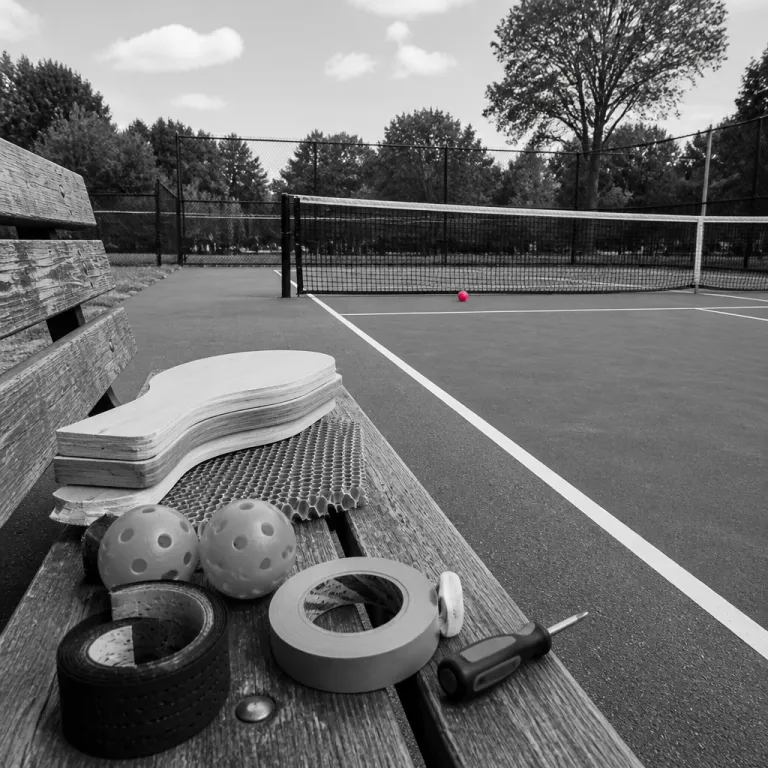
What a paddle stack is and why it matters in open play
A paddle stack is the simple system players use to claim the next game on a busy public court. When pickleball play heats up on summer evenings and all four courts are full, the only fair way to manage time is to let paddles, not voices, decide who plays next. That tiny stack of paddles on the fence quietly runs the entire game flow.
On most public courts, players will place a single paddle in a neat stack near the baseline fence or on a bench to signal they are waiting to play. That visible stack of paddles shows how many players are waiting, which games are open, and who should join game rotations next. If four paddles are stacked together, that usually means a full group is ready to join game play as soon as a court opens.
Think of paddle stacking as a low tech reservation system that keeps the pickleball community from arguing about who was there first. When players stack paddles correctly, nobody needs to shout across courts or sprint to grab the next open game. The system works only if every player paddle is placed in order and everyone agrees that the stack will decide the next four players.
On some courts, players stack paddles vertically on a fence hook, while others place paddles flat in a horizontal play stack on a bench. Either way, the goal is the same ; each player will place their paddle in a clear place stack so the next four paddles tell you exactly who should step onto the court. When several players stack paddles together to form a foursome, they should still respect the overall order of paddles waiting to play.
Good pickleball paddle stack etiquette starts with visibility and honesty, not secret deals. Make sure you place paddles where everyone can see them, and never move another player paddle without asking. If you keep mind that the stack, not your voice, controls the next game, you will avoid most conflicts before they start.
How the next four rule works and how to place paddles correctly
The next four rule is the backbone of fair open play on crowded courts. In its cleanest form, the next four paddles in the stack join game play on the next open court, regardless of who they are. That rule keeps games moving, reduces waiting time, and gives every player a predictable rhythm.
When you arrive at public courts for open play, look for a sign or ask regular pickleball players how they place paddles there. Some parks use a fence hook system where you place paddle handles through a metal loop, while others use a simple bench where players stack paddles in a single line. A few facilities even use whiteboards or chalkboards where players waiting write their names while also placing a paddle in the physical stack.
Whatever the system, you should place paddle or paddles at the end of the existing stack, never in the middle. If you arrive with a partner and want to join game rotations together, you and your partner will place both paddles back to back in the play stack, but still behind any paddles already waiting to play. When four paddles line up at the front of the stack, those four players join game action on the next open court.
Some venues run a strict four off, four on rotation to keep games short and waiting time reasonable. That means after one game to eleven points, all four players leave the court and the next four paddles step in, even if the previous game was quick. If your group prefers two games before rotating, make sure every player understands that rule before you place stack markers or start stacking paddles.
Clear scoring rules help too, especially for newer players who are still learning how pickleball scoring works. If you need a refresher on how to call scores correctly in recreational games, a simple guide to understanding how to score in pickleball can prevent arguments about whether the game is really over. When scoring, rotation, and paddle stacking are all transparent, the entire pickleball community on those courts feels respected.
Mixed skill levels, green beginners, and when to keep your stack closed
Skill level is where pickleball paddle stack etiquette gets tricky, especially on busy summer evenings. On one side of the net, you might have green beginners still figuring out where to stand on the court, while the next court over hosts tournament level players drilling third shot drops and sharp dinking patterns. Both groups paid the same taxes or fees for those public courts, but they want very different games.
Many parks solve this by designating certain courts for specific skill levels during open play blocks. For example, courts one and two might be for beginner and lower intermediate pickleball players, while courts three and four are reserved for higher skill level games. In that setup, players stack paddles only on the fence for the court that matches their current level, so players waiting for advanced games are not constantly mixed with brand new players waiting to play their first real game.
If your park does not have posted levels, you still need to keep mind of the mix of players waiting. When you place paddles in the stack, listen for how people describe their skill level and ask politely whether they are comfortable playing up or down. A simple question like “We are playing a faster game right now ; are you okay joining this game, or would you rather join game play on the next court with newer players ?” can prevent frustration on both sides.
There are times when it is perfectly acceptable to keep your stack closed and maintain a consistent foursome. If your group is drilling specific shots, like aggressive third shot drops or high spin drives, you may not want to rotate in green beginners who are still learning basic footwork. In that case, you should still will place your paddles in the stack, but clearly label your group as a closed stack so players waiting know they will not be invited into that particular game.
On the flip side, if you are an experienced player using public courts during open play, you owe the pickleball community some generosity. Make a point of occasionally opening your play stack to newer players, especially those who have been waiting to play for a long time. When you help a new player understand rules like the double bounce requirement, you can even point them later toward a clear explanation of the rules for hitting the ball on the bounce in pickleball so they keep learning between sessions.
Welcoming newcomers without wrecking your group rhythm
Every crowded public court has a moment when a new player walks up clutching a single paddle and looking slightly lost. That player has heard about pickleball play from friends or social media, but the sight of a long paddle stack and four intense games can feel intimidating. Good etiquette means you do not leave that person standing alone by the fence.
The simplest move is to walk over, smile, and explain how players stack paddles at this park. You might say, “We use a paddle stacking system here ; if you place paddle at the end of this line, you will join game play when your paddle reaches the front.” That short script both teaches the system and signals that the pickleball community on these courts is open to new faces.
When several players waiting are clearly new, consider organizing one court as a green lane for learning games. Ask two or three experienced pickleball players to will place their paddles together in the stack and then join game rotations with those beginners for a few short games. That way, advanced players still get their higher level games on other courts, while newcomers get real coaching on basic shots and positioning.
If your group is in the middle of a tight, high level game, you do not need to drop play immediately to accommodate every new arrival. Instead, finish the game, then walk over and explain how long the waiting time usually is and whether there is a better time of day for easier games. You can also suggest that the new player paddle join game play with a more casual group that is already running shorter games and quicker rotations.
One more subtle point of etiquette involves how you talk about skill level in front of new players. Avoid labeling someone as weak or saying you do not want them in your game ; instead, frame it as matching the right game to the right player. When you keep mind that everyone on those public courts was once a beginner, it becomes easier to balance your own competitive goals with the health of the broader pickleball community.
Three things never to do with a paddle stack, with real examples
Breaking paddle stack etiquette usually does not start a fistfight, but it can poison a public court faster than a bad line call. The first cardinal sin is cutting the stack, which means moving your paddle or your friend’s paddle ahead of players who have been waiting to play longer. On a crowded Saturday at San Pablo Park in Berkeley, I watched a regular quietly slide his partner’s paddle into the third spot in the stack, and within two games half the players on that side of the park had stopped inviting him into their rotations.
The second mistake is ghost stacking, where players stack paddles for friends who are not yet at the courts. In theory, a player will place a paddle in the stack for someone still driving over, but in practice that means players waiting in person get bumped by invisible partners. If you want to hold a spot for a friend, the only fair method is to start playing short games and then drop play as soon as your friend actually arrives, letting your current partner’s paddle stay in the stack for the next round.
The third problem move is hijacking an open court without checking the stack. This usually happens when a game ends and four players who just finished decide to keep playing on the same court, even though eight paddles are sitting in the play stack. Proper etiquette says that once your game ends, you should look at the stack, invite the next four paddles to join game play, and then place paddles at the back of the line if you want to keep playing.
There is also a quieter breach of etiquette that shows up when players stack paddles but then refuse to join game play when their turn comes. If you are not ready to play when your paddle reaches the front, you should remove your paddle from the place stack so players waiting behind you are not stuck in limbo. Leaving your paddle in the stack while you chat or scroll your phone wastes court time and frustrates everyone.
Good systems help prevent these problems, especially at busy venues where open play sessions are the only realistic way to share limited courts. Some parks use color coded clips or green markers on paddles to show whether a player wants competitive games or social games, which makes it easier to match skill level and expectations. If you are thinking about your first sanctioned tournament and want to understand how these informal systems translate to bracket play, a detailed bracket by bracket guide to surviving round robin day can help you see how fair rotation scales up under official rules.
Advanced etiquette: managing time, formats, and different types of games
Once your local group has basic paddle stacking under control, you can fine tune etiquette to squeeze more quality play out of limited court time. One lever is game format ; shorter games to nine points or even rally scoring can move the stack faster when twenty or more paddles are lined up. Another lever is how strictly you enforce four off, four on rotations versus letting winners stay and challengers rotate in.
On extremely crowded days, many public courts switch to a pure four on, four off system where every game ends at eleven points and all four players leave the court. That approach maximizes the number of games per hour and keeps waiting time predictable for every player paddle in the stack. When players know they will place their paddles back in the stack after each game, they tend to play more focused points and waste less time between games.
In smaller groups or during slower hours, you can loosen the system and allow winners to stay on for one extra game while only the losing team leaves. If you choose that format, make sure the stack paddles still move in order and that players waiting understand they might wait through two games instead of one. Clear communication about whether you are running single game rotations or two game sets is part of advanced pickleball paddle stack etiquette.
Another subtlety involves how you handle mixed singles and doubles on the same courts. If one court is running singles games, those games usually finish faster, which can throw off the rhythm of the shared play stack. In that case, you might run a separate mini stack for singles players or agree that singles players will drop play and rejoin the main stack after each short game so doubles players are not stuck waiting through uneven cycles.
Finally, remember that etiquette is not just about rules ; it is about tone. When you remind someone to place paddles correctly or to respect the stack, do it calmly and assume they simply did not know the system. The health of your local pickleball community depends less on the exact rotation format and more on whether players feel that the courts are a fair, welcoming place to join game play without needing to argue for their spot.
FAQ
How long should I expect to wait to play during busy open play sessions ?
Waiting time depends on how many courts are available and how many paddles are in the stack. As a rough guide, if four courts are running games to eleven points and sixteen paddles are already stacked, you might wait for one full game cycle, roughly fifteen to twenty minutes. Shorter games and strict four on, four off rotations can cut that waiting time significantly.
Can I keep playing with the same partner, or do I need to mix partners every game ?
Most public courts allow you to keep a consistent partner as long as you still respect the overall paddle stack order. You and your partner should place paddles together at the back of the stack after each game so you re enter in order. Some groups encourage mixing partners for social reasons, but that is a local preference, not a universal rule.
What should I do if someone cuts the paddle stack or ignores the rotation ?
The best first step is a calm, direct conversation rather than a public confrontation. Explain how players stack paddles at that park and point out where their paddle should go in the order. If the behavior continues, regulars can agree to stop inviting that player into games until they respect the system.
Is it okay to bring my kids or total beginners into advanced games during open play ?
It is usually better to match beginners with other beginners or patient intermediates rather than dropping them into high level games. You can still welcome them by setting up a learning court or by scheduling specific beginner friendly times. For advanced players, it is reasonable to keep some games closed so they can work on faster rallies and more demanding shots.
How do we handle players with very different skill levels sharing the same limited courts ?
Clear labeling and communication solve most of this tension. Use signs or verbal agreements to assign certain courts or time blocks to specific skill levels, and have players stack paddles only for the courts that match their current level. That way, everyone gets appropriate games without constant renegotiation of who should join which game.