Summary
Editor's rating
Is it worth the price, or are you paying for the name?
Longer handle, elongated head: good or annoying?
Comfort and grip: good for long sessions, with one small caveat
Carbon face and 16 mm core: what that actually feels like
Build quality and how it holds up (so far)
On-court performance: control and spin over raw power
What you actually get out of the box
Pros
- Very good control and touch thanks to the 16 mm core and carbon face
- Gritty CAS surface provides reliable spin for serves, rolls, and slices
- Comfortable elongated handle and Sure-Grip make long sessions easy on the hand
Cons
- Not very powerful; you need to swing harder to generate pace
- Price is on the high side, and part of it is clearly paying for the Ben Johns branding

Specifications
View full product page →| Brand | JOOLA |
A Ben Johns paddle for regular players, not just pros
I’ve been playing pickleball 3–4 times a week for a while now, mostly rec games and the odd local tournament. I picked up the JOOLA Ben Johns Hyperion CAS 16mm because I wanted to see what the hype was about with all these Ben Johns paddles, but I didn’t want to jump straight to the really pricey pro models. I used this one for about three weeks, roughly a dozen sessions, before writing this.
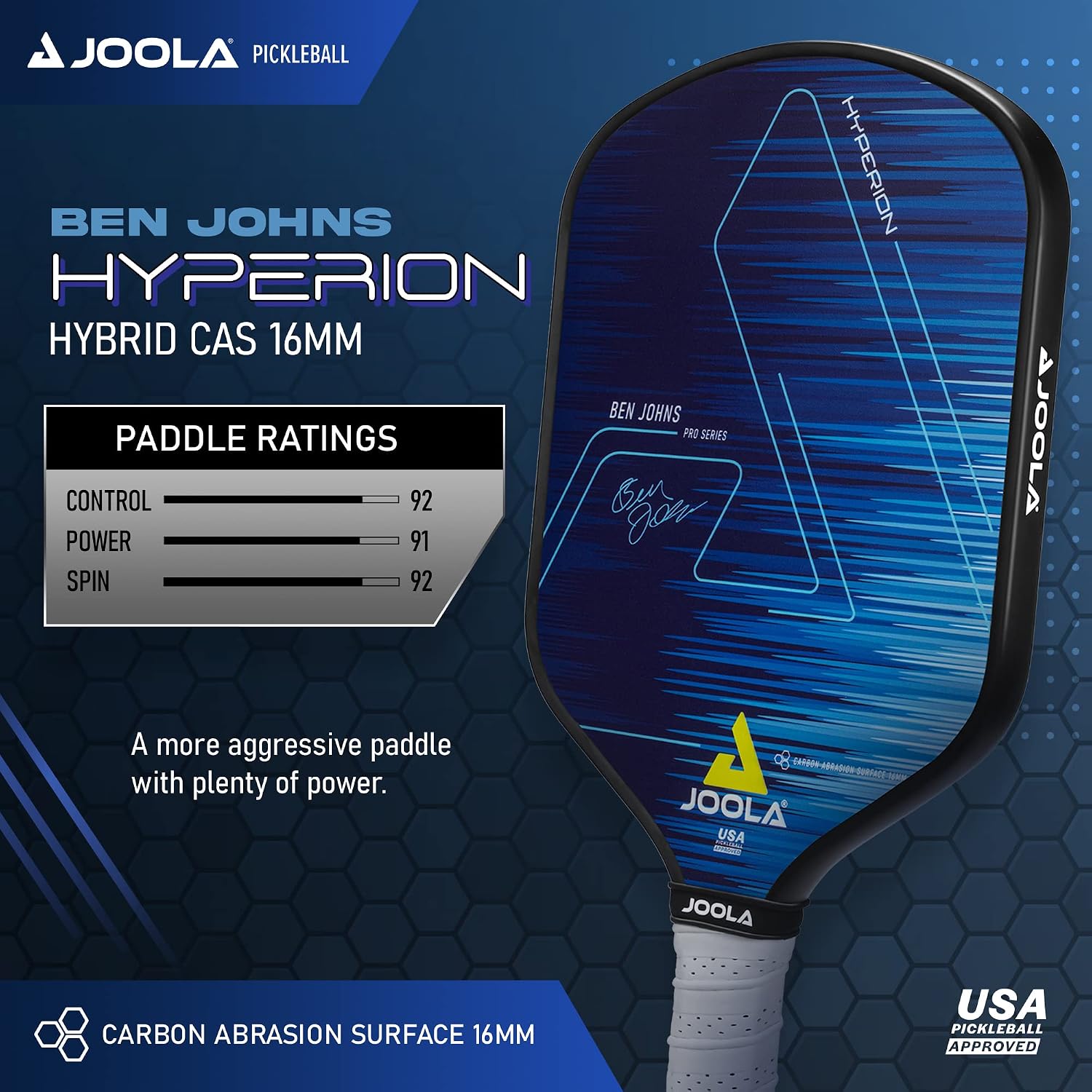
The first thing I noticed is that it feels like a paddle aimed at control and consistency more than raw power. The 16 mm core and the slightly heavier feel (mine weighed in right around the listed 235 g) make it pretty stable in the hand. If you’re coming from a super light beginner paddle, you’ll feel the difference right away, especially on blocks and resets near the kitchen.
During my first few games, I had to adjust my timing on drives and overheads. It doesn’t just catapult the ball like some thinner, poppier paddles. You actually have to swing through the ball. Once I got used to that, I appreciated how predictable it was. I wasn’t suddenly sailing balls long just because I caught them slightly off the sweet spot. That helped my confidence in longer rallies.
It’s not perfect though. The price still stings a bit, especially if you’re not playing a ton. And if you’re a big hitter looking for effortless power, this isn’t the one that’s going to give you that free speed. But if you care more about control, spin, and a solid feel on contact, it’s a pretty solid option that doesn’t feel like just another cheap composite paddle with a fancy name slapped on it.
Is it worth the price, or are you paying for the name?
Price-wise, this paddle sits in that mid-to-upper bracket where you start to wonder how much of the cost is performance and how much is the Ben Johns logo. After using it for a few weeks, I’d say you’re paying for both: you do get a better-built, more controlled paddle than the cheap Amazon specials, but you’re also definitely paying a bit of a premium for the branding and the hype.
Compared to entry-level composite paddles, the difference in feel and spin is noticeable. The CAS surface grips the ball better, the 16 mm core is more stable, and the overall build feels more solid. If you’re moving from a $40–$60 paddle, this will feel like a clear upgrade. The question is whether you want to jump straight to this, or look at slightly cheaper control paddles from lesser-known brands that might give you 80–90% of the performance for less money.
Where it makes more sense is if you’re playing regularly (at least a couple of times a week) and you care about control and spin. In that case, the cost spreads out over a lot of sessions, and the better feel is worth it. If you’re a total beginner who only plays once a month, this is probably overkill, and you’re paying for performance you won’t really use yet. Also, if your style is all about big power and you don’t mind sacrificing touch, there are other paddles in the same price range that will give you more pop.
Overall, I’d call the value “good but not mind-blowing.” It’s not a rip-off, because the quality and playability are there, but it’s not some hidden bargain either. You get a reliable, control-focused paddle with genuine spin potential, a decent cover, and a known brand behind it. Just be honest with yourself about how much you play and whether you actually need what this paddle is built to do.
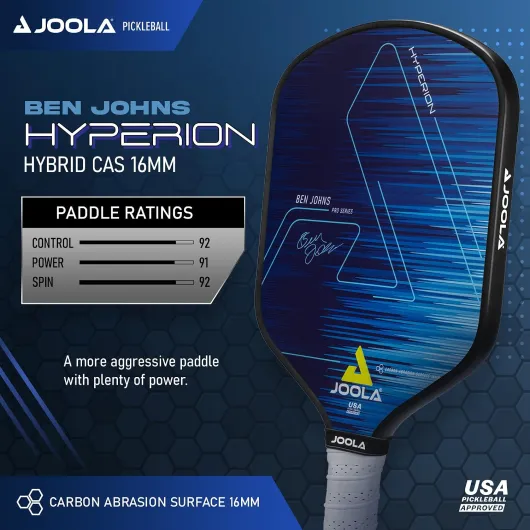
Longer handle, elongated head: good or annoying?
The main design choices on this paddle are the elongated head and the longer handle. The handle length is nice if you occasionally use a two-handed backhand. I don’t do it all the time, but I like having the option, especially when I’m late on a passing shot. With shorter-handled paddles, my top hand always feels cramped; here, it fits without me having to choke up onto the face.
The elongated head gives you a bit more reach and a slightly taller sweet spot. At the kitchen line, that extra length actually shows up in real play. I was able to get to a few lobs and fast balls at my shoulder that I would probably have missed with a shorter, wide-body paddle. On the downside, you do give up a tiny bit of width, so mishits way out on the edge feel more punishing. If your contact point is all over the place, you might notice more mishits at first.
Visually, the carbon fiber look and the darker face are pretty standard for this type of paddle. The graphics are clean enough, but let’s be honest: this is clearly designed to ride on Ben Johns’ name and the PPA tour branding. I don’t mind it, but it’s not exactly low-key. If you don’t care about pro players, the branding doesn’t add any actual value, it just tells everyone you spent more than a beginner paddle.
On the court, the design choices mostly make sense. The elongated shape helps with reach and blocking, the longer handle helps with two-handed shots, and the overall balance leans slightly toward the head but not so much that it feels like a club. I’d call it a practical design for intermediate players who are starting to care about finer details like reach and grip options, rather than just grabbing the cheapest paddle off the rack.
Comfort and grip: good for long sessions, with one small caveat
Comfort-wise, this paddle did well for me over longer sessions. I typically play two-hour blocks, sometimes back-to-back nights, and I didn’t get any wrist or elbow pain from using it. The 16 mm core and the slightly heavier weight help soak up impact, especially on hard drives and when someone tags you with a fast ball at the kitchen. It doesn’t have that harsh, pingy feel some thinner paddles give.
The grip is 4.25" and uses JOOLA’s Sure-Grip material with little ridges and perforations. In real use, the grip feels tacky enough without being sticky, and it does a decent job with sweat. I played in pretty warm conditions a few times, and while my hand still got sweaty, the paddle never felt like it was going to fly out. The ridged texture gives you something to hold onto, which I liked more than perfectly smooth grips. If you have larger hands, you might want an extra overgrip, but for me (average-sized hands) it was fine as is.
One thing to mention: the paddle isn’t super light. At around 235 g, after an hour of very fast hands battles at the net, you feel that weight a bit in your forearm. It’s not extreme, but if you’re very sensitive to weight or you’re coming from a really light paddle, there’s an adjustment period. Personally, I’ll take the small weight penalty for the extra stability on blocks and resets, but that’s preference.
Overall, I’d say comfort is one of the strong points. Between the damped feel from the thick core and the grippy handle, it’s easy to play with this paddle for a full session without thinking about your gear. Just be aware that it’s not a featherweight, so if you want something ultra light, this isn’t that.
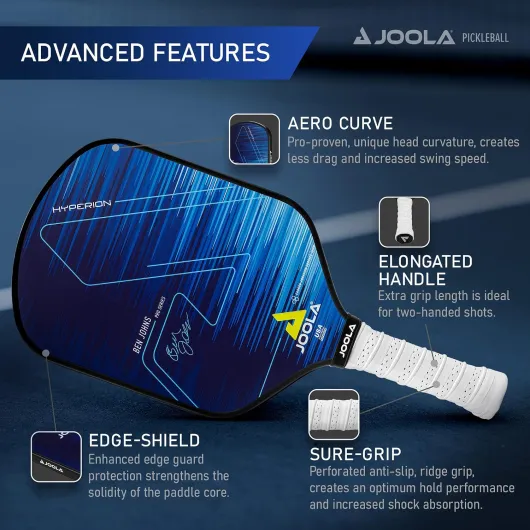
Carbon face and 16 mm core: what that actually feels like
On paper, the materials sound fancy: carbon fiber face, 16 mm polypropylene honeycomb core, and some hybrid-ply layering. In practice, what that means is the paddle feels solid and slightly muted at impact. Compared to the cheap fiberglass paddles I started with, this one has less annoying vibration and a more controlled feel when you hit the ball off-center. You can tell the thicker core is doing some work there.
The carbon abrasion surface is where you really notice the material choice. The face has a gritty, sandblasted texture that you can feel easily with your fingers. It’s not just a painted fake texture; it actually grabs the ball a bit on contact. After a couple of weeks of play, the grit was still there. It might wear down over many months, but at least in this short test it didn’t smooth out quickly like some cheaper textured coatings do.
The core is a 16 mm polypropylene honeycomb, which is pretty standard these days for control paddles. On court, it gives you a softer, more cushioned feel. On dinks and soft shots, the ball sits on the paddle just a fraction longer, which makes it easier to control depth. On the flip side, you don’t get a ton of free power. You have to swing through if you want to put the ball away, which is the trade-off with this kind of build.
Overall, the materials feel solid and in line with the price bracket. You’re not getting something ultra premium and exotic, but it’s clearly a step up from entry-level composite paddles. The carbon face and thick core combination make sense if you’re chasing control and spin rather than pure pop. If you like a lively, trampoline-like feel, this particular material setup is probably not what you’re after.
Build quality and how it holds up (so far)
Durability is always hard to judge in just a few weeks, but I can at least talk about early signs. After roughly a dozen sessions, the edge guard is still firmly in place, no peeling or gaps. I tapped the paddle on the court a few times out of frustration (yeah, I know, bad habit), and it didn’t show anything more than light scuffing on the guard, which is what I’d expect.
The carbon face itself hasn’t shown any chips or cracks. I had a couple of clashes with a partner’s paddle at the net, and it came out with just minor marks, nothing structural. The textured CAS surface still feels gritty under the fingers. There’s a tiny bit of wear in the middle where I hit most balls, but not enough to affect spin yet. If you’re a heavy spinner playing five days a week, you might wear it down faster, but for a normal schedule it seems decent.
The grip has held up well too. No unraveling or weird loosening. The perforated, ridged surface hasn’t flattened out yet. I’d still expect to replace or overgrip it after a few months of regular play, but that’s normal maintenance, not a flaw. The handle itself feels solid, no creaks or flex even when I lean hard into two-handed backhands.
From what I’ve seen and from the brand’s general reputation, I’d say durability is pretty solid for this price range. It doesn’t feel fragile, and it doesn’t feel like something that will die after two months. Of course, long term you can always get core soft spots or edge issues if you abuse it, but so far there are no red flags. I’d be comfortable using this as my main paddle for a full season.
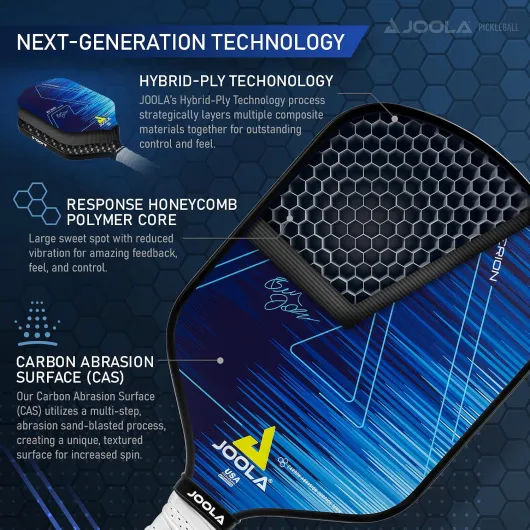
On-court performance: control and spin over raw power
On court, the Hyperion CAS 16 mm clearly leans toward control and spin. At the kitchen, dinks feel very predictable. The thicker core and carbon face give you a softer touch, so it’s easier to keep the ball low and short without accidentally popping it up. My third-shot drops improved a bit compared to my older, poppier paddle, mostly because the ball wasn’t jumping off the face as much. I had to swing a bit more, but my depth control was better.
Spin is one of the highlights. The gritty surface actually bites into the ball, and you can feel it on topspin rolls and slice serves. I noticed my serves kicking a bit more and my roll volleys dipping sooner than with a smooth-faced paddle. It’s not magic, you still need the right technique, but if you already know how to generate spin, this surface helps rather than gets in the way. After a few sessions, I was consistently getting more shape on my passing shots.
Power is where opinions will split. This paddle has enough power, but it’s not a rocket. If you have decent mechanics and you’re willing to swing, you can finish points just fine. But if you’re used to thin, poppy paddles where you barely swing and the ball flies, this will feel more subdued. Personally, I liked that I could swing aggressively without constantly sending the ball long, but some people I let try it said they wanted more instant pop, especially from the baseline.
In fast exchanges at the net, the paddle feels stable and solid. The slightly head-heavy balance helps absorb pace on blocks, and I felt confident just putting the face in front of the ball to reset. The trade-off is a tiny bit less whip speed on last-second flicks compared to a lighter, more evenly balanced paddle. Overall, if I had to sum up the performance: it rewards clean swings and good touch, and it doesn’t give you tons of free power. That will either fit your style really well, or it won’t.
What you actually get out of the box
Out of the box, the JOOLA Ben Johns Hyperion CAS 16mm looks like a serious paddle but not overdone. You get the paddle itself and a fitted cover that actually feels decent, not like the super thin covers some brands toss in. The cover is custom-shaped for the elongated head, zips cleanly, and it’s padded enough that I don’t worry about tossing it in a bag with a few other paddles and balls.
The paddle is listed as one size, 235 g, with a 4.25" grip. On my scale, mine came in just a hair under that, so the published specs seem honest. The head is a standard elongated shape, not crazy long but clearly more stretched than a wide-body beginner paddle. If you’re used to a shorter, squarer paddle, you’ll notice you get a bit more reach at the kitchen and on overheads, which is nice in actual play.
They advertise a carbon abrasion surface (CAS) and a 16 mm polypropylene honeycomb core. That basically means: thick core for control and softer feel, textured face for spin. It’s USAPA approved, which for most casual players doesn’t matter much, but if you ever play in sanctioned events, you’re covered. The branding is pretty visible: Ben Johns name, JOOLA logos, the usual tour references. If you like that pro-player branding, you’ll be happy; if you prefer low-key, this one still looks a bit like it wants everyone to know what you’re swinging.
Overall, presentation is straightforward: you get a ready-to-play paddle with a proper cover and clear specs. No useless extras, no overcomplicated packaging. It feels like something meant to be used a lot, not just displayed. For the price, I would have been annoyed if it came without a cover, so that part is a plus in my book.
Pros
- Very good control and touch thanks to the 16 mm core and carbon face
- Gritty CAS surface provides reliable spin for serves, rolls, and slices
- Comfortable elongated handle and Sure-Grip make long sessions easy on the hand
Cons
- Not very powerful; you need to swing harder to generate pace
- Price is on the high side, and part of it is clearly paying for the Ben Johns branding
Conclusion
Editor's rating
After a few weeks of using the JOOLA Ben Johns Hyperion CAS 16 mm, I’d sum it up as a solid, control-focused paddle that suits intermediate players or improving beginners who play regularly. The main strengths are the predictable feel, the gritty surface that actually helps with spin, and the comfortable, slightly longer handle that works well for both one- and two-handed backhands. It feels stable on blocks and resets, and it doesn’t buzz your arm with vibration, even when you catch the ball a bit off-center.
It’s not the best choice if you want effortless power. The thicker core and more muted face mean you need to swing to generate pace. If your whole game is big drives and put-aways and you don’t care much about soft game control, you might be happier with a thinner, poppier paddle in the same price range. Also, the price is on the higher side for casual players, and part of what you’re paying for is clearly the Ben Johns branding and JOOLA name.
If you’re playing a few times a week, working on your dinks, drops, and spinny serves, and you prefer a paddle that feels stable and honest rather than super hot and bouncy, this fits pretty well. If you’re just starting out and only play occasionally, or you’re chasing pure power on a tighter budget, I’d say look at cheaper options first and maybe come back to something like this once your game and needs are clearer.