Summary
Editor's rating
Is it worth the money?
Design: more practical than pretty
Battery life and practicality between charges
Build quality and how tough it feels
On-court performance: how it actually hits
What you actually get for the price
Pros
- Consistent ball delivery with good speed range up to around 70–75 mph
- Internal oscillation and app-based drills create more realistic practice patterns
- Portable enough with trolley handle and large wheels despite the 48–56 lb weight
Cons
- High price, especially for casual players or those who rarely drill
- Learning curve to dial in settings and get the most out of the app and features
- Remote sold separately and no balls included despite the premium positioning

Specifications
View full product page →| Brand | TITTAN |
A practice partner that actually shows up on time
I’ve been using the TITTAN Titan ONE pickleball machine for a few weeks now, roughly 3–4 sessions per week, about 60–90 minutes each time. I bought it because my schedule is all over the place and finding partners for drills is a pain. I’m around a 3.5 player, trying to push up, and I wanted something that could give me consistent reps on dinks, drives and third shots without begging people to come drill at 7 am.
Right away, this isn’t a plug‑and‑play toy. You don’t just drop balls in, hit a button and instantly get perfect drills. There’s a bit of a learning curve with the app, the settings, and how speed/height/spin interact. The good news is, once you’ve spent a couple of sessions figuring it out, it starts to feel pretty logical. But if you hate fiddling with settings, you might get annoyed at first.
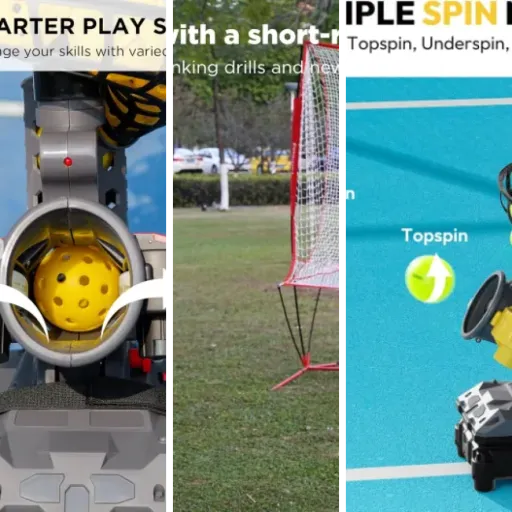
What surprised me most is how close it can get to real match patterns. With the internal oscillation and the pre-set drills, you can actually simulate someone pushing you side to side or mixing deep balls with shorter ones. It’s not the same as a human, obviously, but it’s a lot closer than just feeding yourself balls from a basket. I used it for dinks, volleys, resets, and even some lobs and overheads.
Overall, my first impression is pretty simple: it’s a solid training tool, not magic. It helps with volume and consistency, and it definitely exposes weaknesses when you crank up the speed. But it’s not cheap, and it’s only worth it if you’re actually going to use it regularly and don’t mind spending some time dialing it in. If you’re casual and only play once a week, this will probably feel like overkill and a bit of wasted money.
Is it worth the money?
The price is around the $2,000 mark, which is a lot for most casual players. You can basically think of it as the cost of 10–20 private lessons with a good coach. If you’re only playing once a week and mostly for fun, this is overkill. You’ll get bored, or it’ll sit in your garage. But if you’re playing multiple times a week and you like drilling, the math starts to make more sense. You’re paying upfront for a machine that will feed you balls whenever you want without complaining or canceling last minute.
Compared to cheaper ball machines, you’re mostly paying for three things: higher speed range, more realistic oscillation (especially internal), and the app with custom drills. If you don’t care about those and just want a basic feeder to practice one or two shots, you can find lower-priced machines that will get the job done. But if you want to simulate more match-like patterns, this sits in that higher tier that actually lets you program specific sequences and adjust them on the fly.
Where the value feels good is for players around 3.0–4.0 who are serious about improving and either don’t have regular drilling partners or want extra sessions on top of games. For that crowd, this can replace a chunk of paid lessons, or at least make the lessons more efficient because you show up with mechanics already grooved. If you split the cost with a few friends or use it in a club setting, it becomes a lot easier to justify.
On the flip side, there are some small things that bug me at this price: the remote is sold separately, no balls included, and no long-term track record yet for durability. Also, one reviewer said it felt "meh" for 3+ level players, which I think is more about expectations. It’s strong for repetition and consistency, less so for pure randomness. Overall, I’d call the value "pretty solid" if you actually drill often and are okay spending time learning the settings. If you’re lazy about practice or tight on budget, there’s better use of your money.
Design: more practical than pretty
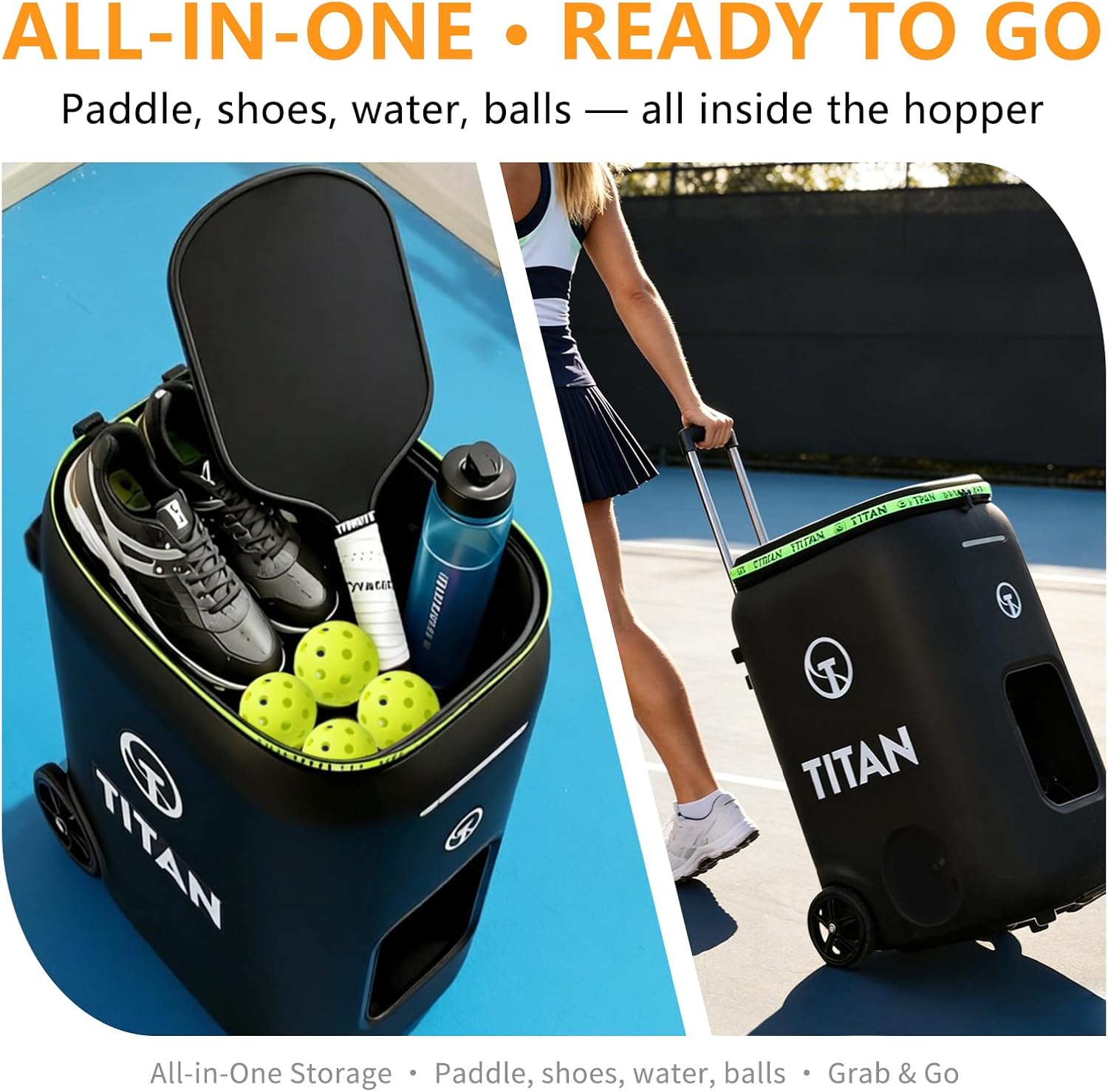
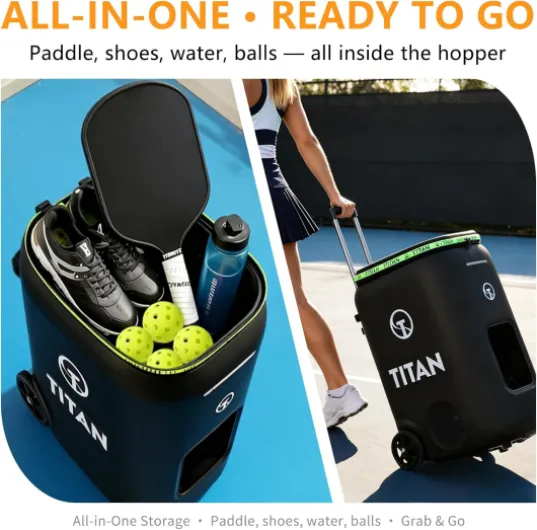
Design-wise, the Titan ONE is pretty straightforward: tall-ish black unit, about 31" high, 14" wide, 22" long. It’s not something you buy for looks, and that’s fine. The shape is basically built around the hopper and the internal mechanics. The good part is there are multiple grab points, so you’re not stuck trying to lift it from one awkward handle. I usually tilt it back on the wheels and use the extendable trolley handle, which feels similar to pulling a heavy suitcase.
The internal oscillation design is actually the interesting bit. Instead of the whole machine visibly swinging left and right, the movement happens inside. From the outside, the unit stays still, but the balls go all over the court. In practice, this matters because your opponent in a real match doesn’t telegraph where the ball is going with big side-to-side movements. With external oscillation machines, you can sometimes cheat by watching the head move. Here, you don’t get that cue, which makes the drills feel a bit more like real play.
One thing I liked is that the angle and trajectory are easy enough to adjust. You can go from low over-the-net dinks up to pretty high lobs and deep drives. The max trajectory is around 60 degrees, which is enough to practice overheads without needing someone to stand there tossing lobs. The controls are all in one place and labeled clearly. It still takes a bit of trial and error to match the numbers on the screen to what you actually see on the court, but once you’ve done a few sessions, you start to remember your favorite settings.
If I nitpick, the overall design is a bit bulky for small cars. I can fit it in the trunk of a mid-size SUV with no problem, but if you drive a tiny hatchback, you’ll probably have to fold seats down and play Tetris. Also, there are no fancy covers or cable management touches – it’s functional, not polished. For me, that’s fine. I care more about it surviving being rolled over rough parking lots and being shoved into the back of the car than about it looking stylish. It feels like a tool, not a toy, which matches the price and the target user.
Battery life and practicality between charges
The battery situation is decent but not mind-blowing. There’s a charger included, and I’ve been charging it after every 2–3 sessions just to be safe. In my use (around 60–90 minute sessions, feed interval usually between 3–6 seconds, medium speed and some oscillation), I haven’t run out of juice mid-session yet. So in realistic terms, you can comfortably get a couple of solid practices on one charge if you’re not running max speed and crazy-fast feed rates the whole time.
One thing to keep in mind: if you start cranking everything up – high speed, fast feed, lots of oscillation – you’ll drain it faster. That’s pretty normal for this kind of gear, but worth mentioning if you’re planning team practices or group sessions. My routine became: charge it the night before I knew I’d be using it, then not worry about it on court. The machine doesn’t give you a super detailed battery percentage like a phone, but you get enough indication to know if you’re running low.
The charger itself is basic and gets the job done. Plug it in at home, let it sit, and it’s ready by the next day. I didn’t time a full 0–100% charge because I never fully drained it, but from partially low to full seemed to take several hours, which is normal. It’s not something you can quickly top off courtside in 20 minutes, so you do need to plan ahead a bit. If you’re the kind of person who forgets to charge stuff, that might bite you.
Overall, I’d say the battery is solid for individual or small-group practice, but if you’re a coach running back-to-back clinics for half a day, you might push its limits unless you manage speed and feed rates. For regular players like me, it’s more than enough. It’s just not at the "charge once a week and forget it" level – you still need to treat it like a serious piece of equipment and keep it topped up.
Build quality and how tough it feels
The Titan ONE feels reasonably sturdy for something made from a mix of plastic and metal. I’ve rolled it over rough parking lots, up small curbs, and in and out of the car trunk, and nothing has rattled loose or cracked so far. The housing doesn’t feel cheap or flimsy. It’s not tank-level heavy-duty, but it gives the impression it can handle regular use without falling apart in a season.
The big trolley wheels help a lot with durability because you’re not dragging the machine and slamming it into every small bump. The handle mechanism feels solid – it extends and retracts smoothly, and I haven’t felt like it’s going to snap under the weight. The internal parts obviously are more delicate, but from an outside user perspective, nothing has jammed or made weird grinding noises yet, even when I’ve run longer sessions with continuous feed.
That said, long-term durability is still a question mark. I’ve only had it for weeks, not years. Some Amazon reviews mention good build quality, but there’s not a massive history yet since the machine seems relatively new. This isn’t a decades-old model with a big track record. If you’re worried about it lasting five or more years of heavy use, you’re kind of betting based on early impressions and the feel of the materials rather than a long list of long-term user reports.
From my own use, I’d say it feels like a serious training tool, not a toy. You still need to be a bit careful – don’t leave it out in the rain, don’t toss it around, don’t throw it into the trunk like a gym bag. Treated like proper equipment, I don’t see any red flags so far. Just don’t expect it to be indestructible, and remember that moving parts + dust + outdoor courts means you’ll probably want to keep it clean and maybe check for loose screws every now and then if you’re using it a lot.
On-court performance: how it actually hits
This is where the Titan ONE earns its keep. In terms of ball delivery, it’s pretty consistent. Once you lock in a drill, the placement doesn’t wander much. I used it for repetitive third-shot drops from the baseline and cross-court dinks, and it kept sending balls to roughly the same zones. It’s not laser-perfect, but for training footwork and stroke timing, it’s more than good enough. Compared to lower-end machines I’ve tried at clubs, the Titan feels a lot more stable in speed and direction.
The speed range is listed from 10 to 70 mph, and you feel it. At lower speeds, you can do beginner or warm-up stuff. Around mid-range, it’s good for realistic game drives and volleys. At the higher end, it’s honestly rough if you’re under 3.5. I cranked it up closer to max for reaction volleys and speed-ups at the kitchen, and it forced me to shorten my swing and get my paddle up. If you’re a solid 4.0+, you’ll appreciate that it can actually challenge you on pace. If you’re below 3.0, a lot of the top-end range will just feel like getting peppered.
The oscillation and randomization are where it starts to feel more like real play. With internal horizontal oscillation, it can send balls anywhere across the width of the court. You can set it to go side to side or use more random patterns. For example, I ran a drill where it mixed deep drives to my backhand with shorter balls near the kitchen, and it really forced me to move my feet instead of just standing in one spot. Vertical oscillation lets you alternate between low dinks and higher balls, which is handy for transition work.
On the downside, it’s not plug-and-play for level 3+ players if you want very specific patterns like deep cross-court topspin drives that land right on the sideline with perfect variation. You can get close, but it takes time to dial in spin, height, and speed to match what you see in matches. One Amazon reviewer said it felt "meh" for 3.0+ players, and I get where that’s coming from if you expect match-perfect randomness. It’s still a machine – you’re repeating patterns, not reading a human. For me, it’s strong for volume training and grooving mechanics, but it doesn’t fully replace a smart drilling partner who can read and react.
What you actually get for the price
The Titan ONE is basically a rolling black box that throws pickleballs at you in a bunch of different ways. On paper, it’s loaded: speeds up to around 70–75 mph, feed rate down to 1 second, internal oscillation, vertical and horizontal movement, plus an app that lets you build custom drills and use pre-programmed ones. The hopper holds about 85 balls by default, and there’s an optional extension to go up to 240, which I didn’t buy but honestly would be nice if you drill in groups.
The all‑in‑one hopper design is pretty handy in real life. You can dump your paddles, balls, and a few small items inside when you’re transporting it, so you’re not juggling three bags. The machine itself is about 48 lb empty and around 56 lb when it’s full of balls. It sounds heavy on paper, but with the big trolley wheels and the extendable handle, it’s manageable. I can get it from my car to the court without feeling like I’m hauling a fridge.
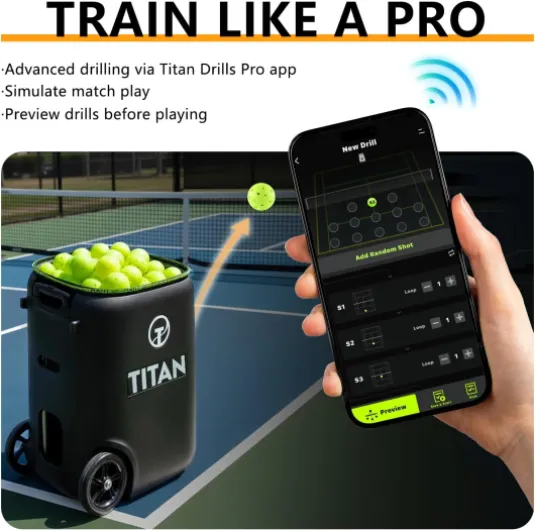
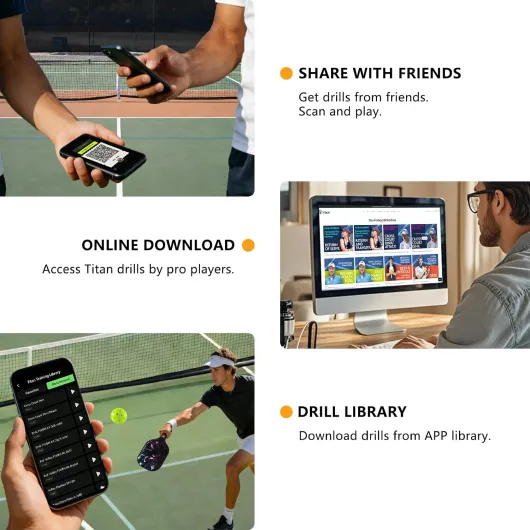
The app side is where it starts to feel more like a training system rather than just a machine. You get 12 built‑in drills that cover basics: cross‑court dinks, volleys, baseline drives, that kind of stuff. Then there’s the MegaDrill feature, where you can chain a bunch of patterns together. I used the pre‑sets for the first few sessions and then started tweaking them to fit my level. It’s not super fancy visually, but it’s functional, which is what matters to me.
In terms of overall package, you get the machine and a charger. No remote included by default, which is annoying at this price. There is a separate remote you can buy, but I just kept my phone courtside with the app and it was fine. If you’re expecting a full kit with balls and accessories out of the box, that’s not the case. It’s basically: machine, charger, and you handle the rest. For the price point, I think they could easily bundle at least a simple remote or a starter pack of balls, but they don’t.
Pros
- Consistent ball delivery with good speed range up to around 70–75 mph
- Internal oscillation and app-based drills create more realistic practice patterns
- Portable enough with trolley handle and large wheels despite the 48–56 lb weight
Cons
- High price, especially for casual players or those who rarely drill
- Learning curve to dial in settings and get the most out of the app and features
- Remote sold separately and no balls included despite the premium positioning
Conclusion
Editor's rating
The TITTAN Titan ONE is a solid pickleball machine for players who actually like to practice and are willing to tinker a bit. It delivers consistent feeds, has enough speed to challenge intermediate and advanced players, and the internal oscillation plus the app-based drills make sessions feel a lot less robotic than older, basic machines. It’s not magic, but it definitely helps you get volume on key shots: third shots, dinks, volleys, resets, overheads. If you’re the type who goes to the courts alone and wants to make that time useful, it fits that need well.
It’s not perfect, though. There’s a learning curve, especially if you want very specific patterns and speeds. At this price, the lack of an included remote and balls is a bit annoying. Durability looks good so far, but the product is still relatively new, so long-term reliability is more of an educated guess than a certainty. And if you’re a casual 2.5–3.0 player who mostly shows up for social games, this is probably more machine than you need and more money than you should spend.
I’d recommend it to intermediate and above players (around 3.0–4.0+) who drill regularly, coaches who want a flexible tool for lessons, and serious beginners who know they’re committed for the long run. People who should skip it: very casual players, anyone expecting it to fully replace a smart human partner, and folks who hate messing with apps and settings. Used the right way, it’s a strong training partner; used half-heartedly, it’s just an expensive box taking space in your garage.