Summary
Editor's rating
Value for money: good performance, but you’re paying for the name and tech
Design: head-heavy control shape with a big usable face
Comfort and grip: good in the hand, but swing weight matters
Materials: raw carbon, polymer core, and a solid (but not flawless) build
Durability and build consistency: sturdy paddle, but QC could be tighter
Performance on court: control-first with decent power and spin
What you actually get out of the box
Pros
- Very good control and forgiveness thanks to 14.3 mm core and large sweet spot
- Raw carbon face offers solid spin for serves, drives, and dinks
- Comfortable high-tack grip and handle length that works for one or two hands
Cons
- Head-heavy feel can slow down hand speed and cause extra fatigue for some players
- Power is only average; not ideal for players who rely on big drives
- Quality control seems inconsistent based on some buyer reports

Specifications
View full product page →| Brand | Paddletek |
A control paddle that still packs a punch
I’ve been playing pickleball 3–4 times a week for a few years, mostly rec play and the odd local tournament. I picked up the Paddletek Tempest TKO-C because I wanted more control and spin than my older fiberglass paddle, without jumping into those super thick, super soft paddles that kill all power. On paper, this one hits that middle ground: 14.3 mm core, raw carbon face, and a shape that’s clearly meant for control players.
Over a couple of weeks, I used this paddle in mixed doubles and men’s doubles, both indoors and outdoors. I swapped back and forth with my usual paddle (a more power-oriented carbon model) so I could really feel the difference. Right away, what stood out was the head-heavy feel and the solid control on dinks and blocks. It’s not some magic wand, but it’s easier to keep the ball in when you’re under pressure at the kitchen.
At the same time, it’s not a featherweight toy. Some people will find it a bit heavy or at least swing-heavy, especially if you’re used to lighter, more balanced paddles. A couple of players I let try it said exactly what one Amazon review mentioned: "Heavy but good for control." That lines up with my experience. You trade a bit of hand speed for stability and forgiveness.
Overall, it feels like a paddle built for players who already have some basics down and want a bit more precision and spin without losing all power. It’s not perfect, and there are some small annoyances, especially around quality control and the feel of the balance, but it does its job well enough that I kept reaching for it during league nights instead of just tossing it back in the bag.
Value for money: good performance, but you’re paying for the name and tech
Price-wise, the Tempest TKO-C sits in that premium but not crazy bracket. You’re paying for a known brand, a raw carbon face, and a control-focused design with some thought put into balance and sweet spot. For someone who plays a lot and cares about feel and consistency, the price is justifiable. It’s not cheap, but it’s also not out of line with other raw carbon paddles on the market right now.
In terms of what you actually get for the money, the paddle delivers good control, solid spin, and reliable build quality (assuming you get a properly new unit). If you’re a control player or an all-rounder who wants to tighten up your soft game while keeping enough pop to finish points, it’s a pretty good fit. You’re not buying hype here; you’re buying a paddle that does what it says: more control, decent power, and a forgiving sweet spot.
On the downside, there are competitors in the same price range that offer similar or better performance, sometimes with a slightly more balanced feel or extras like a cover, better packaging, or a more refined finish. Also, the head-heavy balance won’t suit everyone, so you might be paying for a paddle that doesn’t match your style if you don’t know what you’re getting into. Add to that the occasional quality control complaint from other buyers, and the value picture gets a bit more mixed.
Overall, I’d call the value pretty solid but not mind-blowing. If you like Paddletek paddles already (especially the Tempest line) and want a carbon upgrade with more spin and a familiar control feel, the price makes sense. If you’re just looking for the absolute best performance per dollar, you might want to compare a few other raw carbon options before committing. It’s good, it works, but it’s not some hidden bargain—what you’re paying is roughly what you’re getting.
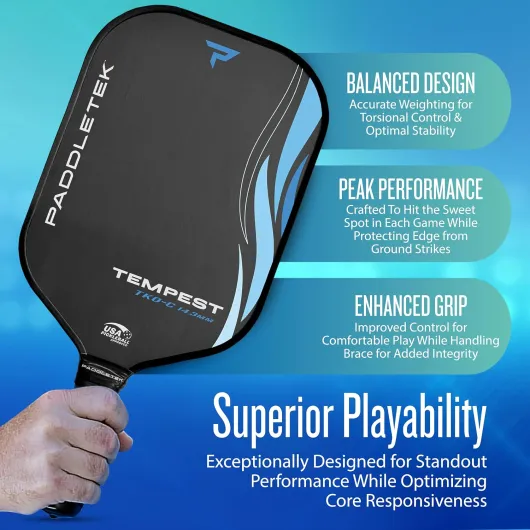
Design: head-heavy control shape with a big usable face
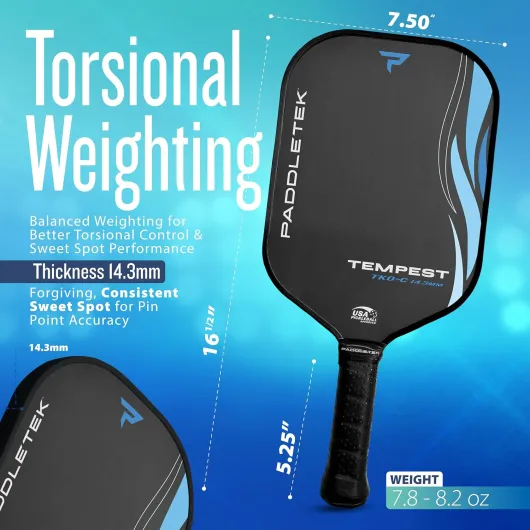
The main design idea here is pretty clear: control first, with enough reach and power to stay competitive. The 16.5" x 7.5" shape gives you a tall, fairly narrow face. It’s not as skinny as some extreme elongated paddles, but it’s definitely not a classic wide-body either. On court, that translates to good reach on wide dinks and overheads, but a slightly smaller margin on off-center hits near the edges compared to really wide paddles.
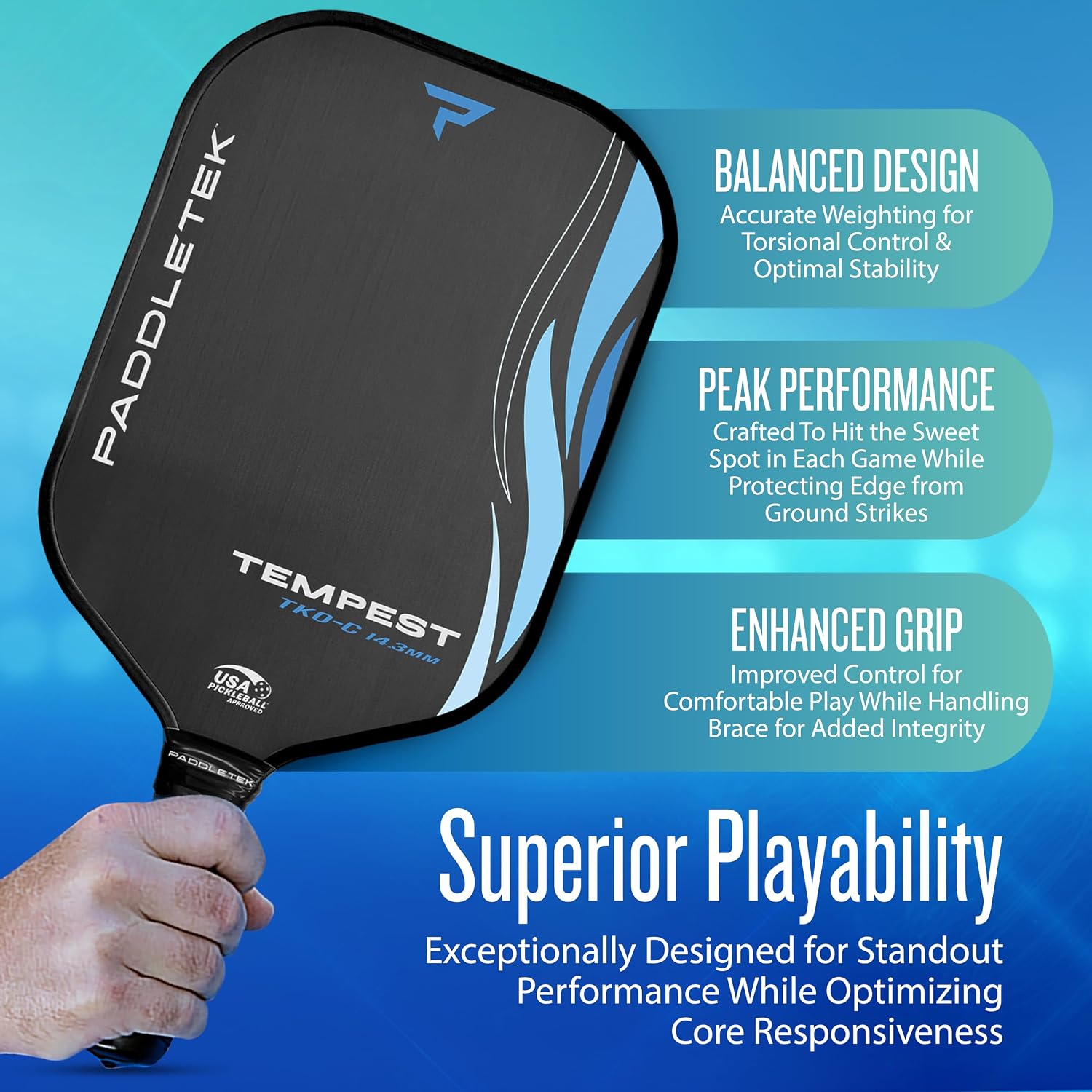
The corners are more rectangular than rounded, which Paddletek calls out as part of their "optimized sweet spot" design. In practice, what I noticed is that the usable area feels big and forgiving. Mishits near the top half of the paddle didn’t die as much as I expected. The paddle also has what they call "torsional weighting"—basically, they’ve put weight in a way that’s supposed to help with twisting on off-center shots. I won’t pretend I can feel the engineering, but I can say that blocks and resets on slightly off-center contact still felt pretty stable.
The downside of this design is the head-heavy feel. If you’re used to more evenly balanced paddles, you’re going to notice it right away. My hand speed at the kitchen took a few games to adjust, especially on fast hands battles. I found myself a bit late on some counters until I consciously shortened my swing and used more wrist. Once I adapted, it was fine, but this is not the quickest paddle in the hand. Players with elbow or shoulder issues might also want to be careful with that extra swing weight.
Cosmetically, the design is simple and practical. Blue accents, clear branding, matte carbon face. No loud patterns or flashy logos. For me, that’s totally acceptable—this feels like a paddle made for people who care more about how it plays than how it looks on Instagram. If you want something eye-catching, this will feel a bit plain. If you just want a clean, functional design with a big sweet spot and some extra reach, it hits that mark pretty well.
Comfort and grip: good in the hand, but swing weight matters
Comfort-wise, the handle and grip are one of the strong points of this paddle. The grip is a high-tack, cushioned style that feels secure even when your hand gets sweaty. I didn’t have any slippage issues, and I didn’t feel the need to immediately re-grip it, which I usually do with a lot of stock grips. The tack level is pretty high, so if you like a dry, smooth grip you might want an overgrip, but if you like that "locked-in" feel, this works well out of the box.
The handle itself is around 5.25", which to me feels like a good middle ground. I can do a two-handed backhand if I want to, but it doesn’t feel like a tennis racket. One Amazon reviewer said the handle length made it hit their waist sometimes, and I get that. On low balls or when I’m crowding the kitchen line, I did occasionally feel the butt of the handle bump into my body. After a few sessions I adjusted my stance a bit and it stopped being an issue, but it’s something shorter players or those with a very compact stance might notice.
Where comfort gets a little more mixed is the overall balance and swing weight. The paddle feels head-heavy. That’s great for stability and absorbs pace nicely on blocks and resets, but if you rely on quick flicks and fast hands at the net, your arm and wrist might feel it after a long session. I didn’t get pain, but after back-to-back nights of play, I could feel more fatigue in my forearm than with some lighter, more evenly balanced paddles I’ve used.
In terms of impact feel, the 14.3 mm core keeps it on the controlled but not overly soft side. It doesn’t have the harsh, pingy feel of some thin paddles, and it doesn’t feel like you’re hitting with a sponge either. I’d call it comfortable enough for most adult players, including older players, as long as they’re okay with that slightly heavier swing. If you already struggle with elbow or shoulder issues, I’d test it first or be ready to switch if it feels too demanding over time.
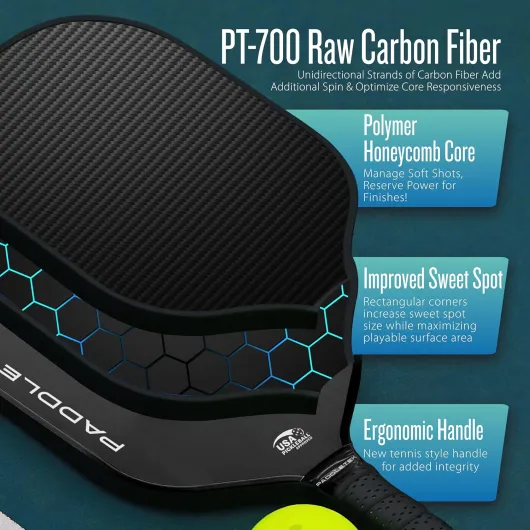
Materials: raw carbon, polymer core, and a solid (but not flawless) build
On paper, the materials are what you’d expect from a modern mid-to-high tier paddle. You get a polymer honeycomb core at 14.3 mm thickness and a PT-700 raw carbon fiber face. That combo is pretty common now: polymer gives you some softness and control, and raw carbon gives you grip on the ball for spin. The frame and shaft are both listed as carbon fiber, which should keep the overall structure stiff enough to avoid too much flex or dead spots early on.
In actual use, the paddle feels solid and well-built. There were no weird vibrations or rattles, and the face felt consistent across the hitting area. The core thickness is a nice middle ground: thicker than old-school thin power paddles, but not as chunky as those 16mm+ "pillow" paddles. That translates to a feel that’s controlled but not mushy. You can still drive the ball and get some pop on put-aways, but you have more touch on drops and dinks than with a pure power paddle.
The raw carbon surface feels grippy to the touch and held up fine over a couple of weeks of play. I didn’t see any early peeling, bubbling, or weird marks beyond normal wear. That said, one of the Amazon reviews mentioned getting a paddle that already had ball marks and a torn grip out of the box. That’s not a material problem as much as a quality control or shipping/storage issue, but it’s worth mentioning. For the price these paddles usually go for, you expect something that looks new when it arrives.
Overall, the materials are pretty solid for the category: modern core, raw carbon face, sturdy frame. You’re not getting some cheap plastic feel here. Still, we’re not talking about some luxury build either. It’s a functional, performance-focused setup that gets the job done without any fancy gimmicks. If Paddletek tightens up quality control on what leaves the warehouse, I’d have no real complaints on the materials side.
Durability and build consistency: sturdy paddle, but QC could be tighter
In terms of actual durability on court, my experience was positive. Over a couple of weeks of regular play, the edge guard stayed tight, the face didn’t show any weird dead spots, and there were no rattles or strange noises. Just the usual light scuffing you get from scraping the court on low digs and a few ball marks. The polymer core and carbon face combo felt like it could easily handle months of play without falling apart, assuming normal use.
The handle feels reinforced and solid, and Paddletek mentions a handle brace for added structural integrity. I didn’t feel any flex or wobble when hitting hard or when stretching for volleys. That’s good news, because handle cracks are one of the more annoying failures you see in paddles. With this one, the handle felt reliable and sturdy, and the stock grip didn’t start unraveling or twisting during my tests.
Where things get a bit shaky is around quality control and what you get out of the box. One of the Amazon reviews mentioned getting a paddle that clearly looked used: ball marks on the face and a torn grip. For a high-end paddle, that’s not acceptable. My own unit arrived clean and clearly new, so I didn’t run into that personally, but knowing that at least one person had that issue makes me think Paddletek or the seller needs to pay more attention to inspection and returns. You don’t want to roll the dice when you’re paying this kind of money.
So, durability during play: no real complaints, it feels like it will last. Durability in the sense of consistent manufacturing and shipping quality: there’s room for improvement. If you buy it, I’d check it carefully on arrival—look for scuffs, grip damage, or face imperfections—and don’t hesitate to send it back if it doesn’t look genuinely new. Once you have a good copy, though, it feels like a paddle that can easily handle long-term use for regular players.
Performance on court: control-first with decent power and spin
On court, the main story is control and forgiveness, with enough power to finish points but not so much that you’re sailing balls long all the time. The 14.3 mm polymer core plus the raw carbon face gives you a nice blend: soft enough for dinks and drops, firm enough to drive. If you’re coming from a pure power paddle, you’ll notice you have to swing a bit more to get the same pace. If you’re coming from a very soft, thick control paddle, this will feel like a small step up in pop.
At the kitchen, I liked it a lot. Dinks, resets, and soft blocks felt predictable and consistent. The big sweet spot and torsional stability helped on slightly off-center hits, especially in those scramble points when you’re just trying to get the ball back in play. The extra reach from the 16.5" length also helped me save a few balls I’d normally miss with a shorter, wider paddle. For players who like to slow the game down and win with placement, this paddle fits that style well.
On drives and serves, it’s solid but not a rocket. You can definitely hit hard, but the paddle doesn’t give you free power like some thinner, stiffer paddles. I found myself focusing more on spin and placement than brute force. The raw carbon face grabs the ball well, so topspin drives and heavy topspin serves were reliable. I wouldn’t say the spin is off the charts, but it’s clearly better than basic fiberglass paddles and enough to be annoying for your opponents if you know how to use it.
In fast hand battles, the head-heavy balance is a double-edged sword. The stability is nice when you’re blocking hard drives or countering close to your body, but quick exchanges way out in front sometimes felt a bit slow. I had to shorten my motion and rely more on small wrist movements instead of big swings. Once I adjusted, it was fine, but if your game is built on pure hand speed, you might prefer something lighter or more evenly balanced. Overall, I’d call the performance very solid for control players, decent for all-around players, and just okay for pure bangers who want max power with minimum effort.
What you actually get out of the box
Out of the box, the Tempest TKO-C looks like a pretty standard modern carbon paddle: tall shape, carbon face, simple graphics. You’re not getting some fancy display case or extra accessories. It’s just the paddle, grip already wrapped, ready to play. That’s fine by me; I’m more interested in how it plays than in unboxing theatrics. The color I had was the Riptide blue version, which is low-key and doesn’t scream for attention on the court.
The paddle is 16.5" tall and 7.5" wide, so it’s more of an elongated control paddle than a wide-body. The handle length is around 5.25", which is long enough for a loose two-handed backhand but still feels like a standard grip for one-handed play. If you’re coming from a short-handle paddle, you’ll notice this extra length. One Amazon reviewer mentioned the handle hitting their waist, and I had the same thing happen a couple of times on low backhands until I adjusted my stance a bit.
In the hand, it feels like a midweight paddle, but the swing weight is higher than you’d expect from the listed weight (around 0.5 pounds / ~8 ounces). That means it feels heavier when you’re actually swinging, especially on quick exchanges at the net. Visually, the PT-700 raw carbon face has that typical matte, textured look. You can feel the texture with your fingers, which usually means decent spin potential. There’s nothing flashy about the design, and honestly that’s fine. It looks like a tool, not a fashion item.
If I compare it to some other paddles I’ve tried in the same price area, the presentation is pretty standard: solid, no extras, nothing fancy. The only thing that slightly bothered me is that for the price, I’d expect a bit more consistency in finish. The edges and face were fine on mine, but after reading the review about someone getting a paddle with ball marks and a torn grip, I’d say quality control might be hit or miss. Mine arrived looking new and clean, so personally I can’t complain, but it’s something to keep in mind.
Pros
- Very good control and forgiveness thanks to 14.3 mm core and large sweet spot
- Raw carbon face offers solid spin for serves, drives, and dinks
- Comfortable high-tack grip and handle length that works for one or two hands
Cons
- Head-heavy feel can slow down hand speed and cause extra fatigue for some players
- Power is only average; not ideal for players who rely on big drives
- Quality control seems inconsistent based on some buyer reports
Conclusion
Editor's rating
The Paddletek Tempest TKO-C is a control-first raw carbon paddle that does its job well without trying to be flashy. The big takeaways after playing with it are: very solid control and forgiveness, a grippy face for spin, and a comfortable handle and grip. The 14.3 mm polymer core gives you a nice balance between touch and pop, so you can dink and reset confidently but still drive the ball when you need to. It feels especially good for players who like to slow things down, win kitchen battles, and rely on placement more than brute force.
The trade-offs are pretty clear. The paddle feels head-heavy, which helps with stability but can slow down your hands in fast exchanges and might cause some fatigue if you’re sensitive to weight. Power is decent but not wild; you’ll need to swing with intent if you want to hit through people. And while my unit arrived in good condition, at least one buyer reported getting what looked like a used paddle, which raises a question mark about quality control at the seller or manufacturer level.
If you’re a serious rec player or a competitive player who values control, spin, and a big sweet spot, and you’re okay with a slightly heavier swing, this is a good fit. If you’re a beginner who just wants something cheap, or a power-hungry player who wants maximum pop with minimal effort, there are better options for you. In short: good, reliable, control-oriented paddle with a few quirks, worth considering if the balance and style match what you’re looking for.