Summary
Editor's rating
Value: worth it if you care about control more than raw pop
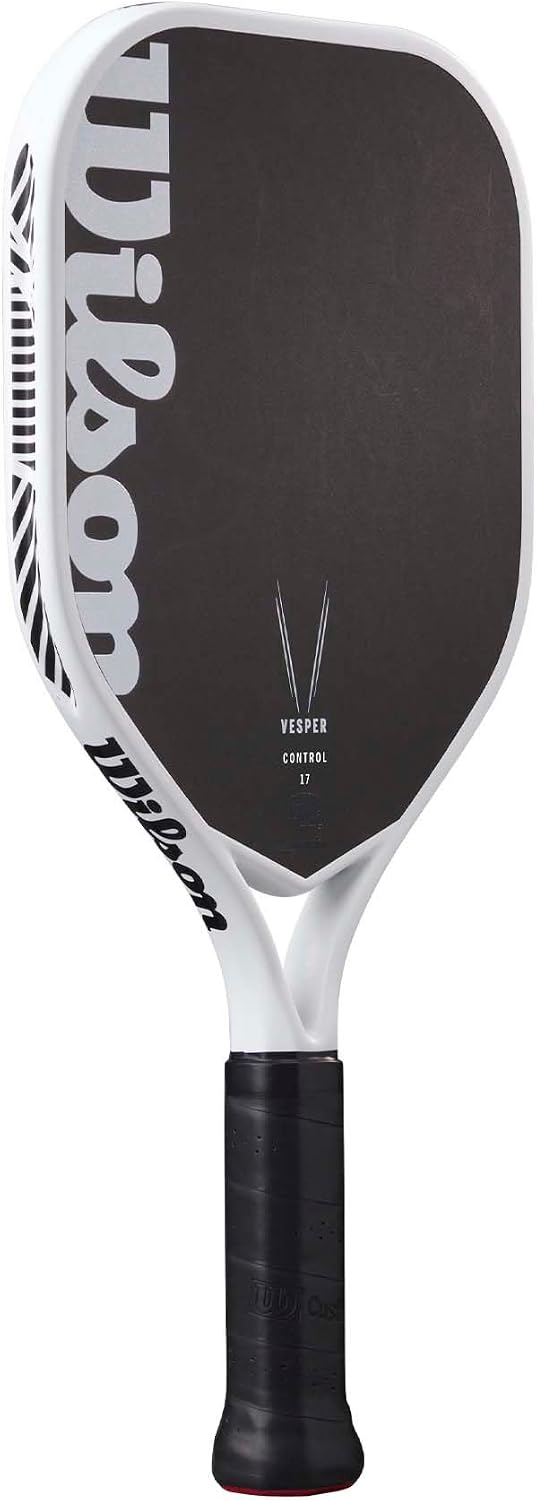
Design: mini tennis racket vibes with a smaller-looking head
Comfort and grip: good for tennis-style swings and two-handed backhands
Materials: raw carbon face and dense foam core in real life
Durability after a few weeks: solid so far, with typical wear
On-court performance: control first, power second
What you actually get out of the box
Pros
- Very good control and predictable response, especially for players with big tennis-style swings
- Comfortable hybrid handle length that works well for two-handed backhands
- Raw carbon face gives solid spin and a muted, arm-friendly feel
Cons
- Less free power than many popular thermoformed or thicker paddles
- Head looks and feels slightly smaller, so off-center hits are punished more
- No cover or extras included despite mid-to-upper price range

Specifications
View full product page →| Brand | Wilson |
A control paddle that actually reins in your power
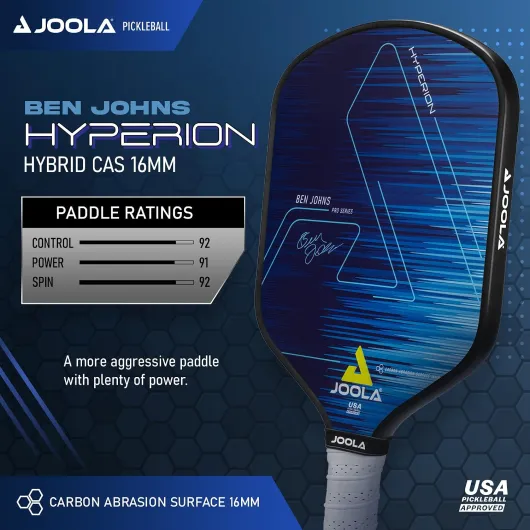
I’ve been playing pickleball 3–4 times a week for a while, and I picked up the Wilson Vesper Control 17 because I kept sailing balls long with my power paddles. I used it for about three weeks in rec games and a small local tournament, swapping back and forth with my Joola Hyperion and a cheap Amazon fiberglass paddle to see if the difference was real or just marketing talk. Short version: this thing clearly leans toward control and feels very familiar if you come from tennis.
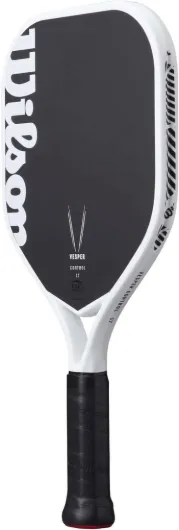
The first thing I noticed is the smaller, wide head and open throat. It really does feel like a mini tennis racket in hand. At first it threw me off on blocks and hand battles at the kitchen because the shape is a bit different from the typical elongated paddles. After two or three sessions, though, I started finding the sweet spot pretty consistently and felt more confident driving the ball hard without sending it out the back.
Wilson talks a lot about the bladder-moulded frame and raw carbon face. Honestly, I don’t care how they built it; what matters to me is what happens when I hit. Compared to my Joola, I instantly felt less trampoline effect and more of a muted, solid contact. That helped me keep fast drives and counterattacks down, especially when I was swinging like I still had a tennis racket in my hand. If you’re used to just flicking the wrist with a very poppy paddle, this will feel more controlled but also a bit less forgiving on lazy shots.
It’s not perfect, and it’s not some miracle paddle that fixes bad footwork or late swings. The sweet spot is good but not huge, and mishits near the edge die quickly. But if you’re a player who tends to overhit, especially with a tennis background and a big swing, this paddle actually does help you keep the ball in play and place your shots better. That’s really the main story here.
Value: worth it if you care about control more than raw pop
In terms of value for money, the Wilson Vesper Control 17 sits in that mid to upper-mid price range where you expect real performance but not luxury-level bells and whistles. You’re paying for the carbon face, foam core, and Wilson branding, not for a big bundle of accessories. If you just look at specs, there are cheaper paddles that claim similar features, but on court this one actually feels well tuned for control and spin, which is what it’s supposed to do.
Compared to my Joola Hyperion, the Vesper feels less powerful but more controlled, especially for someone with a tennis background. If you regularly overhit or struggle to keep your drives and counters in, the money makes sense because it might genuinely cut down your unforced errors. If you’re already very precise and you just want more pop, then you might feel like you’re paying a decent amount for a paddle that doesn’t add much to your attack. So it really depends on what you need.
Against the cheap Amazon fiberglass paddle I own, there’s a clear difference in feel and consistency. The cheap one has random hot spots and dead spots; the Vesper is much more predictable across the face. That alone justifies the price jump for me. Add in the better spin, more comfortable handle for two-handed shots, and the build quality that feels more serious, and I’d say the value is pretty solid if you’re at least an intermediate player or a serious beginner who knows they’re going to stick with the sport.
If you’re brand new to pickleball and just figuring out if you like the game, this might be overkill. Start cheaper. But if you already play regularly and you’re looking for a control-focused paddle that reins in your power instead of boosting it, the Vesper Control 17 is reasonably priced for what it delivers. Not a bargain, not overpriced – it lands in that “fair deal if it fits your playing style” zone.
Design: mini tennis racket vibes with a smaller-looking head
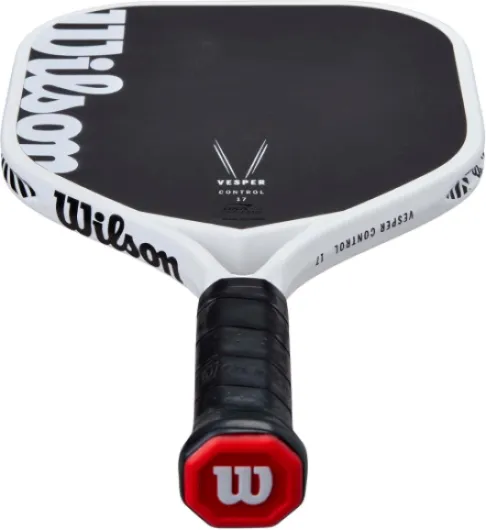
The open-throat design is the first thing that jumped out at me. It really does look like someone shrunk a tennis racket and squared off the head. When you put it next to a more traditional, solid-throat pickleball paddle, it looks a bit unusual at first. On court, though, it doesn’t feel gimmicky. The throat gives a clear separation between handle and head, and I found it easier to adjust my grip for two-handed backhands because of that visual and physical break.
People worry about the head looking smaller. I had the same reaction: when I first unboxed it, I thought, “Great, I just bought a paddle with less hitting area.” In practice, the usable hitting zone is about the same; they’ve basically trimmed the lower part of the face that you don’t really hit with anyway. The sweet spot sits a bit higher, roughly around where you’d expect it on a wide-body paddle. Once I stopped overthinking it and just played, I didn’t feel like I was missing more balls than usual, though mishits near the top edge still punished me like any other control paddle.
Visually, it’s pretty simple and low-key. Black carbon look, minimal color, no huge flashy graphics. I actually like that – it doesn’t scream “look at me,” and it doesn’t get old after a month. If you want loud colors and wild patterns, this isn’t it. The overall shape is broad but not cartoonish. It fits easily in a standard paddle bag, and the edges don’t catch or fray easily on the zipper because there’s a decent edge guard built in.
On the court, the design choices translate into a paddle that feels compact and maneuverable at the net. The open throat and broad face help with quick resets and blocks because you can move it around fast without feeling like you’re swinging a shovel. The trade-off is that this isn’t a reach monster; if you like extra-long paddles to poach every ball, you won’t get that here. It’s more about compact control than extra reach.
Comfort and grip: good for tennis-style swings and two-handed backhands
Comfort-wise, the hybrid handle length and 4-1/4" grip are probably the biggest selling points if you’re coming from tennis. The handle is long enough for a two-handed backhand without feeling cramped, but not so long that it makes the paddle feel tail-heavy. I play with a semi-western-ish grip on my forehand and often use two hands on the backhand for rolls and counters, and I had no issue finding a comfortable hand position here.
The stock grip itself is fine but nothing special. It’s slightly cushioned, not too tacky, and about the right thickness for my medium-sized hands. After about an hour of play in warm weather, it did start to feel a bit slick, so I ended up adding an overgrip. Once I did that, the comfort level went up a notch and I didn’t think about it again. If you sweat a lot, I’d plan on throwing an overgrip on from day one. That’s pretty standard for most paddles anyway.
In terms of arm comfort and vibration, the paddle feels reasonably forgiving for a carbon-faced control model. It’s not pillow-soft like some thick, foam-heavy paddles, but I didn’t feel any harsh shock on off-center hits. I’ve had some mild elbow issues in the past, and after a couple of long sessions with the Vesper, I didn’t notice any flare-up that I could blame on the paddle. The combination of foam core and carbon frame seems to take the sting out without turning everything into mush.
At the net, the weight and balance make it easy to react to fast exchanges. It feels neutral to slightly head-light, so hand battles and quick blocks are comfortable and don’t tire out your wrist. Over a full two-hour session, I never felt like the paddle was fatiguing, even on days when I played mostly at the kitchen line. If you’re sensitive to heavy, head-loaded paddles, this one should feel manageable and friendly to your joints.
Materials: raw carbon face and dense foam core in real life
Wilson pushes the pure/raw carbon face and high-density foam core in the description, and you can feel that right away in the way the ball comes off the paddle. Compared to my fiberglass paddle, the Vesper has a more muted, solid contact. It doesn’t have that springy, trampoline feel. The raw carbon surface has a slightly gritty texture, which helps grab the ball for spin. When I was brushing topspin drives or heavy topspin rolls from the baseline, I could get good dip on the ball without needing to swing out of my shoes.
The dense foam core gives it a pretty even feel across the face, but it’s still a control paddle, not a power brick. When you hit dead center, you get a firm, predictable response. When you drift toward the edges, the power drops off, but it doesn’t feel hollow or clunky. It’s more like the paddle is telling you, “Hit the center if you want more.” For dinks and soft drops, this is actually nice, because you can be a bit more aggressive with your swing without the ball flying long.
The frame is carbon, and after a few weeks of play – including some paddle clashes at the net that made us all cringe – no cracks, no obvious structural issues. The edge guard is holding up fine so far, just some normal scuffing from picking up balls off the ground. I’ve seen cheaper paddles start to chip or peel around the edges pretty quickly; this one feels more solid. The surface texture is still there after a bunch of sessions, so spin hasn’t dropped off yet in any noticeable way.
Overall, the materials feel reliable and purpose-built for control and spin, not raw power. If you’re expecting the carbon to give you extra pop like some thick thermoformed paddles, that’s not what this is. It’s more of a controlled, connected feel. For me, that’s a plus, but if you rely on the paddle to do most of the work on power, you might find it a bit underwhelming on big serves and drives.
Durability after a few weeks: solid so far, with typical wear
Durability is always a bit of a gamble, but after a few weeks of regular use, the Vesper Control 17 is holding up well. I’ve used it on both indoor and outdoor courts, including some not-so-gentle rec play where paddles collide at the net. The carbon frame hasn’t shown any cracks or soft spots, and the edge guard is still firmly attached. There are some normal scuffs on the guard from scraping the ground to pick up balls, but nothing that affects play.
The raw carbon face still has its texture. I compared it by touch to a brand-new carbon paddle a friend had, and while mine has smoothed slightly in the highest-contact area, it still grips the ball fine. Spin hasn’t noticeably dropped off in my shots yet. I’ve seen cheaper paddles lose their bite pretty quickly, so this is a good sign. I’ll be more curious to see how it looks after 3–6 months, but for now, no red flags.
The handle and grip area also feel secure with no wobble or creaking. Some paddles start to feel loose where the handle meets the head, especially with a lot of two-handed backhands and hard serves. I’ve been using two hands on the backhand quite a bit with this one, and there’s no sign of that joint weakening. The stock grip is starting to show a bit of wear, but I added an overgrip early on, so most of the sweat and friction is on the overgrip anyway.
Overall, I’d say durability looks pretty solid for the price and build. Obviously, I can’t pretend I’ve used it for a full year yet, but based on the frame, face, and edge guard after several weeks of heavy play, I don’t see anything that makes me worry. If you treat it like a normal paddle and don’t slam it into the ground or the fence, it should last a good amount of time. The 2-year manufacturer warranty from Wilson is also reassuring if something weird does happen.
On-court performance: control first, power second
Performance-wise, this is clearly a control-oriented paddle. From the baseline, I noticed right away that my drives and serves were landing deeper but staying in more consistently compared to my Joola Hyperion. With the Hyperion, if I really go after the ball with a full tennis-style swing, I have to hold back a bit or the ball flies long. With the Vesper Control 17, I could swing more naturally and trust that the paddle wouldn’t launch the ball. I still got decent pace, just not the same free power. You have to bring your own.
At the kitchen line, the soft game is where this paddle feels most at home. Dinks, drops, and resets are very predictable. The muted feel makes it easier to keep the ball low and short without constantly babying your swing. I was able to push my dinks a bit more aggressively and still keep them in the kitchen. On third-shot drops from mid-court or the baseline, the paddle helped me shape the arc and depth nicely. I wouldn’t say it magically fixes bad technique, but it doesn’t fight you like some overly bouncy paddles do.
Spin is solid, especially for topspin and roll shots. The raw carbon surface grabs the ball well when you brush up on it. I got good kick on serves and topspin drives that dipped inside the baseline. Slices and cuts also felt controlled, though not quite as nasty as with a super-grippy textured face I tried from another brand. Still, for a mainstream carbon paddle, spin is more than adequate. If you like brushing the ball, you’ll be happy here.
The main downside performance-wise is pure power on big shots. If you rely a lot on flat, hard drives and put-aways and expect the paddle to add a ton of pop, this one will feel a bit tame. You can still finish points, but you need to be in good position and swing with intent. For me, the trade-off is worth it because I get more control and fewer unforced errors. But if your style is smash-first, finesse-second, you might lean toward a more explosive paddle.
What you actually get out of the box
Out of the box, the Wilson Vesper Control 17 is pretty straightforward: one paddle, no cover, no extras. For the price bracket it’s in, I would have liked at least a basic sleeve, but it’s not a deal-breaker. The branding is clean and low-key: mostly black with simple Wilson and Vesper markings. It looks more like a serious piece of sports gear than a toy, which I appreciate, but don’t expect anything flashy or eye-catching.
The specs on paper: 35 x 18 cm face, 4-1/4" grip (size 2), broad shape, raw carbon face, dense foam core, about mid-weight in the hand (Wilson doesn’t plaster the weight everywhere, but it feels in the typical 7.8–8.2 oz range). The open throat and the molded frame give it a more racket-like profile, and you can immediately see why tennis players in the reviews say it feels familiar. It’s not one of those super-elongated paddles; it’s a bit wider, which is meant to give you more control and a bigger sweet spot.
From a practical standpoint, it’s easy to just grab and play. No weird balance issues, no feeling that the head is too heavy or too light. A couple of my friends tried it during open play: the ones with tennis backgrounds liked it right away, while the ones used to thicker, poppier paddles felt it was a bit too muted and control-oriented. That lines up with how it’s marketed. It’s clearly aimed at players who already know how to generate their own power and want something to help them keep the ball in.
In terms of first impression, I’d say it feels like a serious intermediate-to-advanced paddle, not an entry-level toy. But the presentation is no-frills: you’re paying for the paddle itself, not accessories or fancy packaging. If you want a bundle with a case, balls, and overgrips, this is not it. If you just want a solid control paddle from a known brand, it fits the bill.
Pros
- Very good control and predictable response, especially for players with big tennis-style swings
- Comfortable hybrid handle length that works well for two-handed backhands
- Raw carbon face gives solid spin and a muted, arm-friendly feel
Cons
- Less free power than many popular thermoformed or thicker paddles
- Head looks and feels slightly smaller, so off-center hits are punished more
- No cover or extras included despite mid-to-upper price range
Conclusion
Editor's rating
The Wilson Vesper Control 17 is a solid choice for players who want control and consistency more than raw power, especially if you have a tennis background. The open-throat, mini-racket feel, raw carbon face, and dense foam core come together to give you a predictable, muted contact that makes it easier to keep the ball in when you swing hard. Spin is good, the handle is friendly for two-handed backhands, and the paddle feels comfortable for long sessions without beating up your arm.
It’s not perfect. The head looks smaller at first, the stock grip is only okay, and if you rely heavily on the paddle to generate power, you might find it a bit tame compared to some thicker, poppier models. You’re also not getting extras like a cover in the box, so the value is more about on-court performance than accessories. But for intermediate and competitive rec players who are tired of hitting long with bouncy paddles, this is a practical, no-nonsense control tool that does what it claims without a lot of fluff.
If you’re a finesse-focused player, a former tennis player, or someone who wants to clean up their soft game and cut unforced errors, the Vesper Control 17 makes sense. If you’re a pure banger who wants maximum pop and put-away power with minimal effort, you should probably look at more power-oriented options instead.