Summary
Analysis score
Average of the criteria rated below
Is the TruFoam Genesis worth the price tag?
Elongated shape and tennis-inspired feel on paper
Weight, grip and on-court comfort feedback
Foam core longevity and consistency over time
Spin, control and power: what buyers actually report
What the TruFoam Genesis CRBN 3 Elongated brings to the table
Pros
- 100% foam core and 14 mm thickness designed for consistent feel and to reduce core crush over time
- Strong user feedback on spin, control, and reach, especially for players with good technique
- Elongated shape with 4" grip suits two-handed backhands and players who value extra coverage
Cons
- Premium price, and at least one buyer feels the performance jump vs other CRBN paddles is modest
- Power is described as adequate rather than explosive, which may not suit players seeking maximum pop

Specifications
View full product page →| Brand | CRBN Pickleball |
A foam-core paddle that’s trying to change the rules
The CRBN TruFoam Genesis CRBN 3 Elongated is a pretty bold move in a market where most paddles look similar on paper: honeycomb cores, multiple thicknesses, and small tweaks year after year. Here, CRBN goes in a different direction with a 100% foam core and a single, fixed thickness of 14 mm. The brand clearly positions this as a new generation of paddle aimed at players who care about precision, spin, and long-term consistency more than raw pop.
On the numbers side, the paddle sits at about 0.33 kg (~11.6 oz) package weight, has a 4-inch grip size, and uses a carbon fiber hitting surface with what CRBN calls 4th Generation Technology. It’s USA Pickleball approved and marketed for all ages and skill levels, from ambitious rec players to people grinding tournaments. So the promise is: you buy one thickness, one foam formula, and you’re done—no need to wonder if you should pick 14, 16, or 19 mm.
In the Amazon comments, the overall tone is positive: 4.4/5 from around 90+ reviews, with many verified buyers praising the mix of spin, control, and what they see as predictable power. Some players even call it the best paddle they’ve played so far, which is a strong statement in a crowded space. At the same time, there are voices saying the difference versus other CRBN models is not as dramatic as the marketing suggests, especially considering the price bracket.
In my opinion, this paddle looks like a serious option for players who already have somewhat clean mechanics and want more dwell time and spin potential, without dealing with core fatigue or dead spots over time. It’s not a budget product, and it doesn’t pretend to be. The big question is whether the foam-core tech and the on-paper consistency justify the cost compared with classic honeycomb paddles. That’s what the next sections dig into, using the spec sheet and what real buyers report in their reviews.
Is the TruFoam Genesis worth the price tag?
The TruFoam Genesis CRBN 3 Elongated sits in the premium pickleball paddle segment. The exact price isn’t listed here, but given the brand, technology claims, and market positioning, it clearly isn’t trying to compete with entry-level composite paddles. So the real question is whether the unique foam core and the performance feedback justify paying more than for a standard honeycomb-carbon paddle. The Amazon rating of 4.4/5 from 90+ reviews suggests that most buyers feel they got their money’s worth, but it’s not a flawless 5/5, which lines up with some nuanced opinions.
One reviewer explicitly says that the paddle is good but, in their view, “not worth the expense” and “not a dramatic change” from CRBN’s carbon 1 and 3 models. That comment is important: if you already own a recent CRBN paddle, the jump to TruFoam might feel more like refinement than revolution. On the flip side, other buyers describe it as the best paddle they’ve played, with excellent touch and power, and praise the spin and control. That split shows that perceived value is heavily tied to your reference point and expectations.
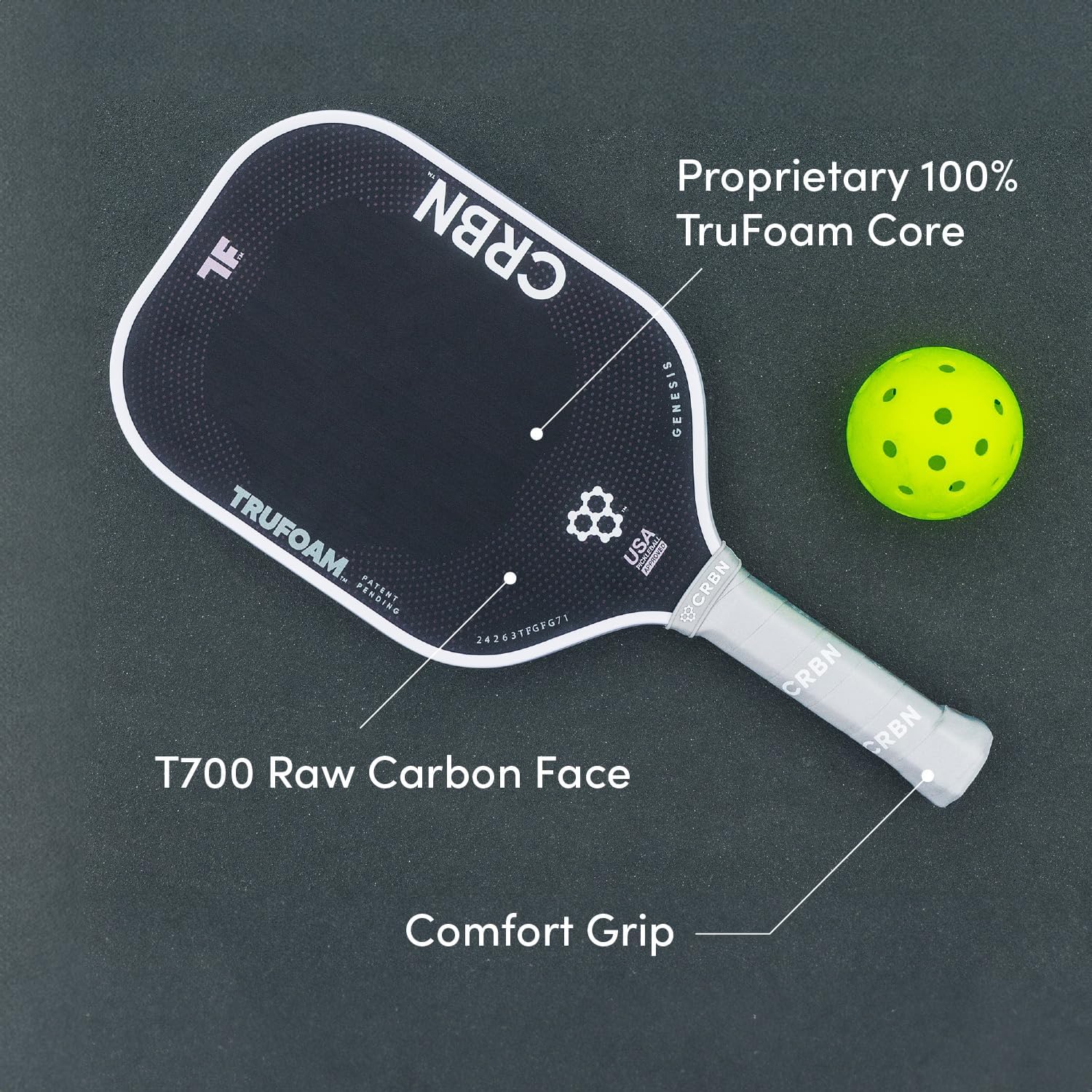
On paper, the value proposition rests on a few concrete points: one optimized 14 mm thickness instead of a confusing lineup, a 100% foam core designed to avoid core crush, a carbon fiber face for spin, and an included neoprene cover. For players who chew through paddles and hate inconsistency as the core ages, paying extra for a design that aims at long-term stability can make sense financially over time. For someone just dabbling in pickleball or upgrading from a $40 starter paddle, the price jump might feel steep, and there are plenty of cheaper options that will still be fun to use.
In my opinion, the TruFoam Genesis offers good but not unbeatable value. It looks like a smart purchase for serious rec or tournament players who: 1) already know they like elongated shapes, 2) care a lot about spin and control, and 3) are tired of paddles feeling dead after a few months. If you’re casual, on a tight budget, or already happy with a recent CRBN honeycomb model, the extra cost might not translate into a huge performance gain for you personally.
Elongated shape and tennis-inspired feel on paper
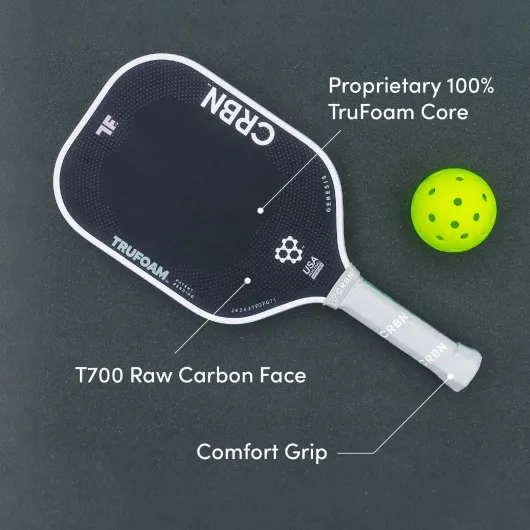
The CRBN 3 variant here is the elongated shape, which is usually the choice for players who want extra reach at the net and more leverage on serves and drives. Amazon lists package dimensions at around 16.89 x 8.19 x 2.13 inches, which fits the profile of a long paddle face with a more compact width compared with standard shapes. Several reviews mention the reach specifically, with one buyer calling it a “weapon” and pointing out that the extended grip helps them with two-handed backhands and coverage.
Design-wise, the big conceptual difference is how CRBN says this paddle is engineered to mimic the dynamics of a tennis racket. The foam core is marketed as increasing dwell time and flex, similar to strings pocketing the ball for a split second. That’s supposed to help players who already have decent technique to load spin and control depth more precisely. One reviewer backs this up by talking about how the foam “exaggerates the dwell,” which is exactly the behavior CRBN advertises. So, at least in the comments, the design goal and user feedback line up.
The spec sheet lists the frame and material as “plastic,” which is generic Amazon labeling; in reality, the key element is the carbon fiber hitting surface paired with the foam core. Carbon faces are now standard on performance paddles because they tend to grab the ball better and stay consistent over time. The handle uses a 4-inch grip size, which is fairly neutral. One buyer mentions adding weight to both sides to increase the sweet spot, which suggests the base design is light or balanced enough that lead tape or weighted strips are easy to integrate without making the paddle unwieldy.
In my opinion, the design looks thought-through for players coming either from tennis or from previous CRBN paddles. The elongated head, carbon surface, and focus on dwell make sense for aggressive baseliners and kitchen attackers who rely on reach and spin. It’s not a beginner-friendly “just swing and the ball flies” design; instead, it seems tuned for someone who wants a paddle that rewards clean technique. If you’re used to widebody shapes and massive sweet spots, this elongated format might require some adjustment, but for players already gravitating to that style, the design concept is coherent.
Weight, grip and on-court comfort feedback
Comfort on a paddle usually comes down to three things: weight balance, grip size, and vibration behavior. The TruFoam Genesis CRBN 3 Elongated comes with a 4-inch grip, which is a middle-of-the-road circumference that many players can adapt to using overgrips if needed. The listed item weight of 0.33 kg for the package suggests a mid-weight paddle once unboxed, probably in line with other performance carbon paddles. Several reviewers mention “nice weight and control,” which indicates that, for them, the swing weight feels manageable rather than sluggish.
One buyer specifically notes that they added weight to both sides to increase the sweet spot, and they still “love this paddle.” That implies the base configuration is light or balanced enough that adding lead or weighted tape doesn’t push it into uncomfortable territory. The elongated shape naturally shifts some mass toward the head, which can be a plus for players coming from tennis who like feeling the paddle head during the swing, but might be a touch demanding for those used to ultra-head-light setups.
On the vibration side, foam cores in general tend to absorb shock differently from honeycomb. CRBN markets this paddle as being consistent and precise rather than harsh, and the comments about “touch” and “control” hint that players are not fighting unpleasant feedback on contact. There aren’t waves of reviews complaining about arm pain or discomfort, which is usually a sign when a paddle is too stiff or jarring. The USA Pickleball approval also means it sits within acceptable bounds for performance equipment; nothing exotic like super-heavy or ultra-thin experiments.
In my opinion, the comfort profile looks solid for intermediate to advanced rec players. If you have very small hands, the 4-inch grip might still need an adjustment (thinner grips are rare in this category anyway), and if you are extremely sensitive to swing weight, you may want to be careful with how much extra weight you add. But for the average player looking for a controlled, spin-friendly paddle that doesn’t feel like a brick, the combination of mid-weight, standard grip, and likely damped foam behavior seems like a sensible package.
Foam core longevity and consistency over time
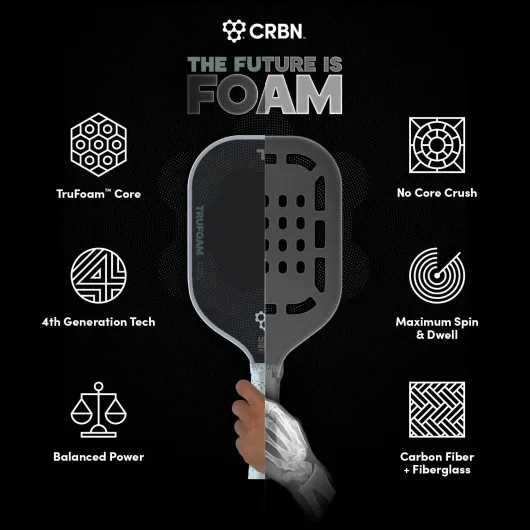
Durability is one of the biggest talking points for the TruFoam Genesis. CRBN clearly targets a common complaint in the community: core crush and dead spots developing as honeycomb cores fatigue. The brand claims that the 100% foam core avoids this issue and keeps the paddle playing the same from day one, without a weird break-in curve. On paper, foam can be engineered for more uniform compression and rebound, which theoretically should help maintain a consistent feel across the face and over months of play.
In the published reviews, there’s no wave of complaints about early failures, cracks, or delamination. The average rating of 4.4/5 with 90+ reviews would likely be lower if a lot of people were seeing the paddle fall apart quickly. Instead, comments focus more on performance and price than on quality issues. One buyer emphasizes that they like it specifically because they aren’t dealing with “core crush,” which suggests they’ve had problems with this on other paddles and see the TruFoam as an improvement.
The included neoprene cover is a small but relevant detail for durability. Protecting the carbon surface from bag rash, grit, and other paddles can help the texture last longer, which matters for spin. CRBN also pushes its Eraser accessory to keep the face clean, implying that the surface treatment is important and that proper care will help maintain performance. With the paddle being carbon-faced and foam-cored, there’s no reason on paper to expect worse durability than other high-end paddles, and the brand talks a lot about it being “built for the future,” which usually means they’re confident enough to stand behind the construction.
In my opinion, if you’re tired of paddles that feel great for a couple of months and then slowly die, the TruFoam concept is one of the main reasons to consider this model. It doesn’t mean it’s indestructible—no paddle is—but the combination of foam core, carbon face, and the absence of alarming durability reviews suggests a solid long-term bet for frequent players. As always, edge guard impacts, abuse, and extreme temperatures will still matter, but nothing in the feedback hints at a glaring durability red flag so far.
Spin, control and power: what buyers actually report
Performance is clearly the main argument for the TruFoam Genesis. CRBN claims that the foam core maximizes dwell time and flex, leading to heavy spin and precise placement. In the Amazon comments, several buyers back this up. One verified purchase calls it “a weapon” and says the foam design really exaggerates the dwell, leading to “awesome spin.” Another says it’s the best paddle they’ve used, with “excellent touch and power.” A third buyer notes that it has the “right amount of power and control” for their play, especially after adding some weight to expand the sweet spot.
On paper, the 14 mm thickness paired with carbon fiber suggests a control-oriented setup with respectable pop rather than pure blasting power. The elongated shape also adds swing leverage, which can translate to more speed through contact if your mechanics are decent. Reviews seem to match this: people rarely complain about lack of power, but they more often highlight placement, touch, and the ability to shape shots. In my opinion, that points toward a paddle that rewards technique and timing rather than bailing you out with trampoline-like rebound.
There is at least one more reserved review that says the paddle is good but “not a dramatic change” from other CRBN models like the CRBN 1 and 3 traditional cores. That’s an important reality check: if you already own a high-end CRBN, you might feel the performance jump is incremental rather than night and day. The 4.4/5 average rating from 90+ reviews suggests that most players are satisfied with how it plays, but it’s not universally praised as a revolution. People who are already playing at a high level might notice nuanced differences in dwell and spin potential, while more casual players may just feel it’s a solid carbon paddle.
In my view, if your priorities are spin, control, and consistent response across the face, the performance profile looks strong. Players who want effortless power with minimal swing might find it a bit more controlled than they like, especially out of the gate. But if you’re working on dinks, resets, and roll shots, and you’re willing to fine-tune weight with lead or edge tape, this paddle seems to give you a solid platform to build on.
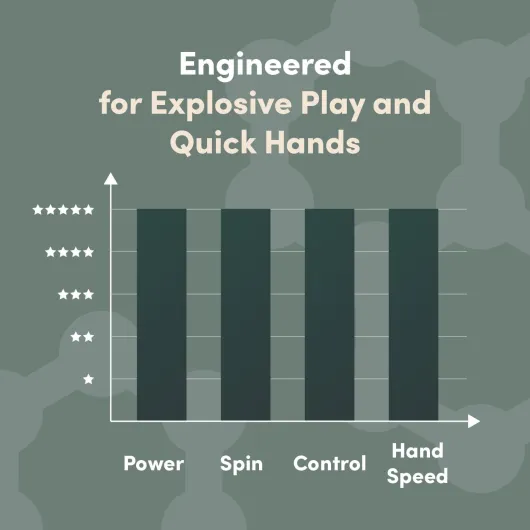
What the TruFoam Genesis CRBN 3 Elongated brings to the table
The TruFoam Genesis CRBN 3 Elongated is presented as a performance paddle built on an uncommon foundation: a 100% foam core instead of the usual polymer honeycomb. CRBN says it spent 18 months and over 200 prototypes to land on this construction, which is meant to deliver consistent performance from day one and avoid the typical “break-in” and “core crush” issues people complain about with some paddles. On paper, the idea is simple: tune foam density and structure instead of juggling multiple thicknesses and core layouts.
The specs list a 14 mm thickness, and CRBN really leans into that: no 13/16 mm variants, no confusing lineup. The brand claims its proprietary foam tech lets them hit the same or better stability and control that others chase by adding thickness. The paddle is USA Pickleball and other governing bodies approved, so it’s cleared for sanctioned play. Weight-wise, the package is 0.33 kg, which suggests a typical mid-weight paddle once you remove packaging. Grip size is 4 inches, a pretty standard circumference that should fit a wide range of hands with overgrips if needed.
One detail that stands out for value is that each TruFoam paddle includes a neoprene cover. It’s a small thing, but it saves you from buying a separate cover just to keep the carbon surface protected in your bag. CRBN also pushes its separate “CRBN Eraser” to keep the surface clean, which signals that the textured face is important for spin and worth maintaining. The sport is listed simply as pickleball, suggested users are unisex-adult, and the age range is “all ages,” so nothing niche here—just a high-end paddle aimed mostly at serious adult players.
Among the reviews, people often mention spin, reach, and control as the main selling points, especially on this elongated CRBN 3 version. Some note that the power is “enough” but not wild, which lines up with the marketing emphasis on dwell time and precision. In my opinion, the presentation is clear: this isn’t trying to be a cheap power cannon; it’s pitched as a controlled, spin-oriented tool that should feel predictable over a long lifespan. If that’s what you’re chasing, the concept makes sense on paper.
Pros
- 100% foam core and 14 mm thickness designed for consistent feel and to reduce core crush over time
- Strong user feedback on spin, control, and reach, especially for players with good technique
- Elongated shape with 4" grip suits two-handed backhands and players who value extra coverage
Cons
- Premium price, and at least one buyer feels the performance jump vs other CRBN paddles is modest
- Power is described as adequate rather than explosive, which may not suit players seeking maximum pop
Conclusion
Analysis score
The CRBN TruFoam Genesis CRBN 3 Elongated is a serious paddle aimed at players who want spin, control, and consistent performance more than pure rocket power. On paper, the 100% foam core and 14 mm thickness are a clear break from classic honeycomb designs, and the Amazon comments back up CRBN’s claims about dwell time and spin potential. Several buyers highlight its reach, touch, and ability to place the ball, while the overall 4.4/5 rating shows that most users are satisfied.
Where it stands out is the combination of foam-core consistency, carbon fiber surface, and elongated shape. That package makes sense for competitive rec players or tournament grinders, especially those with a tennis background who like extended reach and a head that they can feel through the swing. Durability feedback so far is reassuring, and the included neoprene cover is a small but real plus. The main downside is price versus perceived improvement: at least one buyer finds that it doesn’t differ dramatically from other CRBN paddles, which means value will depend a lot on what you’re coming from and how sensitive you are to feel differences.
In my opinion, this paddle fits best for intermediate to advanced players who are technique-focused and spin-oriented, and who see a paddle as a long-term tool rather than a disposable accessory. If you’re just starting out, or if you mainly want maximum free power for the lowest price, you’ll probably be happier with a more affordable composite or a cheaper carbon model. But if you care about control, like elongated paddles, and want a core that should stay consistent over time, the TruFoam Genesis CRBN 3 Elongated looks like a solid, if not cheap, choice.