Summary
Analysis score
Average of the criteria rated below
Value for money: does the spec sheet justify the hype?
Shape, balance and spin-focused design choices
Titanium base, T700 carbon face and the honeycomb core
Build reliability and long-term outlook
Spin, control and power on paper and in the reviews
Specs and positioning: what EdgeTech is really selling here
Pros
- Modern spec sheet: 16 mm PP core, T700 raw carbon face, titanium base, and Orbit Grooves for spin
- Strong user feedback on spin, control, and overall feel (4.8/5 from around 274 reviews)
- USAPA approved with generous 2-year defect coverage and lifetime discounted replacement program
Cons
- Less brand prestige and long-term track record than the biggest pickleball names
- Not a dedicated power paddle; heavy hitters might prefer a thinner, more explosive option

Specifications
View full product page →| Brand | EdgeTech |
A spin-oriented paddle that’s making noise without a big logo
The Cosmos Spin from EdgeTech is one of those paddles that keeps popping up in conversations between players who are tired of paying premium prices for a well-known logo. On paper, it checks a lot of the same boxes as higher-end models: 16 mm polypropylene honeycomb core, T700 raw carbon fiber surface, and a mid-weight build around 8.1 oz. The brand leans heavily on a value message: pro-style tech, trimmed marketing costs, and a price that stays well below flagship paddles from mainstream names.
What really stands out is the combination of a dual-layer face—titanium weave base plus carbon fiber—and the so-called Orbit Grooves, which are advertised as grooves in the hitting surface meant to “catch” the ball for extra spin. That’s unusual in a category where most paddles rely purely on texture and grit. Add USAPA approval, and in theory you’re looking at a paddle that could be used for anything from casual rec play to proper tournaments.
On the review side, the paddle sits at around 4.8/5 from roughly 274 ratings, which is very positive for a relatively young brand. Buyers repeatedly mention spin, control, and value. Several comments come from players moving up from starter paddles, and a few from intermediate/advanced players who compare it favorably to more expensive models. There are not many negative reviews visible, which suggests that major quality issues are not widespread, at least so far.
In my opinion, this paddle positions itself clearly: it targets players who want modern carbon-face performance and good spin without crossing into the price bracket of the most hyped brands. It’s not pretending to be a super-light control-only blade or a pure power monster. Instead, it aims for a balanced all-court profile with a strong spin bias. The rest of this analysis looks at whether the specs and user feedback really line up with that promise, and where the compromises likely are.
Value for money: does the spec sheet justify the hype?
Even without a listed price here, the way buyers talk about the Cosmos Spin makes the positioning clear: this is meant to be a high-spec paddle at a mid-range price. Multiple reviews explicitly compare it to more expensive paddles and state that they don’t see a big enough performance gap to justify paying more. Comments like "For the price this is a great paddle" and "Why pay more!?" show that a lot of owners feel they got strong performance for the money spent.
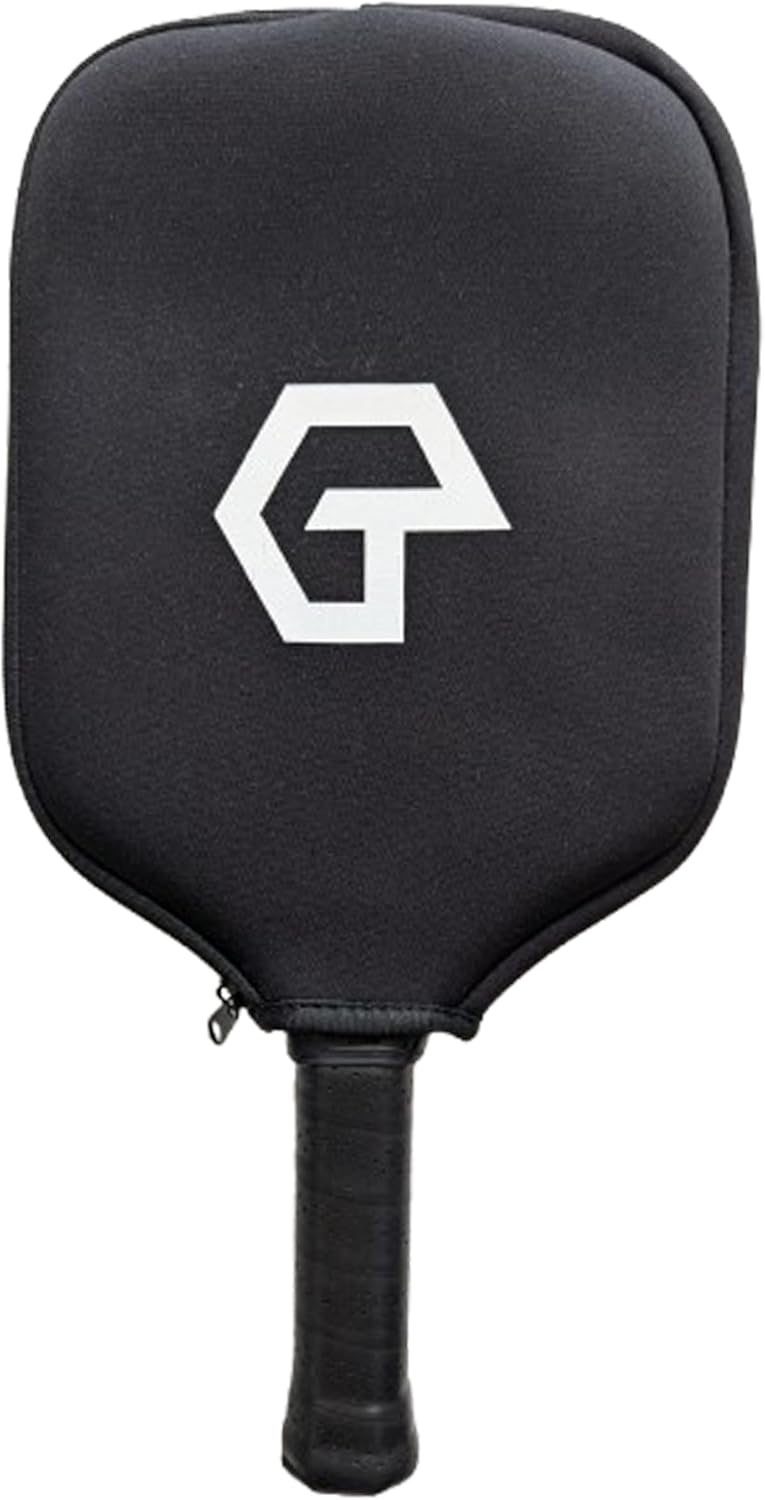
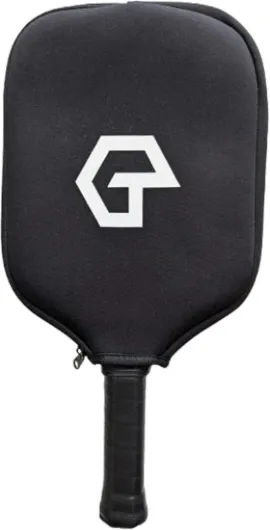
Looking at the specs, the value argument holds up. You’re getting a T700 raw carbon face, a titanium weave underlayer, a 16 mm PP honeycomb core, USAPA approval, and a protective cover included. Many big-brand paddles with a similar configuration sit noticeably higher in price. Add the extended 2-year factory defect coverage and the lifetime discounted replacement program (one replacement every six months), and the total package becomes even more attractive for players who worry about chipping, delamination, or simply wearing out their gear.
The main trade-offs, in my opinion, are around brand prestige and ultra-fine-tuned performance. EdgeTech is not a heritage name with a giant pro roster, and serious tournament grinders might still gravitate toward the most established brands for peace of mind, resale, or matching what their favorite pro uses. Also, while the reviews are very positive, there isn’t much detailed feedback on niche aspects like exact swing weight, feel compared to specific pro models, or performance under very heavy, daily use.
For most players—from ambitious beginners to solid intermediates who want to push toward advanced levels—the Cosmos Spin looks like strong value. You get modern materials, clear spin and control benefits, and a generous support policy. If your priority is squeezing every last bit of performance nuance and you don’t care about cost, you might still look at flagship paddles from the biggest brands. But if you want 80–90% of that spec sheet for significantly less money, this EdgeTech model makes a very solid case for itself.
Shape, balance and spin-focused design choices
The design choices on the Cosmos Spin clearly prioritize spin and control over pure power. The 16.3" x 7.7" profile gives a bit of extra reach compared to classic widebody shapes, without going full elongated. That usually means a slightly narrower sweet spot than a very wide paddle, but more coverage at the net and better reach on serves and overheads. Several reviews from intermediate players mention a "good sweet spot" and more consistent contact than with their starter paddles, which suggests the core and face combo is reasonably forgiving for this style of shape.
The weight at 8.1 oz and a 16 mm core imply a moderate swing weight—not ultra whippy, but not a brick either. Buyers often describe it as "well balanced" and "light" in feel, even though on the scale it sits in the mid-range. That usually means the weight distribution is not too head-heavy. A more neutral balance tends to help with hand speed at the kitchen line and reduces arm fatigue, which lines up with one user mentioning playing over an hour without shoulder or elbow discomfort.
Visually and functionally, the Orbit Grooves are the key talking point. EdgeTech compares them to the grooves on golf irons, meant to grab the ball and increase spin. While there is no lab data here, multiple comments say the paddle "enables spin" or that the amount of spin is "incredible" compared to basic paddles. That doesn’t mean it will out-spin every high-end carbon paddle, but it does suggest the surface texture and groove design are doing more than just looking fancy.
The longer 5.5" handle is another deliberate design move. That length makes it easier for players who like two-handed backhands or who simply prefer more handle space for leverage. A couple of buyers initially thought the handle looked short or different, but then reported that it "sat beautifully" in the hand once on court. In my opinion, the design leans toward a modern all-court style: spin-friendly face, extended reach, slightly longer grip, and a neutral weight balance that should suit both aggressive baseliners and net-focused players, as long as they are not looking for an ultra-wide sweet spot monster.
Titanium base, T700 carbon face and the honeycomb core
Material-wise, EdgeTech throws a lot of tech terms at this paddle: T700 raw carbon fiber surface, titanium weave base, and a "Space Propulsion" polypropylene honeycomb core. Stripped of marketing labels, this is essentially a 16 mm PP honeycomb core with a dual-layer composite face. T700 raw carbon is widely used in higher-end pickleball paddles because it tends to provide a gritty texture and good durability when done right. The titanium layer underneath is less common; in theory it should help with structural rigidity, vibration management, and impact resistance.
The frame is listed as graphite, which in this context usually means a carbon/graphite composite around the edge and face structure. Combined with the polypropylene core, this should result in a paddle that leans toward a quieter, more cushioned impact compared with hard, thin, fiberglass-heavy paddles. At 0.53 kg (about 8.1 oz), the materials do not push the weight into heavy territory, suggesting EdgeTech is not overbuilding the frame just to look "premium".
In the Amazon comments, buyers regularly mention the "grippy, sandpaper-like face" and a feeling of quality in the build. One reviewer specifically calls it "well built" and "well balanced" and points out that the textured surface helps with feel and control. Another review from an intermediate/advanced player mentions a reassuring "pop" sound on impact, which usually indicates the core and face are working together consistently, without dead spots or overly hollow sections.
In my opinion, the material package is one of the clear strengths of this paddle at its likely price point. You’re getting tech (T700 carbon, dual-layer face) that is usually reserved for more expensive models. The titanium base is the wild card: if implemented well, it could slightly stiffen the face and extend durability. Without long-term data, it’s impossible to say how it holds up after heavy play, but the extended factory defect coverage to two years suggests the brand has at least some confidence in the construction. For players who want modern materials and a gritty carbon surface without paying top-tier money, this spec sheet looks solid.
Build reliability and long-term outlook
Durability is always tricky to judge without long-term lab data, but a few elements give some clues. First, the construction: a titanium fiber base under a T700 carbon face, wrapped around a polypropylene honeycomb core. In theory, the titanium layer should add rigidity and impact resistance, helping the paddle resist warping and face softening over time. The 16 mm thickness also means there’s more material in the core, which can help avoid early dead spots compared with very thin designs that get hammered by heavy hitters.
Second, the published user feedback so far is largely positive, with a 4.8/5 average over more than 250 reviews. There are no widely repeated complaints about edge separation, face peeling, or core collapse visible in the highlighted comments. Some buyers even mention that the paddle feels "well built" and solid. While that doesn’t guarantee flawless longevity, it suggests that obvious quality issues are not a common theme among owners at this stage.
Third, EdgeTech’s after-sales policy is more aggressive than most in this range: extended coverage for factory defects up to 2 years and a discounted replacement option every 6 months for life. Brands usually don’t offer that unless they’re reasonably confident in their defect rate, because otherwise the program would become a financial headache. For a mid-priced paddle, this is a strong sign that the company is trying to build trust and expects the build to hold up for typical recreational and club play.
In my opinion, if you’re playing several times a week, you should still expect any paddle—especially carbon-faced—to gradually lose some pop after enough hours. That’s just how materials behave under repeated impact. But nothing in the published reviews suggests that the Cosmos Spin is unusually fragile or prone to early failure. The combination of titanium-reinforced face, 16 mm core, and generous warranty makes it look like a reasonably safe bet for players who want a paddle they can keep in rotation for a while without babying it.
Spin, control and power on paper and in the reviews
Performance is where the Cosmos Spin seems to earn most of its praise. The combination of a 16 mm core, carbon surface, and Orbit Grooves points clearly toward a control-and-spin profile with enough power, but not a pure cannon. Multiple buyers upgrading from cheap starter paddles report noticeable improvements in spin, control, and consistency. One verified purchaser even says they "hardly miss a shot now just through poor contact" and highlights the "such a good sweet spot and contact". That kind of comment suggests the paddle is forgiving enough for everyday play while still giving feedback.
On the spin side, there is a recurring theme: several reviews mention that the paddle makes it easy to put rotation on the ball. Phrases like "surface that enabled spin on the ball without too much effort" and "the amount of spin is incredible" pop up more than once. One player specifically mentions a backhand return of a fast, spinning serve that came off the paddle cleanly with strong spin, which lines up with EdgeTech’s claims about the Orbit Grooves and gritty face. Again, this doesn’t prove it outperforms every spin-oriented paddle out there, but for this price bracket, buyers clearly feel they’re getting a strong spin tool.
When it comes to power, the feedback is more moderate but still positive. People talk about "great spin, good power with control" and mention that smashes feel powerful while dinks stay under control. That’s what you’d expect from a 16 mm mid-weight paddle: not a rocket like some 13 mm power paddles, but plenty of pace when you swing properly. One intermediate/advanced player notes a reassuring "pop" sound and says the paddle helped take their game to the next level, which usually means enough power to finish points combined with reliable touch.
In my opinion, the Cosmos Spin sits in the balanced performance category: above-average spin, solid control, and respectable power, without going extreme in any direction. Players coming from big-box-store paddles or bundled beginner sets are likely to feel a clear jump in quality and shot-making options. Very advanced players who obsess over tiny differences in swing weight or specific power profiles might still prefer more specialized, premium models, but the overall user feedback suggests this paddle performs strongly for beginners through solid intermediates and even some advanced rec-level players.
Specs and positioning: what EdgeTech is really selling here
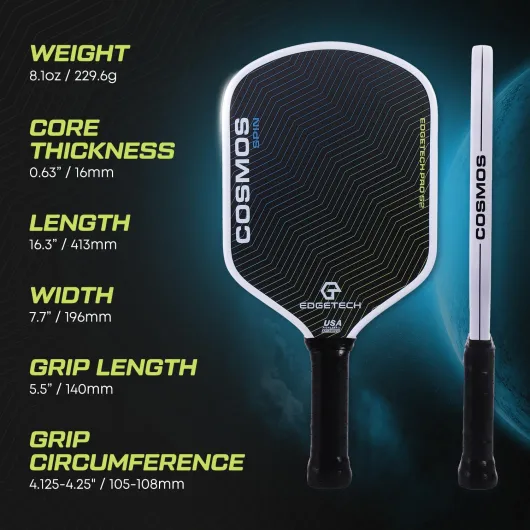
On paper, the Cosmos Spin is a standard elongated hybrid shape: 16.3" long and 7.7" wide. That’s a pretty common footprint for modern paddles that try to balance reach, forgiveness, and maneuverability. The core is a 16 mm "Space Propulsion" polypropylene honeycomb—marketing name aside, this just means a thick PP core, typically associated with a softer feel, more control, and a quieter sound compared with thinner 13 mm cores. Weight is listed at 8.1 oz (229.6 g), putting it squarely in the mid-weight category, which tends to work for most players unless they have very specific preferences.
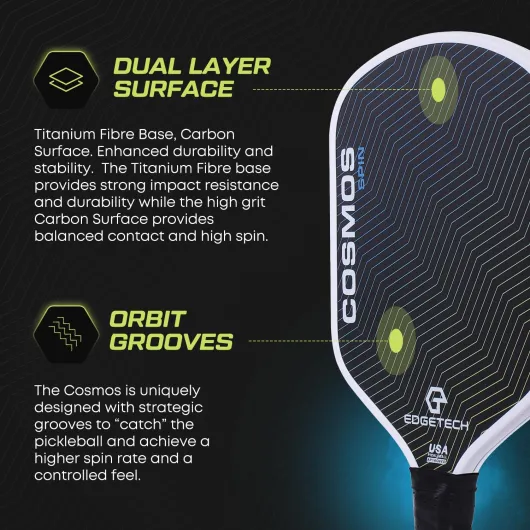
The face construction is where EdgeTech tries to stand out: a dual-layer surface with a titanium fiber base and a T700 raw carbon fiber outer layer. The titanium base is pitched as helping impact resistance and stability, while the carbon top provides grit and spin. On top of that, the brand highlights Orbit Grooves, described like golf-club-style grooves designed to grip the ball. Whether those grooves are purely surface texturing or more structural is not clear from the spec sheet, but the intent is obvious: boost spin beyond a standard gritty face.
Certification-wise, the paddle is USAPA approved, which matters if you plan to play in sanctioned tournaments. Grip length is 5.5", which is slightly longer than many traditional shapes and can appeal to two-handed backhand players. Grip circumference is listed around 4.125–4.25", so small-to-medium. That fits a broad range of hands, with overgrips available for those who want a thicker handle.
EdgeTech also tries to sweeten the deal with after-sales policies: a discounted replacement program for life (one replacement every six months) and extended coverage for factory defects up to two years. That is fairly generous for this price bracket and suggests the brand expects the paddle to hold up reasonably well. In my opinion, all this positions the Cosmos Spin as a mid-priced, performance-focused paddle that’s trying to punch above its weight by copying the feature set of higher-end competition and then undercutting on cost.
Pros
- Modern spec sheet: 16 mm PP core, T700 raw carbon face, titanium base, and Orbit Grooves for spin
- Strong user feedback on spin, control, and overall feel (4.8/5 from around 274 reviews)
- USAPA approved with generous 2-year defect coverage and lifetime discounted replacement program
Cons
- Less brand prestige and long-term track record than the biggest pickleball names
- Not a dedicated power paddle; heavy hitters might prefer a thinner, more explosive option
Conclusion
Analysis score
The Cosmos Spin from EdgeTech comes across as a well-thought-out paddle for players who care about spin, control, and value more than a flashy logo. The 16 mm polypropylene core, T700 raw carbon fiber face, and titanium base give it a very modern spec sheet that lines up with what many higher-priced paddles are offering. The Orbit Grooves and gritty surface are not just marketing on paper; owners repeatedly mention easier spin and more controlled shot-making compared with basic starter paddles.
The user feedback is consistently positive: a 4.8/5 average from hundreds of reviews, with comments highlighting a generous sweet spot, good balance, and enough power to finish points while keeping dinks and resets under control. The mid-weight build and slightly longer 5.5" handle should fit a wide range of players, including those experimenting with two-handed backhands. On top of that, the USAPA approval and the extended defect coverage plus discounted replacement program strengthen the overall package.
It’s not perfect. Players who obsess over tiny differences in feel, or who want maximum power from a thin, stiff paddle, may find more specialized options elsewhere. And the brand doesn’t have the same long history as some of the giants in the space, which could matter to a small group of buyers. But for most recreational, club, and even aspiring competitive players, in my opinion the Cosmos Spin offers strong performance and materials for the money. If you’re moving up from a cheap composite or wooden paddle and want a serious upgrade without paying top-tier prices, this model is very much worth shortlisting.