Summary
Editor's rating
Value for money: where it makes sense and where it doesn’t
Simple design, works best with a tripod and a bit of DIY
Power options: flexible but not all equal
Build quality and how careful you need to be
How it actually hits on court
What you actually get out of the box
Pros
- Very affordable compared to high-end pickleball machines
- Consistent 4-second feeds with enough power for realistic recreational-level shots
- Multiple power options (AC, D batteries, power bank) and tripod compatibility for flexible setups
Cons
- Light plastic build with some weak points (arc knob, oscillating base) that need gentle handling
- Limited ball capacity and no adjustable feed interval or remote control, so more manual work and DIY solutions

Specifications
View full product page →| Brand | Furlihong |
Cheap practice partner that mostly does what it says
I’ve been using the Furlihong 3802PBH pickleball machine as a budget practice partner, and overall, it does what I wanted: feed me balls consistently without spending over a grand. This is not a fancy club-level machine, and if you expect that, you’ll be annoyed. But if you see it as a low-cost training tool that you’ll have to baby a bit, it starts to make sense. I went in with pretty low expectations because of the price and the mixed reviews, and I’d say it landed slightly better than I thought.
The main thing to understand is: this is a light plastic box with two wheels and simple controls, not a tank. The power is decent, the feed is regular at about every 4 seconds, and once you find your sweet spot for angle and distance, it’s actually pretty fun to drill with. I’ve used it for practicing returns, volleys at the kitchen line, and some basic serve returns from the baseline. For that use, it gets the job done.
Where it shows its price is in the build and little annoyances. The oscillating base can be finicky, the plastic feels cheap, and the ball capacity is limited unless you buy extra spiral extensions. You also have to get a bit creative about starting it and getting to the other side of the court in time, unless you rig some kind of remote or string trick like other users mentioned. If you enjoy tinkering and don’t mind DIY solutions, you’ll be fine. If you want plug-and-play perfection, this will probably irritate you.
So my short take: it’s a pretty solid low-budget pickleball launcher for beginners to intermediate players who want reps and are okay with some compromises. It’s not perfect, it won’t feel premium, but it can absolutely help you work on your strokes, especially if you pair it with a sturdy tripod and treat it gently. Just don’t expect it to survive abuse or heavy club use.
Value for money: where it makes sense and where it doesn’t
From a value point of view, the Furlihong 3802PBH sits in a pretty interesting spot. Full-blown pickleball machines with big hoppers, remotes, programmable drills, and rock-solid builds can easily run from $1,200 to $2,000+. This one usually lands around a fraction of that price. So you’re basically paying maybe one-tenth the price for a stripped-down version that still throws balls at you with adjustable speed, angle, some spin control, and an optional oscillating base. For a lot of casual players, that trade-off is actually pretty reasonable.
What you don’t get for the price is important to understand: no remote, no adjustable feed interval, limited ball capacity unless you buy extras, and a build that you clearly have to baby. Also, you might have to deal with customer service if something arrives defective, which seems fairly common, especially with the base. The good news is that support sounds responsive and replacement-friendly, so at least you’re not stuck. But if you hate dealing with returns or support tickets, factor that into your decision.
Where the value really shows is if you’re a beginner to intermediate player who wants to drill specific shots without always needing a partner. For the cost of a couple of private lessons, you get a tool you can use over and over to work on returns, volleys, and basic footwork. If you’re willing to add a solid tripod and maybe a cheap remote power strip, you can squeeze even more out of it. That’s where it feels like good value for money: not fancy, but effective enough.
If you’re a coach, a very serious player, or you want something that will live at a club and be used by a lot of people, I’d say this is probably not the right investment. You’d be better off saving for a more robust machine that’s built for heavy use. But for personal use, especially if you’re on a budget and okay with a few quirks, the Furlihong 3802PBH gives you a lot of practice potential without blowing up your wallet.
Simple design, works best with a tripod and a bit of DIY
The design philosophy here is clearly: keep it simple and cheap. The core unit is a vertical tube with two throwing wheels inside and a basic feed system. On its own, it sits pretty low to the ground, which limits what you can practice unless you’re okay with low, rising shots. Where it becomes more versatile is when you mount it on a standard camera tripod. The machine is compatible with normal camera stands, and that’s honestly the best way to use it. With a solid tripod at about net height, you can simulate volleys, drives, and more realistic shot trajectories.
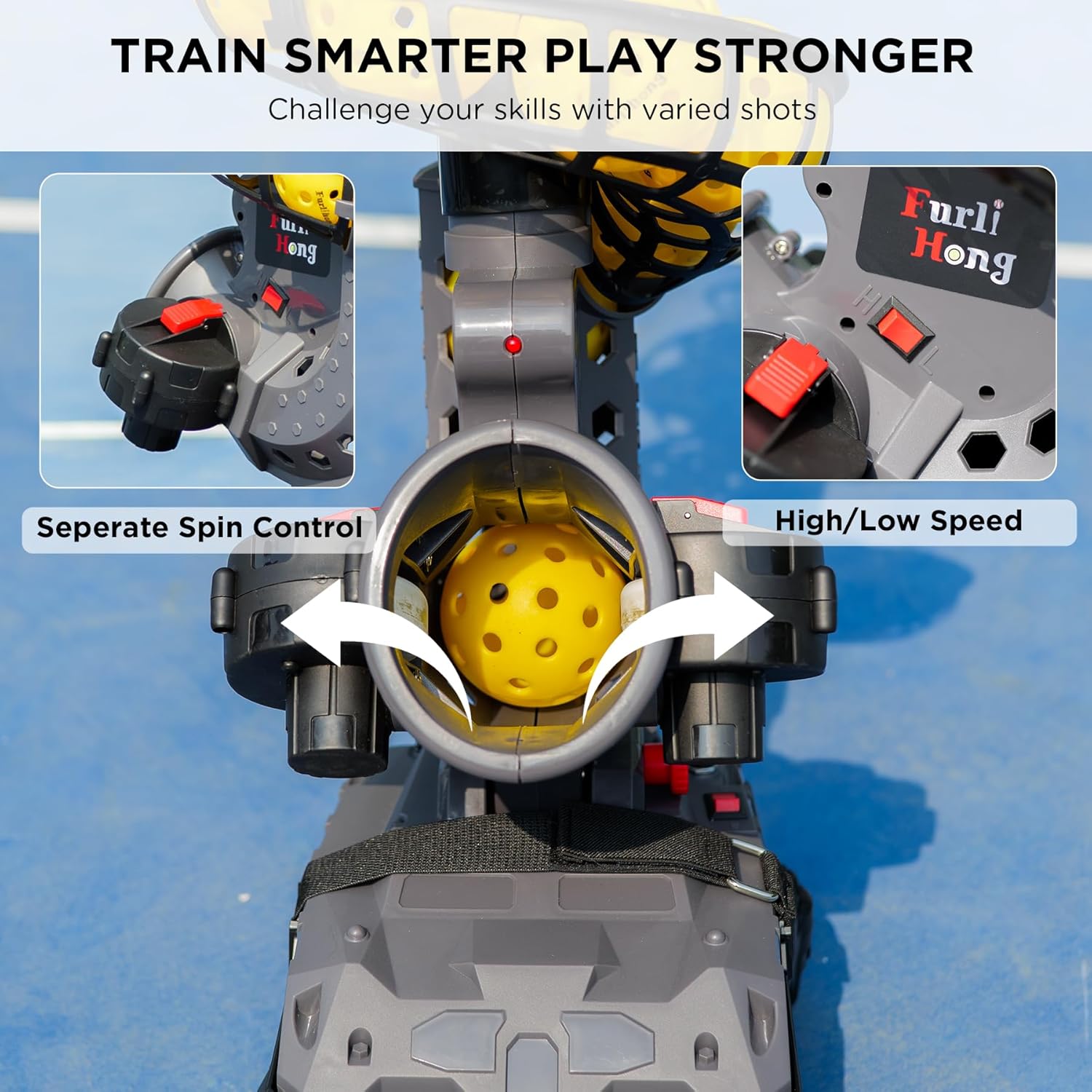
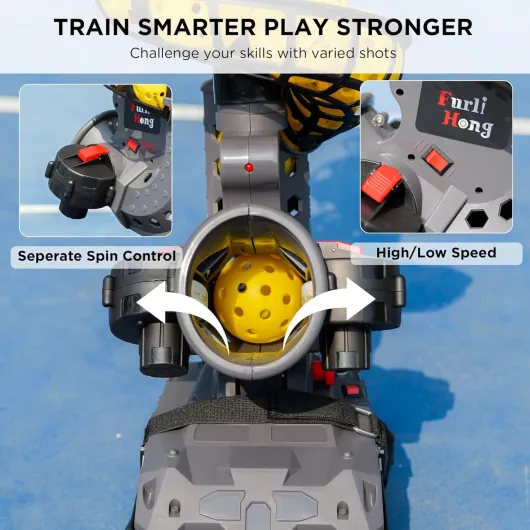
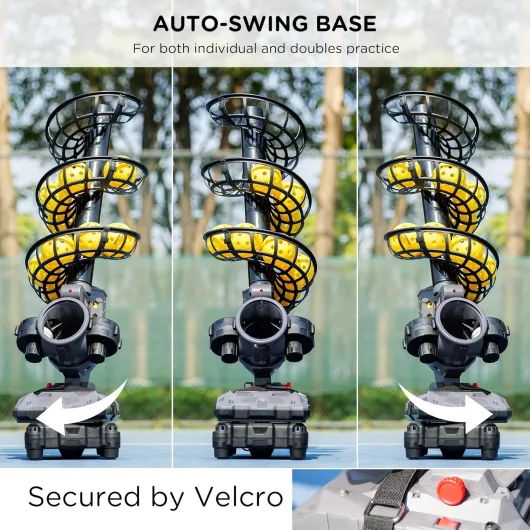
There are a few adjustment points that matter. You’ve got an arc/angle knob to set how high the balls fly, and you can tweak the spin by running one wheel faster than the other. There are two speed settings (high/low), and you can mix them between the wheels to get topspin or some funky spin. It’s not ultra-precise, but for a budget machine, it’s enough to add some variety. The automatic swing base adds side-to-side movement with two speeds, but the spread can be pretty wide, which is good for footwork if you’re fit, and kind of brutal if you’re slower or older.
The downside of the design is that some parts feel like they’re right on the edge of what they can handle. For example, the arc adjustment knob is okay with the stock hopper, but once you start stacking extra spiral tracks and more balls on top, you’re putting more weight on it than it seems designed for. Some users had to resort to duct tape to lock the angle, which tells you the tolerances are not very generous. Also, the oscillating base is an extra moving part that can fail or arrive defective, and that seems to happen often enough that it’s mentioned a lot in reviews.
In practice, I’d describe the design as: functional but a bit DIY. If you’re willing to tweak, tape, or reinforce a couple of spots, you can get a lot of use out of it. If you want something you never have to touch or adjust once it’s set, this design will feel a bit cheap and fussy. Personally, I’m fine with a bit of tinkering at this price point, but I wouldn’t trust this layout for heavy club or coaching use with lots of different people handling it.
Power options: flexible but not all equal
Power is one of the strong points on paper: you can run this thing off D batteries, a portable power bank, or straight AC power. In real life, they’re not equal. With the included AC adapter, the machine clearly runs the strongest and most consistently. The wheels spin up fast, the rhythm feels steady, and the shots have the most pace. If you have access to an outlet near your court (home setup, backyard, or some indoor courts), that’s the way to go. Just keep in mind the power cord isn’t thick or rugged, so I’d avoid yanking it around or letting it get stepped on.
On D batteries, it still works fine, just a bit less punchy. People report getting about two solid one-hour sessions from a set of decent alkaline D cells. That’s pretty reasonable, but if you play a lot, you’ll either go through batteries or need to invest in rechargeables. Performance on batteries is still good enough for typical drills, but you can feel a slight drop compared to AC, especially on the high-speed setting. For public courts where you don’t have outlets, this is the only real option besides a power bank.
Using a portable power bank is the weakest of the three in terms of performance. With a 2A power bank, the speed can be a bit inconsistent and slower. It still throws, but if you’re trying to simulate stronger drives or longer serves, you’ll notice the difference. I’d treat the power bank option as a backup, not the main way to run it, unless you have a really beefy power bank that can deliver enough current.
Overall, the flexibility is nice: you’re not stuck if there’s no outlet. But if you want the best performance and the most consistent ball speed, AC power is clearly the best, then D batteries, and power bank last. For my use, I’d say: AC at home for serious drilling, D batteries for the park, and forget about the power bank unless you have no choice. Just factor in the ongoing cost of batteries if you’ll be using it a lot away from power.
Build quality and how careful you need to be
Durability is where you really feel the low price. The whole thing is mostly plastic and light plastic at that. The ball feed tracks, in particular, feel thin when you first touch them. That said, the balls themselves are light, so they don’t need to be built like steel pipes. If you treat the machine gently—no throwing it in the trunk, no leaving it in the sun or rain, no kids climbing on it—it should hold up for regular personal use. But I wouldn’t expect this to survive heavy club usage or rough handling for long.
There are a couple of weak points to watch. One is the arc adjustment knob. With just the stock hopper and 17–19 balls, it holds the angle fine. Once you start adding extra spiral tubes and more balls, you’re putting more leverage and weight on that joint, and that’s when it can start to slip. Some users fixed this with something as simple as duct tape wrapped to lock the angle, which tells you the design is just on the edge of what it can hold. It’s not a disaster, but it’s a clear sign this wasn’t engineered for heavy add-ons.
The oscillating base is another potential failure point. There are quite a few reports of the base arriving dead or dying early. The good news is that Furlihong’s customer service seems pretty responsive: people got replacements or partial refunds fairly quickly after sending a video. But you still have the hassle of dealing with it, waiting for a new unit, etc. If you really care about the oscillation feature, keep that in mind. The core launcher unit itself seems to be more reliable than the swing base.
In short: if you’re careful, store it indoors, don’t expose it to moisture, and don’t overload it with a crazy tall hopper, I think you can get decent life out of it. I personally treat it like a fragile electronic, not like a rugged sports machine. For the price, that trade-off is acceptable to me, but if you’re rough on gear or want something you can toss in a car every day without thinking, I’d be cautious.
How it actually hits on court
On court, the Furlihong 3802PBH performs better than it looks. With the high speed setting and AC power, it can send balls deep enough from the baseline to feel like a decent serve or drive. No, it’s not as strong or as flexible as a $1,500+ machine, but for regular recreational play, it’s enough to push you. The 4-second feed interval is fixed, which is both good and bad: good because it’s predictable, bad because you can’t slow it down for total beginners or speed it up for intense cardio-style drills. For most casual to intermediate players, 4 seconds is fine.
The consistency is where I was pleasantly surprised. Once you lock in the angle and distance, the balls land in roughly the same area over and over, which is exactly what you want for repeating shots and building muscle memory. When you start playing with spin (one wheel on high, one on low), you get a decent variation in ball behavior. It’s not super advanced spin, but it’s enough to practice handling topspin or slightly heavier shots. The auto-swing base, when it works, adds a lot of randomness side-to-side, which is great for footwork and reacting to balls instead of just camping in one spot.
The main performance limitation is ball capacity and lack of timing control. With only about 19 balls, you’re constantly walking back to reload. You can extend with spiral tracks, but then you start stressing the angle mechanism and making the whole thing wobbly unless you support or tape it. Also, if you want to hit every ball, you basically have to rig some sort of remote start solution (like a remote power strip or a string-pull hack), otherwise you lose the first one or two balls while you run to position. It’s not the end of the world, but it’s another reminder that this is a budget tool.
Overall, for drills like: returning serves from the baseline, practicing backhand drives, working on kitchen volleys with the unit at net height, or just grooving a stroke, the performance is pretty solid. If you’re expecting super fast, heavy, pro-level shots or fine-grained control over pace and interval, you’ll hit a ceiling quickly. For recreational and intermediate training, though, it covers the basics quite well as long as you’re okay reloading often and doing a bit of setup work.
What you actually get out of the box
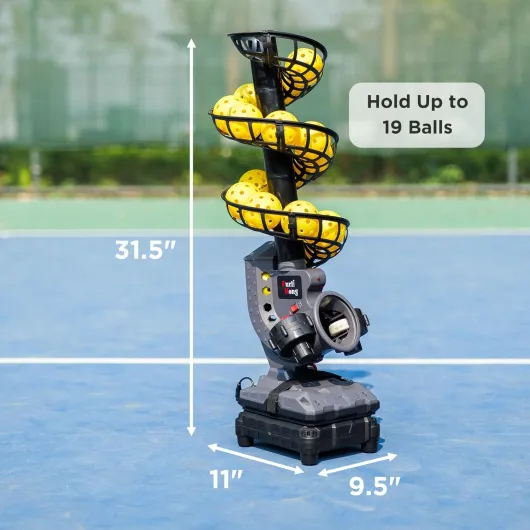
Out of the box, the Furlihong 3802PBH is basically a compact launcher unit plus a separate auto-swing base and some plastic ball tracks you stack on top. The footprint is small: roughly 11 x 9.5 inches at the base and about 31.5 inches tall when assembled with the top track. Weight is around 3.2 kg, so it’s light enough to carry with one hand, but that also means it doesn’t feel super robust. In the box you get the main machine, 5 ball tracks, the top track, the swing base, an AC adapter, a 6V connector, and a small screwdriver. No balls, no tripod, no batteries.
The hopper capacity with the included tracks is about 17–19 balls, which matches what other users reported. That’s not a lot, so you’re getting short bursts rather than long sessions unless you keep feeding it or buy extra spiral extensions. It fires a ball every 4 seconds, and you can’t change that interval. So 19 balls means just over a minute of continuous hitting before you need to reload. For drills, that’s okay, but if you’re dreaming of 10-minute unattended sessions, that’s not happening with the stock setup.
Controls are basic: you can adjust speed (two settings), angle/arc, and spin on each wheel separately, plus you have the auto-swing base with two speeds. Distance range is roughly 17 to 33 feet, and height goes from about 1 ft up to around 8 ft depending on how you angle it or if you mount it on a tripod. There’s no remote, no fancy programming, no custom drills. It’s literally: plug it in, set angle and speed, load balls, flip the switch, and go.
In terms of first impression, it feels like a budget gadget, but not total junk. The design is pretty straightforward and you can set it up quickly once you know which piece goes where. I’d say if you’re comfortable assembling basic IKEA stuff, you’ll manage this without reading the manual twice. Just go in knowing this is a simple, manual machine: you’re trading features and premium feel for price.
Pros
- Very affordable compared to high-end pickleball machines
- Consistent 4-second feeds with enough power for realistic recreational-level shots
- Multiple power options (AC, D batteries, power bank) and tripod compatibility for flexible setups
Cons
- Light plastic build with some weak points (arc knob, oscillating base) that need gentle handling
- Limited ball capacity and no adjustable feed interval or remote control, so more manual work and DIY solutions
Conclusion
Editor's rating
Overall, I’d describe the Furlihong 3802PBH as a budget-friendly practice tool that does a solid job as long as you keep your expectations realistic. It feeds balls at a steady 4-second rhythm, has enough power on AC or fresh D batteries to simulate decent serves and drives, and the adjustable angle and basic spin options give you enough variety for most beginner to intermediate drills. Add a sturdy camera tripod and it becomes much more useful, especially for volleys and more realistic shot trajectories.
On the downside, the machine is clearly built to a price. The plastic parts feel light, the arc adjustment and oscillating base can be weak points, and the ball capacity is limited unless you start stacking extensions and maybe taping things down. There’s no remote or control over feed timing, so you’ll probably end up doing a little DIY hack if you want a smoother start to each drill. The good news is that customer service seems responsive when something goes wrong, but you still need to be ready for that possibility.
I’d recommend this machine for casual and intermediate players who want more court time and repetition without dropping serious money. It’s good for working on returns, volleys, and footwork, as long as you’re okay reloading often and treating the unit gently. If you’re a coach, a heavy user, or someone who wants a robust, feature-rich machine with zero fuss, this probably isn’t for you. In short: good value for money if you accept the compromises; not the right pick if you expect premium build and full pro features.