Summary
Editor's rating
Value for money: worth it if you know what you’re buying
Design: simple, plasticky, but smarter than it looks
Power options: flexible but a bit finicky
Durability and maintenance: decent, but keep your expectations realistic
Performance on court: good reps if you set it up right
What this launcher actually does (and what it doesn’t)
Pros
- Gives you consistent solo practice with adjustable speed, spin, and angle
- Multiple power options (AC adapter, D batteries, power bank) make it usable indoors and outdoors
- Good value compared to high-end ball machines while still being effective for drills
Cons
- Lightweight plastic build and launch wheels that may wear or need cleaning frequently
- Connectors and cabling feel cheap and can be finicky with power banks
- Limited ball capacity (19 balls) means frequent reloading during longer sessions

Specifications
View full product page →| Brand | A11N SPORTS |
Finally drilling without begging friends to practice
I picked up the A11N Pickleball Automatic Launcher for one simple reason: I was tired of chasing people who "just want to play games" and never want to drill. I’m around a solid intermediate level, and I wanted something cheap enough that I wouldn’t feel dumb if it ended up collecting dust in the garage. So I went in with pretty low expectations, more like “this will be a toy” than a serious training tool.
After a few sessions, I had to admit it: it’s not just a toy. It’s still a budget machine, you feel that right away, but it actually lets you work on very specific shots on your own: dinks, volleys, some drives, returns. I set it up in my driveway first just to see if it would even shoot the ball with any decent pace. It does. The first time I cranked the speed up a bit, the ball came out quicker than I expected for something in this price range.
I used it over about two weeks, 5–6 sessions total, between a community center gym and an outdoor court. I tried both the wall power and a power bank, played with the oscillation base, and messed around with spin and angle. It’s not at the level of a Lobster or Pickleball Tutor, but that should be obvious just from the price tag. You’re not getting pro-club gear here; you’re getting a plastic machine that’s good enough to give you reps.
If you expect a high-end robot that perfectly mimics match play from every spot on the court, you’ll be disappointed. If you look at it as a no-frills ball feeder that throws decent balls every 4 seconds so you can groove strokes, it makes a lot more sense. That’s the mindset you need with this thing: it’s a practice buddy, not a miracle worker.
Value for money: worth it if you know what you’re buying
In terms of value, this is where the A11N launcher makes sense. It’s nowhere near the cost of a Pickleball Tutor or Lobster machine—people mention it being roughly 1/15 of the price. Obviously, you’re not getting the same build quality, capacity, or features, but that price gap is huge. For what you actually pay, you do get a usable tool that lets you drill on your own and see real improvement in specific shots like dinks, drops, and volleys.
For beginners and intermediates, especially those who can’t always find drilling partners, it’s pretty solid value. A few weeks of regular use already made me more comfortable on certain patterns, just because I could repeat the same motion 50–100 times in a session without someone else getting bored. That’s basically what you’re paying for: guaranteed reps on demand. If you break down the cost over a season of practice, it’s not a crazy investment.
On the flip side, there are compromises. The plastic build, the questionable long-term life of the rubber wheels, the basic connectors, and the limited ball capacity all remind you this is a budget option. If you’re already a high-level player or super picky about ball trajectory and consistency, you might outgrow it pretty fast and end up wishing you’d just saved up for a higher-end machine from the start.
So in my opinion, the value is good but not magical. It makes sense if: you’re in the beginner to solid-intermediate range, you want more structured practice, and you understand you’re buying something that “gets the job done” rather than a professional-grade robot. If that matches you, the price-to-utility ratio is fair. If you want something bulletproof and ultra-precise, you’ll probably see this as a stepping stone at best.
Design: simple, plasticky, but smarter than it looks
Design-wise, the A11N launcher is very much “functional plastic box” and not a premium gadget. The whole thing is pretty light (a bit over 3 kg), which makes it easy to carry but also reminds you that you’re dealing with a budget device. Assembly, though, is straightforward. The parts are keyed, so you basically snap the frame, ball tracks, and top track together, and you’re done in a couple minutes. I didn’t even really need the manual after the first time.
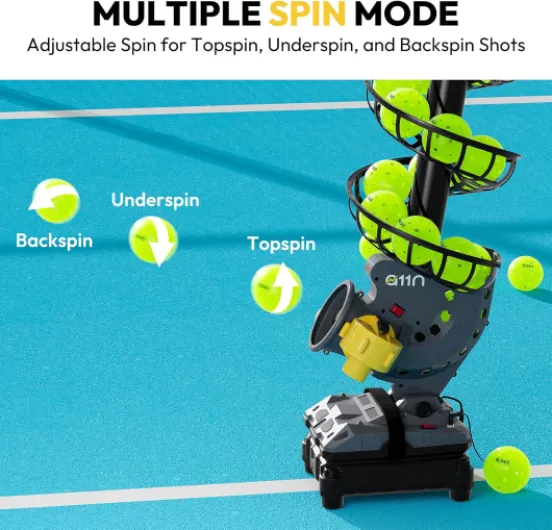
The interesting part is how the wheels and angles are set up. You’ve got two launch wheels, left and right, and each has its own speed and tilt adjustment. That sounds a bit “technical,” but in practice it just means you can create different spins and curves: faster on one side for side spin, tilt one up and one down for curve. It’s not ultra-precise, but you can clearly see the difference in how the ball flies. For the price, that flexibility is honestly better than I expected.
The whole unit tilts forward and backward to change the launch height, and you can also mount it on a tripod if you want even more height or a different angle. I tried it on a basic camera tripod, and it worked, but you do have to be careful about stability if you’re on an uneven surface. The oscillating base is a separate piece that straps on with Velcro and plugs into the launcher, which is a bit DIY-looking but it works. You feel the low-cost design in things like the Velcro strap and the overall finish, but nothing felt like it was about to snap in normal use.
The main design downside I noticed is that cable and connectors feel a bit cheap. One user mentioned a loose USB connector to the power bank causing intermittent power, and I can see how that could happen. Mine was okay, but I was very aware I shouldn’t yank or twist the cable too much. Overall, the design is basic and a bit rough around the edges, but the layout is logical, and it’s easy to set up and adjust once you understand which knob does what.
Power options: flexible but a bit finicky
One thing I liked about this launcher is that it’s not married to one power source. You can run it on D batteries, use the included AC adapter, or hook it up to a USB power bank that puts out at least around 2.6A. That makes it actually usable on outdoor courts where there’s no outlet nearby. I tested it mostly on wall power and with a 10,000 mAh power bank that outputs about 2.5A, similar to what another user mentioned.
On wall power, it’s simple: plug it in, switch it on, and it runs without any obvious power dips. On the power bank, I didn’t notice a huge difference in performance either, which is good. The motors still had enough juice to launch balls at the higher speed settings. For a typical session of 45–60 minutes with some breaks to pick up balls, my power bank handled it fine without dying. If you’re planning long sessions, I’d go for a bigger bank or bring a second one, but for casual use, it’s okay.
The downside is the actual physical connection. The USB cable and connector don’t feel very robust. One reviewer had a loose connector that caused intermittent power, and I can absolutely see how that would get annoying fast. In my case, the connection was stable, but I was careful to keep the cable straight and not bump the power bank. I wouldn’t toss it around or let it dangle; it’s the kind of thing that will probably be the first failure point if you’re rough with it.
I didn’t bother testing D batteries because, frankly, I don’t want to burn through a pile of them for something that draws this much power. If you’re serious about using it outdoors, I’d say: use the AC adapter whenever you’re near an outlet, and invest in a decent power bank just for this machine when you’re not. The flexibility is a strong point, but the connectors and cable quality are just average, so handle them with a bit of care.
Durability and maintenance: decent, but keep your expectations realistic
After a couple of weeks of use, I didn’t have anything break, but you can tell this isn’t built like a tank. It’s lightweight plastic, so if you toss it around or leave it rolling around in your trunk, don’t be shocked if something eventually cracks. For normal use—carry it by hand, set it down carefully, store it in a closet or garage—it feels okay. Not super tough, not super fragile, just average.
The part that worries me most long-term is the rubber launch wheels. One user mentioned residue from certain balls (like Franklin X) building up on the wheels, and I ran into the same thing: after a few sessions, you can see a layer of gunk on the rubber. That starts to affect grip and consistency. Customer service suggested using fine sandpaper (around 400 grit) to clean the wheels, and that actually works if you’re gentle. It feels a bit sketchy sanding your machine, but with light pressure it cleaned the residue without shredding the rubber.
Switching ball brands also helped. Cheaper balls like Navona, as mentioned in the reviews, left less residue and still played fine. So you kind of have to treat balls as a consumable here: if you pick a brand that sheds a lot of material, you’ll clean the wheels more often and probably wear them faster. What’s annoying is that A11N doesn’t seem to offer replacement wheels, and customer service couldn’t give a source either. That means if the wheels die, you’re basically on your own to find a compatible part or the machine becomes a doorstop.
On the positive side, customer support seems responsive from other buyers’ experiences. People mentioned quick replies and actual help with issues like cable connectors and cleaning tips. That doesn’t fix the hardware limitations, but at least you’re not shouting into the void if something goes wrong early on. For the price, I’d say durability is acceptable as long as you don’t abuse it and you’re willing to do a bit of basic maintenance like cleaning the wheels and treating the cables gently.
Performance on court: good reps if you set it up right
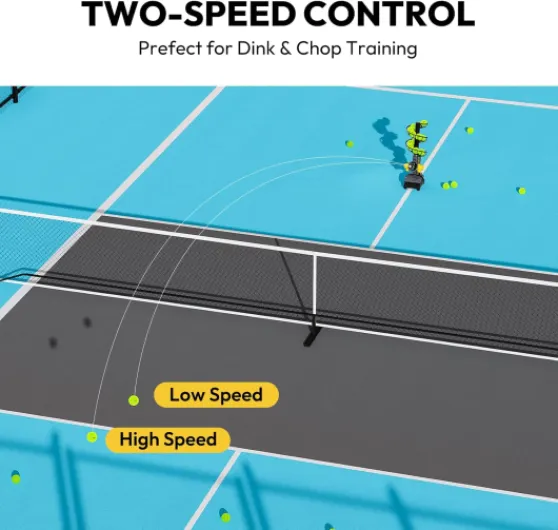
This is where the A11N launcher actually surprised me. I went in expecting weak lobs, but the ball speed is decent. When I set it up closer to me and cranked the wheel speeds up, I got shots that felt close enough to real drives and firm volleys to be useful. It’s not pro-level pace, but it’s plenty fast to work on reaction volleys and blocks. For soft stuff like dinks and drops, it’s even better, because you can dial the speed way down and focus on control.
The 4-second interval between balls is a good middle ground. It gives you enough time to reset your feet and prepare, but you still feel like you’re in a drill and not standing around. With the oscillation turned on, I actually got a decent cardio session going, especially when I set it for slightly wider side-to-side movement. You can do patterns like: forehand volley, shuffle, backhand volley, repeat. After 3–4 baskets of 19 balls, I was sweating more than I expected.
The spin and curve options are basic but real. By adjusting the two wheels differently, you can get left or right spin and some curve in the air. I used this mostly to practice returns and blocks against spinny balls. It’s not as consistent as an expensive machine, so every ball isn’t identical, but that’s not necessarily a bad thing. In real games, balls aren’t perfect either. You just have to accept that this is more “general pattern” than “laser-precise feed.”
Where it’s weaker is full-court realism. If you stick it deep behind the baseline and try to simulate hard drives from the far end, you mostly get higher, floatier balls. Like one reviewer said, this machine works better set up closer and higher, sometimes even on your side of the court, to simulate pace. Once I started using it that way, the performance made a lot more sense. For intermediate players who just want volume reps on specific shots, the performance is honestly decent. If you want perfect match simulation, you’ll hit the limits pretty fast.
What this launcher actually does (and what it doesn’t)
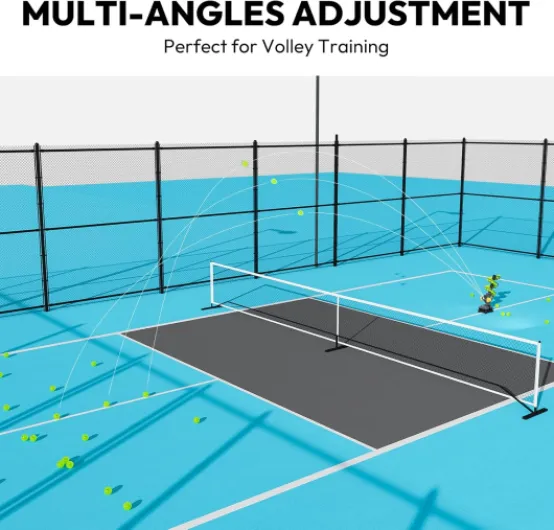
On paper, the A11N launcher sounds pretty loaded: it holds up to 19 pickleballs, fires a ball about every 4 seconds, has adjustable speed, spin, angle, and even an auto-swing base for side-to-side feeds. In real life, most of that is accurate, but the way you use it matters a lot. It’s not just “drop it on the baseline and simulate full rallies.” You need to place it closer and tweak the height if you want realistic shots.
The launch range is roughly 17 to 33 feet with adjustable height from about 1 to 8 feet. That means you can set it up to send soft dinks from near the kitchen or more driven balls from midcourt. I had the best results putting it closer than the product photos suggest. For example, to work on cross-court dinks I put it near the kitchen cross-corner instead of way back at the baseline. If you set it all the way at the opposite baseline and try to get fast drives, you mostly get high loopy balls that aren’t very realistic.
Where it shines is repetition. The 19-ball capacity doesn’t sound like much, but when you’re getting a ball every 4 seconds, that’s a decent little drill set. You hit 19 balls, gather them, and go again. It’s enough to get tired if you’re doing movement drills with the oscillation on. The auto-swing base actually moves the machine left and right, so you can practice side-to-side footwork instead of just standing in one spot.
Just to be clear: this doesn’t replace playing with real people. It’s not smart, it doesn’t react, and it won’t throw super-precise patterns like higher-end machines. But if your goal is to groove mechanics on dinks, volleys, blocks, and some returns, it’s pretty solid. Think of it as a glorified, adjustable ball feeder that you can tune a bit for speed and spin, rather than a full-blown ball machine that covers every scenario.
Pros
- Gives you consistent solo practice with adjustable speed, spin, and angle
- Multiple power options (AC adapter, D batteries, power bank) make it usable indoors and outdoors
- Good value compared to high-end ball machines while still being effective for drills
Cons
- Lightweight plastic build and launch wheels that may wear or need cleaning frequently
- Connectors and cabling feel cheap and can be finicky with power banks
- Limited ball capacity (19 balls) means frequent reloading during longer sessions
Conclusion
Editor's rating
Overall, the A11N Pickleball Automatic Launcher is a pretty honest product: cheap materials, simple design, but it does what most casual and intermediate players actually need. It feeds balls every 4 seconds, you can tweak speed, spin, and angle enough to keep drills interesting, and the oscillating base lets you work on movement instead of just standing in one spot. If your main problem is “I can’t find people who want to drill,” this solves that at a reasonable cost.
It’s not perfect. The build is light and plasticky, the rubber wheels need occasional cleaning and may be the weak point long-term, and the power connectors feel a bit fragile. You also have to be smart about where you place it on the court; if you blindly follow the promo photos and stick it at the far baseline, you’ll get floaty shots and think the machine is bad. Used closer and at the right height, it becomes much more useful. I’d recommend it mainly for beginners and intermediates who want more reps on dinks, volleys, returns, and basic drives. If you’re already high level or want super precise, match-like feeds, you’ll probably be better off saving for a more serious machine.