Summary
Editor's rating
Is it worth the money?
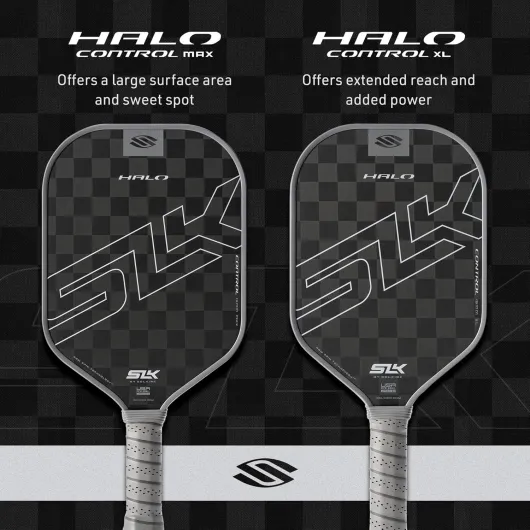
Elongated shape that favors reach and control
Comfort and feel during long sessions
Carbon fiber face and polymer core: what it actually feels like
Build quality and how it holds up after repeated play
On-court performance: control, spin, and power
What you actually get out of the box
Pros
- Very good control and touch thanks to the 16 mm Rev-Control polymer core
- Raw carbon face offers reliable spin for topspin and slice shots
- Elongated shape and long handle give extra reach and help with two-handed backhands
Cons
- Less free power than many paddles in the same price range
- No cover or accessories included in the box
- Narrower face punishes off-center hits more than a standard wide-body paddle

Specifications
View full product page →| Brand | Selkirk Sport |
A control paddle that actually feels controllable
I’ve been playing pickleball 3–4 times a week for a couple of years, and I picked up the Selkirk SLK Halo Control XL because I wanted more control and spin without dropping a chunk of money on the top-end pro models. I used it for about three weeks, mostly in rec play and a couple of local round-robin nights. I’m not sponsored, I paid for it myself, and I’m comparing it to a couple of mid-range paddles I already own (a fiberglass power paddle and a cheaper carbon-face control paddle).
First takeaway: this paddle really leans into the “control” part of its name. It’s 16 mm thick with the Rev-Control polymer core, and you feel that right away on soft shots and dinks. The ball doesn’t rocket off the face; it sits on the paddle just long enough that you feel where it’s going. If you’re coming from a thin, loud power paddle, this will feel calmer and more predictable.
The other big thing is the XL elongated shape. The paddle is 16.4" long with a 5.75" handle, so you get a little extra reach on lobs and at the kitchen, plus enough handle for a two-handed backhand. If you’re used to a standard shape, it takes a session or two to adjust to the narrower face, but after that the extra reach is pretty handy, especially on defense and overheads.
Overall, my first impression was: solid build, very control-focused, and geared more toward consistency than raw power. It’s not magic, but it does what it says: it helps you slow the game down, keep more balls in, and add spin without feeling like you’re swinging a brick. If you like to reset points and play the soft game, this is the kind of paddle that fits that style.
Is it worth the money?
In terms of value, I’d put the Selkirk SLK Halo Control XL in the solid but not crazy cheap category. You’re paying for a recognized brand, a raw carbon face, and a control-focused 16 mm core. It’s not bargain-bin pricing, but it’s also not at the top of the market like some pro-level paddles that cost significantly more. For the price, you get a paddle that feels well built, plays consistently, and should last a while if you take basic care of it.
Where it makes sense is for players who are past the absolute beginner stage and want to invest in something that will actually help them develop better control and spin. If you’re still figuring out the rules and only play once a month, this might be overkill; a cheaper composite paddle will be enough. But if you’re playing weekly, maybe doing some local tournaments, and you like the idea of a control-first, elongated paddle, the value is decent. It’s not a steal, but you do get what you pay for.
Compared to random no-name Amazon paddles that claim “carbon” but feel dead or inconsistent, this one feels more trustworthy. The ball response is predictable, the spin is better, and the build quality is cleaner. On the flip side, if you’re chasing pure power, there are other paddles in the same price range that give you more pop, especially thinner or fiberglass options. So the value really depends on what you want: if you want control, touch, and reach, this is a good value. If you just want to hit as hard as possible, your money might be better spent elsewhere.
Overall, I’d say it’s good value for money for control-oriented players who like elongated shapes. Not a crazy deal, not overpriced—just a solid purchase that makes sense if it fits your play style.

Elongated shape that favors reach and control
The design is clearly aimed at people who like an elongated control paddle. At 16.4" long and 7.4" wide, it’s slimmer than a standard wide-body paddle but gives you more reach. On court, that extra length is noticeable when you’re trying to dig out lobs, stretch for dinks at the kitchen, or defend against hard drives at your feet. I’m about average height, and I found myself getting to a few balls I’d usually miss with my shorter paddle.
The trade-off is the narrower sweet spot horizontally. With the elongated shape, if you’re lazy with footwork and hit way off the sides, you’ll feel more twist in the handle. The sweet spot is decent and fairly forgiving vertically, but mishits toward the edges punish you a bit more than a wider paddle. After a couple of sessions I adjusted, but during the first day I definitely shanked a few more shots than usual until I got used to the shape.
Visually, the gray design is pretty low-key. No loud colors, just a clean carbon look with simple branding. I actually liked that—it doesn’t scream for attention. If you like flashy graphics, you might find it a bit boring, but at least it doesn’t look cheap or plasticky. The edge guard blends in well and the branding is not overdone. It’s the kind of paddle you can bring to any level of play without it looking like a discount toy.
Functionally, the 5.75" handle length is a big design win if you like a two-handed backhand. I use a two-hander sometimes on returns and counterattacks, and there’s enough room without stacking your hands awkwardly. People with smaller hands might even choke up a bit for more control. The design clearly targets players who care about reach, spin, and controlled play rather than pure power, and in that sense, it lines up with how it actually performs on court.
Comfort and feel during long sessions
Comfort-wise, this paddle is easy to live with. At around 7.7–8.0 oz, it sits in that sweet spot where it doesn’t feel like a feather, but it’s also not a wrist-killer. I played back-to-back two-hour sessions with it and didn’t feel any extra strain in my arm or shoulder compared to my usual paddle. The balance leans a bit toward neutral, so it doesn’t feel overly head-heavy, which helps with hand speed at the net.
The 4.25" grip circumference is pretty standard. For my medium-sized hands, it felt natural. The cushioned faux leather grip is actually one of the nicer parts of the paddle. It has a bit of padding, so you don’t feel harsh vibration on mishits. When I hit near the top of the paddle or off the side, I could tell from the feedback, but it didn’t send any sharp sting into my hand or elbow. If you’re sensitive to vibration or dealing with mild tennis elbow, this softer, thicker core plus padded grip combo is more forgiving than a stiff, thin paddle.
During play, the control-focused feel also adds to comfort in a weird way. Because the ball doesn’t fly off the paddle, I felt more relaxed in the soft game. Dinks and resets felt predictable, so I wasn’t constantly overhitting and adjusting. On the other hand, when I wanted to hit hard drives from the baseline, I had to remind myself to swing through and use my legs more, otherwise the ball landed shorter than with my power paddle. That’s not really a comfort issue, just something you need to adapt to.
Overall, for long play sessions, the Halo Control XL is friendly. No hot spots on the grip, no excessive shock, and the weight is manageable even if you’re playing multiple matches. If you want a really beefy, heavy paddle, this probably feels light. But for most rec players who want a mix of control and comfort, it’s a good balance.
Carbon fiber face and polymer core: what it actually feels like
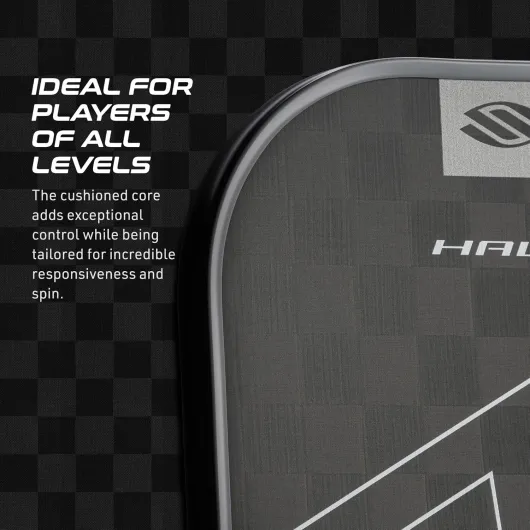
On paper, the materials sound fancy: 18k UltraWeave carbon fiber face with raw spin tech, plus a 16 mm Rev-Control polymer honeycomb core. In practice, it feels like a modern raw-carbon control paddle, not some miracle tool, but definitely a step up from cheap Amazon paddles. The surface has that slightly textured, matte feel you expect from raw carbon, and you can feel the grip on the ball when you brush up for topspin or cut across for slices.
The 16 mm polymer core is thick enough that the paddle feels quiet and soft compared to thinner, fiberglass paddles. The sound is more of a dull pop than a loud crack. If you play in noise-sensitive places or just hate loud paddles, this is a plus. The thick core is also what gives it that control-focused feel—shots don’t jump off the face, which helps with resets and dinks but means you need to swing a bit more for put-aways from the baseline.
The grip is a faux leather, cushioned wrap. Out of the box, it feels soft, with just enough tack to stay in your hand when your palm gets sweaty. I played a couple of hot sessions and the grip never felt slippery, but I did wipe it on my shirt a few times. It’s not as tacky as some overgrips, so if you like a super sticky feel, you’ll probably add an overgrip on top. The good part is the base grip is comfortable and doesn’t have any weird seams or pressure points.
Overall, the materials feel solid for this price range. It doesn’t feel like a cheap composite paddle, and the raw carbon face does actually help with spin and control. It’s not on the same level as the most expensive pro paddles I’ve tried, but for recreational and lower-level competitive play, the build and materials are more than good enough and feel durable so far.
Build quality and how it holds up after repeated play
Durability-wise, I can’t speak for years of use, but after a few weeks of regular play, the Selkirk SLK Halo Control XL is holding up well. I’ve used it on both indoor and outdoor courts, hit a few fences, and had the usual paddle clashes at the net. So far, the edge guard is still firmly attached, with no peeling or gaps. The face has the normal scuff marks from balls and court dust, but there’s no visible chipping or flaking of the carbon layer.
The raw carbon texture is still there after several sessions. On some cheap paddles, the textured surface wears smooth pretty fast, which kills the spin. With this one, I ran my fingers across the face after about 10–12 hours of play and it still had good grip. Obviously, all surfaces wear over time, but at least early on it doesn’t feel like it’s fading too quickly. The paddle also hasn’t developed any weird rattles or buzzing sounds, which sometimes happen when the core or edge guard starts to go.
The grip is another area I paid attention to. I sweat a fair amount, and some factory grips start to loosen or twist under the hand after a few hot sessions. This faux leather grip has stayed tight and hasn’t started peeling at the edges. The only thing I noticed is that it darkened slightly in the usual high-contact spots, which is normal. If you’re picky, you’ll probably throw an overgrip on it eventually, but the base grip itself seems well installed and durable.
Given the brand’s track record and how this one is built, I’d expect it to last a good while for a regular rec player. If you’re playing every single day and really pounding on it, you’ll eventually see the usual wear, but there’s nothing in my testing that suggests weak construction. It feels like a pretty solid, reliable paddle rather than something that will fall apart in a month.
On-court performance: control, spin, and power
This is where the paddle shows its true personality. Control and touch are definitely its strengths. At the kitchen line, dinks are easy to keep low because the paddle face feels soft and predictable. When I was under pressure and had to reset hard drives, the 16 mm core helped absorb pace and drop the ball into the non-volley zone more often than my thinner, power-oriented paddle. If your style leans toward slowing the game down and winning with consistency, this paddle fits that approach.
Spin is also pretty solid thanks to the raw carbon surface. When I brushed up on the ball for topspin drives or topspin rolls from the mid-court, I could see the ball dip more than with my older fiberglass paddle. Same thing with slices—returns and dinks with backspin stayed low and skidded a bit more. It’s not magic, but the texture and raw carbon definitely help you grab the ball more than a smooth composite face. If you already know how to generate spin, this paddle supports that well.
Power is where you might feel a bit underwhelmed if you’re coming from a power paddle. The Halo Control XL is playable from the baseline, but you do need to swing with intent. My serves and drives had good placement and spin, but not the same pop as with a 13–14 mm power paddle or a more aggressive core. At the net, put-aways are fine if you catch the ball clean and in front, but if you’re lazy with footwork, the paddle won’t bail you out with extra power. In short: control and spin: yes; free power: not really.
Defense is where the elongated shape shines. That extra reach helped me dig out balls at my feet and chase down lobs that I’d usually watch sail over my head. The sweet spot is big enough vertically that you can get away with being a bit late as long as you still catch the ball somewhere near the middle. If your game leans toward defense, resets, and smart placement, this paddle supports that style quite well. If you’re a banger who just wants to crush everything, you might find it a bit tame.
What you actually get out of the box
Out of the box, the Selkirk SLK Halo Control XL is pretty straightforward. You get the paddle and that’s it—no cover, no extras, no stickers or random junk. Personally, I don’t really care about extras, but if you’re used to paddles that come with a case, you should know this one doesn’t. For the price point, I think they could have at least thrown in a basic sleeve, but it’s not a deal-breaker.
The paddle came well packaged, though. It was in a plastic sleeve, then in a padded box, and mine arrived with no chips, no edge damage, and the face looked clean. I checked the edges and the grip closely because I’ve had cheaper paddles arrive with glue showing or uneven edge guards. Here, the edge guard is even all around, and there weren’t any obvious glue blobs or sloppy finishes. After a few sessions, there were the usual scuff marks from balls and the court, but nothing abnormal and no early peeling on the carbon face.
In hand, the first thing I noticed was the weight and balance. Mine weighed in right around 7.9 oz (they claim 7.7–8.0 oz), and it feels slightly head-light to neutral. That means it doesn’t feel sluggish on quick exchanges at the net. Compared to my heavier power paddle, I could react faster on fast volleys, but I did lose a bit of punch on drives unless I really swung through. If you like to add lead tape, there’s enough room on the sides and top to tweak the balance easily.
All in all, the presentation is pretty no-nonsense: it shows up protected, looks clean, and feels like a real piece of gear, not a toy. No fancy unboxing moment or anything, but that’s fine. The important part is that it comes out of the box ready to play, with no weird defects or quality red flags in my case.
Pros
- Very good control and touch thanks to the 16 mm Rev-Control polymer core
- Raw carbon face offers reliable spin for topspin and slice shots
- Elongated shape and long handle give extra reach and help with two-handed backhands
Cons
- Less free power than many paddles in the same price range
- No cover or accessories included in the box
- Narrower face punishes off-center hits more than a standard wide-body paddle
Conclusion
Editor's rating
The Selkirk SLK Halo Control XL is a control-focused, elongated paddle that does what it says. The 16 mm Rev-Control core and raw carbon face give you a soft, predictable feel with plenty of spin potential. At the kitchen, it’s easy to keep dinks low and resets controlled. On defense, the extra reach from the XL shape helps you dig out tough balls and chase lobs you’d normally miss. It feels comfortable in the hand, with a cushioned faux leather grip and a manageable weight that doesn’t beat up your arm over long sessions.
It’s not perfect, though. If you’re looking for raw power and big put-aways from the baseline, this isn’t the strongest option in its price range. You have to supply more of the power yourself, and players who prefer a heavier, more head-heavy setup might find it a bit light out of the box. It also doesn’t come with a cover or extras, which is a minor annoyance given the price. That said, the build quality seems solid, the spin is legit, and the control benefits are real if you already have some basic technique.
I’d recommend this paddle to intermediate-ish players (and ambitious beginners) who want to clean up their soft game, add more spin, and like the feel of an elongated shape with a longer handle. If you’re a banger who mainly wants to crush the ball, or you’re on a tight budget and just learning the game, you might want to look at a cheaper composite or a thinner power paddle instead. For control-oriented players who play regularly, the Halo Control XL is a pretty solid, no-nonsense choice.