Summary
Editor's rating
Value for money: solid, but you’re paying partly for the name
Design and shape: built for control and reach
Comfort and feel in hand
Materials and build quality: solid, with a few quirks
Durability after several weeks of play
On-court performance: control first, power second, spin third
What you actually get out of the box
Pros
- Very good control and stable feel at the kitchen and on blocks
- Comfortable 5.5" handle that works well for two-handed backhands
- Solid build quality with reduced vibration and a durable-feeling surface
Cons
- Spin is only average compared to some other carbon paddles at this price
- NFC chip and extras feel like gimmicks, and no paddle cover is included
Specifications
View full product page →| Brand | JOOLA |
A “pro-style” paddle for regular players
I’ve been playing pickleball 3–4 times a week for a while now, usually with mid-range paddles around the $100 mark. I picked up the JOOLA Vision/Double Vision Perseus (Ignite Red) because I wanted something closer to what better players use, without jumping straight into the super expensive pro stuff. I used it for about three weeks, around a dozen sessions, to see if it really made a difference versus my usual fiberglass paddle.
The short version: this paddle feels clearly more "serious" than cheap Amazon paddles. The build is clean, the feel on contact is more controlled, and mishits don’t vibrate as much in the hand. At the same time, it’s not magic. If your technique is off, it won’t suddenly fix your game, and there are a couple of things that annoyed me, especially the NFC chip gimmick and the spin not being as strong as I expected from a carbon surface.
I mainly played doubles with it, with a mix of rec play and some slightly more competitive games. My level is somewhere around low to mid-intermediate: I can dink, I can drive, I can do some spin, but I’m not drilling every day. So this review is from the point of view of a regular player, not a pro. I swapped it back and forth with my older paddle during sessions to really feel the differences.
Overall, it’s a solid control-oriented paddle with decent power, but it’s not perfect. If you’re moving up from a starter paddle, you’ll likely feel an upgrade in feel and stability. If you already own a good carbon or thermoformed paddle, the jump might be smaller than you’d hope, and you might be paying partly for the JOOLA/Ben Johns name and the shape.
Value for money: solid, but you’re paying partly for the name
In terms of value, this JOOLA paddle lands in that mid-to-high price range where you expect real performance gains over cheap Amazon specials. Compared to entry-level paddles, yes, you feel the difference: better control, less vibration, more consistent contact, and a shape that actually helps at the net. If you’re moving from a $40–$60 paddle to this, you’ll probably feel like your money went somewhere useful, especially if you’re playing a lot and care about your game.
Compared to other paddles in the same price bracket, the value is a bit more debatable. You do get a well-built carbon/aramid paddle with a recognized brand and USAP approval for tournament play. You also get that 12-month warranty and the Ben Johns association, which some people like. But performance-wise, it’s not miles ahead of other good paddles in this range. The NFC chip is basically a gimmick. The spin is okay but not outstanding. You’re partly paying for the JOOLA name and the Perseus label.
If I look at it purely from the “does it justify the price?” angle, I’d say it’s good but not insane value. It’s not overpriced junk, but it’s also not some secret bargain. If you’re an intermediate player who wants a reliable, control-focused paddle from a known brand and you don’t mind paying a bit extra for that, it’s a sensible buy. If you’re on a tight budget, there are cheaper paddles that will still get the job done, even if they won’t feel as polished.
So overall, I’d rate the value as solid: you get quality build, good on-court performance, and a proper brand behind it. Just keep in mind there’s better pure bang-for-buck out there if you don’t care about brand names and are willing to dig around lesser-known options.
Design and shape: built for control and reach
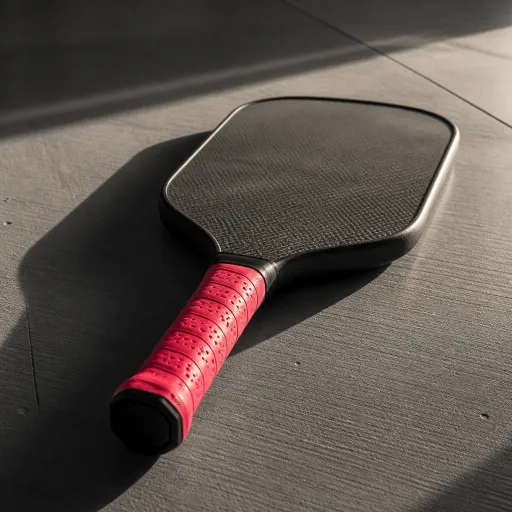
The design leans into that "pro-style" look: mostly dark surface with the Ignite Red accents and the JOOLA branding. It’s not flashy, but it looks clean and modern. The face has a textured carbon/aramid look, not the glossy fiberglass vibe you see on cheaper paddles. After several sessions, the surface still looks solid. Some light scuffing from balls, but nothing weird. One Amazon user mentioned receiving one with ball marks already on it; mine came clean and new, so that sounds more like a one-off quality control or warehouse return issue.
The Perseus shape is elongated with a slightly narrower width than some classic shapes, which gives you a bit more reach at the net and on overheads. I noticed this especially when stretching wide for dinks or when someone tried to pass me down the line. Compared to my older, wider paddle, I saved a couple of balls I probably would have missed before. The trade-off is that the sweet spot feels a bit more focused in the center. If you hit off the extreme edges, you feel a clear drop in power and control, more than on some chunkier, more forgiving paddles.
The handle design is one area I actually liked quite a bit. The 5.5" ergonomic handle feels long enough for a two-handed backhand without feeling like a tennis racket. The shape is slightly rectangular/oval, not too round, which I prefer because it helps me keep track of the face angle without looking. The stock grip thickness is around a standard medium. If you have very small hands you might find it a bit chunky, but for me it was fine right out of the box.
Visually, it’s fine: not something you’re going to stare at, but not ugly either. More importantly, the design choices (elongated head, longer handle, thermoformed build) clearly aim at players who already know what they like: control at the kitchen, reach at the net, and enough stiffness for power drives. If you’re used to a super wide beginner paddle, you’ll feel the difference in shape the first time you use it, both in reach and in how precise you need to be with your contact point.
Comfort and feel in hand
Comfort-wise, this paddle is pleasant to play with for long sessions, but it’s not the softest thing on the market. The SK film and honeycomb core definitely cut down some of the harsh vibration. When I mishit a hard drive, I feel a firm impact, but I don’t get that sharp shock up the arm I’ve had with some stiffer paddles. After a couple of two-hour sessions, I didn’t notice any extra wrist or elbow pain compared to my usual setup, which is a good sign for me.
The grip is one of the parts I liked most. The texture is slightly tacky without being sticky, and it held up fine in hot weather when my hand was sweaty. I didn’t feel it slipping, and I didn’t need an overgrip right away. The handle length at 5.5" worked well for my two-handed backhand. With some shorter handles, I feel cramped; here I had space for both hands without feeling like I was choking up on the head. If you only use one hand, you might even choke up a bit by choice for more control.
In terms of swing weight, at first the paddle felt a bit slower than my lighter, shorter paddle. The slightly head-heavy balance makes it feel stable on contact but not super whippy. At the kitchen, during fast exchanges, I had to adjust my timing for a couple of sessions. Once I got used to it, I actually liked the extra stability on blocks and counters. Just be aware that if you’re coming from a very light, head-light paddle, the first impression might be that this one is a bit more demanding.
For people with arm issues, I’d say this paddle is okay but not ultra-cushioned. It’s stiffer than soft, foam-filled paddles but less harsh than cheap hard composites. If vibration is your main worry, this is a decent middle ground. If you want something super damped and pillowy, there are softer options. For regular players without big injury concerns, the comfort level is more than acceptable for long sessions.
Materials and build quality: solid, with a few quirks
On paper, JOOLA packs a lot of tech words into this thing: carbon fiber frame, carbon/aramid surface, honeycomb core, SK film bonding layer, thermoformed construction. In practice, what I actually feel is a fairly stiff, nicely built paddle that doesn’t buzz in my hand on mishits as much as some cheaper ones. The SK film is supposed to reduce vibration, and to be fair, contact feels pretty stable. When I hit off-center, I don’t get that sharp sting or loud hollow ring that I’ve had with some budget paddles.
The aramid surface is a bit different from the typical raw carbon paddles that are everywhere now. It’s supposed to offer a softer, more controlled feel while still being durable. I’d say the feel is indeed on the softer side at the net, but it’s not a pillow. You can still drive the ball hard. The surface texture is there, but it’s not the most aggressive I’ve used. If your whole game is heavy topspin and crazy cut shots, you may feel like there are paddles with grippier faces out there. One Amazon review also mentioned that their previous paddle gave them more spin, and I agree this one is more about controlled contact than extreme spin.
Weight-wise, the listed 7.8 oz is about right. Mine, as I said, was a touch closer to 8 oz. That’s in the middle range: not super light, not a brick. The balance feels slightly head-heavy, which helps with power on drives and overheads but can feel a bit slower at the net if you’re used to very light paddles. I got used to it after a couple of sessions, but it’s worth knowing if you have elbow issues or prefer ultra-light gear.
In terms of build quality, after three weeks: no rattles, no edge separation, no weird noises. The edge guard is clean and hasn’t started peeling. The only minor thing is that the surface shows ball marks a bit more than my previous paddle, but it’s purely cosmetic. Overall, the materials and build feel pretty solid and reliable, even if the tech names (SK film, aramid, NFC chip) sound more impressive on the product page than they actually feel in real life.
Durability after several weeks of play
Durability is always hard to judge long-term, but after three weeks of pretty regular play, the JOOLA Perseus shape paddle looks in good shape. No edge guard separation, no rattling, no soft spots developing. I’ve banged it a few times on the court going for low balls, and the edge shows the usual scuffs but nothing worrying. The thermoformed construction and carbon frame do give a sense of solidity when you tap it or flex it by hand.
The surface itself has picked up visible ball marks and some light wear, but that’s normal for a textured paddle. One Amazon review complained about receiving a paddle with ball marks straight out of the box, but that sounds more like they got a used or returned item, not a durability issue. In my case, the marks only appeared after playing, and they don’t affect play at all, it’s just cosmetic. The texture still feels the same to the touch as on day one.
The grip has held up surprisingly well. No peeling, no tearing, and the tackiness is still there. I sweat a fair amount, and some cheaper grips get slick and gross quickly. This one just feels like a standard quality grip. I’ll probably regrip it after a few more months, but for now it’s holding its own. The handle and neck connection also feel tight; no creaks or flex sounds when I lean on it or twist it slightly.
Given JOOLA’s reputation and the 12-month warranty you get when you register through the NFC link, I’m not too worried about durability. Of course, time will tell if the core softens or the surface loses texture, but based on the first few weeks, it seems pretty robust. If you’re rough on your gear, I’d still recommend using a cover and not tossing it loose in the trunk, but nothing about this paddle screams fragile or poorly built.
On-court performance: control first, power second, spin third
On court, this paddle clearly leans toward control and stability, with enough power when you swing properly. At the kitchen, dinks felt very predictable. The softer aramid surface gives a clear sense of how much the ball sinks into the face. I could drop the ball short or push it a bit deeper without feeling like the paddle was doing something random. Compared to my older, bouncier fiberglass paddle, I had fewer balls sailing long on touch shots once I got used to the feel.
On drives and serves, the power is there, but you have to swing. If you’re lazy with your stroke, the paddle won’t magically send rockets. When I committed to a full swing, I got solid, straight power that felt easier to control than with some super poppy paddles. The sweet spot is decent size, but not huge. Center hits feel great; off-center hits lose some pace and pop. That lines up with the Amazon review from the player who said it’s good for intermediate players but less forgiving than their previous paddle. I had the same impression: rewarding when you hit clean, a bit punishing when you’re sloppy.
Spin is the one area where I was slightly disappointed. The surface has texture, but it doesn’t grab the ball as much as some raw carbon paddles I’ve tried. My topspin rolls and cut serves had spin, just not as much as I expected at this price and tech level. It’s usable, and if your technique is good you’ll still produce spin, but if your main buying reason is spin, I’d look at other options first. The paddle feels like it’s tuned more for precision and feel than for crazy spin.
At the net during fast exchanges, the stability really shows. Blocks, counters, and quick reflex volleys feel solid. The slightly higher swing weight helps the paddle not twist in the hand when someone fires at your body. After a few sessions, I started to trust it more on those quick reaction shots. Overall, performance-wise, I’d sum it up like this: great control, good power if you swing, average-to-decent spin, medium forgiveness. If that matches your style, you’ll probably like it. If you want max spin or a super forgiving beginner paddle, this isn’t it.
What you actually get out of the box
Out of the box, the JOOLA Vision/Double Vision Perseus looks like a fairly serious piece of kit. Mine came in a simple cardboard box with some branding, but nothing fancy like a case or extra grip tape. You basically get: the paddle, a small info sheet, and that’s it. For the price point, I would have liked at least a basic cover, but no luck there. So if you care about protecting it in your bag, plan on buying a separate cover.
The main thing JOOLA pushes is this embedded NFC chip. In practice, you tap your phone on the handle, it opens a link, and you land on a page to register your paddle and see some JOOLA content. That’s it. No tracking, no stats, nothing smart. Honestly, it feels like a pure marketing add-on. I registered it once and never touched that feature again. It doesn’t hurt anything, but it’s basically pointless.
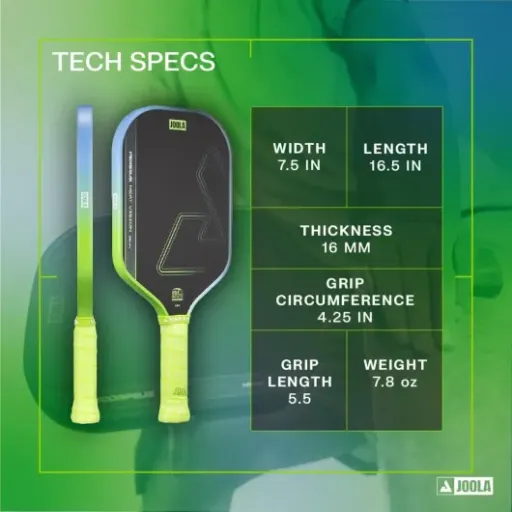
Specs-wise, the paddle is 16.5" long and 7.5" wide, with a weight around 7.8 oz (mine on a kitchen scale came in just a hair under 8 oz with the grip wrap it ships with). The handle length is about 5.5", which is on the longer side and nice if you like two-handed backhands. The shape is their "Perseus" shape, which is kind of an elongated control/power hybrid. On paper, it’s built around a honeycomb core with an SK film layer and an aramid surface on top, but all you really need to know is: it feels like a stiff, thermoformed carbon paddle.
In use, the paddle sits in that intermediate-to-advanced target zone. It’s not ultra forgiving like some wide-body beginner paddles, but it doesn’t feel super punishing either. If you’re just starting pickleball, this is overkill. If you’ve been playing for a bit and want to step up from a cheap starter paddle, the overall presentation and feel does give the impression of a more serious tool, even if the extras like the NFC chip are mostly fluff.
Pros
- Very good control and stable feel at the kitchen and on blocks
- Comfortable 5.5" handle that works well for two-handed backhands
- Solid build quality with reduced vibration and a durable-feeling surface
Cons
- Spin is only average compared to some other carbon paddles at this price
- NFC chip and extras feel like gimmicks, and no paddle cover is included
Conclusion
Editor's rating
After a few weeks with the JOOLA Vision/Double Vision Perseus (Ignite Red), my take is pretty straightforward: it’s a well-built, control-oriented paddle that suits intermediate players who want something more serious than a cheap starter, without going full pro-level price. The feel is stable, the vibration is under control, and the handle length is great if you like using two hands. At the kitchen, it’s predictable and easy to place the ball. On drives, there’s solid power as long as you commit to your swing.
It’s not perfect, though. The spin is decent but nothing special compared to some raw carbon paddles. The sweet spot is good but not super forgiving, so you’re rewarded for clean contact and punished a bit when you’re off. The NFC chip is basically a marketing toy, and for the price, I would have liked a simple paddle cover in the box. Also, if you’re coming from a very light, wide beginner paddle, you’ll need a couple of sessions to adjust to the slightly head-heavier, elongated shape.
I’d recommend this paddle for regular rec players and intermediates who care about control and consistency and want a known brand with tournament approval. If your style leans heavily on spin, or if you just started playing and want something super forgiving and cheap, you should probably look elsewhere. Overall, it’s a pretty solid paddle that gets the job done and feels reliable on court, even if it doesn’t blow everything else out of the water.