Summary
Editor's rating
Value for money: strong performance, but the price and missing cover sting a bit
Design: elongated shape, aero curve, and a handle that actually feels usable
Comfort and feel: stable, slightly head-heavy, and kind on the arm
Materials and build: carbon fiber frame, CAS surface, and a 13.5 mm core
Durability after a few weeks: solid so far, with a few things to watch
On-court performance: control and spin first, power second
What you actually get when you buy the Hyperion CAS 13.5
Pros
- Very good control and spin, especially for dinks, drops, and topspin/slice shots
- Comfortable elongated grip and balanced weight that works for long sessions
- Solid build quality with stable feel and durable CAS surface so far
Cons
- No paddle cover included despite the higher price
- Confusing listing between CAS and CFS models can lead to wrong expectations
- Power is only moderate; not ideal for players who rely mainly on big hits

Specifications
View full product page →| Brand | JOOLA |
A popular "pro" paddle that I actually took to the courts
I’ve been seeing this JOOLA Ben Johns Hyperion everywhere at my local courts, so I finally grabbed the Hyperion CAS 13.5 version to see what the fuss was about. I’m an intermediate player, play 3–4 times a week, mostly doubles, and I used it for about three weeks before writing this. Before this, I was using a cheaper fiberglass paddle and occasionally a friend’s raw carbon control paddle, so I had a decent comparison in terms of feel and power.
Right away, the main thing that stood out is that this paddle is clearly tuned more for control and spin than pure power. The 13.5 mm core gives it a bit more pop than the 16 mm control paddles I’ve tried, but it still doesn’t hit like a thick, power-focused paddle. If you’re expecting some kind of rocket launcher because Ben Johns’ name is on it, that’s not what this is. It’s more of a “place the ball exactly where you want” kind of paddle.
During the first few sessions, I noticed my soft game improved faster than my drives. Dinks, drops, and resets felt very secure once I got used to the sweet spot. My drives were fine, but nothing that made people step back in fear. Where it did shine was spin: topspin rolls and slice serves were clearly heavier compared to my old fiberglass paddle. Opponents started popping balls up more often, which is always a good sign.
Overall, this isn’t a miracle tool, but it’s a pretty solid option for intermediate players who want more consistency, touch, and spin. It’s not perfect: the price is on the higher side, it doesn’t come with a cover, and the product listing being confusing between CAS and CFS is annoying. But on court, it gets the job done and actually helped my control, which matters more than the marketing stuff.
Value for money: strong performance, but the price and missing cover sting a bit
On the value side, this paddle sits in that higher mid-range / premium bracket. You’re paying for the JOOLA name, the Ben Johns branding, and the overall build and performance. In terms of what it does on court—control, spin, stability—it delivers pretty well. If you’re an intermediate player who’s outgrown a cheap starter paddle, you’ll feel the difference. Your soft game gets more consistent, your spin improves, and your overall confidence on touch shots goes up. So from a pure performance standpoint, the price is at least justifiable.
That said, there are a few things that bug me at this price. No cover included feels cheap. When a paddle costs this much, throwing in a basic sleeve wouldn’t kill the margins. It makes the unboxing feel a bit bare and pushes you to spend extra if you care about protection. Also, the confusion between CAS and CFS in the product title is not great. If someone pays full price thinking they’re getting the CFS raw carbon version, that’s frustrating. Clarity should be better when you’re charging this kind of money.
Compared to other paddles I’ve tried or seen friends use in the same price range, I’d say the Hyperion CAS 13.5 offers very solid control and spin, decent power, and good comfort. There are raw carbon paddles from smaller brands that might give you slightly more spin for similar or less money, but they don’t always have the same consistent build quality or brand backing. So you’re partly paying for peace of mind and a known product line that a lot of players already trust.
If you can catch it on a discount (which seems to happen fairly often), the value looks much better. At a reduced price, I’d call it a good buy for an improving intermediate who wants a reliable, control-focused paddle with legit spin. At full price, it’s still a good paddle, but you’re paying a bit of a brand and pro-name tax, and you’ll probably grumble once about the missing cover before you move on and just enjoy how it plays.
Design: elongated shape, aero curve, and a handle that actually feels usable
The overall design is very much in line with what you see in modern, higher-end pickleball paddles: elongated face, aerodynamic curve at the top, and a longer grip. The “Aero-curve” head isn’t just marketing fluff; you can feel that the paddle cuts through the air a bit easier on fast swings compared to a more blocky, traditional shape. When I was speeding up balls at the kitchen or going for hard drives, the paddle didn’t feel like it was dragging, which I’ve noticed on some cheaper, boxier paddles.
The elongated shape gives you extra reach, and that does matter in real games. On wide dinks or lobs that are just out of normal range, I was able to scrape a few balls back that I’d probably miss with a standard shape. The trade-off is that the sweet spot feels a bit more stretched vertically. Off-center hits toward the extreme tip or down by the handle feel less forgiving. You don’t mishit every other ball or anything, but you do notice more vibration and loss of control on those contact points.
The handle design is one of the things I actually liked most. The elongated grip is comfortable for one-handed play and gives enough room for a two-handed backhand without feeling cramped. I don’t use a two-hander all the time, but when I did, it felt natural. The grip size (4 1/4”) is pretty standard and should work for most adult hands. The factory grip has a nice tacky feel, not too squishy, and it didn’t slip even when I got sweaty. After several sessions, it still felt decent, but I’d probably add an overgrip for long-term use.
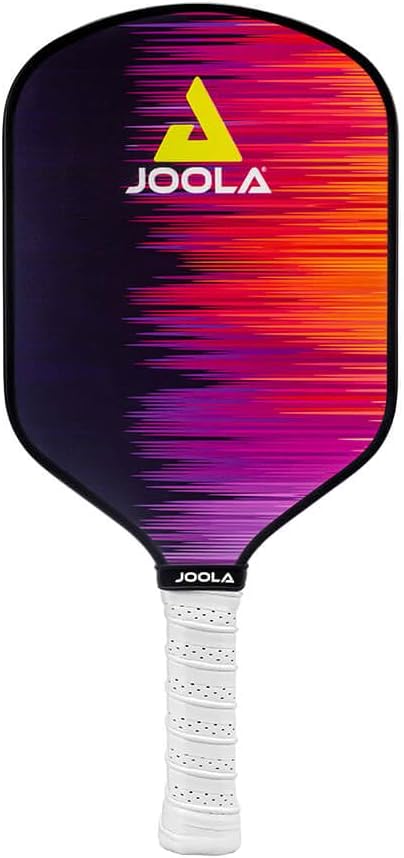
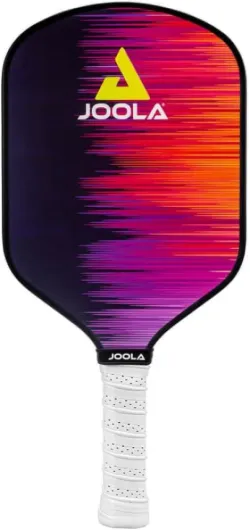
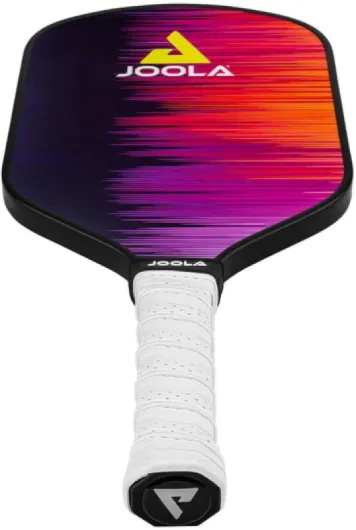
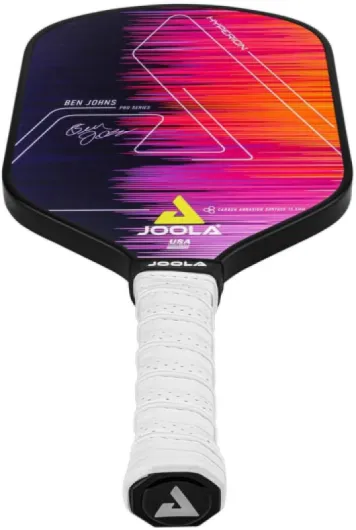
Visually, it looks like a “serious” paddle, but not overdone. Mostly dark with some branding and Ben Johns’ name. Nothing flashy, nothing ugly. If you like clean, sporty design, you’ll be fine with it. The main thing design-wise is this: it’s built for control, reach, and spin, not for brute-force power. If that matches how you play or how you want to play, the design makes sense. If you’re a banger who just wants to crush the ball, there are other shapes and thicknesses that fit that style better.
Comfort and feel: stable, slightly head-heavy, and kind on the arm
Comfort-wise, I’d say this paddle is generally easy to live with, especially if you’re playing several times a week. The first thing I noticed is the balance: it’s a touch head-heavy, which helps with plow-through on volleys and drives, but it’s not so extreme that it tires you out. I could play two-hour sessions, including lots of hand battles at the kitchen, without my wrist or forearm feeling overworked. If you’re coming from a very light paddle, you’ll feel the difference, but I got used to it after one or two sessions.
The vibration level is moderate and controlled. Off the sweet spot, you do feel some feedback, but it’s not harsh or painful. I’ve used paddles that buzzed my elbow on mishits; this one didn’t do that. The 13.5 mm core and carbon frame seem to soak up enough shock while still letting you feel what’s happening on contact. If you have serious elbow or shoulder issues, a thicker 16 mm, more damped paddle might be even gentler, but for my average arm, this was completely fine.
The grip comfort is actually a strong point. The 4 1/4" circumference felt natural in my medium-sized hand, and the length gave me options for one- or two-handed shots. The stock grip has light cushioning and decent tack. Even when my hand got sweaty, it didn’t twist in my hand. After a few sessions outdoors in the heat, I did start to think about adding an overgrip just to keep it fresher and slightly softer, but that’s normal for pretty much any paddle I use regularly.
One thing to keep in mind: because of the elongated shape and narrower width, off-center hits toward the tip can feel a bit more unstable than on a wider, more traditional paddle. It’s not brutal, but you feel the twist. Once I adjusted my contact point and got used to the shape, it was less of an issue. Overall, I’d call the comfort level “pretty solid” for most intermediate players: stable enough, not too jarring, and easy to handle over long sessions without your arm hating you.
Materials and build: carbon fiber frame, CAS surface, and a 13.5 mm core
On paper, the materials tick all the usual boxes: carbon fiber frame and shaft, carbon-based hitting surface (Carbon Abrasion Surface), and a 13.5 mm reactive honeycomb core. In practice, the paddle feels solid in the hand. No rattles, no weird hollow sounds, and the weight feels well-balanced slightly toward the head but not extreme. The 8.2 oz weight is a good middle ground: not ultra-light, not a heavy club. For me, it was easy to swing for a full two-hour session without feeling like my arm was going to fall off.
The CAS surface is where a lot of the character comes from. It’s a textured coating rather than a raw, gritty carbon weave. When you rub your fingers across it, you can feel the texture, but it’s not super rough. On court, it gives plenty of spin, especially on topspin rolls and cut dinks, but if you’ve tried very gritty raw carbon paddles, this feels slightly less grabby. Still, I never felt like I was lacking spin. For me, it was a good middle ground between grab and control, especially on soft shots where you don’t want the ball to fly off.
The 13.5 mm core is an interesting compromise. Compared to a 16 mm control paddle, this one has a bit more pop and feedback. You feel more of the ball in the hand, which I personally like. It doesn’t feel dead. But it’s not a thin 13 mm “power paddle” either. It sits in that zone where you can still play a solid soft game but have enough juice to finish points when you get a sitter. The honeycomb core seemed consistent across the face; I didn’t feel random dead spots, though the very edges are obviously less forgiving, like any paddle.
Build quality on my unit looked clean: edges were finished properly, no glue residue, no warping. After several weeks, the edge guard is intact and the surface texture is still there. Some paddles lose their grit quickly; this one hasn’t yet, at least in the early stages. Long term, it’s hard to say, but given JOOLA’s reputation and the feel so far, I’d say the materials are solid for intermediate to competitive rec players. Just don’t expect luxury-level presentation—this is more about function than looking fancy in the bag.
Durability after a few weeks: solid so far, with a few things to watch
Durability is always tricky to judge long-term, but after a few weeks of regular play, the Hyperion CAS 13.5 is holding up well. I used it on outdoor courts, with the usual bumps against the surface and the odd clash with a partner’s paddle at the net. The edge guard is still firmly attached, no peeling or gaps. That’s important, because if the edge guard starts to separate, it can be a sign of bigger build issues. So far, mine looks clean.
The CAS surface has kept its texture. I checked it by running my fingers and a ball across the face after each week. It still feels grippy and hasn’t gone slick. Some cheaper textured paddles lose that roughness quickly, and then your spin drops off. I haven’t seen that yet here. There are a few light scuff marks from contact with the ball and the ground, but that’s normal cosmetic wear, nothing structural. The graphics haven’t flaked or peeled either.
The core and frame feel sturdy. No buzzing, no internal rattle, and no soft spots developing. I’ve seen some paddles develop a weird hollow sound after a couple of clashes or drops; this one still sounds and feels consistent. The carbon fiber frame seems to do its job of keeping the shape and stiffness intact. The grip has compressed slightly, as expected, but it hasn’t unraveled or started to twist. For regular players, you’ll probably re-grip it before the rest of the paddle gives out.
Of course, I can’t speak to multi-year durability yet, but based on the first weeks and JOOLA’s general reputation, I’d say it feels like it will last a good while for an intermediate or competitive rec player. Just keep in mind that it doesn’t come with a cover, so if you toss it loose in your bag with keys and other junk, you’ll probably scratch it up faster than necessary. Spend a bit on a sleeve and you’ll likely get more life out of the surface and edges.
On-court performance: control and spin first, power second
In terms of performance, this paddle leans clearly toward control and spin, with just enough power to finish points if your technique is decent. At the kitchen, I felt very confident with dinks and resets after a short adjustment period. The face gives you a predictable response on soft shots; the ball doesn’t jump unexpectedly, which helped me keep the ball low and short. Third-shot drops from mid-court also felt easier to land in the kitchen compared to my old fiberglass paddle, which tended to launch balls a bit more.
Where this paddle really shines is spin. The CAS surface grabs the ball well enough that top-spin rolls and heavy slices actually do something. My topspin drives dipped into the court more, and opponents had more trouble attacking my slice returns. On serves, I could add a good amount of curve and kick. Is it the grittiest paddle I’ve ever tried? No. But it’s clearly a step up from smooth composite paddles and more than enough for most intermediate players to develop a solid spin-based game.
Power is where things are more middle-of-the-road. If you’re used to thin, power-focused paddles, this will feel tamer. Drives and overheads have enough pop to be dangerous, but you still need to swing with intent. I didn’t feel shortchanged, but I also never thought, “wow, this thing crushes.” For me, that’s fine because I care more about placing the ball and winning hand battles than just hitting as hard as possible. But if your style is pure banger, this might feel a bit underwhelming in the power department.
In fast exchanges at the net, the aero-curve design and balance really help. I could react quickly, block hard shots, and redirect with decent control. The sweet spot feels comfortable in the upper-middle area of the face, which is where you’re usually contacting in hand battles. Overall, the performance is very solid for someone who likes to build points with spin and control and then finish when the opportunity comes, rather than trying to smash through people on every shot.
What you actually get when you buy the Hyperion CAS 13.5
Out of the box, the presentation is pretty basic: you get the paddle only, no cover, no extras. For a paddle in this price range, I honestly expected at least a simple sleeve. That’s one of the first small disappointments. If you’re someone who likes to protect their gear, you’ll need to buy a separate cover, which adds to the real cost. The box itself is just standard packaging, nothing fancy, nothing terrible, but it feels a bit bare compared to how premium the paddle is marketed.
The model I tested is clearly marked as CAS 13.5 (Carbon Abrasion Surface, 13.5 mm core). This is important, because the Amazon listing mixes CFS and CAS in the title and images, and they are different paddles. The CAS surface is more of a textured coating compared to the raw carbon style on some other models. If you specifically wanted the raw carbon CFS feel, you might be disappointed if you don’t read carefully. In my case, I knew I was getting CAS, but I can see how people get confused, and that’s on JOOLA and the listing.
Specs-wise, the paddle is about 8.2 ounces, elongated shape, with a 4 1/4" grip size and a longer handle. The dimensions are roughly 42 x 19 cm. On court, that translates to an extended reach and a little extra leverage for two-handed backhands if you use them. It’s approved for all the usual tours and USAP, which is nice if you play tournaments, but for regular rec play, that’s more of a side note.
From a pure “what am I getting for my money” perspective, the main value is clearly: a known brand, a shape and feel that many competitive players like, and a surface that gives good spin. On the downside, the lack of included cover and the confusing title make the buying experience feel a bit sloppy for the price. If you’re okay with that and mainly care how it plays, it’s fine. But if you like clean, clear product info and a more complete package, this might annoy you a bit right from the start.
Pros
- Very good control and spin, especially for dinks, drops, and topspin/slice shots
- Comfortable elongated grip and balanced weight that works for long sessions
- Solid build quality with stable feel and durable CAS surface so far
Cons
- No paddle cover included despite the higher price
- Confusing listing between CAS and CFS models can lead to wrong expectations
- Power is only moderate; not ideal for players who rely mainly on big hits
Conclusion
Editor's rating
The JOOLA Ben Johns Hyperion CAS 13.5 is a control and spin-focused paddle that suits intermediate players who like to play a smart, precise game rather than just hammering every ball. The elongated shape, aero-curve design, and 13.5 mm core give you good reach, stable blocking, and enough feedback to really feel your dinks, drops, and rolls. Spin is clearly better than on basic composite paddles, and the paddle feels solid and comfortable over longer sessions, with manageable weight and no nasty vibrations.
It’s not perfect. Power is decent but not huge, so if you live off pure pace, you might find it a bit tame. The Amazon listing mixing CAS and CFS is confusing, and the lack of an included cover at this price is annoying. But if you know you’re getting the CAS version and you care more about placement, spin, and consistency than sheer pop, it does its job well. I’d recommend it to intermediate players who are serious about improving their soft game and want a reliable, well-built paddle from a known brand. If you’re on a tight budget, or you want maximum power per dollar, you might want to look at other options or wait for a sale.