Summary
Editor's rating
Is it worth the price, or are you just paying for the name?
Shape, balance, and how it actually feels in hand
Comfort and feel after a few long sessions
Carbon fiber, SK film, and what that actually means on court
Build quality and how it holds up (so far)
How it actually plays: power, control, spin, and sweet spot
What you actually get out of the box
Pros
- Very good control and touch for dinks, drops, and resets
- Light-to-mid weight with reduced vibration, comfortable for longer sessions
- Solid build quality and materials with USAP approval and 12‑month warranty
Cons
- Medium power at best – not ideal for players who rely on free pop
- Narrower head and sweet spot can be less forgiving for inconsistent hitters
- No case included and stock grip is just okay, likely needs an overgrip

Specifications
View full product page →| Brand | JOOLA |
A Ben Johns-branded paddle regular players can actually use
I’ve been playing pickleball 3–4 times a week for a couple of years now, mostly rec games and the odd local tournament. I picked up the JOOLA Vision/Double Vision Perseus (Bolt Blue) because I wanted something a bit more serious than my entry-level fiberglass paddle, but I didn’t want to jump straight into a super stiff, pro-only carbon paddle that punishes every mishit. The “reduced vibration” pitch and the Ben Johns association got my attention, I’ll be honest.
I’ve used this paddle for about three weeks now, probably 12–15 sessions, mostly doubles, a few singles games. I swapped between this and my older Onix and a cheaper Amazon carbon paddle so I could feel the differences back-to-back. I’m not sponsored, I paid for it, and I’m not trying to sell you anything. I just wanted to see if this is actually a good step-up paddle for normal people, not just for that one guy at the courts who lives on YouTube drills.
Overall, my first impression was: light, easy to swing, and a lot more feedback than my old paddle. The paddle face feels firmer and the ball pops off a bit quicker, but it’s not a rocket. If you’re expecting some crazy power boost just because Ben Johns’ name is floating around the brand, you’ll probably be a bit underwhelmed. Where it stands out more is in control and feel at the net.
In short: it’s a pretty solid intermediate-friendly paddle with good control and a nice mix of power and touch, but it’s not perfect. There are some things I really liked, and a couple that bugged me enough that I’d tell a friend to think twice depending on their style and budget.
Is it worth the price, or are you just paying for the name?
Price-wise, this paddle sits in that mid-to-upper range where you start asking yourself if you’re paying for real performance or just a logo and a pro’s name somewhere in the marketing. For what you get – carbon fiber construction, aramid surface, SK film, thermoformed build, USAP approved – I’d say the value is pretty solid but not insane. You’re not being ripped off, but it’s also not some crazy bargain.
Compared to cheaper Amazon carbon paddles in the $50–$80 range, the JOOLA feels more refined: less vibration, more consistent response across the face, and better overall build quality. If you play a lot (2–3 times a week or more), that difference is noticeable and worth something. If you only play once a month with friends, honestly, you might not care enough to justify the extra cost and a cheaper paddle might do the job.
Against other big-brand paddles in a similar price bracket, the Perseus holds its own. You get good control, decent spin, and a comfortable weight, plus the JOOLA name and the Ben Johns association if that matters to you. But let’s be real: this paddle will not magically fix bad footwork or lazy swings. It’s a good tool if you’re already working on your game and want something that rewards proper technique, especially at the net.
So in terms of value: if you’re an intermediate player or a serious beginner stepping up and you want a reliable, control-focused paddle from a known brand, this is a reasonable buy. If you’re a pure power hitter or on a tight budget, there are better options for you. You’re partly paying for the JOOLA name, but you’re also getting a genuinely well-built paddle, not just branding.
Shape, balance, and how it actually feels in hand
The Perseus uses JOOLA’s “iconic” elongated shape: longer and slightly narrower than a traditional paddle. On court, that basically means more reach and a smaller face. If you’re used to a wide-body paddle, you will notice the head feels smaller. One of the Amazon reviews mentioned that, and I agree – you need a few sessions to adjust your timing and contact point, especially on fast exchanges at the net.
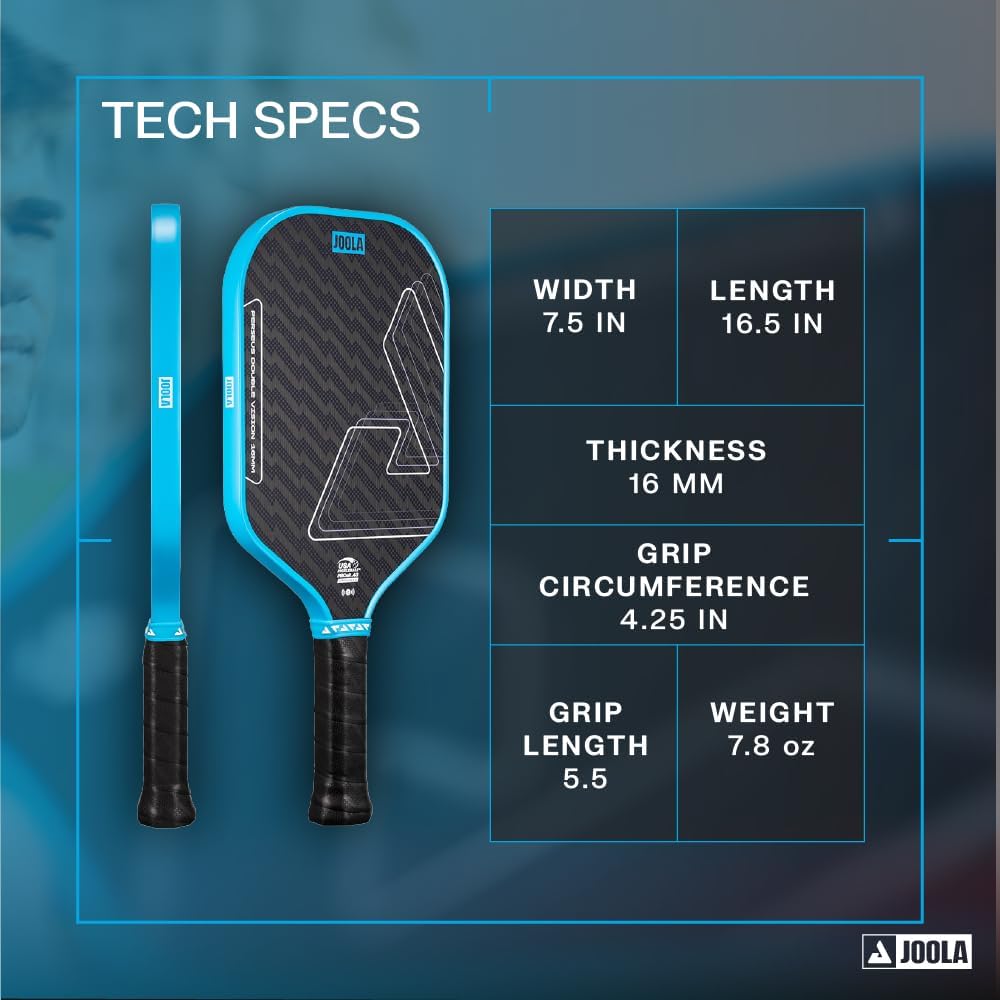
The balance is slightly head-light to me. At 7.8 oz, it swings fast, and I didn’t feel any sluggishness on quick volley battles. Coming from a heavier 8.3 oz paddle, I instantly felt quicker at the kitchen line. The downside is that raw power on drives and serves is moderate. You can hit hard with good technique, but the paddle doesn’t do the work for you like some heavier, more head-heavy models. If your main weapon is bashing the ball, you might find it a bit tame out of the box.
The 5.5" handle is one of the nicer design choices. I like to use a two-handed backhand occasionally, and here it’s actually comfortable, not cramped. The grip circumference feels like a standard medium. If you have very small hands you might want an overgrip that’s slightly thinner, but for average hands it’s fine. The handle shape is slightly ergonomic – not crazy molded, but there’s a bit of contour so it doesn’t twist easily when you catch the ball off-center.
Visually, the Bolt Blue version is simple and sporty. Matte carbon with blue accents, nothing flashy. It doesn’t scream “look at me”, which I like. One thing to note: the edge guard and thermoformed design feel tight, no gaps or weird glue marks on mine. So from a design standpoint, it’s functional and pretty clean. Not the coolest-looking paddle on the court, but definitely not cheap-looking either.
Comfort and feel after a few long sessions
Comfort was one of the main reasons I tried this paddle. I’ve had some mild elbow pain after long sessions with a very stiff, heavier paddle. With the JOOLA Perseus, I played a couple of 3+ hour sessions back-to-back to see how my arm would react. Overall, comfort is pretty good. I still felt normal fatigue from playing a lot, but I didn’t get that sharp soreness in the elbow the next day like I did with my old setup.
The combination of the 7.8 oz weight and the SK film/honeycomb core seems to help. The paddle doesn’t feel head-heavy, so you’re not constantly muscling it around at the net. On quick volley exchanges, I could just react and block without feeling late, which also helps reduce strain because you’re not over-swinging. Mishits on the edge or high on the face are noticeable, but they don’t buzz through the handle in a painful way.
The stock grip is comfortable but a bit basic. It’s tacky enough when dry, but once my hand got sweaty, I started to feel it slip slightly. I ended up adding an overgrip after the second week, which fixed the issue. If you play in hot conditions or sweat a lot, I’d plan on throwing an overgrip on from day one. The handle thickness with one overgrip feels just right for my average-sized hands.
One more thing: the longer handle is surprisingly nice for comfort on backhands. When I reach for two-handed backhands, I’m not pinching my second hand onto the edge of the butt cap, so there’s less strain on my wrist. If you only ever use a one-handed backhand, you might not care, but if you mix it up, it’s a small but real plus. In short, not the softest paddle ever, but for a carbon-style paddle with some pop, it’s friendly on the arm.
Carbon fiber, SK film, and what that actually means on court
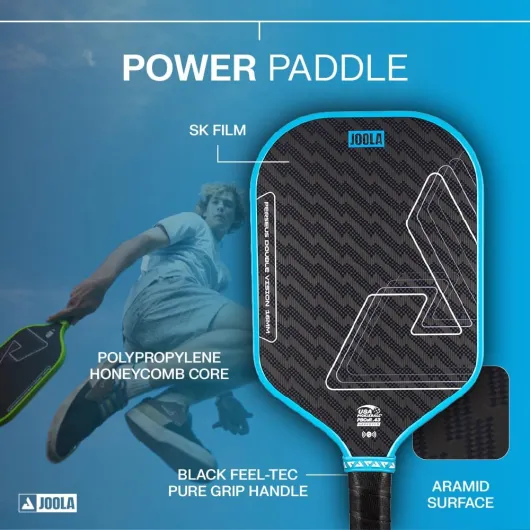
On paper, JOOLA throws a lot of buzzwords at this paddle: carbon fiber frame, honeycomb core, SK film, aramid surface. Here’s how it felt in real use, not just in marketing language. Compared to my older fiberglass paddle, the face is clearly firmer and more controlled. The ball comes off the paddle with a more predictable bounce, especially on blocks and resets. You don’t get that “trampoline” feel that some cheaper paddles have.
The SK film is supposed to reduce vibration by bonding the core to the surface more evenly. In practice, I did notice less harsh vibration on mishits compared to a cheaper carbon paddle I got off Amazon. With that cheap one, a hard drive at my feet felt like a shock through my wrist. With the JOOLA, I still feel where I hit the ball, but it’s more of a dull feedback than a sting. If you’ve got sensitive elbows or are worried about tennis elbow, this is a plus. It’s not magic, but it’s gentler than some stiff paddles I’ve tried.
The aramid surface is advertised as softer and more responsive. To me, that translated to better touch around the kitchen. Dinks and drops feel easier to control because the ball sits on the paddle just a fraction longer. I could play softer shots without feeling like the ball was jumping off the face. At the same time, if you really swing through, there’s enough backbone in the core to put the ball away. It’s not a pure power paddle, but it’s not dead either.
Overall, the materials feel legit, not gimmicky. The carbon fiber frame is stiff enough for stability, the core doesn’t feel hollow or cheap, and the surface has decent grip for spin (I’ll get into that more in performance). Just don’t expect all these fancy terms to suddenly make you play like Ben Johns. They mainly translate to solid feel, reduced sting, and decent durability potential.
Build quality and how it holds up (so far)
Durability is always a bit of a guess after only a few weeks, but there are some signs you can look at early. After roughly 15 sessions, the edge guard is still tight, no lifting or gaps. The thermoformed build seems solid; I don’t see any separation between the face and the edge. I’ve had a couple of accidental paddle clashes at the net (because rec play…) and only picked up minor scuffs, no chunks or cracks.
The surface texture is holding up fine. There are some light ball marks, but that’s normal. I don’t see any bald spots where the grit has worn off yet. With some cheaper paddles I’ve owned, the texture started fading after a month and the spin dropped off; that hasn’t happened here so far. The matte look hides scratches reasonably well too, so it still looks in good shape even after being tossed in a bag with other gear.
The grip is the only part that felt like it would wear out quicker. After a couple of sweaty sessions, it started losing some tackiness, and the top edge of the grip tape began to lift slightly. That’s pretty standard, to be honest. I fixed it with an overgrip and a bit of tape, and now I don’t think about it anymore. I wouldn’t judge the whole paddle on the stock grip quality; almost everyone I know regrips anyway.
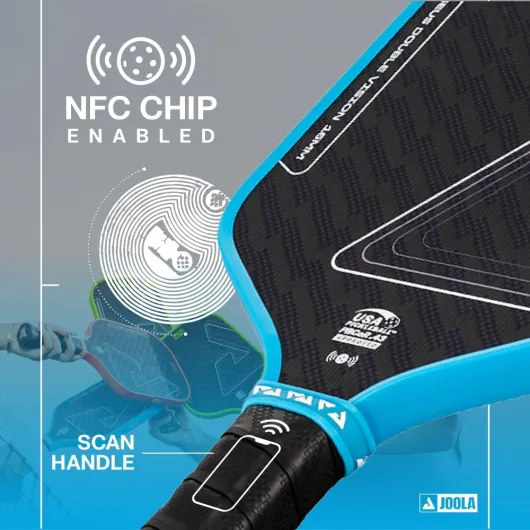
Since JOOLA offers a 12‑month warranty when you register via the NFC chip, that gives a bit of peace of mind. I obviously haven’t had to use it yet, but it’s good to know it’s there if something structural goes wrong. Overall, build quality feels solid and I don’t see any early red flags that would make me worry about it falling apart in a few months.
How it actually plays: power, control, spin, and sweet spot
On court, this paddle leans clearly towards control and feel, with enough power to finish points if you swing properly. If you’re coming from a cheap beginner paddle, you’ll probably notice an upgrade in both consistency and the way the ball responds off the face. Compared to my heavier power-focused paddle, I lost a bit of free pop but gained a lot of confidence on softer shots.
Power: Drives and serves are solid but not insane. I’d rate it medium power. When I really swung through the ball, I could still hit plenty hard, but I had to use my body and technique more. One of the Amazon reviewers raved about their serves being much harder; for me it was more about accuracy than raw speed. I was able to place serves better, especially wide or deep, which is honestly more useful than just hitting hard.
Control & touch: This is where the paddle shines. Drops from mid-court and dinks at the kitchen felt very predictable. I noticed that I was missing fewer drops into the net compared to my older paddle. The aramid surface and the slightly softer face let me take pace off the ball nicely. Resetting fast balls from the baseline back into the kitchen also felt easier because the paddle doesn’t trampoline the ball as much.
Spin & sweet spot: The surface has a decent texture. I’m not a huge spin junkie, but when I purposely brushed up on the ball, I could get good topspin on drives and some bite on slices. It’s not the grippiest face I’ve ever tried, but it’s definitely better than smooth fiberglass paddles. The sweet spot is good but a bit narrow due to the elongated shape. Center hits feel great, with a nice solid pop. Off-center hits toward the edges drop off in power and feel a bit dead. After a week I adjusted my contact point and it was fine, but if you’re very inconsistent, the smaller head might annoy you at first.
What you actually get out of the box
Out of the box, the JOOLA Perseus Double Vision looks like what you’d expect from a mid-to-high range paddle: clean graphics, matte carbon look, and that long, narrow shape that’s popular right now. There’s no case included, at least in my box, which is a bit cheap at this price. You basically get the paddle, the grip already wrapped, a hang tag, and that’s it. If you were hoping for overgrips or a sleeve, forget it.
The paddle has an embedded NFC chip for the JOOLA Connect App. In practice, this is a small gimmick. You tap your phone on the handle, it opens a registration page and some content. I did it once out of curiosity, registered for the 12‑month warranty, and haven’t touched it since. It’s not bad, it’s just not something that changes how the paddle plays. If tech features excite you, cool, but don’t buy this paddle just for that.
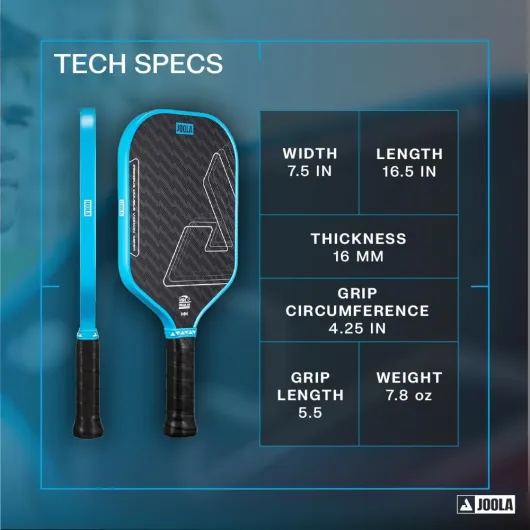
Specs-wise, it’s 16.5" long and 7.5" wide, around 7.8 oz. That puts it in the light-to-midweight range. In hand, it feels quick, especially at the net. The grip length is listed as 5.5", which is a bit longer than a standard paddle, so if you like two-handed backhands, that’s actually useful. I can comfortably get my second hand on there; with my older paddle I was always half on the butt cap.
Overall presentation is decent but nothing more. It looks like a proper piece of gear, not a toy, but there’s nothing mind-blowing in the unboxing. You get a solid-looking paddle, basic packaging, and a QR/NFC thing to register it. That’s about it. For the price, I would have liked at least a simple sleeve, but it’s not a deal-breaker.
Pros
- Very good control and touch for dinks, drops, and resets
- Light-to-mid weight with reduced vibration, comfortable for longer sessions
- Solid build quality and materials with USAP approval and 12‑month warranty
Cons
- Medium power at best – not ideal for players who rely on free pop
- Narrower head and sweet spot can be less forgiving for inconsistent hitters
- No case included and stock grip is just okay, likely needs an overgrip
Conclusion
Editor's rating
After a few weeks with the JOOLA Vision/Double Vision Perseus Bolt Blue, my take is pretty straightforward: it’s a solid, control-oriented paddle that suits intermediate players or improving beginners who play regularly. The touch at the kitchen, the predictable response on drops and resets, and the relatively low vibration all make it a comfortable, trustworthy choice if you care more about placement than raw power. The elongated shape gives extra reach, and the longer handle works well if you like a two-handed backhand.
On the flip side, it’s not a rocket launcher. If your style is built around blasting drives and serves with minimal effort, this paddle will feel a bit tame unless you’re willing to swing hard and use your legs. The head is also narrower than some might expect, so if you’re coming from a wide-body paddle, you’ll need a short adjustment period to find the sweet spot consistently. And while the price is fair for the build and brand, it’s not a budget option – casual players might be fine with something cheaper.
Overall, I’d recommend this to players who are on court a few times a week, care about developing control and consistency, and want a reliable, well-built paddle from a known brand without going into crazy pro-level stiffness. If you’re brand-new to pickleball or just mess around occasionally, save your money. If you’re grinding rec games, doing drills, and want a paddle that keeps up without beating up your arm, this one is worth a serious look.