Summary
Editor's rating
Value: fair price if you actually use both modes
Design: smart idea, slightly fussy in real life
Materials and build: good enough for backyard abuse
Durability after regular home use
Performance: good for dinks, mixed for deeper shots
What you actually get out of the box
Pros
- 2‑in‑1 design: works as both rebounder and mini practice net
- Solid frame and weather‑resistant net suitable for regular home use
- Very handy for dinks, volleys, and solo control drills in small spaces
Cons
- Rebound can feel weak unless bungees are tensioned very tightly and you hit fairly hard
- Setup and tensioning are a bit fussier than the marketing suggests
- Not ideal for heavy, long‑distance groundstroke training compared to a solid wall

Specifications
View full product page →| Brand | SwingIt |
A backyard pickleball trainer that’s almost like a wall… almost
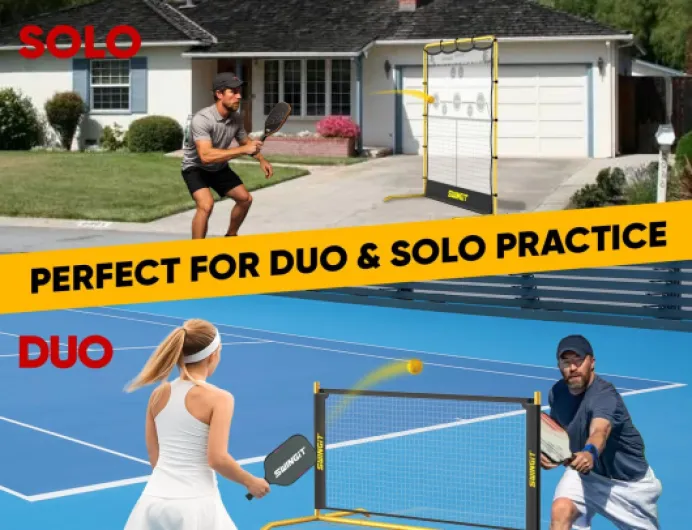
I picked up the SwingIt Pickleball Practice Rebounder Net because I got tired of waiting for court time and tired of begging friends to come drill. I wanted something I could throw in the driveway or garage, smack balls at for 20–30 minutes, and feel like I actually worked on my strokes. On paper, this thing ticks a lot of boxes: 6 ft by 6 ft, doubles as a mini net, folds into a bag, and you can use it solo or with a partner.
After a couple of weeks using it in my driveway and occasionally in the garage, my overall feeling is: it’s pretty solid for casual practice, but it’s not magic. If you expect it to behave exactly like a concrete wall or a professional club rebounder, you’re going to be a bit let down. You need to set it up right and tension the net properly, otherwise the rebound feels weak and a bit dead.
Where it shines is for dinking and control work. If you’re trying to build consistency at the kitchen line or just get more touches on the ball, it does the job. For full groundstrokes from further back, it’s more limited and a bit finicky. I also had to tweak the bungees more than I expected to get a rebound that felt useful. It’s not hard, but it’s not as plug‑and‑play as the marketing suggests.
So, if I had to sum it up: it’s a decent training tool for the price, especially if you’re space‑limited and don’t have a good wall nearby. Not perfect, a bit fiddly, but it lets you practice at home without turning your garage into a construction project. In the rest of this review I’ll break down what worked for me, what annoyed me, and who I think will actually be happy with this thing.
Value: fair price if you actually use both modes
Price‑wise, this sits in that middle zone: not cheap junk, but also not premium training gear. For what you pay, you’re getting two functions: a rebounder for solo work and a mini net for partner drills. If you plan to use both regularly, the value is pretty good because you don’t have to buy two separate pieces of equipment. I used the rebounder mode more, but the mini‑net mode was handy when a friend came over and we just wanted to dink in the driveway.
Compared to just using a plain wall and drawing a line, the wall obviously wins for rebound speed and realism, and it’s free if you already have it. But not everyone has a good, flat wall at the right height, especially in apartments or HOAs that don’t love people slamming balls against the building. In that situation, this net makes more sense. It’s also easier on the ball and a bit quieter than hammering a concrete wall, which neighbors might appreciate.
Compared to some dedicated rebounders that cost more, you’re sacrificing a bit of performance and probably some long‑term durability, but you’re saving money and gaining the mini‑net option. That’s really the tradeoff here: versatility vs. top performance. If you’re a serious competitive player who drills a ton, you might outgrow this and want something stiffer and more adjustable. If you’re a casual to intermediate player who just wants more reps at home, it feels like decent value.
I’d call the overall value good but not mind‑blowing. It’s worth it if you actually use it a few times a week and take advantage of both modes. If you’re the type who buys gear and lets it sit in the garage, then obviously it’s a waste no matter how good it is. For me, it earns its spot because it makes it easy to squeeze in 15–20 minutes of practice without driving to the courts.
Design: smart idea, slightly fussy in real life
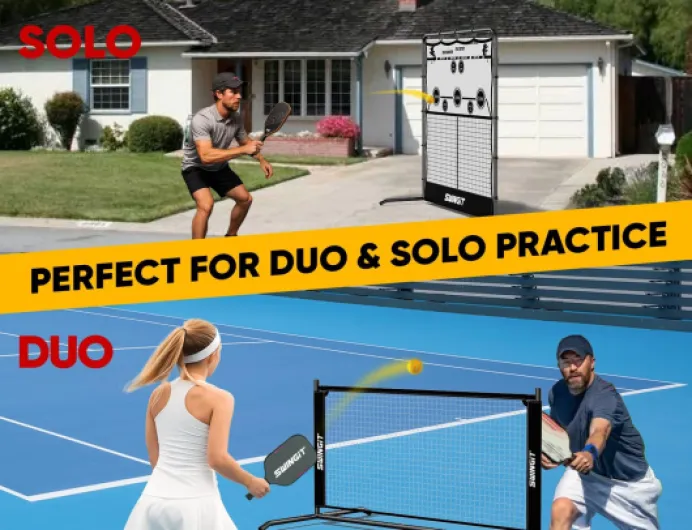
The main design idea is actually pretty clever: one 6x6 frame that you can use as a rebounder or as a mini net. In rebounder mode, the whole surface is meant to kick the ball back at you so you can work on timing and control. In mini‑net mode, you lower the hitting area to regulation net height and use it like a short court for dinks and volleys with a partner. On paper, that’s a nice way to squeeze more use out of one piece of gear instead of buying two separate things.
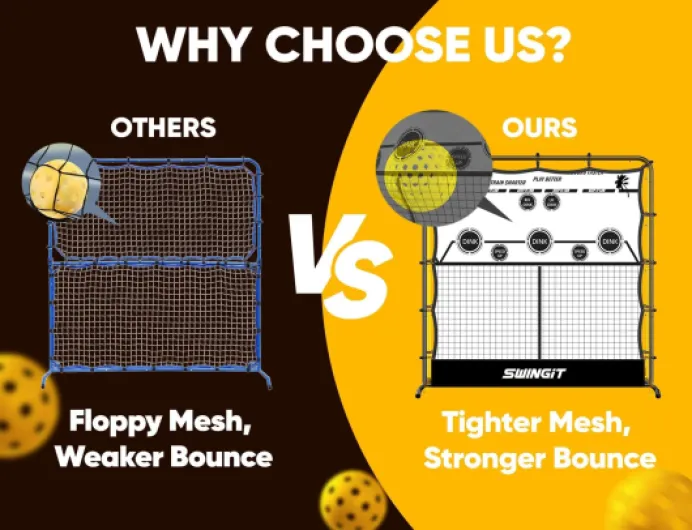
In practice, the design depends a lot on how tight you get the net. There’s no fancy tension wheel or anything; it’s all bungee cords that you wrap around the frame. If you don’t pull them hard enough, the net plays soft and the ball dies quickly, especially on softer shots. If you really crank them tight, the rebound gets much better, but setup takes longer and you have to be a bit more deliberate. One of the Amazon reviewers mentioned wrapping the bungees very tight for a good spring back, and that matched my experience exactly.
Stability‑wise, the frame is decent. When I hit harder drives at it, it shook but didn’t tip over in my driveway. I did notice that if the surface is slightly uneven or if there’s wind, you might want to put a sandbag or something on the base, just for peace of mind. The 6x6 footprint helps; it’s wide enough that it doesn’t feel like it’s going to fall over with every shot, unlike some skinny rebounders I’ve tried.
One design tradeoff: because it tries to be both a rebounder and a mini net, it’s not perfect at either. As a rebounder, the response isn’t as crisp as a solid wall or a dedicated tension‑adjustable rebounder. As a mini net, it’s fine, but you’re still looking at a fairly bulky frame compared to those super‑light roll‑up mini nets. If you’re okay with that compromise and you like the idea of one product doing two jobs, the design makes sense. If you want the absolute best feel in either category, you’ll probably end up buying more specialized gear.
Materials and build: good enough for backyard abuse
The frame is powder‑coated metal, and the net is a mix of 600D Oxford fabric, PVC, and polyester mesh. In normal language: metal tubes and a tough nylon‑style net. After hauling it in and out of the garage, dropping it a couple of times, and leaving it set up outside for a few days, nothing bent or tore. The powder coating didn’t chip, and the net didn’t show any fraying. For a mid‑priced training net, that’s about what I’d hope for.
The bungee cords are the weak point in terms of feel. They work, but they feel more like the generic ones you’d get with a budget trampoline than the heavy‑duty kind. I haven’t snapped any yet, but I wouldn’t be shocked if, after a year of sun and rain, a few start to lose elasticity. The plus side is they’re simple to replace with hardware‑store bungees if needed. So it’s not a deal‑breaker, but it’s not top‑shelf either.
The netting itself is tight‑weave enough that pickleballs don’t get stuck or push through, which sounds obvious but I’ve seen some cheap nets where the ball half‑pokes through and kills the rebound. Here, even when I hit hard topspin drives, the ball stayed on the right side and came back. It’s also weather‑resistant; I left it out during a light rain, let it dry, and the net didn’t sag or go weird. I still wouldn’t leave it outdoors all season, but for casual use it holds up.
As for the carrying bag, it’s basic but functional. The fabric is closer to a budget duffel than a heavy‑duty travel bag, but it held the frame and net without ripping. The zipper feels like the usual mid‑range Amazon gear: not junk, not premium. Overall, materials are decent for the price. You’re not getting pro‑club quality, but you’re also not getting dollar‑store junk. For a home setup that you use a few times a week, I’d expect it to last at least several seasons if you don’t abuse it or leave it baking in the sun all summer.
Durability after regular home use
I’ve been using it a few times a week, mostly in my driveway, sometimes dragging it into the garage when the weather looked sketchy. So far, nothing has failed: no bent poles, no ripped net, no broken connectors. For something that gets whacked by plastic balls at decent speed, that’s reassuring. The frame stays square, and the joints haven’t loosened up to the point of wobbling.
That said, you can tell it’s built for home use, not for a club with 50 people using it every day. The metal tubes are sturdy enough but not super thick, so I wouldn’t sit on it, hang on it, or let kids climb it. The weakest long‑term point in my opinion is still the bungees. Constant stretching, UV exposure, and weather will probably wear those down first. If you live somewhere very sunny or very wet, I’d store the net indoors when not in use to stretch its lifespan.
The net material itself has handled mishits fine. I’ve had a few shots go off the frame edges and even clip the metal, and nothing bent or chipped. The powder coating is holding up better than I expected at this price. No rust spots yet, even after a couple of light rains and some damp mornings. I did towel it off once just to be safe, but I didn’t baby it.
Overall, I’d rate durability as pretty solid for the money. If you’re using it a couple of times a week for personal practice, I can see it lasting several seasons with minor maintenance, maybe swapping out bungees down the line. If you want something you can leave outside 24/7 or that a whole club will pound on daily, you should look at more heavy‑duty (and more expensive) options. For a typical driveway or garage setup, it holds up fine.
Performance: good for dinks, mixed for deeper shots
This is where opinions split, and I get why the Amazon rating is around 3.8/5. As a rebounder, it’s decent if you use it right, but it’s not going to feel like a hard wall. The tensioned net simply doesn’t send the ball back as fast unless you hit with some pace. When I was standing closer, working on volleys and quick reactions, it performed pretty well. The ball came back quickly enough to keep me honest, and I could get into a nice rhythm.
When I stepped back to simulate baseline or deeper drives, the limitations showed up. If I hit firm, the rebound was fine and I could keep a rally going with myself. But if I tried to practice softer, more controlled shots, the ball often died short and I had to step forward to catch it. One of the reviewers said you need to hit the ball very hard to get a good rebound, and that’s not totally wrong. You can improve it by cranking the bungees tighter, but there’s only so much a fabric net can do compared to a solid surface.
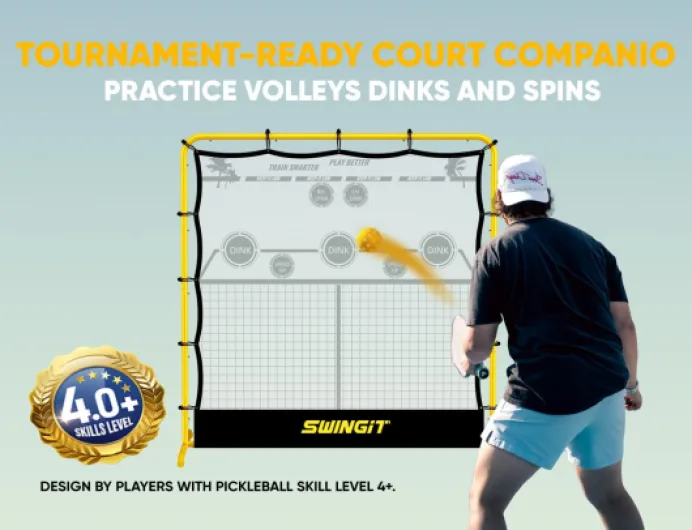
Where the net really makes sense is in dink and volley practice. In mini‑net mode or just standing closer in rebounder mode, it’s easy to work on keeping the ball low, aiming at specific spots, and building consistency. The 6x6 size gives you enough area to aim at without feeling like you’re just trying not to miss a tiny target. I liked using it for 10–15 minute sessions of pure dinks and blocks, especially on days I couldn’t get to the courts. My touch around the kitchen did improve a bit just from the extra reps.
If you’re expecting a hardcore training tool for power hitters or you’re very picky about how the ball comes off the surface, you might find it a bit meh. If your goal is more casual: stay active, get more ball contacts, work on control at home, then the performance is good enough. Just know that setup tension and how far you stand from it make a big difference. Dial those in, and it’s a useful tool; skip that step, and it feels like a dead net.
What you actually get out of the box
When you open the box, you basically get one metal frame and two net setups: the rebounder configuration and the mini practice net configuration. The frame is all metal tubes that snap together, plus a pile of bungee cords that hold the net tight. There’s also a black carrying bag that everything fits into. The whole thing is around 12 pounds, so you can carry it with one hand without feeling like you’re dragging gym equipment around.
The size is 6 ft high by 6 ft wide, which in real life feels big enough to be useful but not so big that it takes over the driveway. I could set it up next to my car and still have room to stand a few steps back. In rebounder mode, the net is pulled tight across the frame; in mini‑net mode, you drop it down to regulation height for dinks and mini games. Switching modes is basically loosening and re‑hooking the net and bungees, not some fancy mechanism. It’s straightforward but takes a few minutes.
The brand itself isn’t some big name like Franklin or Onix, and you feel that a bit in the presentation. The instructions are clear enough, but they’re pretty basic: a few diagrams, minimal text. It took me about 10–15 minutes to build it the first time while double‑checking I wasn’t missing anything. After that, teardown and setup were faster, but it’s not truly a 60‑second job unless you’ve done it a bunch of times and just leave some parts semi‑assembled.
Overall, the first impression is: functional and no‑nonsense. Nothing fancy, nothing that screams premium, but also nothing that looked flimsy straight out of the box. If you’ve ever put together a cheap soccer goal or hitting net, this is very much in that same category: simple metal frame, mesh net, bungees everywhere. It’s clearly designed for people who want something they can toss in a car or lean in the garage, not a permanent structure.
Pros
- 2‑in‑1 design: works as both rebounder and mini practice net
- Solid frame and weather‑resistant net suitable for regular home use
- Very handy for dinks, volleys, and solo control drills in small spaces
Cons
- Rebound can feel weak unless bungees are tensioned very tightly and you hit fairly hard
- Setup and tensioning are a bit fussier than the marketing suggests
- Not ideal for heavy, long‑distance groundstroke training compared to a solid wall
Conclusion
Editor's rating
The SwingIt Pickleball Practice Rebounder Net is a practical home training tool with some clear strengths and a couple of annoyances. It’s at its best for dinks, volleys, and general control work from closer range. The 6x6 size is friendly, the frame feels solid enough, and the fact that it converts into a mini net gives it more ways to earn its keep. For driveway, backyard, or garage sessions when you don’t have a partner, it gets the job done.
The flip side: if you’re expecting a super lively rebound from all distances, you might be let down. You need to tension the bungees aggressively to get a decent bounce, and even then it doesn’t fully match the feel of a hard wall. Some people will see that as a deal‑breaker, especially if they’re focused on drives and deeper groundstrokes. It’s also not something I’d leave outside all year; the materials are good for home use, but not bombproof.
Who is it for? Casual to intermediate players who want more touches on the ball at home, especially for kitchen work and basic stroke repetition. People without access to a good wall or who want a portable setup they can move between driveway, garage, and park will probably be happy. Who should skip it? Very picky players focused on power training, or anyone expecting a perfect wall replacement. In short: decent value, useful if your expectations are realistic, and better for touch work than for heavy hitting.