Summary
Editor's rating
Value: strong performance per dollar, with a durability asterisk
Design: modern shape, good handle, a questionable joint
Comfort: very arm-friendly, but you need to swing
Materials: real raw T700 carbon, budget core philosophy
Durability: solid face, but the handle–head joint worries me
Performance: soft-game specialist with enough but not huge power
What you actually get with the Ronbus R1.16
Pros
- Very soft, controlled feel that makes drops, dinks, and resets easier
- Raw T700 carbon face offers good spin and a modern playing feel
- Comfortable, longer handle with clear bevels, good for two-handed backhands
Cons
- Handle–head joint design raises durability concerns for heavy use
- Power is only moderate; you have to swing harder to get depth and put-aways

Specifications
View full product page →| Brand | Ronbus |
Soft control paddle that plays way above its price… at first
I’ve been playing pickleball 3–4 times a week for a while, mostly at an intermediate level, and I picked up the Ronbus R1.16 because I wanted to try a raw carbon paddle without paying Joola or Selkirk prices. On paper it looked perfect: raw Toray T700 carbon, 16 mm core, USAPA approved, and a price that’s way lower than the big brands. I used it for a few weeks in rec play and some local round robins to see if it could replace my usual control paddle.
The first thing that stood out is how soft and controlled it feels. If you’re coming from a cheap fiberglass or beginner paddle, this will feel like someone put a pillow behind the ball in a good way. Drops, dinks, and resets are very easy to keep low. I didn’t need a big adjustment period, which is rare when switching paddles.
But once the honeymoon phase passed, a few things started to bother me. The paddle has decent power if you swing hard, but you definitely have to work for it. If you rely on the paddle to do the heavy lifting on drives and put-aways, this might feel a bit underpowered, especially compared to something like a CRBN 1X or a more poppy thermoformed paddle. It’s clearly tuned for control first, power second.
Overall, my first impression was: great playability for the price, but I’m not fully sold on the build choices. The user review about the head snapping off after a few months lines up with what I saw when I looked closely at how the handle meets the head. If you’re hard on your gear or play a lot, that’s something to keep in mind.
Value: strong performance per dollar, with a durability asterisk
From a value standpoint, the Ronbus R1.16 sits in that sweet spot where you’re getting real raw carbon performance without paying top-shelf prices. Compared to big-name paddles with similar materials and specs, this one is usually significantly cheaper. On court, it genuinely plays close to some higher-priced control paddles: soft feel, big sweet spot, good spin, and a comfortable handle. If you’re upgrading from a beginner composite paddle, the jump in control and feel is pretty noticeable.
Where the value becomes a bit of a "it depends" situation is the potential durability concern. If you get a unit that holds up, you’re getting a very good deal: tournament-approved, modern tech, and solid performance for the money. If you end up being one of the unlucky ones with a handle or throat issue after a few months, that good deal starts to look less attractive, because now you’re buying again sooner than planned. That’s the trade-off with a lot of mid-priced gear: you get most of the performance, but not always the longest lifespan.
For players who are still figuring out their style or just want to try raw carbon without spending big, the value is pretty solid. You can learn the soft game, work on spin, and see if you like this type of paddle before committing to something pricier. For heavy tournament grinders or people who already know they’re picky about build quality, I’d maybe spend more and get something with a more reinforced handle–head design.
So overall, I’d call the value good but not flawless: you get a lot of performance per dollar, with the caveat that longevity might not match the big brands. If you accept that risk, it’s a pretty smart buy. If you want something that feels bombproof, you might want to look higher up the price ladder.
Design: modern shape, good handle, a questionable joint
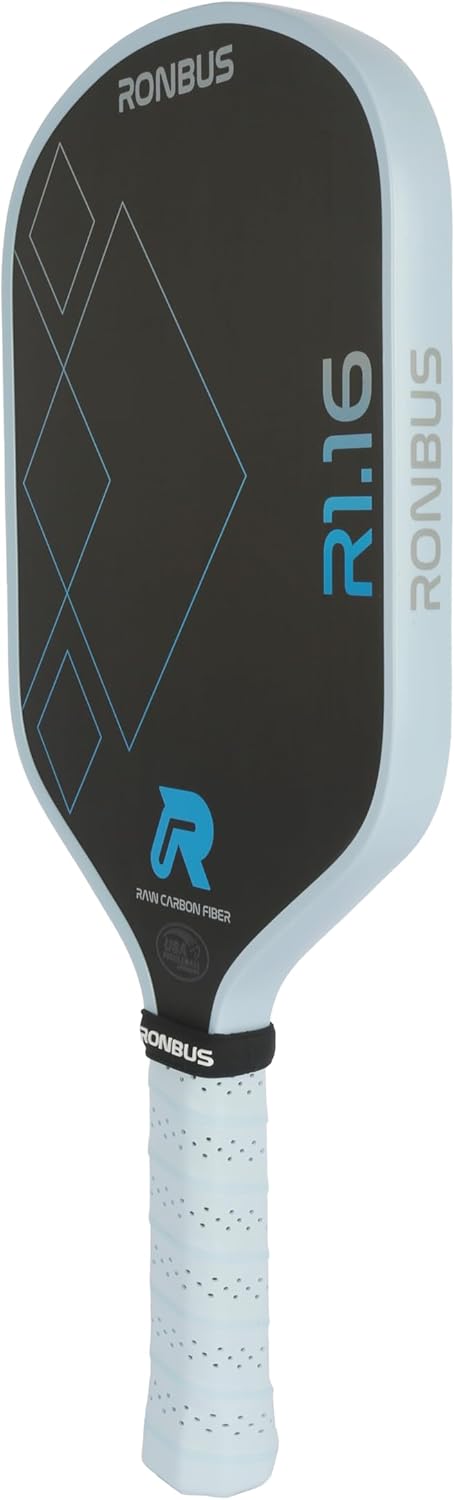
Design-wise, the Ronbus R1.16 goes for the now-classic elongated control paddle shape: 16.5" long, 7.5" wide, 5.5" handle. That gives you a decent mix of reach and forgiveness. The sweet spot feels centered and pretty big. I rarely hit that dead "heel" feeling you sometimes get on weirdly shaped paddles. The face is raw carbon with a consistent texture that you can feel easily when you run your fingers over it.
The handle is probably the part I liked the most in terms of design. It’s relatively thick, with well-defined bevels, and there’s no exposed polymer core at the throat. That gives it a more solid and finished feel than some budget paddles where you can literally see the honeycomb right under the grip. I had no issues with twisting on mishits; the handle shape gives you decent leverage and grip security, especially with a semi-western or continental grip.
Where the design gets a bit dicey is the connection between the head and the handle. After reading that Amazon review about the head snapping off and mentioning there’s no internal support, I took a closer look. You can’t see inside without tearing it apart, but tapping and flexing around the throat area, it does feel like the handle is basically glued onto the core without any visible foam or solid internal bridge. It didn’t break on me, but knowing that and feeling a slight flex there under hard mishits doesn’t inspire total confidence.
So from a design standpoint: the shape, dimensions, and grip are well thought out and feel very playable. But the way the paddle is built at the joint makes me think it’s designed more to hit a price point than to last multiple seasons for heavy players. If you baby your paddles, you’re probably fine. If you bang them on the court or your partner’s paddle a lot, I’d be a bit cautious.
Comfort: very arm-friendly, but you need to swing
In terms of comfort, this paddle is actually one of the nicer ones I’ve used in this price range. The soft 16 mm core does a good job of soaking up vibration. After a couple of long sessions with a lot of mishits (I was working on some new serves and drives), I didn’t have any arm or elbow soreness. If you’re dealing with a bit of tennis elbow or general arm fatigue from stiffer paddles, this one feels much gentler. The impact feel is muted without being mushy.
The weight at around 8.1 oz is a good middle ground. It feels slightly head-light, so it’s quick at the net and easy to maneuver for hand battles. I never felt like I was fighting the paddle on fast exchanges. Because it’s softer and not super powerful, I did find myself swinging a bit harder on drives and serves to get the depth I wanted. That can be tiring if you’re used to a more powerful face doing more of the work for you.
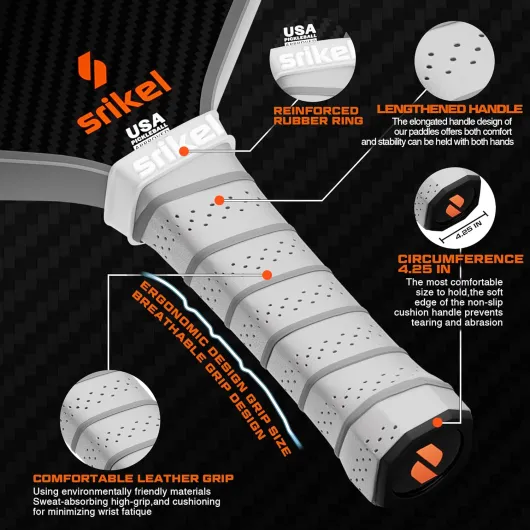
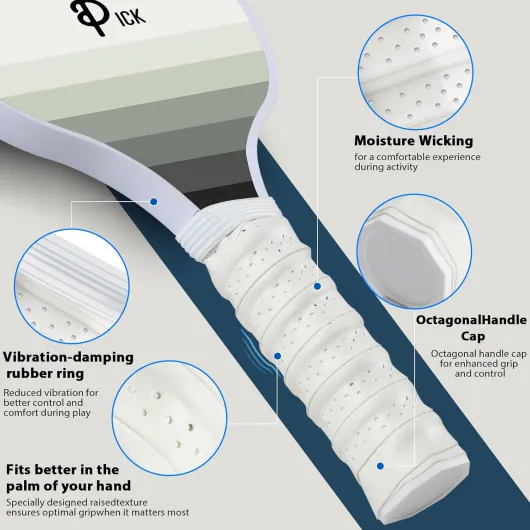
The longer 5.5" handle is comfortable for two-handed backhands. I use a two-hander sometimes on high backhands, and with this grip length I wasn’t cramped. The stock grip is thick enough that I didn’t feel any pressure points or sharp edges underneath, and the bevels help you keep the right grip without having to look down. If you have very small hands, the grip might feel a bit chunky, but for average adult hands it’s fine.
So on the comfort side, I’d say very good for control players and people with sensitive joints, with the small caveat that you’ll probably work a bit harder on power shots. If your style is soft game first and you like a smooth, quiet impact, this checks those boxes nicely.
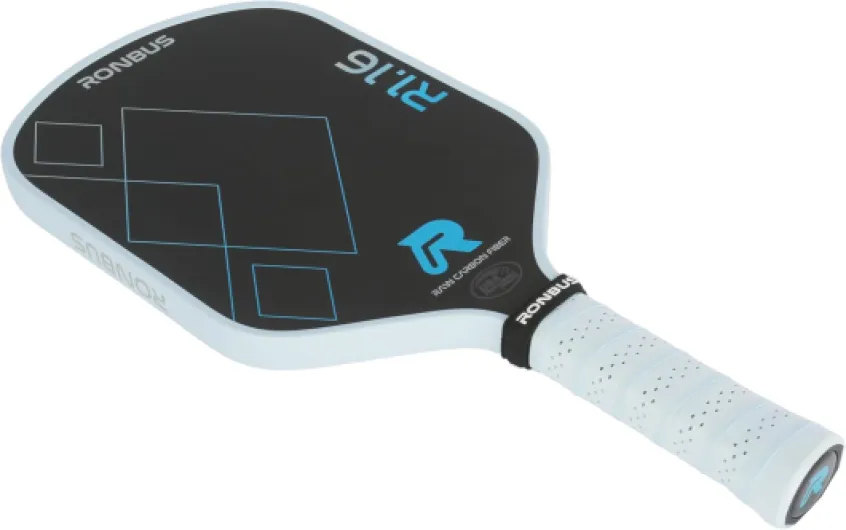
Materials: real raw T700 carbon, budget core philosophy
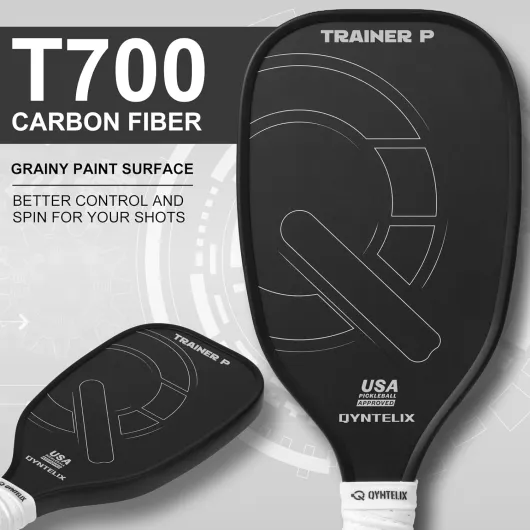
The big selling point of this paddle is the raw Toray T700 carbon fiber face. That’s the same base material a lot of higher-end paddles brag about. When you touch it, you can feel the gritty texture and the woven carbon pattern. It’s not a painted-on texture; it’s the typical raw carbon feel you get on more expensive paddles. In practice, the surface grips the ball well, and I had no trouble generating spin on topspin drives, rolls, and cut dinks.
The core is a 16 mm polypropylene honeycomb, which is standard in this category. The way it’s tuned makes the paddle play very soft. You get that muted "thud" instead of a loud "pop". If you’re coming from a cheaper, thinner paddle, it might feel dead at first, but once you get used to it, it’s actually very nice for control. The trade-off is that you don’t get the same effortless power as some thermoformed or power-focused paddles. Material-wise, it’s clearly built more for touch and forgiveness than raw punch.
The grip material is decent: tacky enough, not too squishy, and it held up fine through sweaty sessions. After a few weeks, mine showed normal wear but nothing crazy. I’d still recommend throwing an overgrip on if you’re playing a lot, just to preserve it and tweak the thickness. The internal handle construction, though, seems basic. Based on the user review where the person ripped the handle off and saw just honeycomb and no internal support, I’m not surprised. It feels like typical midrange construction, not reinforced like some premium paddles that add foam or solid inserts at the joint.
Overall, the materials are a bit of a mix: high-end face, standard core, and a cost-cut handle structure. For the price, getting real raw T700 on the face is pretty solid value. Just don’t expect the same robust internal build quality you’d get from paddles that cost almost double.
Durability: solid face, but the handle–head joint worries me
Durability is the part where I’m a bit cautious with this paddle. During my few weeks of use, the face and edge guard held up fine. The raw carbon texture didn’t noticeably wear down, even after a bunch of spin serves and roll volleys. No chips or cracks on the surface, just normal scuffing from balls and a couple of light scrapes on the court. The edge guard stayed in place and didn’t start peeling, which is good.
However, after reading that Amazon review where the player said the head snapped off the shaft after about 3 months, I paid more attention to the throat area. When you flex the paddle a bit or hit hard off-center shots, you can feel a tiny bit of flex at the handle–head joint. Not enough to say it’s about to break, but enough to make you think that there isn’t a ton of internal reinforcement there. And that matches what the reviewer said about finding only honeycomb and no support when they tore it apart.
If you’re a lighter hitter who mostly plays soft game and doesn’t slam the paddle into the ground or other paddles, you’ll probably be okay. For my use (mostly rec play, no crazy abuse), it held up with no visible damage. But if you’re an aggressive player, like to dig low balls, or tend to clash paddles in doubles, I’m not fully confident this will last as long as some of the beefier, more expensive options that reinforce the throat with foam or solid inserts.
So I’d rate the durability as acceptable but not bulletproof. The face and edge look good, the grip doesn’t fall apart right away, but the structural design around the handle is the weak link. If you buy it, I’d keep an eye on that area over time and maybe avoid treating it like a hammer.
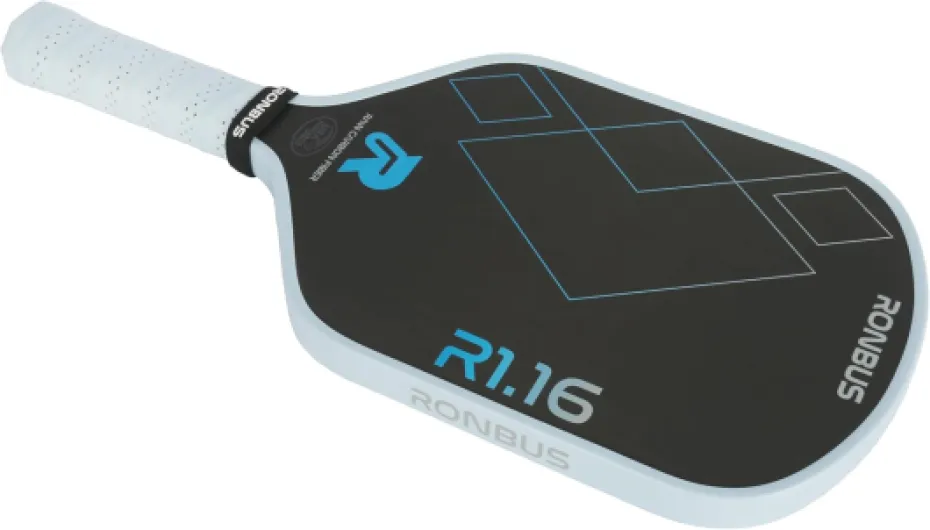
Performance: soft-game specialist with enough but not huge power
On court, this paddle clearly leans toward control and touch. The soft 16 mm core and raw carbon face make drops and dinks very easy to keep low. After two or three sessions, my third-shot drops from both the baseline and midcourt felt very consistent. The ball doesn’t rocket off the face, so you can swing through without constantly sailing shots long. Resetting hard drives at the kitchen was also pretty comfortable; the paddle absorbs pace well and sends the ball back with a predictable arc.
Spin is solid. It’s not the grippiest paddle I’ve ever used, but for this price, the raw carbon surface does a nice job. My topspin drives had noticeable dip, and I could carve some decent slice on returns and dinks. Compared to a painted fiberglass face, this is a clear step up in spin potential. Compared to the top-tier raw carbon paddles, it’s in the same ballpark, maybe slightly less aggressive but still very capable for most rec players.
Power is where opinions will split. If you’re a control player with your own swing speed, you’ll probably say the power is "good enough". If you’re used to thermoformed paddles or stiff 14 mm cores, you’ll probably call it a bit lacking. I had to really commit to my swings on serves and drives to get the depth I wanted. Put-aways at the net were fine as long as I was in good position; the paddle has "enough" pop to finish when the ball is high. But it doesn’t bail you out when you’re late or off-balance.
In quick exchanges at the kitchen, the slightly head-light balance and big sweet spot help a lot. I felt confident blocking and countering. Mishits still went over more often than with some smaller or more demanding paddles. Overall, performance-wise I’d label it as a soft-game focused paddle that still has decent punch if you swing. Great for intermediates who want control and spin, less ideal for bangers who want free power.
What you actually get with the Ronbus R1.16
On paper, the Ronbus R1.16 is positioned as a control-focused raw carbon paddle for all skill levels. It’s USAPA approved, so you can use it in tournaments, and the specs are pretty standard for the current "control raw carbon" trend: 16.5" length, 7.5" width, 16 mm polypropylene honeycomb core, and a raw Toray T700 carbon fiber face. Mine came in at about 8.1 oz, which is right in that comfortable middle range for most players.
Out of the box, the paddle is very straightforward. You get the paddle and… that’s it. No cover, no extras, no fancy packaging. Honestly, I don’t care about extras at this price point, but if you’re used to brands throwing in a sleeve or some stickers, you won’t find that here. It feels like Ronbus put the money into the paddle itself, not the presentation, which is fine by me.
The handle is 5.5" long with a 4 1/4" grip size. That longer handle is nice if you like a two-handed backhand or if you switch hands. The grip is on the thicker side and feels pretty solid right away. I usually slap an overgrip on everything, but with this one I actually played a couple of sessions stock and didn’t hate it. The bevels are clear enough so you can feel your grip orientation without looking.
If I had to sum up the presentation in one line: it looks and feels like a modern raw carbon paddle without the big-brand polish. Nothing fancy, but functional. The Amazon listing oversells it a bit with the buzzwords, but in real life it’s just a straightforward control paddle that targets people who want raw carbon performance at a lower price.
Pros
- Very soft, controlled feel that makes drops, dinks, and resets easier
- Raw T700 carbon face offers good spin and a modern playing feel
- Comfortable, longer handle with clear bevels, good for two-handed backhands
Cons
- Handle–head joint design raises durability concerns for heavy use
- Power is only moderate; you have to swing harder to get depth and put-aways
Conclusion
Editor's rating
The Ronbus R1.16 is a very playable control-focused raw carbon pickleball paddle that punches above its price in terms of feel and on-court performance. The soft 16 mm core, raw T700 carbon face, and comfortable 5.5" handle make it easy to dial in drops, dinks, and resets. Spin is solid, the sweet spot is generous, and the slightly head-light balance keeps it quick in hand battles. If you’re an intermediate or improving player who wants to develop a softer game and see what raw carbon is all about, it does the job nicely without wrecking your budget.
The downside is mostly around build confidence. While my unit held up fine over a few weeks, the way the handle and head are joined, plus the user report of the head snapping off after a few months, makes me a bit wary about long-term durability, especially for harder hitters or people who play a lot. Power is also on the moderate side; it’s there if you swing, but it’s not a rocket. So I’d recommend this paddle to control-oriented players, newer tournament players, and anyone wanting a budget-friendly raw carbon option. If you’re a heavy banger, play 5+ times a week, or want something that feels tank-like, I’d probably look at a more robust (and pricier) model.