Summary
Editor's rating
Is it actually worth the money?
Shape, balance, and how it actually feels in the hand
Grip, feel, and how it treats your arm over a full session
Carbon fiber face and thick core: good on paper, mixed in reality
The big question mark: how long will it actually last?
On-court performance: control and spin first, power second
What you actually get when you buy it
Pros
- Very good control and consistency on dinks, drops, and resets
- Textured carbon face provides strong spin potential for serves and rolls
- Stable, solid feel with elongated shape for extra reach at the net
Cons
- Less natural power than some thinner or more poppy paddles
- Durability concerns reported (dents, wear) for the price bracket
- Slightly head-heavy, which can cause more arm fatigue over long sessions

Specifications
View full product page →| Brand | JOOLA |
A pricey paddle a lot of people are curious about
I’ve been seeing this JOOLA Ben Johns Hyperion CFS 16 everywhere at my local courts. A couple of the better players use it, and I finally decided to grab one and play with it for a few weeks instead of just borrowing a few points here and there. I’m around a 3.5–4.0 level on a good day, so not a pro, but I play 3–4 times a week and I can tell when a paddle helps or when it’s just hype. This one definitely sits in that “serious hobby player” category, both in feel and in price.
The first thing I noticed is that it’s clearly tuned more for control and spin than raw power. Coming from a more basic composite paddle, my soft game got tighter pretty fast: dinks, resets, and third-shot drops felt more predictable after a short adjustment. But I had to work a bit more to finish points, especially from the baseline, because the paddle doesn’t naturally give a big trampoline effect. If you rely on the paddle to do the work for you on drives, you’ll feel that right away.
I also kept hearing about the “Carbon Friction Surface” like it was some kind of magic. In practice, yes, you can grab the ball better on topspin rolls and slices. My spin serves jumped higher and my crosscourt dinks curved a bit more. But it’s not like suddenly you’re Ben Johns. If your technique is decent, the paddle helps; if your technique is sloppy, it won’t save you. It’s an upgrade, not a miracle.
Overall, my first impression was: good paddle, clearly designed for people who already know what they’re doing, but with a couple of things that bug me for the price, especially when you start reading about dents and durability in other reviews. After a few weeks of use, I’d say it’s a strong option for intermediate/advanced players who want control and spin, but I wouldn’t blindly recommend it to every beginner or budget-conscious player.
Is it actually worth the money?
When you look at value for money, the Hyperion CFS 16 sits in a tricky spot. Performance-wise, it does a good job: strong control, good spin, stable feel. If you’re a 3.5–4.5 player who plays a lot and cares about your soft game, you’ll feel the difference compared to a budget paddle. But the price is high enough that you really need to ask if those gains are worth it for you personally, especially with the durability question hanging over it.
Compared to mid-range paddles, you’re paying extra for a few things: the Ben Johns name, the textured carbon face, and the thick, stable core. If you’re already investing a lot of time into pickleball and you want a control-focused paddle with legit spin, the price can be justified. You’re basically paying for a tool that lets you fine-tune your game, not a casual toy. For me, I did feel an upgrade in consistency on drops and dinks, so I can’t say it’s just hype.
On the downside, there are paddles in a slightly lower price bracket that offer similar performance, maybe with a bit less brand prestige but comparable control and spin. When you add in the reports of dents and shorter lifespan, the value calculation gets tougher. If you end up replacing it sooner than expected, that nice performance starts to feel expensive pretty quickly.
Overall, I’d call the value good but not great, and very dependent on who you are. For a serious rec player or early tournament player who really wants that control/spin combo and doesn’t mind paying for it, it’s a justifiable purchase. For casual players, beginners, or people on a tighter budget, I’d say it’s overkill and there are cheaper paddles that will get the job done without making you nervous about every little ding.
Shape, balance, and how it actually feels in the hand
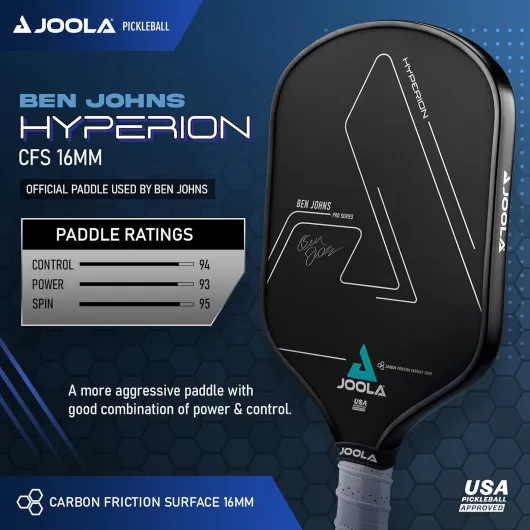
The Hyperion CFS 16 has that elongated shape a lot of modern paddles use. The dimensions are roughly 43.8 x 25.6 cm, so it’s clearly not a wide-body. On court, this means two things: more reach at the net, and a slightly smaller sweet spot compared to a classic, wider paddle. If you’re used to a traditional shape, you’ll probably mishit a few balls high on the face until you adjust. Once you get used to it, the extra reach for volleys and overheads is nice, especially in fast hands battles.
The balance is a bit head-heavy, at least on my unit. You feel the weight more towards the top of the paddle, which helps with stability on blocks and drives, but can feel a bit sluggish on quick flicks and last-second reactions at the kitchen. It’s not a brick, but it’s not whippy like some lighter, more evenly balanced paddles. After a couple of long sessions, my wrist and forearm felt more worked than with a lighter paddle, so if you’re prone to elbow or wrist issues, that’s something to consider.
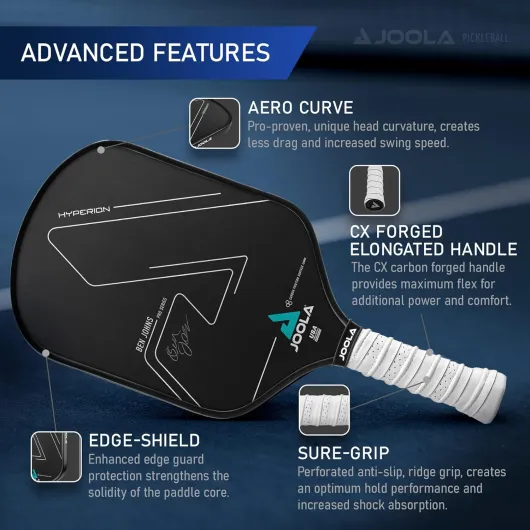
In terms of design features, JOOLA talks about the “Aero-Curve” which is basically the slightly curved top edge that’s supposed to reduce drag. In real play, I can’t say I felt a huge difference in swing speed compared to other similar paddles. If there’s less air resistance, it’s subtle. What I noticed more is the overall swing weight: solid on contact, but not super fast when you’re trying to whip the paddle around quickly.
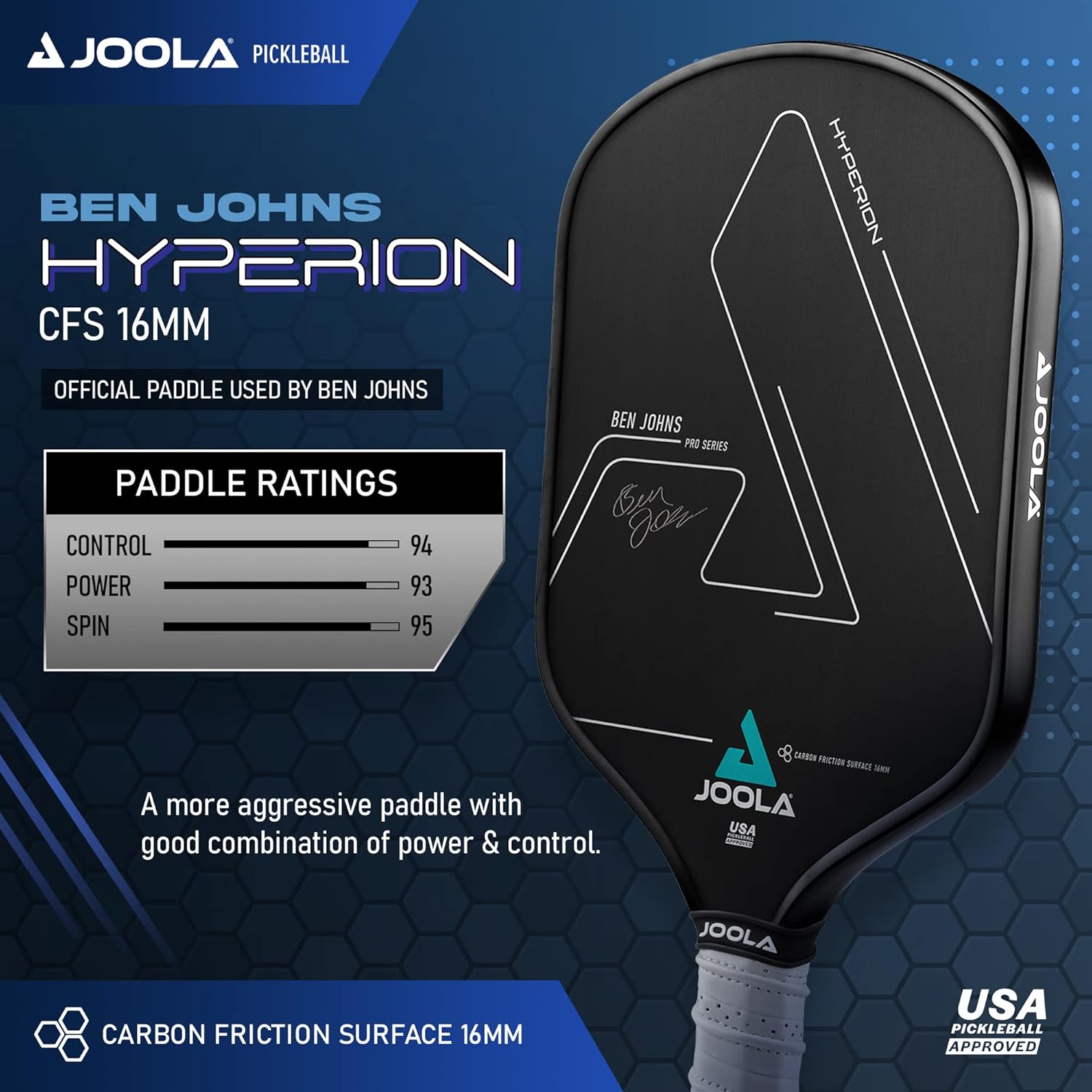
Visually, it’s pretty clean: dark face, clear branding, and the usual pro-signature vibe. It looks like a paddle meant for advanced players, not a beginner toy from a big-box store. But design-wise, the main takeaway for me is this: elongated control paddle with a head-heavy feel. If that’s what you’re after, the design matches the marketing. If you want a super quick, feather-light paddle, this isn’t it.
Grip, feel, and how it treats your arm over a full session
Comfort-wise, the Hyperion CFS 16 is pretty solid but not perfect. The 4.25-inch grip size feels standard and should work for most adult hands. The stock grip is on the softer, tacky side, and I didn’t feel like I had to change it immediately. After a couple of sweaty sessions, it stayed grippy enough, though I’d probably add an overgrip if I planned to use it as my main paddle long term, just to keep it fresh and slightly thicker.
The 16 mm core helps with comfort on off-center hits. When you miss the sweet spot a bit, you don’t get that sharp vibration you sometimes feel with cheaper paddles. Blocks at the net and hard drives into the body feel cushioned rather than jarring, which is nice if you play a lot of rec games back to back. I’ve had paddles where mishits felt like a shock up the arm; this one is much kinder in that sense.
Where comfort takes a small hit is the swing weight and head-heaviness. Over a full 2–3 hour session, I noticed my wrist and forearm feeling more tired than with a slightly lighter or more evenly balanced paddle. It’s not extreme, but if you already deal with tennis elbow or wrist issues, this is something to think about. You get stability and plow-through, but you pay for it a bit in fatigue.
In short, the Hyperion is comfortable in terms of impact feel and vibration, but just okay in terms of long-session fatigue. If you’re reasonably fit and don’t have arm problems, you’ll probably be fine and might even like the solid, stable feel. If you’re sensitive or recovering from an injury, you might want to test it first or consider something a touch lighter or more evenly balanced.
Carbon fiber face and thick core: good on paper, mixed in reality
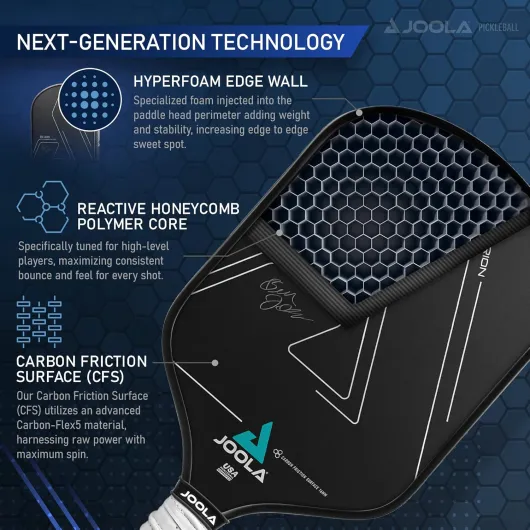
The Hyperion CFS 16 is built around a 16 mm reactive polymer core and a carbon fiber face with that rough “Carbon Friction Surface.” On paper, that combo is aimed at stability, control, and extra spin. In practice, the thick core definitely makes the paddle feel more plush on contact. Hard drives and fast volleys don’t feel harsh in the hand; there’s a bit of a cushioned feel when the ball hits the sweet spot. It’s not dead, but it’s not super lively either. The materials clearly lean more towards control than power.
The carbon fiber face has a textured finish you can feel if you run your fingers over it. It’s not sandpaper-level rough, but enough to grab the ball a bit on spin shots. After several sessions, the surface on mine still feels pretty grippy, so it doesn’t seem to wear off instantly. That said, I’ve seen some players online mention their surface smoothing out faster than they liked, especially if they play a lot outdoors. I haven’t put months on mine yet, but I can see how heavy use might dull it over time.
One concern that keeps coming up in reviews is durability: dents, soft spots, or core issues after a short period. I haven’t managed to dent mine yet, but I did notice the edge guard isn’t the thickest. If you’re someone who constantly clips the ground or fence, I wouldn’t be shocked if you start seeing cosmetic damage or worse after a while. For a paddle in this price range, that’s the part that bugs me the most: the materials feel good performance-wise, but they don’t give off that “tank” feeling you might expect when spending this much.
Overall, I’d say the materials are performance-focused but not bulletproof. The carbon fiber face and thick core do their job for control and spin, but if you’re rough on your gear or you expect a paddle to last a very long time with heavy weekly use, I’d keep your expectations realistic or plan on babying it a bit more than a cheaper beater paddle.
The big question mark: how long will it actually last?
Durability is where I have the most doubts about this paddle, especially given the price. Personally, after a few weeks of regular play (2–3 times a week, mostly outdoor courts), mine is still in decent shape: no cracks, no obvious soft spots, and the surface still feels grippy. The edge guard has a couple of small scuffs from scraping the ground on low shots, but nothing major yet. So in my own use, it’s holding up fine so far.
But when you start reading other users’ feedback, a pattern shows up: dents and wear earlier than expected. One reviewer mentioned getting a bad dent in under two months, which is not what you want to hear for this price. I haven’t had that issue yet, but it’s enough to make me cautious. The paddle doesn’t feel fragile in the hand, but it also doesn’t give that “tank” vibe you might expect from a high-end carbon paddle. The edge guard in particular feels like a weak point if you’re rough on your gear.
Another thing to watch is the textured surface. Any grit-style or rough coating tends to wear down over time. So far, mine hasn’t smoothed out too much, but I’m not pounding it every single day either. If you’re a heavy player who logs a ton of hours weekly, I wouldn’t be shocked if the surface gets noticeably smoother in a few months, which will affect spin. That’s normal to a degree, but with the cost of this paddle, it stings more when it happens.
In short, I’d rate durability as questionable for the price. It’s not falling apart out of the box, but there are enough reports of dents and early wear that I wouldn’t call it super reliable long term. If you treat your paddles carefully and don’t mind potentially replacing it after a season or so, you’ll probably be okay. If you want a workhorse that you can beat up for years, I’d be hesitant.
On-court performance: control and spin first, power second
On court, the main thing with the Hyperion CFS 16 is control. The thick 16 mm core and textured carbon face give you a very predictable response on dinks, drops, and resets. After a few games, my soft game felt more dialed in than with my older, bouncier paddle. Third-shot drops landed shorter and with more margin, and I could take pace off hard balls at the net without sending them too high. If you like to slow the game down and win with placement, this paddle supports that style really well.
Spin is also a strong point. The Carbon Friction Surface actually does something. My topspin rolls and cross-court dinks had more bite, and my spin serve kicked up more than with a smooth-faced paddle. It won’t magically turn you into a spin monster if your technique is off, but if you already brush the ball well, you’ll notice the extra grip. I’d put it in the “good to very good” spin category compared to other paddles I’ve tried.
Where it’s less impressive is raw power. You can absolutely hit winners with it, but you have to swing with intent. From the baseline, my drives and passing shots didn’t jump off the paddle the way they do with thinner or more power-focused paddles. At the net, punch volleys are solid and stable, but again, not super explosive. This isn’t necessarily a bad thing if you value control, but if you like to finish points quickly with big drives and overheads, you might feel like you’re working a bit harder.
Overall, performance is strong for intermediate and advanced players who prioritize control, consistency, and spin. If your game is more about touch, resets, and smart placement, the Hyperion fits nicely. If your style is all-out aggression and big power, you might find it a bit too tame and want something thinner or more poppy. It’s very capable, but clearly tuned to a certain style of play.
What you actually get when you buy it
Out of the box, the Hyperion CFS 16 keeps it pretty simple. You get one paddle, no case, no extras, no overgrip, nothing. For the price, I honestly expected at least a basic sleeve or something. The packaging is clean but minimal: cardboard, some branding, and a quick description of the Ben Johns signature thing, the USAPA approval, and the fancy names like “Carbon Friction Surface” and “Reactive Polymer Core.” It looks fine, but it doesn’t feel premium in terms of unboxing. If you like accessories and add-ons, you’ll be a bit underwhelmed.
The paddle itself comes in at about 8.4 oz, which matches what’s listed. Mine felt slightly head-heavy, which lines up with how it swings on court. The grip size is around 4.25 inches, and out of the box it’s pretty comfortable, though if you have bigger hands you’ll probably want to throw an overgrip on it. There’s a protective edge guard, but it’s not super thick, so if you’re the type who constantly scrapes the ground on low balls, I’d keep an eye on that.
One thing that stands out in the presentation is the branding. Ben Johns’ name is all over it, and the JOOLA logo is pretty visible. It’s clear they’re selling the association with a top player. That’s fine if you care about that kind of thing, but from a practical standpoint, what matters more is: does it feel balanced, and does it look like it will survive regular play? My first impression: it looks like a serious paddle aimed at advanced players, but not bulletproof.
Compared to cheaper paddles I’ve bought, the Hyperion looks more technical and “pro,” but the lack of included case or any small extras makes the overall package feel a bit barebones. You’re really paying for the tech in the face and core, not the accessories or the unboxing experience. If that’s all you care about, no problem. If you like a full kit, this feels a bit stripped-down for the price tag.
Pros
- Very good control and consistency on dinks, drops, and resets
- Textured carbon face provides strong spin potential for serves and rolls
- Stable, solid feel with elongated shape for extra reach at the net
Cons
- Less natural power than some thinner or more poppy paddles
- Durability concerns reported (dents, wear) for the price bracket
- Slightly head-heavy, which can cause more arm fatigue over long sessions
Conclusion
Editor's rating
The JOOLA Ben Johns Hyperion CFS 16 is a control-first paddle with legit spin that makes sense for intermediate and advanced players who care about their soft game. The 16 mm core and carbon friction surface give you predictable drops, solid resets, and enough grip on the ball to shape your shots. If you’re the type who likes to win with placement, dinks, and smart angles instead of pure power, this paddle fits that style pretty well. It feels stable on blocks and volleys, and the elongated shape gives you extra reach at the net.
Where it’s less convincing is in raw power and long-term value. You can hit hard with it, but it doesn’t give you free pop, so aggressive baseline hitters might feel a bit underwhelmed. On top of that, the durability stories—dents, wear on the surface—are hard to ignore at this price. Mine has held up so far, but I’d still say it doesn’t feel like a tank built to last years of heavy play. You’re paying for performance and a pro name, not for bulletproof construction.
If you’re a 3.5–4.5 player who plays often, likes a head-heavier, control-oriented paddle, and is okay spending more for a refined feel and spin, the Hyperion CFS 16 is a solid pick. If you’re a beginner, a power-hitter looking for a cannon, or someone who wants maximum durability per dollar, I’d look at other options first or wait for a good discount before pulling the trigger.