Summary
Editor's rating
Is it worth the money?
Shape, feel, and on-court handling
Grip, handling, and fatigue over long sessions
Carbon fiber build and 16mm core in real life
Packaging and extras: where it really disappoints
Build quality and how it seems to hold up
On-court performance: dinks, drives, and defense
What you actually get when you order it
Pros
- Very good control and stability, especially for dinks, blocks, and resets
- 16 mm core with a generous sweet spot that helps with consistency
- Solid carbon fiber build that feels durable and well constructed
Cons
- High price compared to paddles that offer similar performance
- Packaging is very basic with no useful accessories included
- Heavier feel may cause fatigue for some players and won’t suit everyone

Specifications
View full product page →| Brand | JOOLA |
High-end paddle, high expectations
I’ve been playing pickleball regularly for a few years, and I’ve gone through a small pile of paddles: cheaper Amazon specials, a couple of Selkirks, and some mid-range JOOLA models. I picked up the JOOLA Pro V Kosmos 16mm because I wanted a more control-oriented paddle for dinks and resets, and this one is clearly marketed as a top-of-the-line option. The price puts it in the "serious player" category, so I went in with pretty high expectations, both for how it plays and how it’s presented.
On the court, my main goal was to see if this 16 mm control paddle really helped with soft game and consistency, especially in kitchen battles and transition zone defense. I used it for about two weeks, around 10–12 sessions total, mixing rec games and a local ladder night. I’m a 4.0-ish player, mostly doubles, and I tend to like paddles that lean more toward control than raw power. So this shape and thickness looked like it should fit me pretty well on paper.
Right away, the first impression was a bit weird: the paddle itself feels premium in the hand, but the way it’s packaged and what comes in the box feels cheap for the price. Some of the Amazon reviews mention this, and I had the same reaction. You get the paddle, and that’s basically it. No case, no overgrip, no edge tape, nothing. For a paddle in this price range, I expected at least a basic cover and maybe a grip or two, especially when some listings show extras in the photos.
Once I got past the packaging disappointment and actually started playing, the story got a lot better. The Kosmos 16 mm is clearly built for control and consistency. It doesn’t have that trampoline feel you get with thinner, power-heavy paddles, but it gives you a lot of confidence on dinks, blocks, and resets. Still, it’s not perfect, and compared to some paddles that cost quite a bit less, the performance jump isn’t as big as the price jump. That’s really the theme of this review: nice paddle, plays well, but the value and presentation are debatable.
Is it worth the money?
This is where things get a bit harsh. The JOOLA Pro V Kosmos 16 mm plays well, no question. If we only talk about control, stability, and overall feel on court, it’s a strong paddle. But when you factor in what you pay and what you actually get in the box, the value is not as clear. There are paddles out there at half the price that offer maybe 80–90% of the performance. The difference is there, but it’s not massive, especially for intermediate players.
One Italian reviewer summed it up pretty well: compared to paddles that cost less than half, the performance difference isn’t huge. I agree. You do feel a bump in consistency, sweet spot size, and overall feel, but it’s more of a small step than a big leap. If you’re a mid-level player still working on basic consistency, that extra money might be better spent on lessons or court time instead of stretching for this paddle.
Then there’s the whole packaging and accessory story. Paying top dollar and receiving just a paddle in a plastic bag, while the ad suggests more, doesn’t help the value equation. Add in the fact that some people are paying more on Amazon than on JOOLA’s own site, and it starts to feel like you’re overpaying for convenience. If you can find it on sale or closer to competitor prices, the value looks better. At full price, it’s hard to justify unless you really care about fine-tuned control and already know you like heavier, 16 mm paddles.
So in my opinion, the value is okay but not great. If you’re a serious player, play a lot of doubles, and specifically want a control-heavy, stable paddle from a known brand, you might be happy with it despite the cost. If you’re more casual or simply price-sensitive, there are plenty of paddles that will get the job done for much less. This one feels like you’re paying a premium for brand, small performance gains, and not much else.
Shape, feel, and on-court handling
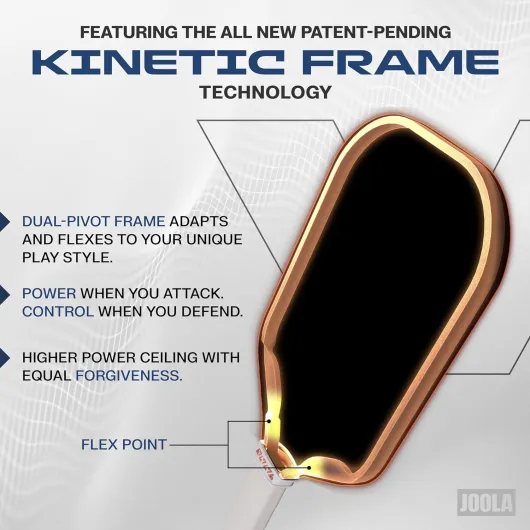
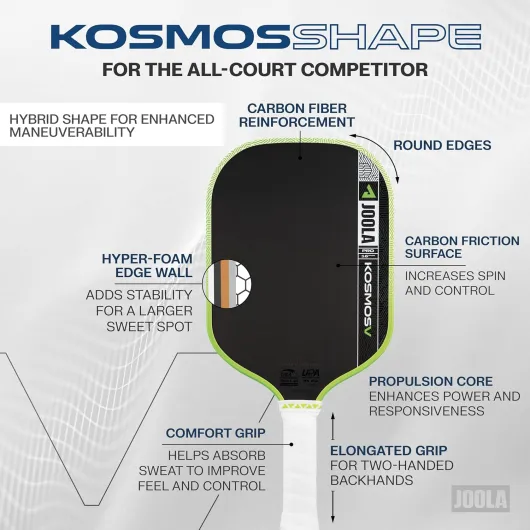
The Kosmos 16 mm uses what JOOLA calls a "Kosmos Hybrid Shape." In practice, that means it’s a bit elongated compared to a classic widebody, but not as stretched as some super-elongated paddles. On court, the shape gives you good reach at the net and on wide dinks without feeling awkward or tip-heavy. I noticed right away that I could poach a bit more confidently and reach for balls that I’d normally just watch go by with a more traditional shape.
The paddle weighs around 0.56 kg (about 12.3 oz), which puts it on the heavier side. For me, that translated into a solid, stable feel on blocks and counters. When someone rips a drive at you, the paddle doesn’t twist much in the hand, and that’s where the design really helps. However, if you’re used to paddles in the 7.8–8.2 oz range, you might feel the weight after a long session. I felt some forearm fatigue during longer play, especially on days where I was playing three hours straight. It’s not unbearable, but it’s noticeable.
Balance-wise, it feels slightly head-heavy but not extreme. That head weight helps with plow-through on drives and punch volleys, but it also means you have to be a bit more deliberate with fast hand battles. Compared to a lighter, more evenly balanced paddle I use, my hand speed at the kitchen dropped a bit, but my stability and control on blocks went up. So the design choice clearly leans toward control and stability over super-fast hands.
Visually, it’s pretty clean: carbon fiber face, JOOLA branding, and a modern look without being too loud. It looks like a serious paddle rather than a toy. There’s nothing flashy in terms of special shapes or gimmicks; it’s more about getting a practical balance between reach and sweet spot. Overall, from a pure design and playability standpoint, I think they did a pretty solid job. It just skews toward players who value reach and stability more than ultra-quick wrist action.
Grip, handling, and fatigue over long sessions
Comfort-wise, the Kosmos 16 mm is a bit of a mixed bag. The Feel-Tec grip itself is nice: it has a slightly tacky feel, decent cushioning, and the 5.5 grip size felt fine in my hand (I usually play a standard/medium grip). I didn’t feel any hotspots or rubbing, even during three-hour sessions. It absorbs sweat reasonably well, but if you sweat a lot, you’ll probably still want an overgrip. And that’s where the lack of included overgrip stings a bit. At this price, tossing one in the bag would have been easy for JOOLA.
The weight, around 0.56 kg, is what affects comfort the most. The paddle feels solid and stable, which is nice on contact, but if you’re sensitive to weight or coming from something much lighter, your wrist and forearm might complain. I noticed some fatigue by the end of longer nights, especially when I played mostly at the net with a lot of quick exchanges. If you have elbow or shoulder issues, I’d be careful and maybe try it first before committing, or add a slightly thinner grip to reduce overall strain.
During play, the 16 mm core helps reduce harsh vibrations. Mishits don’t sting the hand the way they sometimes do on cheaper, thinner paddles. The feedback is firm but not jarring, which I appreciated on cold mornings when the ball is harder. The sweet spot is forgiving enough that you don’t get punished too brutally for slight mishits, which also adds to overall comfort because you’re not constantly feeling shocks through your arm.
So in short, comfort is good if you can handle the weight. The grip and core do their job, but the heavier feel and slightly head-heavy balance will not suit everyone. If you’re strong enough or used to heavier paddles, you’ll probably enjoy the stable, solid feel. If you’re smaller, have arm issues, or prefer quick, whippy paddles, this might feel a bit tiring over time.
Carbon fiber build and 16mm core in real life
On paper, the materials sound like what you’d expect from a high-end paddle: carbon fiber frame, carbon fiber hitting surface, 16 mm core for control, and JOOLA’s usual tech buzzwords. In practice, what matters is how that combo feels when you actually hit the ball. The 16 mm core really stands out: contact feels a bit softer and more cushioned than a 13 mm or 14 mm power paddle. You get a longer dwell time on the ball, which helped me place dinks and resets more precisely. The sweet spot feels fairly big, especially compared to some cheaper carbon paddles I’ve tried.
The carbon face grips the ball decently for spin. I wouldn’t say it’s spin-crazy, but I could get solid topspin on drives and good bite on spin serves. It’s more than enough for most players. The surface doesn’t feel overly gritty like some paddles that almost feel like sandpaper, but it’s not slick either. After a couple of weeks, I didn’t see obvious wear on the face, and spin felt consistent from day one to day fourteen, which is a good sign.
One thing I noticed is the sound: compared to some of JOOLA’s earlier generation paddles, this one has a less muted, slightly crisper sound. It’s not super loud, but it’s more of a pop than a thud. That matches what one Italian reviewer mentioned about the sound being less dull than the previous generation. Personally, I like that feedback; you can better judge contact quality by ear. Some people might prefer a more muted feel, though, so that’s subjective.
Overall, the materials feel trustworthy. It doesn’t feel cheap or hollow, and there’s no obvious buzzing or weird vibrations on mishits. Still, if you compare it to paddles that cost less than half, the gap in material feel is there, but it’s not massive. You’re paying a lot for incremental gains in feel and consistency, not for a completely different world of performance. So the materials are good and reliable, but the price tag makes you notice every little detail.
Packaging and extras: where it really disappoints
The packaging is honestly the weakest part of this product. For something that sits in the high price range, the way it shows up is almost laughably basic. Mine came in a plastic sleeve inside a standard shipping box. No branded box, no foam, no case, no overgrip, no edge tape. If this were a budget paddle, I wouldn’t care, but when you’re paying this much, the first impression matters a bit. It feels like they spent all the cost on the paddle and zero on presentation.
A few Amazon buyers clearly had the same reaction. Some mention that the ad shows premium packaging, extra overgrip, stickers, and clear edge guard tape, and then they receive just the bare paddle. I had the same outcome: only the paddle. That kind of inconsistency is annoying and makes the product listing feel misleading. If JOOLA or the seller changed what’s included, they should update the photos and description instead of leaving people guessing.
There’s also the issue of value perception. When you open a high-end Selkirk or some other premium paddles, you at least get a nice box and sometimes a simple case. It doesn’t change how the paddle plays, but it does make you feel like you’re getting a complete product. With the Kosmos, you immediately realize you’ll need to buy an overgrip, maybe a case, and possibly edge tape if you’re picky. That’s more money on top of an already expensive purchase.
So if packaging and extras matter to you, be aware: this is as bare-bones as it gets. The paddle itself is fine, but the way it’s delivered really doesn’t match the price tag or the brand’s premium image. For me, it doesn’t kill the product, but it definitely knocks it down a notch in terms of overall satisfaction. It just feels like a missed opportunity to make the experience match the cost.
Build quality and how it seems to hold up
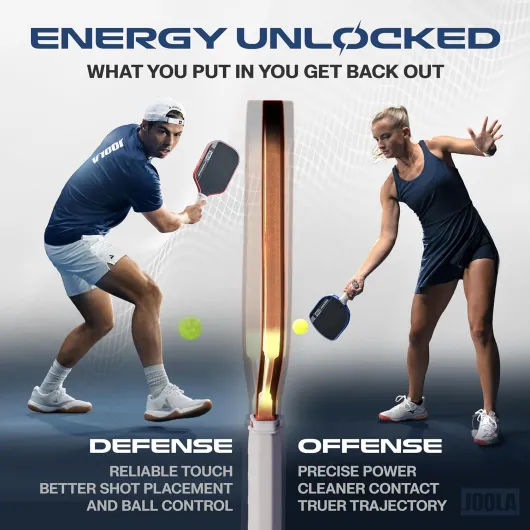
I haven’t used the Kosmos for months and months, but based on a couple of weeks of regular play and a close look at the build, it feels well put together. The carbon fiber face hasn’t shown any weird dead spots or bubbling, and the edges haven’t started peeling or flaking. I had a few clashes with my partner’s paddle at the net (it happens), and while you can see minor scuffs on the edge, nothing looks structurally worrying. The core still feels consistent across the face.
The handle feels solid too. No creaking, no flexing where the handle meets the face, which I’ve seen on cheaper paddles after a short time. The Feel-Tec grip has held up well so far: no unraveling or major wear spots. Of course, if you play a lot, you’ll eventually replace the grip or add overgrips anyway, but at least the base grip doesn’t feel flimsy out of the box.
JOOLA lists EU spare part availability at 10 years, which mainly tells me they intend to support the product line for a while. That doesn’t automatically mean your paddle will last a decade of heavy play, but it’s better than brands that disappear after a season. Also, once I finally got the NFC registration to work, I felt a bit more comfortable about potential warranty issues, though the registration process could be smoother.
From what I’ve seen and felt so far, I don’t have major durability concerns. It feels like it should handle regular league and rec play just fine. That said, when you factor in the high price, you naturally expect this level of durability. It’s not that it feels indestructible; it just feels like what a premium paddle should feel like. There’s no obvious flaw, but also nothing that screams "this will outlast everything else." It’s solid, but not miraculous.
On-court performance: dinks, drives, and defense
This is where the Kosmos 16 mm actually justifies itself the most: control and consistency. Around the kitchen, the paddle feels very steady. Dinks sit nicely on the face, and that 16 mm core gives you time to guide the ball. I noticed fewer pop-ups on short dinks compared to my thinner, more lively paddle. Resets from the transition zone were also easier; the paddle absorbs pace well, so you can just block and drop the ball back into the kitchen without having to be ultra precise with your swing.
On defense, especially against big hitters, the extra weight and stable face are a real plus. Blocking drives and speeding up counterattacks felt automatic once I got used to the timing. You can just stick the paddle out and let the paddle do some of the work. This is where I think the target user is pretty clear: doubles players who like to grind out points and win in the soft game and counters, not necessarily those who want to blast every ball.
Power-wise, it’s decent but not wild. You can still hit strong drives and overheads, but you have to swing for it. Compared to some thinner, power-focused paddles, the Kosmos doesn’t give you as much free pop. The upside is you gain better depth control on serves and returns. I found I could place deep returns consistently without sailing them long, which is nice when you’re playing people who love to rush the net.
Spin is solid but not crazy. My topspin drives dipped enough to be effective, and I could get good cut on slice returns and third-shot drops. It’s enough for competitive play, but if your whole game is built around heavy spin serves and roll volleys, there are paddles with more aggressive grit that will give you a bit more bite. Overall, performance is strong in the control and stability department, average-to-good in power and spin. For my style (control-first doubles), it fits pretty well, but it doesn’t blow cheaper competitors out of the water.
What you actually get when you order it
The first thing I want to talk about is what shows up at your door, because that’s where a lot of people will feel a bit misled. The Amazon listing photos and some descriptions suggest you’re getting a premium box, maybe an overgrip, stickers, and clear edge tape. In my case, and in line with several reviews, I just got the paddle in a basic plastic sleeve. No box, no case, no tape, nothing. For a paddle in this price bracket, it feels a bit lazy, especially when other brands throw in at least a simple cover.
A couple of reviewers also mentioned paying more on Amazon than on JOOLA’s own site. I noticed the same thing when I checked prices afterwards. So you’re paying a premium and still not getting the extras shown in some product images. That mix of higher price and bare-bones presentation is annoying. If you tell me up front it’s just the paddle, fine, but don’t show a fancy bundle and then send the minimal version. It makes the product feel less special right out of the gate, even if the paddle itself is decent.
There’s also the JOOLA NFC tag and registration via the JOOLA Infinity app. In theory, it’s a nice touch: tap your phone, register the paddle, and you get warranty and maybe some extras. In practice, it was hit or miss. One of the Amazon reviewers said the NFC didn’t work for about 10 days; I had a similar hiccup where it took multiple tries and phone restarts before it finally read the tag properly. Once registered, it’s fine, but again, for a high-end paddle, the whole onboarding experience could be smoother.
So overall, in terms of presentation, I’d say it feels underwhelming. The paddle itself looks like a premium piece of gear, but the way it’s shipped and the lack of included accessories make it feel like a mid-range product dressed up with a high price. If you’re the kind of person who cares about unboxing and extras, this will probably annoy you. If you only care about how it plays, you’ll get over it, but it’s still a weak point that’s worth knowing before you buy.
Pros
- Very good control and stability, especially for dinks, blocks, and resets
- 16 mm core with a generous sweet spot that helps with consistency
- Solid carbon fiber build that feels durable and well constructed
Cons
- High price compared to paddles that offer similar performance
- Packaging is very basic with no useful accessories included
- Heavier feel may cause fatigue for some players and won’t suit everyone
Conclusion
Editor's rating
Overall, the JOOLA Pro V Kosmos 16 mm is a solid control paddle with a good sweet spot, stable feel, and reliable build quality. On court, it shines in the soft game: dinks, resets, and blocks feel predictable and easy to control, and the 16 mm core gives you nice touch without being too dead. If you play mostly doubles, like to win points through patience and placement, and don’t mind a bit of extra weight, it fits that style very well.
Where it falls short is everything around the paddle: the bare-bones packaging, the lack of included extras, some confusion around what the Amazon listing promises, and a price that’s hard to justify for many players. The performance is good, but not so far ahead of mid-range options that it clearly earns the big price gap. You’re paying for small gains in feel and consistency, and for the JOOLA name, more than for a dramatic performance jump.
I’d recommend this paddle to competitive rec players or league players who already know they like heavier, 16 mm control paddles and want something stable and reliable from a known brand. If you’re newer to the game, on a budget, or mainly play for fun once or twice a week, I think you can find better value elsewhere and probably won’t miss what this paddle offers. In short: plays well, feels solid, but the price and presentation drag it down.