Summary
Editor's rating
Strong performance, but you’re paying a clear “Ben Johns tax”
Elongated shape, big sweet spot… with some trade-offs
Comfortable grip and low vibration, but a bit tiring over long sessions
Carbon fiber everywhere, but does it hold up?
Good early on, but long-term toughness is questionable
Control and spin are the stars, power is decent but not insane
What you actually get for the price
Pros
- Very good control and spin thanks to the 16mm core and textured carbon surface
- Comfortable, stable feel with low vibration and a useful longer handle
- Large, forgiving sweet spot with fewer obvious dead spots across the face
Cons
- Relatively heavy and slightly head-heavy, which can be tiring over long sessions
- Durability concerns: edge can dent and surface may smooth out faster than expected for the price
- Price is high and includes a clear premium for the Ben Johns branding

Specifications
View full product page →| Brand | JOOLA |
A pricey paddle that a lot of players swear by
I’ve been seeing this JOOLA Ben Johns Hyperion CFS 16 everywhere on the courts, so I finally gave in and picked one up. It’s the “Ben Johns” model you see in a lot of YouTube videos, and the price clearly reflects that. This isn’t a budget paddle; it sits in the higher end of the market. So I went into it asking one simple question: is it actually worth the money for a regular player, or is it just hype around a pro’s name?
I’ve used it for a couple of weeks, playing mainly rec games and a small local tournament. For context, I’m around a solid 3.5–4.0, and I usually play with a Selkirk Amped and a cheaper fiberglass paddle as backup. That gives me a decent comparison point for power, control, and how forgiving the paddle feels when I’m not hitting the perfect sweet spot. I’m not sponsored by anyone, I pay for my gear, and I’m not married to any brand.
Right away, the thing that stood out with the Hyperion CFS 16 is the control and spin. It really does grab the ball more than a basic composite paddle. Dinks, third shot drops, and soft resets are easier to keep low, and I noticed my topspin drives dipping in more often instead of flying long. You still need clean mechanics, but the face definitely helps. If you’re coming from a cheap Amazon paddle, the difference in feel is pretty obvious after just a couple of games.
On the flip side, it’s not perfect. The paddle isn’t the lightest, and after long sessions my wrist and forearm felt a bit more tired than with my old Selkirk. I also have some concerns about durability, especially after seeing other players’ paddles with edge dents and surface wear earlier than I’d expect at this price. So my overall impression is: strong performance, especially for spin and control, but you’re paying a premium and you have to cross your fingers it holds up as long as it should.
Strong performance, but you’re paying a clear “Ben Johns tax”
In terms of value for money, this paddle sits in that awkward zone where the performance is clearly good, but the price is high enough that you start nitpicking. If you’re a 3.5–4.5 player who plays several times a week, you’ll probably appreciate what you’re getting: reliable control, very good spin, and a comfortable, stable feel. In that sense, it does justify being in the premium category more than some random Amazon paddles with flashy graphics.
However, there’s definitely a name premium here. You’re paying partly for the Ben Johns branding and JOOLA’s reputation. There are other paddles in the same price range that offer similar performance, and a few slightly cheaper ones that come close enough for most intermediate players. So if your budget is tight, I wouldn’t say this is some unbeatable deal; it’s more like, “you get a good paddle, but you’re also funding the marketing.”
The part that hurts the value a bit more is the durability doubts. When I drop good money on a paddle, I want it to last a solid season or more of regular play without obvious structural issues or big performance drop-offs. With the Hyperion CFS 16, between the potential for edge dents and the surface wearing smoother over time, I’m not fully convinced. It might still be worth it if you really care about spin and control and don’t mind replacing paddles more often, but for budget-conscious players, that’s not ideal.
So overall, I’d call the value pretty solid but not outstanding. You’re getting a legit high-performance paddle that can help your control and spin, but you’re also paying a premium for the badge and taking a bit of a gamble on how long it will stay in top shape. If you want one of the most popular "pro"-style paddles and are okay with the price, go for it. If you just want something that plays well for less, there are more economical options that will get you 80–90% of the way there.
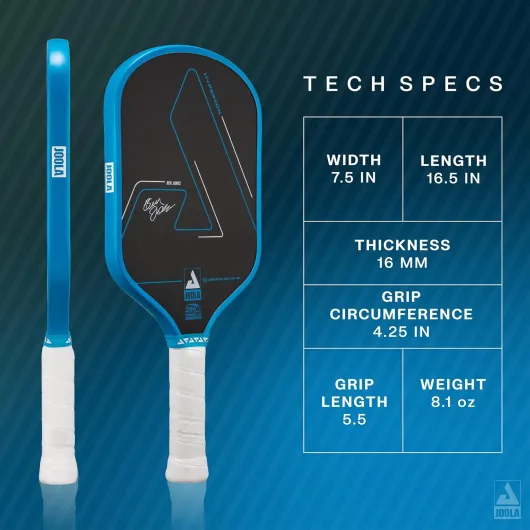
Elongated shape, big sweet spot… with some trade-offs
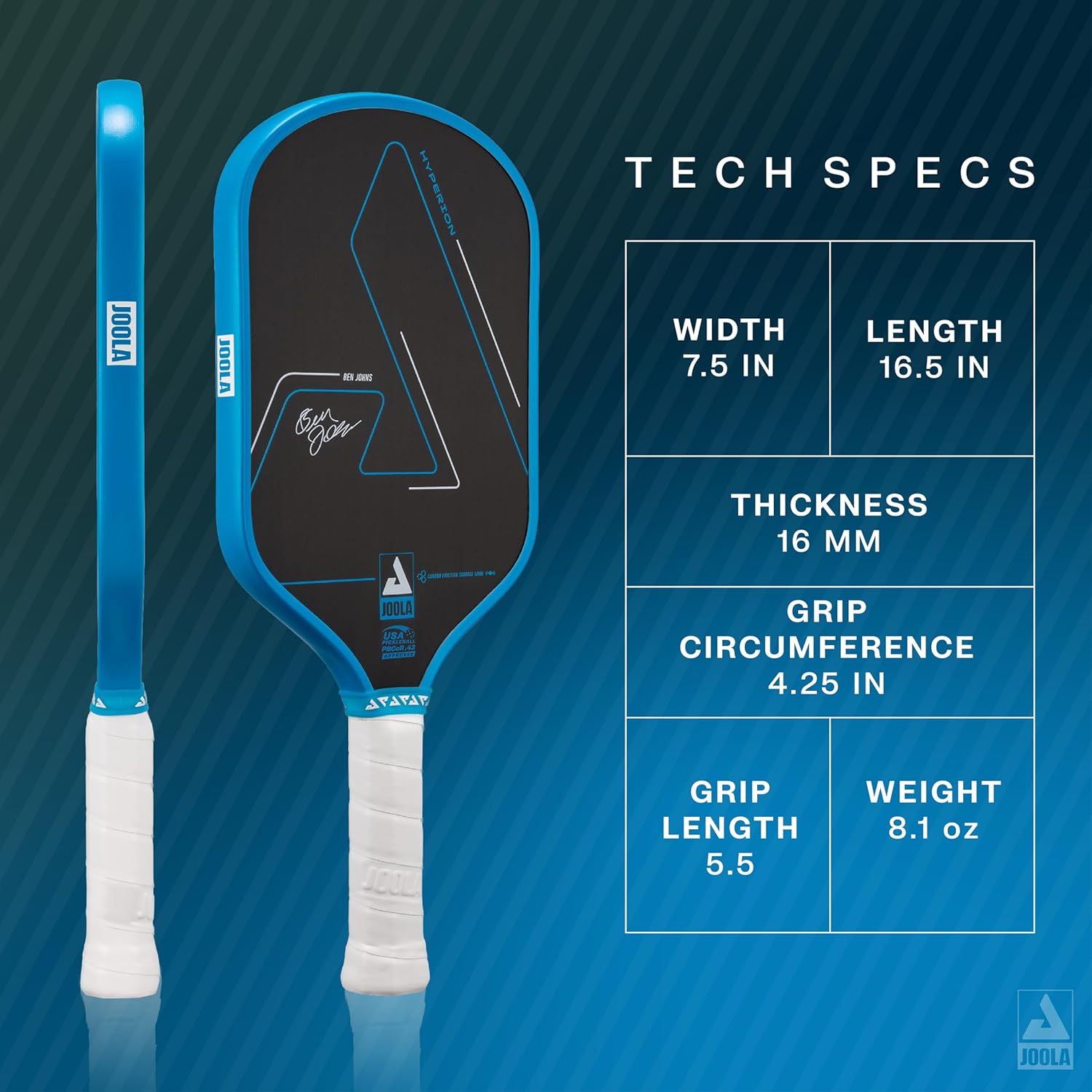
The design of the Hyperion CFS 16 is all about that elongated control paddle style. The face is a bit longer and narrower than a standard paddle, and the thickness is 16mm, which is on the thicker side. In practice, this means more dwell time on the ball and a bit more forgiveness on softer shots. When you’re dinking or resetting, you can feel the ball sit on the paddle just a touch longer, which helps keep it in the kitchen instead of popping it up.
The sweet spot feels pretty generous. Compared to my cheaper fiberglass paddle, I don’t get those random dead spots near the top. Even off-center hits still carry some power and don’t die instantly. JOOLA talks about their “Hyperfoam edge wall” – basically foam in the perimeter – and while I can’t see it, I do feel that the edges aren’t as punishing as some other elongated paddles I’ve tried. That said, if you hit right on the edge, it’s still a mishit; nothing magic here.
Visually, the design is clean and modern. The “Crisp Blue” color is simple but looks good on court. It’s not flashy, which I like. The surface has a noticeable texture when you run your fingers over it, and that matches what they claim with their Carbon Friction Surface. It doesn’t feel like sandpaper, more like a fine, grippy weave. Over the first couple of weeks, the texture stayed pretty consistent, but I’ve seen friends’ Hyperions look more worn after a few months, so long-term, I’m not sure how long that roughness really lasts.
The only downside in design for me is the overall heft and head bias. Because of the elongated shape and foam in the edges, the paddle can feel a bit demanding if you’re sensitive to weight. Quick exchanges at the net are fine once you adapt, but if you like super-fast hand speed and whip, you might find this design a bit sluggish compared to lighter, more balanced paddles. So overall, smart design for control and spin, but with the usual trade-offs in weight and quickness.
Comfortable grip and low vibration, but a bit tiring over long sessions
Comfort-wise, the Hyperion CFS 16 is a mix of very good feel and noticeable weight. The first thing I liked was the handle. It’s slightly longer than many standard paddles and has a ridged grip. That ridge actually helps with orientation; you can feel where the bevels are, so you know if your paddle face is square without looking. For one-handed play, it’s comfortable, and for those who like to slide a second hand up for two-handed backhands, the extra length is handy.
The grip circumference is average – not huge, not skinny. I didn’t feel the need to overgrip it right away, and the stock grip has enough tack and cushioning. After a couple of hours, my hand didn’t feel sore or cramped, which is a good sign. If you have very small hands you might add an overgrip and accept a bit more bulk, but for most adults it should be fine as is. Sweat management is decent; it doesn’t turn into a slippery mess, at least not for me.
The vibration damping is also quite good. That polypropylene honeycomb core and the foam in the edges help cut down on harsh feedback. When I hit off-center or block a hard drive, I don’t get that buzzing shock up my arm that I sometimes feel with cheaper, stiff paddles. If you have elbow or wrist issues, this softer feel will probably be a plus. It’s not mushy, though – you still get enough feedback to know if you hit cleanly or not.
The catch is the overall fatigue factor. Because it’s not a featherweight paddle and it’s a bit head-heavy, after long sessions I felt my wrist and forearm more than with lighter paddles. In quick volley exchanges, the paddle feels stable, but repeated fast hand battles can wear you out if you don’t have good mechanics or strength. So comfort is good in terms of feel and vibration, but if you’re sensitive to weight or have arm issues, you might want something a bit lighter or more evenly balanced.
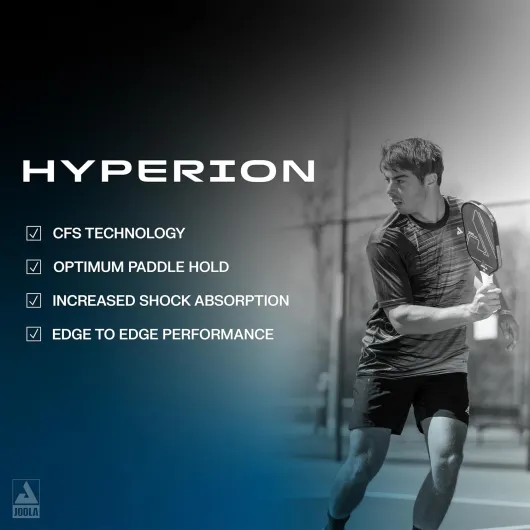
Carbon fiber everywhere, but does it hold up?
On paper, the materials are pretty high-end: carbon fiber frame, carbon fiber shaft/handle area, and a polypropylene honeycomb core. That’s the standard recipe right now for mid to high-end paddles, and it’s what you want if you’re looking for decent power with control and less vibration. The core feels consistent from top to bottom; I didn’t notice big changes in bounce when hitting different parts of the face, which is a good sign.
The Carbon Friction Surface (CFS) is the main selling point here. It’s a textured carbon surface that’s supposed to give you more spin and stay grippy longer than cheaper spray-on textures. In practice, the surface definitely has bite. My topspin serves, rolls, and slice returns all grabbed nicely. Compared to my older Selkirk Amped (which is more about control than spin), the Hyperion CFS clearly helps the ball dip and curve a bit more. After a couple of weeks, I didn’t see major wear, but I also didn’t baby it – regular play, some edge guard scuffs, normal use.
Where I’m a bit less convinced is durability vs. price. The foam-injected edge feels solid at first, but I’ve already seen a noticeable ding on the edge from a clash, and that lines up with what other buyers reported about dents after a short time. For a paddle in this price range, I expect it to take a few knocks without looking tired so quickly. The carbon surface also makes me wonder how it will age; some players say it smooths out faster than they’d like, which would mean less spin down the road.
So, materials-wise, you’re getting modern tech and a proper carbon setup, and it does translate into good feel and performance. But it’s not indestructible, and if you’re rough on your gear or play a ton, you might be slightly disappointed in how quickly it starts to show wear. It’s solid, but for the cost, I’d like it to feel a bit more bulletproof.
Good early on, but long-term toughness is questionable
Durability is where I’m a bit hesitant with the Hyperion CFS 16. Out of the box and during the first weeks, everything feels solid: no rattles, no weird buzzing, the edge guard is tight, and the face texture looks and feels consistent. After a couple of weeks of regular play (3–4 times a week), mine still looks decent with the usual scuffs on the edge guard and some ball marks on the face.
However, I’ve already picked up a noticeable dent on the edge from a paddle clash, and that lines up with what some other users mentioned. For a paddle at this price, I’d expect it to shrug off a few knocks better. The foam-injected edge helps with feel and sweet spot, but it might also make the edge a bit more vulnerable to impact marks. It doesn’t affect play right now, but it doesn’t give me a ton of confidence about how it will look after six months or a year.
Another concern is the face texture over time. The Carbon Friction Surface is nice when new, but a couple of friends who have used this paddle longer than me showed me theirs, and the surface looked noticeably smoother. They still got some spin but said it wasn’t as strong as when it was fresh. That’s pretty normal for textured paddles, but again, at this price point, it stings a bit when the main selling point (spin from the surface) starts fading earlier than you’d like.
So I’d say durability is okay but not outstanding. If you’re careful with your gear, avoid clashes, and don’t grind it on the court, you’ll probably get decent life out of it. If you’re a heavy player, play a lot of hours per week, or tend to bang paddles at the net, you might end up annoyed with the wear versus what you paid. It performs well, but it doesn’t feel like a tank that will last forever.
Control and spin are the stars, power is decent but not insane
On court, the Hyperion CFS 16 is clearly tuned more for control and spin than raw power. If you’re an aggressive, offensive player who likes to shape the ball and mix speeds, it fits that style pretty well. My dinks stayed low, my third shot drops were easier to land in the kitchen, and resets from the midcourt felt more controlled than with my older, bouncier paddle. The 16mm thickness really helps here; the ball doesn’t rocket off the face as much, so you have more margin for error on touch shots.
Spin is where this paddle stands out. The textured carbon face grips the ball well, and you can feel it especially on topspin drives and roll volleys. I was getting more dip on my drives, and some opponents commented that the ball was jumping off the bounce differently. Slices on returns and dinks also bite nicely, which lets you keep the ball low and force awkward contacts. It doesn’t magically fix bad technique, but if you already brush the ball, it rewards that.
Power is good but not crazy. If you’re expecting a rocket launcher, this isn’t it. You can still finish points with speed-ups and overheads, but it relies more on your swing than on trampoline effect. Compared to a thinner or more power-focused paddle, drives don’t fly as hot, but they are more controlled. For my level, that’s actually a plus – I’d rather have control with enough power than a wild cannon I’m always trying to tame.
At the net, the paddle feels stable in hand battles. The weight and foam edge give it a solid feel when blocking hard drives; the ball doesn’t twist the paddle as much as lighter, flimsy models. Reaction time is slightly slower because of the head-heavy feel, but once I adjusted, I felt confident in quick exchanges. Overall, performance is strong, especially if you prioritize spin and control. If you already hit hard and want a paddle that keeps the ball in, it fits well. If you’re hunting for maximum power with minimal effort, you might be a bit underwhelmed.
What you actually get for the price
Out of the box, the JOOLA Ben Johns Hyperion CFS 16 looks like a serious paddle. You get the paddle and… that’s basically it. No fancy case, no extra grip tape, no small extras you sometimes see with cheaper paddles. For the price, I wouldn’t have complained about a simple cover, but it’s not a deal breaker. It’s clearly sold as a performance tool, not as a gift box product.
In the hand, the first thing I noticed was the weight and balance. My scale had it right around the advertised range; it doesn’t feel super light, more on the solid side. The weight is slightly head-heavy, which some players like for power and stability. If you’re used to ultra-light paddles, this will feel more substantial. That said, it doesn’t feel like a brick either; you can still react at the net and hand battles feel manageable once you get used to it.
The branding is pretty visible: big JOOLA logo, Ben Johns signature, and the Hyperion name. It’s not subtle, but that’s the whole point – this is tied to the #1 player and the PPA Tour, and they want you to know it. Personally, I don’t really care about the signature on the face; I just want to know if it plays well. But if you like that “pro model” vibe, it ticks that box.
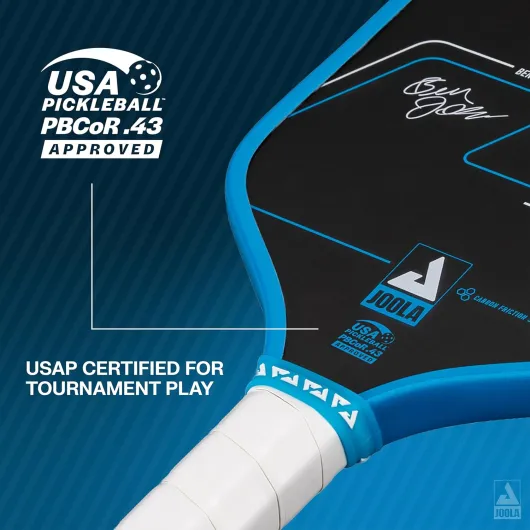
From a practical standpoint, the USAPA approval is there, so it’s fine for tournaments. The size and shape fit the current trends: elongated profile, 16mm thickness, and a longer handle. If you’re coming from a more traditional, shorter and wider paddle, there’s a small adjustment period. The longer shape helps on reach for volleys and lobs, but you lose a bit of width forgiveness on mishits near the edges. Overall, presentation is straightforward: it looks like a modern, serious paddle with no gimmicky accessories, just the tool itself.
Pros
- Very good control and spin thanks to the 16mm core and textured carbon surface
- Comfortable, stable feel with low vibration and a useful longer handle
- Large, forgiving sweet spot with fewer obvious dead spots across the face
Cons
- Relatively heavy and slightly head-heavy, which can be tiring over long sessions
- Durability concerns: edge can dent and surface may smooth out faster than expected for the price
- Price is high and includes a clear premium for the Ben Johns branding
Conclusion
Editor's rating
After a couple of weeks with the JOOLA Ben Johns Hyperion CFS 16, my take is pretty clear: it’s a very solid control and spin paddle with a few caveats that keep it from being an automatic buy for everyone. On the positive side, the 16mm core, textured carbon surface, and foam edge give you a big, forgiving sweet spot and a lot of grip on the ball. Dinks, drops, and resets are easier to keep low, and you can add real topspin and slice without feeling like you have to swing out of your shoes. The handle is comfortable, vibration is low, and at the net it feels stable when blocking hard drives.
On the downside, it’s not the lightest or quickest paddle out there, so some players might find it a bit tiring over long sessions or a bit slow in very fast hands battles. The other concern is durability versus price: edge dents and surface wear seem to show up sooner than I’d like for a premium product. You’re also paying a clear “Ben Johns” and branding tax; this isn’t a bargain, it’s a high-end purchase.
Who is it for? I’d recommend it mainly to intermediate and advanced players (roughly 3.5–4.5) who play often, care a lot about control and spin, and don’t mind spending more for a well-known model. Who should skip it? Beginners who are still learning basics, budget-conscious players, or anyone obsessed with maximum power or ultra-light paddles. If you fit the target group and accept the price and potential wear, you’ll probably like how it plays. If not, you can find cheaper paddles that get you close enough without hurting your wallet as much.