Summary
Editor's rating
Value: good paddle, but you’re paying the JOOLA/Ben Johns tax
Design: green, long, and clearly built for control players
Comfort & feel: light, quick, and not too much shock
Materials: carbon everywhere and a face that actually feels controlled
Durability after a couple of weeks: solid so far, but long-term is to be seen
Performance on court: strong on control and spin, decent on power
What you actually get with this JOOLA paddle
Pros
- Very good control and spin, especially for dinks, drops, and resets
- Light and comfortable with reduced vibration, easier on wrist and elbow
- Solid build quality with USAP approval and a 12‑month warranty via NFC registration
Cons
- On the expensive side, especially for casual or newer players
- Power is decent but not strong; power-focused players may find it too muted
- No cover or real extras included despite the higher price

Specifications
View full product page →| Brand | JOOLA |
Control paddle for people who actually play, not just dabble
I’ve been playing pickleball 3–4 times a week for a while now, and I picked up the JOOLA Vision/Double Vision Perseus Double Vision (Charge Green) because I wanted more control and spin than my basic fiberglass paddle. I’m not a pro, but I’m past the beginner stage: I play rec leagues, do drills, and I know when a paddle is helping or just along for the ride. I’ve used a couple of other JOOLA paddles and some cheaper Amazon brands, so I had something to compare it to.
Right out of the box, this feels like a paddle aimed at people who care about touch and placement. The brand goes on about the SK film, Aramid surface, honeycomb core, etc. In practice, what I noticed was simpler: it’s pretty light, the sweet spot is forgiving, and it grabs the ball well for spin. I didn’t suddenly start playing like Ben Johns, but my dinks and third-shot drops were more consistent after a few sessions.
I used it over roughly two weeks: drills, a couple of round-robin nights, and some casual open play. I swapped back and forth with my older composite paddle to see if I was imagining the difference. The main thing I kept coming back to is that the paddle lets you swing confidently without feeling like the ball will randomly rocket long. You still have enough pop to finish points, but it leans clearly toward control rather than raw power.
It’s not perfect. The price is on the higher side for most casual players, the green look is not for everyone, and if you’re coming from a heavier, power-focused paddle, you might feel like you’ve lost some put-away punch. But if you’re trying to clean up your soft game and want a carbon-style paddle without going into super boutique brands, this one is a pretty solid option.
Value: good paddle, but you’re paying the JOOLA/Ben Johns tax
Let’s talk money. This JOOLA Perseus Double Vision is not a budget paddle. You’re paying for the JOOLA name, the Ben Johns association, the techy materials, and the USAP approval. For someone who plays once a month, I’d say it’s probably overkill. For people who play several times a week and actually care about feel and control, the price starts to make more sense, but it’s still on the higher side of what casual players are comfortable with.
Compared to cheaper Amazon paddles in the $40–$70 range, you do get real benefits: better control, more consistent feel, nicer spin, and likely better durability. Compared to other big-brand carbon paddles in the same price bracket, this one sits right in the middle: not outrageously expensive, but not a bargain either. You’re mainly paying for a well-sorted control paddle that’s tournament-legal and backed by a known brand.
Where the value feels a bit thin is on extras. No cover, no bonus grips, no real accessories. You get the NFC chip and 12‑month warranty, which is nice on paper, but day-to-day, that doesn’t change your game. If JOOLA had included a basic cover or something, it would feel a bit more complete for the price. That said, the actual on-court performance is strong enough that I didn’t feel ripped off.
Overall, I’d call the value good but not outstanding. If you’re already into pickleball, know you like a lighter, control-focused paddle, and want something from a trusted brand, the cost is justifiable. If you’re still figuring out your style or just dabbling, I’d say start cheaper and only move to this kind of paddle once you know you’ll actually use it a lot.
Design: green, long, and clearly built for control players
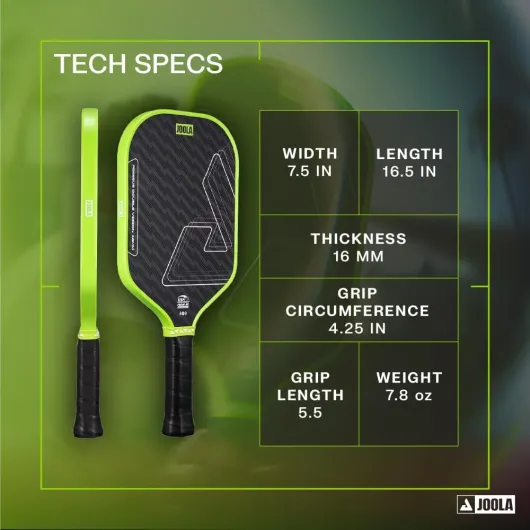
Design-wise, this paddle sits somewhere between flashy and practical. The Charge Green color is pretty bold, but not neon obnoxious. On court, it stands out enough that people asked what paddle it was, but it doesn’t scream “look at me” like some crazy graphic paddles. The shape is the familiar Perseus style JOOLA pushes: slightly elongated with a compact width, which helps reach and gives a more focused sweet spot. If you’ve used other elongated paddles, this will feel familiar.
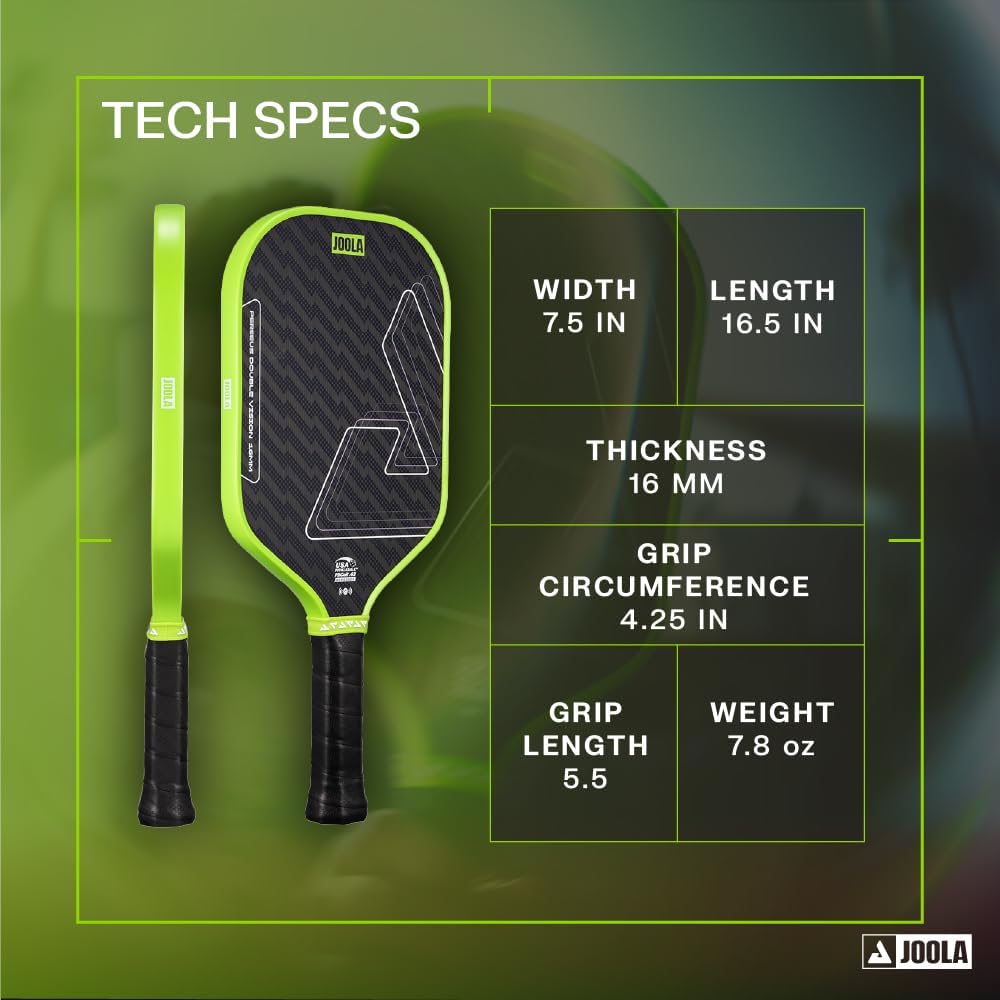
The handle length at 5.5 inches is a nice touch. With my average-sized hands, I can fit both hands comfortably for a two-handed backhand, and it still doesn’t feel like the handle is eating into the face area. The grip diameter feels in the medium range—people with very small hands might want an overgrip to tweak it, but for me it was fine right away. The grip pattern has enough tack that I never felt it slipping, even when sweaty, though I would probably add an overgrip long-term to save the original grip.
On the face, the design is clean. You get minimal text, the JOOLA branding, and the green/black combo. Nothing wild. I liked that the edge guard is low-profile; I clipped the ground and the net post a couple of times and it didn’t chip or peel. The paddle doesn’t feel top-heavy or awkward. Swinging through the ball feels balanced, which is important for quick kitchen exchanges.
One small thing: if you care about looks, this paddle leans a bit “masculine” or neutral. It’s not cute or colorful in a playful way. That doesn’t matter for performance, obviously, but I know some players like brighter or more fun graphics. Personally, I was happy with the clean, serious look. It feels like a paddle you bring when you’re there to play, not just mess around.
Comfort & feel: light, quick, and not too much shock
Comfort was one of the main reasons I wanted to try this paddle. I’ve had some wrist and elbow soreness after long sessions with a heavier, stiffer paddle. After using this JOOLA for about two weeks, including a couple of 3‑hour play blocks, I can say it’s pretty easy on the arm. The combination of weight, balance, and that SK film / Aramid setup seems to take the sting out of mishits without making the paddle feel mushy.
The weight around 7.8 oz feels light but not toy-like. At the net, it’s quick. I noticed I was winning more hands battles just because I could get the paddle into position faster. On the flip side, if you’re used to an 8.2–8.5 oz paddle, you might initially feel like you’re swinging air and not getting the same punch. I adjusted in a few sessions by focusing more on technique than just relying on weight.
The grip itself is comfortable out of the box. It has a slightly cushioned feel, not rock-hard, and the tackiness is decent. I didn’t get any hot spots or blisters, even playing without an extra overgrip. The 5.5" handle length helps with leverage on backhands and overheads, which indirectly helps comfort too, because you’re not over-squeezing or contorting your wrist to generate power.
In terms of impact feel, I’d describe it as controlled and slightly muted. There’s enough feedback to know where on the face you hit, but not so much that it’s jarring. If you like a super crisp, pingy feel, this might come across as a bit too dampened. For me, especially considering elbow comfort, that slight dampening is a positive. I finished long sessions with less soreness than with my older, stiffer paddle, which is probably the best compliment I can give it in the comfort department.
Materials: carbon everywhere and a face that actually feels controlled
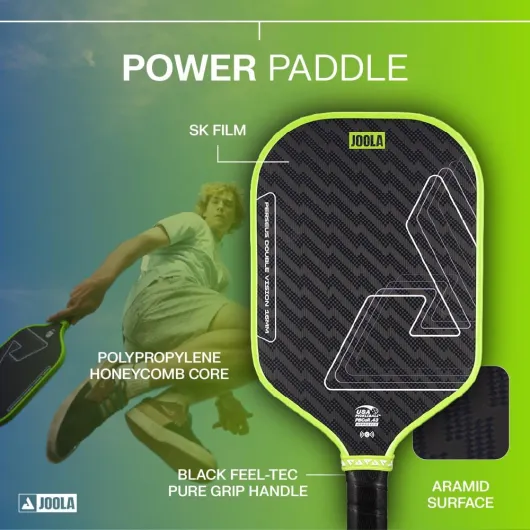
The brand pushes the tech angle pretty hard: carbon fiber shaft and frame, honeycomb core, SK film layer, and an Aramid surface. Stripped of jargon, what this means on court is that the paddle feels stiff enough to be responsive, but not so harsh that every mishit buzzes your hand. Compared to a cheap fiberglass paddle I own, there’s clearly less vibration and a more predictable feel when you catch the ball off-center.
The Aramid surface is the interesting part. It’s supposed to give a softer, more controlled touch. In practice, the paddle face feels slightly muted compared to some raw carbon paddles I’ve tested. When you dink or hit a soft reset, the ball doesn’t jump off the face as much, which helps keep shots short and controlled. On drives, you still get decent rebound, but it’s not a rocket launcher. If you currently play with a super poppy paddle, this may feel a bit “dead” at first, but once you adjust, the predictability is nice.
The SK film layer that bonds the core and surface is mainly there to reduce vibration and even out the response across the face. I can’t scientifically measure that, but subjectively the sweet spot feels fairly generous. Off-center hits near the top or sides still go where I expect most of the time, just with slightly less power. I didn’t get any weird hollow spots or buzzing sensations, which I’ve had on cheaper thermoformed paddles.
Overall, the materials feel aligned with the price: this isn’t bargain-bin stuff. The weight at about 7.8 oz hits a nice middle ground for control and maneuverability. People who like heavier paddles for more plow-through could always add lead tape, but stock, it feels tuned for players who value hand speed and precision over brute force. If you’re upgrading from a basic composite or wood paddle, this will feel like a clear step up in build and feedback.
Durability after a couple of weeks: solid so far, but long-term is to be seen
In terms of durability, I can only speak to a few weeks of regular use, but so far it’s holding up well. I’ve used it indoors and outdoors, hit a few balls off the edge, tapped the court on low pickups, and accidentally clipped a metal net post once. The edge guard is still tight, no peeling, and the face doesn’t show any weird dead spots or soft areas yet.
The texture on the face is still clearly there after multiple sessions. On some cheaper paddles, you start to feel the surface smoothing out pretty fast, which kills spin. Here, after plenty of topspin serves and rolls, the texture still feels about the same as day one. Obviously, I can’t say how it will look after six months of heavy play, but the early signs are good.
I also paid attention to the handle and throat area, since that’s where some thermoformed paddles can crack or feel loose over time. No creaking, no flexing, and the grip hasn’t started to unravel. The carbon frame feels solid, and there’s no rattle inside the core, which I’ve had on cheaper paddles when the internal structure starts to break down.
Realistically, at this price, I expect a paddle to last at least a solid season of frequent play before performance drops off. With the 12‑month warranty via NFC registration, you have a bit of backup if something goes wrong early. I obviously can’t test the whole year in a short review, but based on the first weeks, it feels like a well-built paddle, not a fragile toy. Time will tell, but nothing so far sets off alarm bells.
Performance on court: strong on control and spin, decent on power
On court, this paddle clearly leans toward control and spin rather than raw power. After a few sessions, my soft game—dinks, drops, and resets—felt more consistent. The slightly softer face and the way the ball sits on the paddle just a bit longer made it easier to keep the ball low over the net. When I switched back to my old paddle mid-session, I started popping more balls up, which was a pretty clear comparison.
Spin is another solid point. The textured carbon/Aramid surface grabs the ball well. My topspin drives dipped more, and I could get better shape on cross-court dinks and serves. It’s not insane spin like some super rough raw carbon faces, but it’s definitely better than basic fiberglass paddles I’ve used. I also felt more confident going for aggressive third-shot drops because I knew I could brush up on the ball and still keep it in.
Power is where things are more “good enough” than impressive. You can absolutely finish points with this paddle, especially if your technique is decent, but if you’re coming from a head-heavy, power-focused paddle, you’ll notice you have to swing a bit more. Put-aways at the net are fine, but deep baseline drives don’t have that effortless punch some heavier paddles give. On the plus side, this also means you’re less likely to spray balls long when you get excited.
Where it really shines is hand speed and control in fast exchanges. The lighter weight and balanced feel make it easy to block, counter, and redirect pace. I had a few kitchen battles where I was just reacting with quick flicks and blocks, and the paddle kept up without feeling sluggish. If your style is more about outmaneuvering people and winning the soft game rather than blasting winners, this paddle fits that style very well.
What you actually get with this JOOLA paddle
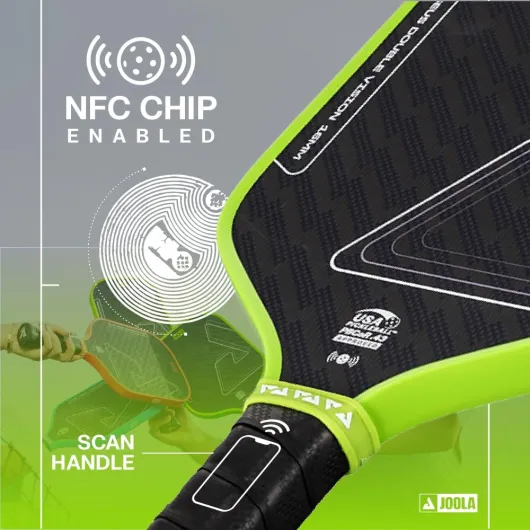
Out of the box, the package is simple: you get the paddle and that’s it. No cover, no extras, no overgrip in the box. For the price, I wouldn’t have minded a basic cover, but it’s not a deal-breaker. The paddle comes shrink-wrapped with the grip protected, and there’s a small note about the NFC chip and the JOOLA Connect app. If you like registering gear and tracking stuff, that might interest you. Personally, I tapped it once out of curiosity, registered it for the 12‑month warranty, then forgot about it.
The marketing talks a lot about SK film, Aramid surface, thermoforming, and all that. In reality, here’s what matters when you pick it up: it’s light (around 7.8 oz), the face feels slightly textured, and the handle length (5.5") gives you room for a solid two-handed backhand if that’s your thing. The overall dimensions (16.5" x 7.5") are pretty standard for a modern elongated/control paddle. It doesn’t feel gimmicky; it just feels like a normal higher-end paddle.
The paddle is USAP approved, so if you play tournaments you’re covered. I didn’t have any issues with sound or people complaining about it being too loud; it’s in the normal range for a carbon paddle. The face texture is there, but it’s not super rough like some sandpaper-feeling paddles. It’s more of a fine texture that still grabs the ball enough for spin.
Overall, presentation is fine but nothing fancy. It looks like a serious paddle, not a toy, and the info on the packaging is clear enough if you’re the type who actually reads it. If you’re expecting a premium unboxing moment, you won’t get that. If you just want a paddle that’s ready to go, it gets the job done with minimal fuss.
Pros
- Very good control and spin, especially for dinks, drops, and resets
- Light and comfortable with reduced vibration, easier on wrist and elbow
- Solid build quality with USAP approval and a 12‑month warranty via NFC registration
Cons
- On the expensive side, especially for casual or newer players
- Power is decent but not strong; power-focused players may find it too muted
- No cover or real extras included despite the higher price
Conclusion
Editor's rating
After a couple of weeks with the JOOLA Vision/Double Vision Perseus Double Vision (Charge Green), my overall take is simple: it’s a very solid control and spin paddle for players who already take the game somewhat seriously. The lighter weight, Aramid/carbon face, and SK film core give you a predictable, comfortable feel, especially in the soft game. Dinks, drops, and resets are easier to keep low and controlled, and the surface grabs the ball well enough for reliable topspin and slices.
It’s not the paddle for everyone, though. If your style is pure power and you love the feeling of just hammering the ball with a heavy, poppy paddle, this will probably feel a bit tame. The price also puts it in the “committed player” category, not the casual impulse buy range. You’re paying for brand, build quality, and tournament approval, not a magic fix for a weak technique.
I’d recommend this paddle to intermediate and up players who want to clean up their soft game, like a lighter and quicker feel, and prefer control over blasting winners. If you’re a newer player still learning the basics or someone on a tight budget, there are cheaper options that will get you started just fine. But if you’re playing several times a week and ready to invest in a reliable, spin-friendly control paddle, this JOOLA holds up well and feels like money reasonably well spent.