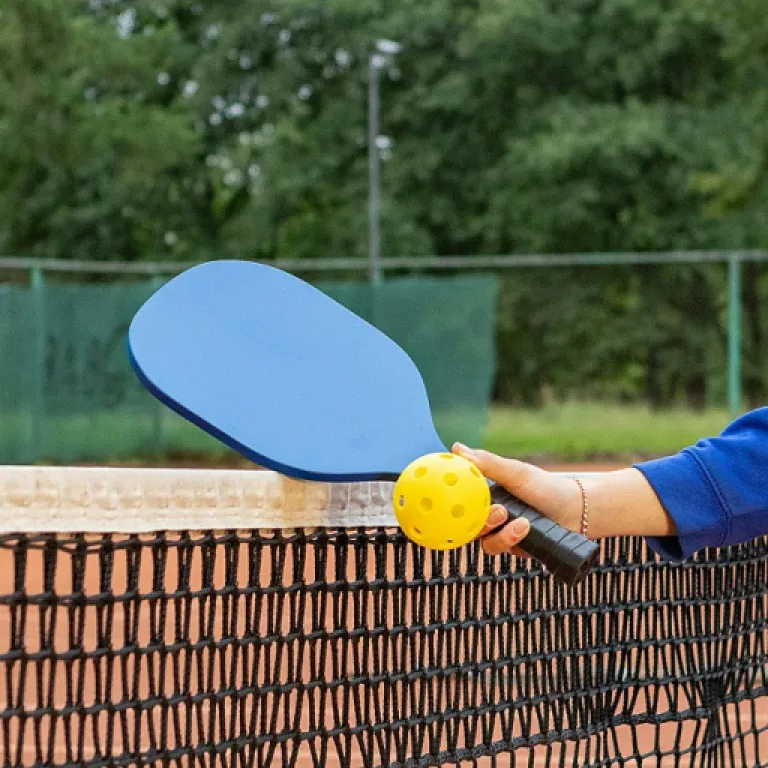
Key differences between a pickleball court and a tennis court
The phrase pickleball court versus tennis court describes two related but distinct playing environments. A standard pickleball court is much smaller than a traditional tennis court, which immediately changes how players move and how the game feels. Understanding these contrasting court dimensions helps anyone decide where and how they prefer to play.
A regulation pickleball court measures 6.10 metres long feet on each side of the net, for a total of 13.41 metres feet long, and 6.10 metres feet wide, while a tennis court is roughly 23.77 metres long feet and 8.23 metres feet wide for singles. These dimensions mean that tennis players must cover far more court feet, which rewards endurance and powerful groundstrokes, whereas pickleball players focus on quick reactions and precise placement. When comparing pickleball courts and tennis courts, the smaller space also affects how the ball travels and how rallies develop.
The net is another central point in the pickleball court versus tennis court debate. A tennis net height is 1.07 metres at the posts and 0.91 metres at the centre, while a standard pickleball net height inches converts to about 0.91 metres at the posts and 0.86 metres at the centre. This slightly lower net height in pickleball, combined with the shorter court pickleball layout, encourages more aggressive play near the volley zone.
The ball itself also changes the nature of the game. A tennis ball is pressurised felt and can bounce high on hard surfaces, while a standard pickleball ball is a perforated plastic sphere that may weigh ounces between 0.8 and 1, which produces a lower bounce and slower flight. Because of this, pickleball tennis rallies often last longer than rallies in tennis pickleball style games played on full tennis courts.
Court layout, lines, and how they shape play
Looking closely at court layout reveals why pickleball court versus tennis court comparisons matter for strategy. A tennis court has baselines, service boxes, and alleys that define singles doubles play, while a pickleball court adds the distinctive non volley zone, often called the kitchen, on each side of the net. This volley zone extends 2.13 metres feet from the net and is crucial to how pickleball is played.
On a tennis court, players usually stand several metres behind the baseline to return a powerful serve, especially on fast hard surfaces. In contrast, on pickleball courts, players often position themselves just behind the non volley zone line, ready to step in and volley once the ball has bounced at least once on each side, as required by the rules. This difference in positioning shows how court dimensions and net height guide where the game is played.
The service rules also highlight the pickleball court versus tennis court contrast. In tennis, the serve is struck overhead into a diagonal service box, and a let serve that clips the net but lands in is replayed, while in pickleball the serve is underhand, must travel diagonally beyond the non volley zone, and lets are usually played. Because the pickleball court is narrower and the ball may weigh ounces less than a tennis ball, the serve in pickleball tennis style games is more about placement than raw power.
Many facilities now paint pickleball court lines onto existing tennis courts to maximise use of space. This multi use approach allows people to play pickleball on tennis courts by adding new court dimensions in contrasting colours, although the net height inches must be adjusted to match standard pickleball regulations. For a deeper look at how posts and hardware affect both sports, see this analysis of how court posts shape modern pickleball and tennis play, which explains how shared infrastructure can still respect each game’s identity.
Nets, equipment, and how the ball behaves on different surfaces
The net is the literal and symbolic divider in the pickleball court versus tennis court comparison. As mentioned, tennis net height is slightly higher overall, which suits the faster ball and longer court, while the lower net height inches in pickleball supports quick exchanges at the volley zone. When courts are converted, adjusting the net height precisely is essential to preserve the intended balance of each game.
Equipment also shapes how play unfolds on different surfaces. A tennis ball is designed for clay, grass, or hard surfaces, and its felt covering grips the court to create spin and varied bounce, whereas a standard pickleball ball has drilled holes and a smooth shell that reacts differently on each surface. On very hard surfaces, the pickleball bounce is crisp and predictable, while on softer courts it can feel slightly muted.
Because a pickleball may weigh ounces less than a tennis ball, wind affects it more, especially outdoors. This is one reason many players prefer indoor pickleball courts with controlled conditions, consistent court dimensions, and uniform lighting. Portable mini nets, such as those reviewed in guides to mini pickleball nets for precise practice in compact spaces, allow people to play pickleball in smaller areas while still respecting the essential proportions of a court pickleball layout.
Racquets and paddles further distinguish pickleball tennis from traditional tennis. Tennis players use longer, strung racquets that generate heavy topspin and powerful serves, while pickleball players use solid paddles that prioritise control over raw speed. When you compare pickleball courts and tennis courts, it becomes clear that every design choice, from court feet measurements to net height, is tuned to the specific ball, equipment, and style of play.
Movement, tactics, and how players experience each game
From a player’s perspective, the pickleball court versus tennis court question is really about movement and tactics. On a full size tennis court, athletes sprint along the baseline, change direction over many metres, and rely on deep shots to push opponents back. On a compact pickleball court, movement is more about short explosive steps, quick pivots, and fast reactions at the volley zone.
Because the pickleball court is only 6.10 metres feet wide, doubles teams can cover the entire width with coordinated positioning. In tennis doubles, the wider 10.97 metres feet wide courts demand more lateral coverage and reward aggressive net play combined with strong serves. These contrasting court dimensions mean that singles doubles strategies in each sport evolve differently, even though both games are played with a net, a ball, and defined lines.
The nature of the bounce also shapes tactics. A tennis ball on a hard surface can jump high, giving tennis players time to set up big forehands, while a pickleball ball, which may weigh ounces less and has a perforated shell, stays lower and loses speed more quickly. This encourages pickleball players to move forward and play pickleball near the non volley zone, where soft dinks and sharp volleys dominate the game.
Many athletes who transition from tennis pickleball style games to dedicated pickleball courts comment on the social and inclusive feel. The smaller court feet area, shorter rallies, and lighter physical demands on joints make the game accessible to a wider range of ages and fitness levels. For newcomers choosing equipment, reviews such as this no nonsense starter pickleball paddle set can help ensure that the first experience on a court pickleball layout is both enjoyable and technically sound.
Shared facilities, conversions, and practical considerations for clubs
Sports clubs and municipalities increasingly face the practical side of the pickleball court versus tennis court debate. Many facilities have long invested in tennis courts with durable hard surfaces, lighting, and fencing, and they now seek ways to accommodate growing demand for pickleball without alienating existing tennis players. Converting or overlaying courts requires careful planning around dimensions, net systems, and scheduling.
One common solution is to paint two or even four pickleball courts across a single tennis court, using contrasting colours to distinguish the lines. This approach maximises court feet usage and allows more players to be on court simultaneously, especially in doubles formats. However, it also requires portable nets set to the correct net height inches for standard pickleball, as the permanent tennis net is too long and slightly too high.
Clubs must also consider noise, as the hard plastic pickleball ball striking paddles and hard surfaces can sound sharper than a tennis ball. Some communities respond by placing pickleball courts farther from residential areas or by using acoustic screens, while others schedule pickleball tennis sessions at specific times to balance interests. The goal is to ensure that both pickleball courts and tennis courts remain welcoming spaces where different games can be played harmoniously.
Maintenance practices differ slightly between the two sports. Because pickleball is often played on smaller areas, wear patterns concentrate near the non volley zone and baseline, which may require more frequent resurfacing in those zones, while tennis courts experience broader wear from baseline to net. Thoughtful facility managers track how many players use each game format, how often singles doubles matches occur, and how the surfaces age, then adjust budgets and layouts accordingly.
Rules, scoring, and how format interacts with court dimensions
Rules and scoring systems are deeply intertwined with the physical realities of a pickleball court versus tennis court. Tennis uses a unique scoring pattern of 15, 30, 40, and games within sets, while pickleball typically uses rally scoring to 11 or higher, with a requirement to win by two points. These frameworks reflect how long rallies tend to last on each type of court and how many players usually share the space.
In tennis, the serve alternates between players or teams after each game, and a powerful serve can dominate on fast hard surfaces. On a pickleball court, the serve is intentionally less dominant, partly because the ball may weigh ounces less and the underhand motion reduces speed, and partly because the smaller court dimensions would otherwise make aces too frequent. The two bounce rule, which requires the ball to bounce once on each side before volleys are allowed, further ensures that rallies develop.
Singles doubles formats also interact differently with space. On tennis courts, singles emphasises endurance and precise placement into corners, while doubles rewards aggressive net play and coordinated poaching, whereas on pickleball courts, both singles and doubles revolve around controlling the non volley zone and forcing awkward volleys. Because the court is only 6.10 metres feet wide, even singles matches feel intimate and tactical rather than purely physical.
Equipment standards, such as the requirement for a standard pickleball ball and regulated paddle dimensions, help keep the game consistent across venues. When people play pickleball on converted tennis pickleball layouts, officials must still verify net height inches, court feet measurements, and line markings to ensure fairness. In both sports, the integrity of the game depends on respecting the relationship between rules, court dimensions, and the physical properties of the ball and surfaces.
Choosing between pickleball and tennis based on goals and preferences
For individuals weighing a pickleball court versus tennis court experience, personal goals and physical needs are central. Someone seeking a high intensity cardiovascular workout over a large area may gravitate toward tennis, where the longer court feet and heavier ball demand sustained movement. Another person who values quick social games, shorter rallies, and less joint impact may find that pickleball courts offer a more sustainable way to stay active.
Age and injury history often influence this choice. Because a standard pickleball court is smaller and the ball may weigh ounces less, many older athletes or those with knee and shoulder issues report that they can play pickleball several times per week without excessive strain, while full court tennis might be reserved for occasional sessions. The lower net height inches and emphasis on touch at the volley zone also allow players to rely more on strategy than on raw power.
However, the decision is not always either or. Many tennis players now cross train on pickleball courts to sharpen reflexes, improve net play, and enjoy a different social dynamic, while some pickleball players use tennis courts for cardio drills or casual tennis pickleball style rallies. Because both games share fundamental skills such as tracking a ball, judging bounce on various surfaces, and coordinating footwork in court dimensions defined by lines, they can complement rather than replace each other.
Ultimately, the best approach is to try both sports in their proper environments. Spend time on a dedicated tennis court and a regulation court pickleball layout, paying attention to how your body feels, how the game pace suits you, and how much you enjoy singles doubles formats with friends. By comparing these experiences directly, the phrase pickleball court versus tennis court becomes less an abstract debate and more a practical guide to choosing the game that fits your life.
Key statistics about pickleball and tennis courts
- Standard pickleball court dimensions are approximately 13.41 metres long and 6.10 metres wide, while a singles tennis court is about 23.77 metres long and 8.23 metres wide.
- Regulation net height for tennis is about 1.07 metres at the posts and 0.91 metres at the centre, compared with roughly 0.91 metres at the posts and 0.86 metres at the centre for pickleball.
- A typical pickleball ball may weigh ounces between 0.8 and 1, whereas a standard tennis ball usually weighs between 1.975 and 2.095 ounces.
- Up to four pickleball courts can sometimes be overlaid on a single tennis court, depending on facility design and safety margins.
Common questions about pickleball courts and tennis courts
Can you play pickleball on a tennis court ?
Yes, you can play pickleball on a tennis court if the space is marked with appropriate pickleball court dimensions and a portable net is set to the correct net height. Many facilities overlay two to four pickleball courts on one tennis court to increase capacity. The key is to ensure that lines are clearly distinguished and that safety margins are respected.
Why is a pickleball court smaller than a tennis court ?
A pickleball court is intentionally smaller to emphasise quick reactions, touch, and strategic positioning rather than long distance running. The compact dimensions suit the lighter ball and underhand serve, which would be less effective on a full size tennis court. This design also makes the game accessible to a wider range of ages and fitness levels.
Is pickleball easier on the body than tennis ?
Many players find pickleball easier on the body because the court is smaller, the movements are shorter, and the ball is lighter. The reduced court feet to cover can lessen stress on knees, hips, and ankles compared with full court tennis. However, any sport can cause strain if played excessively or with poor technique, so proper warm up and footwear remain important.
Do I need different shoes for pickleball and tennis ?
Both sports benefit from court specific shoes designed for lateral movement on hard surfaces. Tennis shoes often work well on pickleball courts, especially when both are played on similar hard surfaces. The priority is a stable sole, good grip, and support for side to side motion rather than running shoe cushioning.
Can one facility successfully host both pickleball and tennis ?
Yes, many clubs and public facilities now host both pickleball courts and tennis courts by using shared infrastructure and thoughtful scheduling. Overlay lines, portable nets, and clear communication help different groups coexist on the same hard surfaces. With careful planning, a single venue can support vibrant communities around both games.
References : International Tennis Federation, USA Pickleball, International Federation of Pickleball.